How to get the lowest mortgage rates in Florida?
Getting the lowest mortgage rates in Florida usually comes down to a few key factors: your credit score, down payment, debt-to-income ratio, loan type, and how well you compare lenders. While many mortgage companies advertise very low rates, the best mortgage rate is not always the one with the lowest headline number. In many cases, the true cost of a mortgage depends on fees, discount points, APR, and whether the loan terms actually fit your financial goals. For Florida homebuyers and homeowners looking to refinance, it is important to understand how mortgage pricing really works before choosing a lender. Getting a lower rate can save you a ton of cash over the life of your loan, but you’ve got to know how to check out the offers the right way. In this guide, we will explain how to shop for the lowest mortgage rates in Florida, what factors affect your rate most, and how to avoid common mistakes when comparing mortgage offers.
Tips And Advice For Getting The Lowest Mortgage Rates In Florida
Getting the best mortgage rates in Florida saves you a ton of cash over the life of your loan. Whether you’re looking to buy a condo in Miami, a single-family home in Orlando, or just refinancing your current mortgage, getting a grip on how lenders set their rates can help you make a smarter financial move.
To get the lowest mortgage rates in Florida, you need a plan, a bit of research, and sometimes good timing. Boost your credit score, line up competing lenders, and check out state-backed programs to shave money off your borrowing costs.
Talk to a local mortgage pro and let them mold this advice to your situation, whether you plan to buy in Tampa, Miami, or Key West. For custom quotes, scout sites like Bankrate, Zillow, or LendingTree, or contact a licensed Florida mortgage broker today. Nationally, Freddie Mac reported the average 30-year fixed rate at 6.30% and the 15-year fixed rate at 5.65% on April 15, 2026. Mortgage rates in Florida change all the time and can vary from person to person, so the best rate isn’t always the lowest one you see advertised. Your true interest rate will be influenced by factors such as your credit score, how much you put down, your debt-to-income ratio, the type of loan, how long you lock in the rate, and the costs at closing. This guide offers handy tips for Florida borrowers to boost their chances of snagging a lower mortgage rate. It makes it easier to compare loan offers.
Boost Your Credit Score for Better Rates
Your credit score sits at the heart of almost every mortgage offer you will see in Florida. The higher that number, the less risk you appear to lenders, and the smaller the interest rate they will give you. If you aim for a conventional loan, target a score of at least 740 to unlock the lowest pricing available.
- Check Your Credit Report: Visit AnnualCreditReport.com for free copies from Equifax, Experian, and TransUnion.
- Look for mistakes, like random late payments, and dispute anything that should not be there.
- Pay Down Debt: One of the quickest ways to boost your score is to pay down high credit card balances.
- Aim to keep your overall credit use below 30 percent; sitting below that level shows lenders you manage money wisely.
- If your total limit is $10,000, keep the balance under $3,000. The lower that figure, the better your score can climb.
- Avoid New Credit Inquiries: Before applying for a mortgage, put new cards and loans on hold.
- When you apply, the lender checks your report and leaves a hard inquiry that can knock a few points off your score for a short spell.
- Because even a small drop may affect the offers you get, wait to seek fresh credit until after closing.
A borrower sitting at 620 might end up with a 30-year fixed rate near 7.2 percent, while another at 760 could lock in around 6.5 percent. That difference adds up to savings worth thousands over the life of the loan.
Shop Around And Compare Lenders
One of the best ways to get lower mortgage rates in Florida is to compare multiple lenders instead of relying on the first offer you receive. Mortgage rates, lender fees, discount points, and closing costs can vary more than many borrowers expect, even for the same loan type and credit profile.
A smart approach is to request quotes from three to five lenders on the same day. Doing this gives you a more accurate comparison because mortgage rates in Florida can change daily. When reviewing each offer, look beyond the interest rate alone. Compare the APR, lender fees, discount points, and estimated closing costs to understand the true cost of the loan.
You should also ask each lender how long the quoted rate can be locked. A low rate may not be as valuable if the lock period is too short to realistically reach closing. In many cases, a slightly higher rate with more reasonable fees and a practical lock period may be the better deal. Most importantly, compare the total monthly payment, not just the advertised rate. A mortgage with a lower rate but higher fees or points may not save you money unless you plan to keep the loan long enough to recover those upfront costs. Checking out the whole situation can help you pick the mortgage deal that works best for your wallet and future plans.
Think About Buying Mortgage Points
Paying discount points means paying more upfront to get a lower mortgage rate. It usually makes sense if you expect to keep the loan long enough to recover the cost.
One discount point usually costs about 1% of the loan amount. So, if you’ve got a $300,000 mortgage, one point would set you back $3,000. If you’re willing to trade something, the lender might give you a lower interest rate, which can help reduce your monthly payments.
The big question is whether spending money now is worth it for the savings down the line. To figure that out, compare the cost of the points with the amount you save each month. If paying $3,000 in points saves you $50 per month, it would take about 60 months, or five years, to break even. Buying mortgage points may make sense if you plan to stay in the home for many years and want a lower monthly payment. It may not make sense if you expect to sell, refinance, or move before you recover the upfront cost. The best way to decide is to ask the lender to show both options side by side, with and without points, so you can compare the total cost over time.
Choose The Loan Program That Fits Your Profile
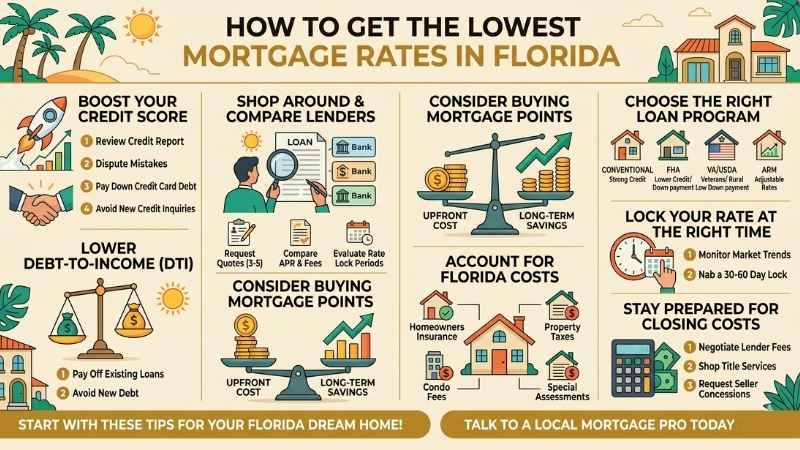 The lowest mortgage rate often depends on the loan program you qualify for. Not every borrower will get the best deal from the same type of mortgage, so it is important to compare options based on your credit profile, down payment, income, and long-term plans.
- Conventional loans usually offer the best deals for people with good credit scores, a steady income, and a solid down payment. If you have a strong financial profile, this loan type may give you the most competitive rate and lowest overall borrowing cost.
- VA and USDA loans can also offer very competitive rates for eligible borrowers. VA loans are available to qualified veterans and active-duty service members. In contrast, USDA loans are designed for eligible rural areas. Both programs can be attractive because they may require little to no down payment.
- FHA loans can be a strong option for borrowers with lower credit scores or smaller down payments. While FHA loans require mortgage insurance, they can make homeownership possible for buyers who may not qualify for conventional financing as easily.
- Adjustable-rate mortgages, or ARMs, start with a lower interest rate than fixed-rate loans, but the kicker is that the rate can change over time. This can be great for keeping your initial payments down, but there’s a catch—if rates go up after the fixed period ends, you could end up paying more down the road.
The best way to compare loan programs is to look at the full cost of each option, including the interest rate, APR, monthly payment, mortgage insurance, and long-term affordability.
Lower Your Debt-To-Income Ratio
Lenders take a look at your debt-to-income ratio, or DTI, to see how much of your monthly paycheck is already going towards paying off debts. In general, a lower DTI shows that you have more room in your budget to manage a mortgage payment, which can strengthen your overall loan profile.
If you want to boost your DTI, a good move is to pay off some of your current debt before you go for a mortgage. Reducing credit card balances, auto loans, or personal loan payments can lower your monthly obligations and improve your financial picture. Avoid taking on new debt during the mortgage process, since new monthly payments can affect both your qualification and your pricing.
If you have stable bonus income, overtime, or other qualifying income sources, documented additional income may also help reduce your DTI. Even a modest improvement in your debt-to-income ratio can make a difference when a lender evaluates your application, especially when combined with strong credit and cash reserves. What matters most is that your mortgage payment fits comfortably within your budget. A manageable DTI not only improves your chances of approval but can also help you qualify for better loan terms.
Lock Your Rate at the Right Time
Mortgage rates in Florida wiggle up and down every day thanks to Fed moves and 10-year Treasury yields. Catching the right moment to lock can spare you money.
To gauge the trend, peek at Freddie Mac’s weekly survey or Bankrate’s daily page.
Soon after you go under contract, nab a 30- to 60-day lock. That shields you from sudden jumps. Navy Federal, for example, has a No-Refi Rate Drop option for a small fee if markets improve. Finally, chat with a local loan officer who tracks Florida’s insurance woes and rising prices. Their insight lets you navigate lender quirks that out-of-state gurus may miss.
Work with a Mortgage Broker
A mortgage broker shops multiple lenders to find the best rates for you, so they can be a big help when rates jump or when people have special circumstances, such as being self-employed or having a lower credit score.
- Vet Your Broker: Double-check that your broker has a Florida license by reviewing the information on the state Office of Financial Regulation. Also, ask which lenders they work with and what fees they’ll charge for their service.
- Compare Broker vs. Direct: A good broker may score you a better deal than walking into a bank, yet it’s smart to compare their quote to offers from popular online lenders like Rocket Mortgage.
Getting the right broker might save you only a tiny slice of interest- about 0.1% to 0.2%- but over the life of a $500,000 loan, that small edge can turn into a monthly drop of $50 to $100.
Account For Florida Housing Costs That Affect Affordability
When comparing mortgage offers in Florida, it is important to look beyond the interest rate alone. Housing costs such as property taxes, homeowners’ insurance, condo association dues, and special assessments can affect your total monthly payment and your debt-to-income ratio. Even if you qualify for a low rate, higher housing costs can reduce affordability and change how much home you can comfortably finance.
Homeowners insurance is especially important in Florida because premiums can be much higher than in many other states. Property taxes and condo fees can also add a meaningful amount to your monthly housing expenses. If you are buying a condo, review association dues and any upcoming special assessments carefully, since those costs can affect both your budget and lender approval.
In higher-priced areas, the loan amount itself can also matter. If your mortgage exceeds conforming loan limits, you may need a jumbo loan, which can have different pricing and qualification standards. That is why the best way to compare mortgage options is to review the full monthly payment and total loan cost, not just the advertised interest rate.
Stay Prepared for Closing Costs
In Florida, closing costs typically run between 2 percent and 5 percent of your loan amount, or around $6,000 to $15,000 on a $300,000 mortgage. Heavy fees can cancel out savings at a lower interest rate, so budgeting for them early is key.
- Negotiate Fees: If you ask, many lenders will drop or trim the origination fee, usually between 0.5 percent and 1 percent of your loan amount.
- Shop for Title Services: Getting written estimates from two or three title companies could save hundreds on title insurance and escrow costs.
- Request Seller Concessions: In a market that tilts toward buyers, sellers may agree to pay part of your closing costs, leaving you extra cash for points or a bigger down payment.
To get the lowest mortgage rates in Florida, you need a plan, a bit of research, and sometimes good timing. Boost your credit score, line up competing lenders, and check out state-backed programs to shave money off your borrowing costs. With rates settling near 6.5 percent to 6.7 percent, the clock is ticking on locking in that deal. Talk to a local mortgage pro and let them mold this advice to your situation, whether you plan to buy in Tampa, Miami, or Key West. For custom quotes, scout sites like Bankrate, Zillow, or LendingTree, or contact a licensed Florida mortgage broker today.
How To Spot Misleading Mortgage Rate Ads
Not every advertised mortgage rate reflects what most borrowers will actually receive. Some lenders promote unusually low rates that only apply under very limited conditions, such as excellent credit, a large down payment, a short lock period, or the payment of discount points. In some cases, the low advertised rate may look attractive at first but come with fees or terms that make the loan more expensive overall.
That is why borrowers should look beyond the headline rate and carefully review the full loan estimate. Pay close attention to the APR, lender fees, discount points, and rate lock period. A mortgage offer is only useful if the terms are realistic and the loan can close within the lock period being offered.
The best way to protect yourself is to compare multiple quotes on the same day and ask each lender the same questions. When you review offers side by side, it becomes much easier to spot a rate that looks low on the surface but carries higher costs beneath the surface. A competitive mortgage offer should be both affordable and realistic, not just eye-catching in an advertisement.
Want the Best Mortgage Rates in Florida? Start With These Tips
From credit score tricks to choosing the right loan, we’ve got you covered.Beware Of Unrealistic Mortgage Rate Ads
Some mortgage ads promote rates that look much lower than what most borrowers will actually qualify for. In many cases, those rates only apply to a narrow group of borrowers with excellent credit, large down payments, very low debt, or the ability to pay discount points up front. Other times, the rate may only be available with a very short lock period that does not align with a typical home purchase timeline. This is why it is important not to judge a mortgage offer solely by the advertised rate. A lower headline rate may come with higher fees, more points, or loan terms that are not practical for your situation. What matters most is whether the offer is realistic, competitive, and affordable based on your full financial profile. Before choosing a lender, ask for a full loan estimate and compare the interest rate, APR, points, lender fees, and lock period. A trustworthy mortgage quote should be clear and usable, not built around a best-case scenario that most borrowers will never receive.
Compare Realistic Rate Lock Periods
When comparing mortgage offers, make sure the rate lock period aligns with your timeline. Most home purchase loans take several weeks to close, so a very short lock period may not be useful even if the rate looks attractive. Ask each lender how long the quoted rate is locked and whether that time frame matches your expected closing date. A slightly higher rate with a practical lock period may be a better deal than a lower rate that expires before your loan can close.
Compare APR, Not Just Interest Rate
When shopping for the lowest mortgage rates in Florida, do not focus only on the interest rate. You should also compare the APR (annual percentage rate), as it gives you a broader view of the loan’s total cost.
The interest rate shows the cost of borrowing money, but APR includes certain lender fees, points, and other financing costs. That means two loans with the same interest rate can have different APRs depending on how they are structured. Sometimes it makes more sense to go for a loan with a slightly higher interest rate if it has lower fees. It could be a better deal overall.
Comparing APRs can help you see whether a low advertised rate is truly competitive or offset by higher upfront costs. This is especially important when lenders offer discount points or charge more in origination fees to create a lower headline rate. The best approach is to review both the interest rate and the APR side by side. Looking at both numbers can help you choose a mortgage that is not only attractive on paper but also more affordable over time.
Final Thoughts On Finding The Lowest Mortgage Rates In Florida
The lowest mortgage rate in Florida isn’t always the one with the lowest advertised rate. In many cases, the best mortgage offer comes from a combination of strong credit, a manageable debt-to-income ratio, the right loan program, realistic lender fees, and careful comparison shopping. Borrowers who understand how APR, discount points, and rate lock periods work are usually in a better position to make a smart long-term decision.
Checking out different lenders, reviewing overall loan costs, and choosing a mortgage that actually works with your budget can really pay off in the long run. Even a small rate improvement can lead to substantial savings over time when paired with the right terms and manageable upfront costs.
If you are comparing mortgage options, focus on the full picture rather than just the advertised rate. A well-structured loan with competitive pricing and realistic terms is often the best path to long-term affordability. If you would like help reviewing mortgage options, speak with a licensed mortgage professional to compare loan terms, costs, and qualification requirements based on your financial profile. Disclaimer: Mortgage rates in Florida and terms change regularly and depend on your unique situation, plus current market conditions. For advice that fits you, talk to a licensed mortgage expert.
Frequently Asked Questions About Mortgage Rates in Florida:
What Affects Mortgage Rates in Florida the Most?
The biggest factors that affect mortgage rates in Florida are your credit score, down payment, debt-to-income ratio, loan type, loan term, and the lender you choose. Property taxes, homeowners’ insurance, condo fees, and whether the loan is conforming or jumbo can also affect affordability and how lenders price the loan. Current Florida rate pages from Bankrate, Zillow, and U.S. Bank all emphasize that rates vary by borrower profile and loan program.
Are Mortgage Rates in Florida Higher Than the National Average?
They can be, depending on the lender, loan type, and day you check. Florida-specific rate pages often show rates that are close to, but not always the same as, national averages. Because rates change daily and borrower profiles differ, the best way to compare mortgage rates in Florida is to shop multiple lenders on the same day and review both the interest rate and APR.
How Can I Get a Lower Mortgage Rate in Florida?
You may improve your chances of getting a lower rate by raising your credit score, reducing debt, saving for a larger down payment, comparing several lenders, and asking each lender for the same loan scenario on the same day. It also helps to compare APR, discount points, and lender fees instead of focusing only on the advertised rate. Sources that track Florida mortgage rates consistently advise borrowers to compare loan terms carefully because pricing varies by lender and borrower qualifications.
Is it Better to Compare APR or Interest Rate?
You should compare both, but APR is often more useful when you want to understand the total cost of the loan. The interest rate shows the cost of borrowing. At the same time, APR includes certain fees and points, which can make a low advertised rate look less attractive once total costs are considered. That makes APR especially important when comparing mortgage offers from different lenders.
Do Florida Condo Fees and Insurance Affect Mortgage Approval?
Yes. Condo association dues, homeowners’ insurance, flood insurance, and property taxes can all increase your total monthly housing payment. That can affect your debt-to-income ratio, your approval amount, and in some cases, the type of loan you qualify for. This is especially important in Florida, where insurance costs can materially change affordability.
Should I Lock My Mortgage Rate Right Away?
It all comes down to your timing and how much risk you’re comfortable with, but many people tend to lock their rates once they’re officially under contract and have a solid idea of when they’re closing. A rate lock can protect you if rates rise before closing, but you should make sure the lock period is long enough for your expected closing date. When comparing lenders, always ask how long the quoted rate is locked and whether an extension would cost extra.
This article about “Tips And Advice In Getting Lowest Mortgage Rates in Florida” was updated on April 15th, 2026.