How Mortgage Regulations Affect Home Buyers: In 2026, mortgage regulations shape how lenders verify income, calculate debt-to-income (DTI) ratios, price loans, and disclose closing costs. These rules protect buyers from risky loans and surprise fees, but they can also make approvals tougher—especially with overlays, credit-score pricing adjustments, and stricter documentation. The right lender helps you navigate these rules and qualify faster.
What Changed in How Mortgage Regulations Affect Home Buyers in 2026?
- Higher conventional (conforming) loan limits: baseline $832,750 for 1-unit homes in most areas; high-cost ceiling $1,249,125.
- Higher FHA loan limits: nationwide floor $541,287 (low-cost areas) and ceiling $1,249,125 (high-cost areas) for 1-unit homes.
- Pricing remains more risk-based for many borrowers: credit score, down payment, and other factors can increase costs through pricing adjustments (LLPA-style), impacting your rate and/or closing costs.
- Ability-to-Repay is still the core compliance focus: lenders must make a reasonable, good-faith determination that you can repay the mortgage based on verified information.
- Disclosure timing still drives the closing timeline: you should receive the Closing Disclosure at least three business days before closing, and certain significant changes can trigger a new waiting period.
Glossary
- TRID: The disclosure rule that standardizes mortgage forms and timing—mainly the Loan Estimate and Closing Disclosure.
- QM (Qualified Mortgage): A category of loans that meets Ability-to-Repay standards and gets certain legal protections for lenders.
- LLPA: Risk-based pricing adjustments (often tied to credit score/down payment) that can increase rate and/or closing costs.
- G-fee: A “guarantee fee” charged by the GSEs (Fannie/Freddie) that’s often built into the pricing borrowers receive.
What Are Mortgage Regulations and Why Do They Matter?

Mortgage regulations are the rules lenders must follow when giving out home loans. These rules protect buyers from risky loans, unfair fees, and predatory lending practices. But sometimes, these same rules can make it harder for honest borrowers to qualify.
Understanding how mortgage regulations affect home buyers is key to getting approved and avoiding surprises.
Mortgage Rules After the 2008 Crash: Why They Still Matter Today
New regulations were introduced after the 2008 housing crash to prevent another meltdown. These include:
- Dodd-Frank Wall Street Reform Act
- The SAFE Act (requiring licensing and background checks for loan officers)
- The Qualified Mortgage (QM) Rule
- The TRID Rule (Loan Estimate and Closing Disclosure requirements)
- Creation of the CFPB (Consumer Financial Protection Bureau)
These rules changed how lenders qualify buyers, calculate debt, and disclose loan details. They still impact how mortgage regulations affect home buyers in 2026.
How the Qualified Mortgage Rule Affects Borrowers Today
The Qualified Mortgage rule basically says that lenders need to make sure borrowers have the Ability to Repay. That sounds like a pretty good idea, right?
Understanding how mortgage regulations affect home buyers when looking for a loan is important.
Usually, most lenders want your debt-to-income (DTI) ratio to be 43% or lower. But Fannie Mae and Freddie Mac can sometimes allow up to 50% if the situation calls for it. Also, things like interest-only payments and balloon payments are generally a no-go. Plus, the total fees and charges for the loan can’t exceed 3% of the loan amount, which helps protect buyers from getting hit with too many costs.
While these rules protect buyers, they can limit how much you qualify for, especially if you’re self-employed or have variable income.
How Do Mortgage Regulations Affect You as a Homebuyer?
Stay informed about the latest mortgage regulations and how they impact your homebuying process.
How Loan Limits and Credit Rules Impact Home Affordability
Each year, FHA and conforming loan limits are updated based on rising home prices. For 2026:
- The FHA loan limit in most areas is $541,287
- The conforming loan limit for conventional loans is $766,550
- High-cost areas go up to $1,249,125 for FHA and $1,249,125 for conforming loans
But even with higher loan limits, borrowers are feeling squeezed. Why?
- Stricter credit score minimums (most lenders want 620+, some require 680+)
- Loan-level price adjustments (LLPAs) make loans more expensive for lower credit scores or higher LTVs
- Overlays by lenders (extra rules on top of agency guidelines)
At Gustan Cho Associates, we understand how how mortgage regulations affect home buyers. We offer no overlay lending on government and conventional loans, helping more buyers qualify.
TRID, Loan Estimates, and Closing Disclosures Explained
Understanding how mortgage regulations affect home buyers is important, as it informs them of their rights regarding fees and disclosures. Since 2015, lenders must provide a Loan Estimate (LE) within three business days of a mortgage application. This document outlines the estimated costs associated with the loan, giving buyers an overview of what to expect financially.
Additionally, borrowers receive a Closing Disclosure (CD) containing the final loan numbers and must be delivered at least three days before the closing date. If lenders fail to accurately disclose costs, specifically under-disclosing by more than 10%, they are responsible for covering the difference. This regulation protects home buyers from unexpected fees during the closing process, ensuring a more transparent transaction.
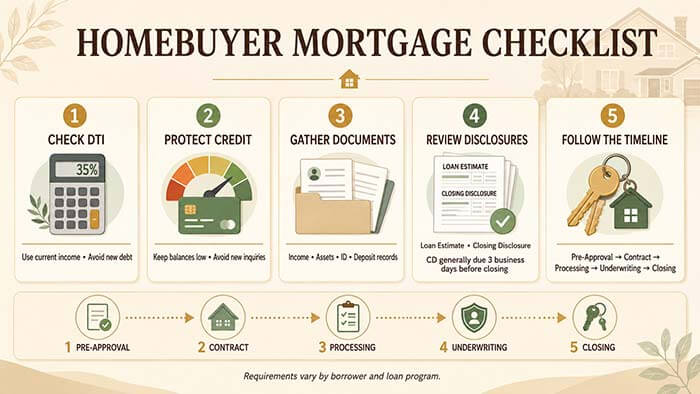
Homebuyer Checklist (DTI, credit, docs, disclosures, timeline)
DTI (Debt-to-Income)
- Calculate front-end (housing payment) and back-end (total monthly debts) using your current income.
- Avoid taking on new debt (cars, furniture, personal loans) before closing.
- If DTI is tight: pay down revolving balances, remove/resolve disputed accounts (if applicable), and document stable income clearly (especially self-employed).
Credit
- Know your mid-score and whether you’re near key pricing/approval thresholds (common ones: ~620, 680, 700, 740).
- Keep utilization low (aim well below max limits), avoid new inquiries, and don’t close old cards right before applying.
- If you’re borderline, ask your lender for a rapid rescore strategy (when appropriate).
Documents (have these ready)
- W-2 borrowers: last 30 days pay stubs, last 2 years W-2s, last 2 years tax returns (if required), 2 months’ bank statements.
- Self-employed: 2 years personal/business returns (or lender-approved alternative documentation), year-to-date P&L, business license/CPA letter if needed, 2–3 months business/personal bank statements.
- Everyone: photo ID, proof of rent history (if relevant), proof of down payment/earnest money source, and documentation for any large deposits.
Disclosures (what to watch)
- Confirm you receive the Loan Estimate (LE) promptly after you apply and review: rate/fees, cash-to-close, and whether items are “can’t change,” “can change a little,” or “can change.”
- Review the Closing Disclosure (CD) as soon as it’s issued; you must receive it at least 3 business days before closing.
Timeline (simple 5-step)
- Pre-approval (credit + income review)
- Under contract (earnest money + initial disclosures)
- Processing (docs collected, appraisal ordered)
- Underwriting (conditions issued/cleared)
- Clear to close → CD → Closing
2026 Mortgage Rate Concerns: What Regulations Have to Do With It
While interest rates are set by market forces and Federal Reserve policy, regulations impact how rates are passed on to borrowers.
For example:
- G-Fees (Guarantee Fees): Extra fees added by Fannie Mae and Freddie Mac to offset risk.
- Passed to borrowers in the form of higher rates.
- New LLPAs (Loan-Level Price Adjustments): In 2024-2025, Fannie and Freddie added higher fees for certain borrowers.
- These are still in place in 2026.
If you’re a buyer with a lower credit score or small down payment, these pricing changes can raise your rate unless you work with a lender who knows how mortgage regulations affect home buyers and how to navigate it.
How Mortgage Regulations Affect First-Time Home Buyers the Most
First-time homebuyers are in a unique spot. Many are younger folks with little credit history, which can make getting a mortgage tough. Plus, many are dealing with student loan debt, and finding enough cash for a down payment and closing costs can be tricky. Mortgage rules can really shake things up for these aspiring homeowners. Stricter debt-to-income (DTI) limits can make it harder to get approved for loans.
If someone has a lower credit score, they often face higher costs, which can be a real buzzkill when buying a home. The process to verify income has also gotten tougher, especially for gig workers or seasonal jobs, since they might not have the usual pay stubs to show.
Luckily, Gustan Cho Associates is there to help first-time buyers tackle these challenges. They have options for people with lower credit scores, like FHA loans that only need a 3.5% down payment and offer more flexible rules. They provide helpful resources for down payment assistance programs. This support helps many people achieve their dream of owning a home and start their exciting journey.
Non-QM Loans: A Solution When Regulations Shut You Out
If the rules are too tight for you to qualify for a QM loan, Non-QM (Non-Qualified Mortgage) loans can be a great alternative.
Popular Non-QM Options in 2026:
- Bank Statement Loans: These loans let you qualify by showing your bank statements from the past 12 to 24 months instead of needing tax returns. This option is great for self-employed individuals or those with variable incomes.
- DSCR Loans: Designed for real estate investors, these loans allow you to qualify based on the rental income your properties generate, rather than your personal income. This makes it easier for investors to secure funding for new properties.
- Asset Depletion Loans: With these loans, you can qualify using the total value of your liquid assets, like cash or investments, rather than relying on a regular paycheck. This is helpful for those who have significant savings but may not have a traditional income.
- No Waiting Period Loans: These loans allow you to get financing right after going through tough financial times, like bankruptcy, foreclosure, or a short sale, without waiting for a certain period. This option helps people get back on their feet more quickly.
These programs help buyers who are:
- Self-employed
- Recently experienced financial hardship
- Investing in real estate
How to Qualify for a Mortgage With No Overlays in 2026
Many banks and lenders implement “overlays,” which are additional rules that go beyond standard guidelines for FHA, VA, USDA, or conventional loans. These overlays can often disqualify potential borrowers who would otherwise qualify. This can significantly impact home buyers, as it limits their access to financing despite having a solid financial standing.
Understanding how mortgage regulations affect home buyers is crucial, as navigating these extra hurdles can create barriers to home ownership for many.
At Gustan Cho Associates, we strive to make the home buying process more accessible by offering mortgages without overlays. This means we adhere strictly to agency guidelines, allowing us to say YES when others say NO. We provide approvals for borrowers with credit scores as low as 500 on FHA loans and work with those who have faced bankruptcies, foreclosures, or require manual underwriting.
Furthermore, our diverse reach includes licensing in 48 states and access to over 300 wholesale lending partners, ensuring we are equipped to meet various financing needs.
Common Denial Reasons (and how “no overlays” solves them)
Common denial reasons
- DTI is too high under a lender’s stricter internal limit (even when agency guidelines might allow more).
- Credit score overlays (e.g., lender requires 640/680 when the program minimum is lower).
- Documentation overlays (extra reserves required, extra months of bank statements, stricter income averaging).
- Manual underwriting refusal (some lenders won’t do it even when guidelines allow).
- Recent credit events (late payments, disputes, collections) have triggered stricter in-house rules.
- Self-employed/gig income not fitting the lender’s narrow documentation preferences.
How “no overlays” helps
A no-overlay lender follows the actual agency guidelines (FHA/VA/USDA/conventional) rather than layering extra rules on top and knows how mortgage regulations affect home buyers inside and out. That can mean:
- Accepting eligible files that other lenders deny due to higher internal score/DTI requirements
- Allowing guideline-permitted income calculations and compensating factors
- Using program-approved underwriting paths that often block (including certain manual underwriting scenarios, when applicable)
The Bottom Line About How Mortgage Regulations Affect Home Buyers
How mortgage regulations affect home buyers can sometimes make purchasing a home feel more daunting. However, these regulations are in place to protect you. With the right loan officer and lender by your side, these rules don’t have to hinder your home buying experience.
At Gustan Cho Associates, we specialize in helping:
- First-time homebuyers
- Borrowers with low credit scores
- Self-employed individuals
- Buyers denied by other lenders
We cut through the red tape, explain every step, and close loans fast, even when others cannot.
Borrowers who need a five-star national mortgage company licensed in 48 states with no overlays and who are experts on how mortgage regulations affect home buyers, please contact us at 800-900-8569, text us for a faster response, or email us at gcho@gustancho.com. The team at Gustan Cho Associates is available 7 days a week, on evenings, weekends, and holidays.
Frequently Asked Questions About How Mortgage Regulations Affect Home Buyers:
What Mortgage Regulations Affect Home Buyers the Most?
- The biggest rules most buyers feel are the Ability-to-Repay/Qualified Mortgage (ATR/QM) requirements (income/debt verification),
- TRID disclosures (Loan Estimate + Closing Disclosure timing), and agency rules that affect pricing and eligibility (such as risk-based pricing adjustments on conventional loans).
What is the Ability-to-Repay (ATR) Rule?
- ATR requires lenders to make a reasonable, good-faith determination that you can repay your mortgage based on verified information (income, debts, etc.).
What is a Qualified Mortgage (QM) and Why Does it Matter?
- A Qualified Mortgage (QM) is a category of loan that meets certain ATR standards and gives lenders certain legal protections, which can influence which loans some lenders are willing to offer.
How do Mortgage Regulations Impact Interest Rates?
- Regulations don’t actually “set” rates, but they can influence how much loans cost by adjusting for risk, like LLPAs on conventional loans.
- If someone has a lower credit score or a smaller down payment, it can end up costing them more in terms of rates or fees.
- That’s why, it’s critical to know how mortgage regulations affect home buyers.
What is an LLPA, and How Does it Affect My Loan?
- An LLPA (Loan-Level Price Adjustment) is a risk-based fee/price adjustment applied to many conventional loans.
- It is often tied to factors such as credit score and loan-to-value (down payment). It can raise your rate or closing costs.
What is TRID, and What Does it Require Lenders to do?
- TRID is the rule that governs how lenders disclose mortgage costs through standardized forms and regulations, especially the Loan Estimate (LE) and Closing Disclosure (CD).
When do You Get the Closing Disclosure Before Closing?
- You must receive the Closing Disclosure at least 3 business days before closing, so you can compare the final terms and costs with your Loan Estimate.
What Are The Conforming Loan Limits For 2026?
- For 2026, the baseline conforming limit for a 1-unit home in most areas is $832,750, with a high-cost ceiling of $1,249,125 (and higher limits for AK/HI/territories).
What Are The FHA Loan Limits For 2026?
- For 2026, FHA’s nationwide forward mortgage limit floor for a 1-unit home is $541,287, and the ceiling is $1,249,125 (higher in special exception areas).
What Does “Lender Overlays” Mean, and Can They Cause Denial?
- Overlays are extra rules a lender adds on top of agency guidelines (like requiring a higher credit score or lower DTI than the program requires).
- Yes—overlays can cause denials even when a borrower meets baseline program rules. (This is why “no overlays” lenders can sometimes approve borrowers that other lenders decline.)
This blog about “How Mortgage Regulations Affect Home Buyers Today” was updated on March 13th, 2026.
How Current Mortgage Regulations Influence Your Homebuying Power
Learn how to navigate the latest mortgage regulations and make smarter decisions as a homebuyer.