How Bankruptcy Affects Mortgage Approval: FHA, VA, USDA, Conventional, Non-QM Guidelines
Bankruptcy does not prevent potential homeowners from qualifying for a mortgage. Many people with a bankruptcy history may qualify for FHA, VA, USDA, conventional, or non-QM loans. In some cases, borrowers can secure home financing while fulfilling Chapter 13 bankruptcy requirements.
The impact of bankruptcy on mortgage approval depends on the specific loan program. No single bankruptcy waiting period applies to all mortgage programs.
The discharge and dismissal dates, the bankruptcy chapter (7 vs. 13), the payment history, the findings of an automated underwriting system, and the documented challenging circumstances (if any) also play a role. This guide on how bankruptcy affects mortgage approval outlines the criteria, waiting periods, and guidelines for mortgage approval after bankruptcy. Mortgage guidelines help underwriters distinguish between borrowers who experienced a one-time financial setback and those with chronic credit or financial problems.
When Evaluating Bankruptcy, Underwriters Have the Following Concerns:
- What were the underlying financial issues?
- Have the financial issues that led to the bankruptcy been resolved?
- Has the credit been satisfactorily rebuilt?
- Have payments been made on time since the bankruptcy?
- Does the borrower have a steady income that meets the lending guidelines?
- Does the borrower have adequate funds to pay the mortgage and have sufficient funds for the down payment, closing costs, and reserves?
- Has the waiting period for bankruptcy passed?
- The bankruptcy is only one consideration in the analysis and approval of a mortgage loan application.
- An applicant with a bankruptcy several years ago, stable employment, and a strong payment history may present less risk than a borrower with good credit but recent late payments.
Chapter 7 vs. Chapter 13 Filing for Mortgage Approvals
Knowing the type of bankruptcy is one of the first things an underwriter considers when deciding if a mortgage application is approvable.
Chapter 7 Bankruptcy
This is the Chapter of the bankruptcy filing that refers to liquidation. This Chapter may allow the borrower to eliminate qualifying obligations; however, lenders are primarily interested in the date of the bankruptcy discharge. Although the bankruptcy has been discharged, the borrower may still need to wait a specific period before the borrower qualifies for a particular mortgage program.
Chapter 13 Bankruptcy
Unlike Chapter 7, Chapter 13 bankruptcy requires the borrower to create a plan to repay their debts, usually over a 3- to 5-year period. At the end of this period, the borrower is then released from their obligations to pay those debts. Chapter 13 bankruptcy offers unique mortgage opportunities that are not available with Chapter 7 bankruptcy. In some loan programs, a borrower may be able to secure a mortgage prior to the discharge of a Chapter 13 bankruptcy if they have completed a significant portion of the repayment plan, made the required payments, and received the necessary court or trustee approval. This is more likely to be the case with FHA, VA, and certain USDA transactions.
What Mortgage Underwriters Look for After Bankruptcy
Meeting the required waiting period after bankruptcy does not guarantee mortgage approval. The mortgage lender will still review your application to determine whether you meet the requirements to obtain the mortgage.
Recent Payment History
A strong payment history demonstrates financial recovery and is especially important to underwriters evaluating a bankruptcy application.
Underwriters Will Review the Borrower’s Payment History for:
- On-time housing payments
- Trustee bankruptcy payments
- Newly established credit account payments
- Avoidance of collections and charge-offs
- Avoidance of financial stress payments (overdrafts)
- Recent late payments after bankruptcy are of particular concern, as they sometimes do not show progress and may indicate that the financial problems before the bankruptcy have returned.
Employment and Income
- The borrower still needs to show stable, qualifying income for the mortgage.
- Bankruptcy does not change income requirements.
- The lender is concerned with employment income, self-employment income, Social Security income, pension income, disability income, rental income, or other income the mortgage program permits.
Debt-to-Income Ratio
- A lender calculates a borrower’s debt-to-income ratio, or DTI, by qualifying monthly debts compared to the borrower’s gross monthly income.
- Bankruptcy eliminates some debts, but obligations still must be accounted for.
- In an active Chapter 13 plan, the required bankruptcy payment may have to be included in the underwriting analysis.
- Having savings after bankruptcy can strengthen a mortgage application.
- Depending on the loan program and underwriting findings, reserves may not be needed.
- However, having money after closing can show financial stability and can be an important compensating factor in underwritten files.
FHA Loan After Chapter 7 Bankruptcy
- FHA lending is often sought after Chapter 7 bankruptcy for borrowers rebuilding credit.
- According to the FHA’s manual underwriting guidelines, after at least two years of no credit activity following bankruptcy, good credit is rebuilt, or no new credit has been incurred.
- Shorter timeframes may be approved after one year of no new credit following bankruptcy,
- if the borrower provides evidence of qualifying extenuating circumstances beyond their control and evidence of good, responsible credit management post-bankruptcy.
- However, not every borrower will qualify for a mortgage two years after bankruptcy.
- The borrower must still meet the FHA credit, income, asset, property, occupancy, and underwriting requirements.
FHA Loan During Chapter 13 Bankruptcy
- A key FHA guideline is that borrowers with an active Chapter 13 bankruptcy may still be eligible for a mortgage.
- Having an active Chapter 13 bankruptcy does not disqualify someone from getting an FHA mortgage.
- A borrower may qualify if they have satisfied 12 months of the Chapter 13 bankruptcy payout period, the payments during that period have been made, and the borrower has been granted permission to enter into the mortgage transaction.
- These types of loans might require manual underwriting based on the situation and FHA underwriting requirements.
Which Mortgage Program Works After Bankruptcy?
FHA and VA may offer more flexible options, conventional loans may require longer waiting periods, and Non-QM loans may help borrowers who do not fit traditional guidelines.Why Chapter 13 Payment History Matters
The lender will check the bankruptcy payment history. Trustee payment history significantly affects underwriting. Chapter 13 borrowers should take care to avoid missed payments.
Bankruptcy Court or Trustee Permission
A borrower in Chapter 13 cannot obtain a mortgage without complying with the bankruptcy requirements. The borrower should consult their bankruptcy attorney to obtain permission to assume the mortgage liability.
VA Loans After Chapter 7 Bankruptcy
VA underwriting prefers a broader credit-risk approach rather than a hard-line approach that disqualifies borrowers with bankruptcies. According to VA guidelines, Chapter 7 bankruptcies discharged more than 2 years before the loan application date may be disregarded.
VA guidelines suggests that bankruptcies discharged over two years prior to the application may be considered if the applicant has rebuilt their credit since the bankruptcy and the bankruptcy was caused by circumstances beyond the borrower’s control.
A bankruptcy discharged within the last 12 months may present problems in determining whether the applicant is a satisfactory credit risk; VA guidance does provide some exceptions that require a case-by-case analysis. Eligible veterans and service members must be aware that meeting bankruptcy credit guidelines does not relieve them from the other VA loan requirements. This includes requirements related to income, residual income, debt, credit, occupancy, entitlement, property, and lender underwriting.
VA Chapter 13 Bankruptcy Loan
VA financing may also be available to borrowers who are making Chapter 13 plan payments. Favorable consideration by the VA may be given one year after the borrower has made 12 payments under the Chapter 13 plan and those payments have been approved by the trustee or bankruptcy judge. Satisfactory completion of all Chapter 13 plan payments may also be considered the re-establishment of satisfactory credit. Approval is not automatic. The lender may not approve the loan until a complete analysis of the applicant’s financial profile is completed and a determination is made that the applicant is an acceptable credit risk.
USDA Loans With Chapter 7 Bankruptcy
USDA Guaranteed Loans have a different perspective on bankruptcy than FHA and VA loans. According to USDA bankruptcy guidelines, a Chapter 7 bankruptcy discharged more than 3 years before the underwriting date is unlikely to be considered adverse credit. A Chapter 7 bankruptcy that was discharged within the last three years does not automatically preclude approval of the loan. The outcome may depend on the Guaranteed Underwriting System (GUS).
If GUS recommends an Accept, the loan may be approved without the credit exception that would otherwise be required on a loan that undergoes manual underwriting or is referred to another underwriter for review.
If a Chapter 7 bankruptcy was discharged within the last three years and a file is referred, receives a Refer with Caution, or requires manual underwriting, additional credit analysis may be required to approve the loan, and a credit exception must be documented. The three-year rule for Chapter 7 bankruptcy and USDA loan eligibility is a general guideline and does not apply to every situation.
USDA Loans with Chapter 11, 12, or 13 Bankruptcy
As with USDA loans, USDA may also finance a Chapter 11, Chapter 12, or Chapter 13 bankruptcy in which the debtor has filed a repayment plan and the bankruptcy remains active. Treatment may be different depending on GUS recommendations and the nature of underwriting.
Under manual underwriting, USDA guidelines for Refer or Refer with Caution state that at least 12 months of the plan must be completed, and payments must be made on time.
The borrower also may need to obtain permission from the bankruptcy court or trustee to initiate the mortgage transaction. USDA guidelines state that if the court or trustee does not give permission, then the loan should not be approved. Each case must be reviewed individually. Borrowers should not assume they are ineligible for a USDA mortgage just because they are in Chapter 13 bankruptcy.
Conventional Loans After Chapter 7 Bankruptcy
Conventional loans backed by Fannie Mae or Freddie Mac have longer bankruptcy waiting periods than FHA or VA loans.
Fannie Mae Chapter 7 Bankruptcy Guidelines
For Chapter 7 and Chapter 11 bankruptcies, Fannie Mae has a four-year waiting period from the date of discharge or dismissal. Fannie Mae will consider a two-year waiting period in certain circumstances. Problems due to poor financial decisions usually will not qualify. Exceptions occur due to a significant and unexpected financial hardship, usually caused by a substantial financial loss or new obligations.
Freddie Mac Chapter 7 Bankruptcy Guidelines
For financially related bankruptcies, Freddie Mac generally will consider a 48-month waiting period from the discharge or dismissal of a Chapter 7 or Chapter 11 bankruptcy. The wait period will be reduced to 24 months with extenuating circumstances. The lender will be required to provide evidence supporting the reason for the bankruptcy and provide evidence that the borrower has restored acceptable credit.
Conventional Loans After Chapter 13 Bankruptcy
Chapter 13 has its own waiting periods for conventional loans.
Fannie Mae Chapter 13 Guidelines
Fannie Mae Normally will Require the Following:
- A two-year waiting period after the discharge of a Chapter 13 bankruptcy.
- A four-year waiting period after a Chapter 13 bankruptcy has been dismissed.
- A shortened timeline after discharge was developed to ensure borrowers who successfully completed Chapter 13 now have a lengthy record of making payments.
- Fannie Mae allows a two-year period after Chapter 13 discharge for qualifying exceptional circumstances is documented.
- Fannie Mae does not have a shorter exception to the normal two-year waiting period after a Chapter 13 discharge.
Freddie Mac’s Chapter 13 Guidelines
For Financial Mismanagement, Freddie Mac Generally Requires:
- 24 months after a Chapter 13 discharge, or
- 48 months after a Chapter 13 dismissal.
- Freddie Mac may use a 24-month recovery period for bankruptcy actions involving properly documented extenuating circumstances.
Bankruptcy Discharge vs. Bankruptcy Dismissal
Many borrowers confuse a bankruptcy discharge with a dismissal. They are not the same.
Bankruptcy Discharge
- A discharge normally releases the debtor from personal liability for debts covered under the bankruptcy.
- For mortgage underwriting, the discharge date is used to determine the bankruptcy waiting period.
Bankruptcy Dismissal
- A bankruptcy case was dismissed, meaning the debtor did not receive a discharge of his/her debts.
- This is very important for loans that conform to Fannie Mae’s guidelines.
For example, Fannie Mae requires two years after a Chapter 13 discharge, but four years after a Chapter 13 dismissal, unless the borrower qualifies for one of Fannie Mae’s exceptions. You should always make sure to obtain the actual bankruptcy documents instead of going off memory of when the case was filed or completed.
Does the Waiting Period Begin on Filing Date or Discharge Date?
Often, the filing date is not the main date when processing a bankruptcy claim. Different bankruptcy chapters and loan programs will define the important date. For a large proportion of Chapter 7 mortgages, the discharge or dismissal of the bankruptcy is the critical date. In Chapter 13 bankruptcy, government-backed programs might consider the borrower for a mortgage loan after an acceptable period has passed and the borrower has made the agreed number of plan payments. For this reason, a borrower must have their bankruptcy documents reviewed to determine whether they are eligible.
What If a Mortgage Were Included in the Bankruptcy?
This is a more challenging area of mortgage underwriting. There are situations in which a bankruptcy court discharges a mortgage, but the lender completes foreclosure or transfers title later. Fannie Mae has provisions that allow the waiting period for bankruptcy to apply in some instances if a mortgage loan is discharged through bankruptcy.
Dependent on the loan program and the individual circumstances of the case, the bankruptcy date, the date of foreclosure completion, the transfer of title date, or other situations may be applicable.
If the bankruptcy mortgage discharge is not documented, the foreclosure waiting-period provisions may apply. Likewise, Freddie Mac has certain provisions that address bankruptcy and its relationship to foreclosure. Just because bankruptcy discharges a mortgage does not mean that foreclosure will not be a consideration. The bankruptcy petition, mortgage discharge, foreclosure, and property disposition documents must be reviewed by the loan officer and the underwriter.
More Bankruptcy Filings Mean Additional Restrictions
Multiple bankruptcy filings will impose additional conventional underwriting standards. Fannie Mae will typically impose a 5-year waiting period after the last discharge or dismissal for borrowers with more than one bankruptcy filing within the last 7 years.
Freddie Mac will use a 60-month waiting period from the last discharge or dismissal for multiple bankruptcy filings that resulted from financial irresponsibility during the review period.
The waiting period will be reduced to three years when the most recent bankruptcy was from qualifying documented extenuating circumstances. Therefore, borrowers with multiple filings should have their case reviewed in its entirety rather than assuming the waiting period for a single bankruptcy applies.
Does Bankruptcy Have to Fall Off Your Credit Report Before Buying a House?
Not at all. Mortgage waiting periods and credit reporting periods are completely independent of each other. A bankruptcy filing may remain on a credit report for several years after the borrower becomes eligible for certain mortgage programs. For example, a Chapter 7 bankruptcy may remain on a credit report for 10 years; however, this does not mean the borrower must wait 10 years to become eligible for a mortgage.
How to Rebuild Credit After Bankruptcy Before Applying for a Mortgage
There is no set minimum credit score required after bankruptcy, but responsible credit management post-bankruptcy is essential.
Pay Every Account On Time
Bankruptcy changes your finances. While expensive, bankruptcy filing fees allow for a fresh financial start. Many things considered quite damaging to mortgage approvals are mitigated by bankruptcy filing. This includes the impact of a single late payment. A mortgage lender will view a bankruptcy filing as a sign that the borrower is taking a new, more financially responsible approach to fulfilling their obligations.
Use New Credit Carefully
While it is true that carefully adding new credit can help rebuild your credit, it is not advisable to open many accounts to build credit quickly. A possibly more conservative approach is to add either a revolving or an installment credit line. These newly added lines of credit help fulfill your new credit obligations and can help build a new payment history.
Avoid Anything That Will Negatively Impact Your Credit

Keep Revolving Balances Manageable
High credit card balances can raise concerns for creditors and increase your monthly debt obligations. Keep revolving balances as low as possible.
Check Your Credit Reports
Bankruptcy filings erase a large amount of debt, but often times this reporting is done incorrectly, and balance zeroes do not appear on accounts as discharged in bankruptcy.
Look for:
- Reporting of accounts that should show a balance of $0.
- Extra accounts added
- Erroneous late payment reporting
- Accounts that are not yours
- Erroneous reporting of bankruptcy
- Reporting accounts that are past due and should be reported as paid
- Accurate credit reporting is important. You can dispute errors, but most negative information remains on your report for several years.
Do You Really Need Three New Credit Cards After Bankruptcy?
There is no rule requiring mortgage agencies to require borrowers to obtain three new credit cards following bankruptcy. The original version of this article suggested obtaining three to five secured credit cards after bankruptcy. This recommendation is too specific. Previous recommendations to obtain three to five secured credit cards after bankruptcy are overly specific.l monthly obligations, and a greater risk of missed payments. The best practice is to establish credit only for amounts you can safely and reliably repay.
Can You Get a Mortgage Without Re-Establishing New Credit?
The best practice is to establish credit only for amounts you can manage and repay reliably. For example, with an FHA mortgage, it is recognized that a borrower who has filed for Chapter 7 bankruptcy may have rebuilt good credit or decided not to take on new credit obligations. Other programs have their own credit-history criteria. Borrowers should avoid opening unnecessary credit accounts based on the misconception that multiple new credit cards are required for mortgage approval after bankruptcy.
Does Bankruptcy Mean You’ll Always Have a Higher Mortgage Rate?
Not necessarily. Bankruptcy does not result in a uniform penalty across all mortgage types.
The Price of a Mortgage will Depend on the Loan Program and the Lender, as Well as Your:
- Credit report
- Loan-to-value ratio
- Property
- Occupancy
- Mortgage amount
- Product
- Market conditions
- Discount points or lender credits
- Government-backed mortgages may have different procedures and pricing than conventional mortgages.
- A borrower with good credit post-bankruptcy may be eligible for competitive FHA, VA, USDA, or conventional mortgages.
Does Bankruptcy Mean a Large Down Payment?
Typically, a larger down payment is not required. Loans backed by an agency do not require borrowers to make a higher down payment if they have declared bankruptcy in the past, as long as all eligibility and underwriting criteria have been met. In such cases, the regular provisions of the program apply. There are some non-QM/portfolio loan offerings made in the short term after bankruptcy that may require significantly higher equity or a larger down payment, since these programs assess risks that agency financing may not. In these cases, requirements can vary significantly depending on the lender and loan program.
Non-QM Loans After Bankruptcy
Borrowers who have not met the waiting period for FHA, VA, USDA, or Fannie Mae and Freddie Mac loans may still qualify for a non-QM loan. Some non-QM lenders issue loans shortly after bankruptcy discharge, and some of these programs have very little or no bankruptcy seasoning requirement. There is no single, universal bankruptcy guideline that governs these loans.
A Borrower May be Subject to:
- A higher interest rate
- A larger down payment
- A reserve requirement
- A more restrictive credit score
- A penalty for the early repayment of the loan (if allowed by U.S. law)
- Alternative or non-standard income documentation
- Restrictions on the property and/or occupancy
- In these situations, borrowers should carefully consider whether to pursue a non-QM loan or wait to qualify for agency financing.
Documents Mortgage Lenders May Request After Bankruptcy
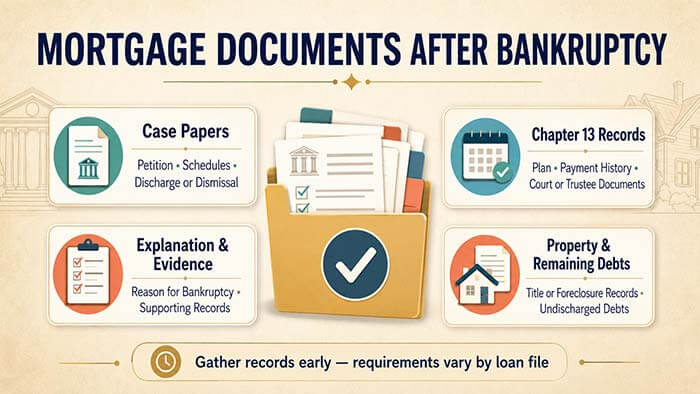 Complete bankruptcy documentation provided early can help avoid delays in the underwriting process.
Based on the File, a Lender May Request:
- Completed bankruptcy petition
- Schedules to bankruptcy
- Discharge or dismissal
- Chapter 13 payment plan
- Chapter 13 payment history
- Documentation by the trustee
- Court order allowing a new mortgage
- A letter explaining the reason for the bankruptcy
- Documentation backing up the reason for the bankruptcy
- Documentation for bankruptcy debts that were not cleared
- Foreclosure or title transfer documents for the real property
- Do not wait until the last minute to gather these records during underwriting.
How Extenuating Circumstances Affect Mortgage Eligibility
Some mortgage programs allow shorter waiting periods for bankruptcies caused by extenuating circumstances. However, the definition of extenuating circumstances is subjective. Declaring bankruptcy as a result of poor financial decisions or a normal business downturn does not mean that extenuating circumstances exist.
The Lender Must Determine That:
- The event was beyond the borrower’s control
- The event caused financial hardship
- The event was non-recurring and isolated
- The financial hardship has ceased to exist
- The financial hardship will not occur in the future
- Documentation exists for the financial hardship
- Examples of financial hardships vary by mortgage program.
- In these cases, the borrower’s explanation alone is not sufficient.
Manual Underwriting After Bankruptcy
Automated underwriting systems such as the FHA TOTAL Mortgage Scorecard, Fannie Mae Desktop Underwriter, Freddie Mac Loan Product Advisor, and the USDA GUS evaluate large volumes of borrower data.
Borrowers should not pay off old collections or discharged debts, believing it will help them get approved for a mortgage. There are cases where accounts are paid or settled, which could affect the credit report or cash available for closing. Get your mortgage file reviewed first.
Not all bankruptcies will result in an automated approval. When the applicable mortgage program allows it, manual underwriting may be an alternative to automated underwriting. Manual underwriting allows lenders to take into account a more complete picture of an applicant’s financial situation.
This Includes:
- Their payment history on a mortgage and Chapter 13
- How steady their income and employment history is
- How much do they earn
- Their debt / income ratio
- How much they save and how much they have in reserve
- Their recent credit history
- What compensating factors are present
- Why did they have to file for bankruptcy?
- Manual underwriting does not allow lenders to override established guidelines. Instead, underwriters make decisions based on manual underwriting requirements rather than automated recommendations.
- It is also important to note that meeting the minimum guidelines of FHA, VA, USDA, Fannie Mae, and Freddie Mac does not mean a lender will approve your loan.
What Are Lender Overlays on Government and Conventional Loans
Each lender may impose guidelines and restrictions that are more stringent than those of the underlying mortgage program or loan. These guidelines are known as lender overlays. For example, one lender may follow mortgage-lending guidelines and still decline to consider Chapter 13 borrowers.
Often, a borrower applies for a loan with a single lender and then receives a decline from that lender. However, that decline is not a denial of the mortgage program.
To learn more about the best practices to avoid when applying for a mortgage after bankruptcy, please see the list provided below of the most common mistakes borrowers tend to make. One of the most common errors is waiting to review the applicable waiting period for bankruptcy until they sign the purchase agreement. Other errors include buying a new car with the payments starting before the application, missing trustee payments, opening multiple new credit accounts, carrying high balances, and thinking each bankruptcy waiting period begins on the filing date.
Steps to Qualify for a Mortgage After Bankruptcy
Find out what type of bankruptcy was filed and obtain the documentation for the filing, discharge, or dismissal. Once you have that, find out what mortgage programs might apply to your bankruptcy case. You may already be eligible for FHA or VA programs if you cannot get a conventional mortgage.
Once you have all of that cleared and sorted out, check your credit, income, employment, assets, debts, and recent housing payment history.
If you are in Chapter 13, verify your payment history for your Chapter 13 bankruptcy, and talk to your bankruptcy attorney about your mortgage transaction. Then you can get your mortgage pre-approved, rather than doing a quick, online prequalification that won’t review your bankruptcy case.
An Example of Approving a Mortgage After Chapter 7 Bankruptcy
A borrower who had their Chapter 7 bankruptcy discharged more than two years ago may potentially meet the bankruptcy seasoning requirement for FHA financing, as long as they meet all the other requirements for FHA’s underwriting.
The borrower has been employed, has been making their payments on time, has been keeping their credit balances within safe levels, and has been saving money toward the purchase of their home.
This borrower potentially meets the bankruptcy seasoning requirement; however, they may not meet Fannie Mae’s four-year waiting period. This is a good illustration of why a case-by-case approach is appropriate for determining mortgage eligibility after bankruptcy, rather than a blanket waiting period for mortgages.
Example of Buying a Home While In Chapter 13 Bankruptcy
Another example: A borrower who is in a Chapter 13 bankruptcy Chapter 13 repayment plan for 20 months. All payments to the trustee have been made on time. The borrower has stable employment and a qualifying income that affords the proposed housing payment. For a complete file, this borrower may be eligible for FHA and VA loans while the Chapter 13 bankruptcy is ongoing. The borrower would have to satisfy the underwriting requirements and receive approval from the bankruptcy court. The borrower may not have to wait until the 3 to 5-year Chapter 13 bankruptcy plan is completed.
Bankruptcy and Its Effects on a Mortgage are Complex
Bankruptcy is a severe credit event, but it should not be the only situation that is analyzed. Mortgage underwriters want to have a history of what happened prior to bankruptcy. More importantly, what happened post-bankruptcy is important. A strong prospective mortgage applicant has a stable income, a good credit history with on-time payments, no excessive debt, and savings.
Types of Mortgage Loan Options
The correct loan program is also important. FHA, VA, USDA, Fannie Mae, Freddie Mac, and non-QM loans do not have the same bankruptcy guidelines. Each individual mortgage loan program has a waiting period after bankruptcy. Gustan Cho Associates has Non-QM Loan Programs one day out of bankruptcy and foreclosure.
FINAL THOUGHTS ON HOW BANKRUPTCY IMPACTS MORTGAGE APPROVAL
Knowledge of bankruptcy and its effect on mortgage approval should help borrowers reduce the risk of delaying homeownership and avoid applying for ineligible mortgage programs. For prospective borrowers who have undergone Chapter 7 bankruptcy, there are varying length waiting periods under the guidelines of FHA, VA, USDA, Fannie Mae, and Freddie Mac. For borrowers who have undergone Chapter 13 bankruptcy, there are government-backed mortgage programs that can finance a mortgage while the borrower is still fulfilling their repayment plan. Ultimately, the most critical aspect to consider is examining the year the bankruptcy occurred during the mortgage underwriting process and reviewing the borrower’s complete mortgage file to determine whether a waiting period is required.
Bankruptcy marks the end of one financial chapter in a borrower’s life, but it does not mark the end of a borrower’s opportunity to obtain a mortgage and fulfill the dream of homeownership.
Homebuyers will be able to get a mortgage loan exactly two years after the discharge date of your bankruptcy. We also have a new program where homebuyers can qualify for home loans with no waiting period after bankruptcy or foreclosure. NON-QM Loans are portfolio loans where it does require 20% down payment but have no waiting period after bankruptcy or foreclosure. Contact us at 800-900-8569 or text us for a faster response. Or email us at gcho@gustancho.com. Visit our website at www.gustancho.com .
FAQs ABOUT HOW BANKRUPTCY IMPACTS MORTGAGE APPROVAL
How Long Do I Have to Wait After a Chapter 7 Bankruptcy Before I Can Buy a House?
A clear answer is that it depends on the mortgage program. As a benchmark, most FHA loans are approved two years after a Chapter 7 bankruptcy has been discharged. As a general benchmark, VA loans also disregard bankruptcies discharged more than 2 years before the anticipated closing, while loans offered through USDA Guaranteed financing have important 36-month credit analysis rules. The standard four-year waiting period for Chapter 7 bankruptcy is used by individual investors, Fannie Mae, and Freddie Mac for mortgage financing to recover from financial mismanagement. In certain instances, exemptions to the waiting period are made under specific circumstances.
Can I Get An FHA Loan One Year After Chapter 7 Bankruptcy?
Maybe, with some exceptions. FHA loan guidelines dictate that you can’t get a loan with them while you have a Chapter 7 bankruptcy. But a repayment plan for a Chapter 13 bankruptcy can allow you to get a loan while the plan is still active. FHA loans can be issued 12 months after the Chapter 7 bankruptcy, but extenuating circumstances may affect other guidelines.
Can I Buy A House While In Chapter 13 Bankruptcy?
Maybe. FHA and VA loan guidelines generally allow qualified borrowers to obtain mortgage loans and financing during a Chapter 13 bankruptcy if payments have been made and proper authorization from the court or trustee is granted. It is also possible to get financing through the Underwriter Service Authority.
How Long After Chapter 13 Discharge Can I Get A Conventional Loan?
Generally, Fannie Mae requires a 2-year gap before a Chapter 13 bankruptcy discharge. Additionally, Freddie Mac requires a gap of two years from a bankruptcy discharge when the bankruptcy is due to irresponsible financial behavior.
Is An FHA Loan Easier Post Bankruptcy?
FHA loans post-bankruptcy can be easier to obtain than conventional loans. The cutoff time for bankruptcy to be considered is generally much shorter for FHA loans than for Conventional loans. However, FHA loans should still be considered short-term loans due to less flexible credit and income requirements.
Does Bankruptcy Have to be Removed from My Credit Report to Qualify for a Mortgage?
Bankruptcy does not need to be removed from the credit report to qualify for a mortgage. Chapters 7 and 13 bankruptcy protections remain on the record for years after a borrower qualifies for a mortgage. A bankruptcy record from Chapter 7 remains on your credit report for 10 years, but it can also impact mortgage eligibility for seven years.
Does Bankruptcy Automatically Increase My Mortgage Rate?
Bankruptcy does not automatically raise mortgage rates. There is no ‘bankruptcy rate,’ and mortgage pricing depends on numerous factors. The lack of conventional ‘waiting period’ mortgages may make Non-QM financing for bankruptcy borrowers more expensive than Agency financing after fulfilling the waiting period.
Does Chapter 13 Bankruptcy Look Better to Mortgage Lenders Than Chapter 7?
Generally, mortgage lenders do not say Chapter 13 bankruptcy is ‘better’ than Chapter 7 bankruptcy. Chapter 13 offers repayment plans and can help a borrower qualify for some mortgages during that period. This is not the same case with Chapter 7 bankruptcy.
What Documents Will a Mortgage Lender Ask Me to Provide After a Bankruptcy?
Lenders can expect to find documents related to the bankruptcy, including the petition, the schedules, the discharge or dismissal, and potentially a written explanation. If you are still in Chapter 13 and bankruptcy proceeding are still active, they may require the plan, your payment history, and authorization to obtain a new mortgage. Depending on the circumstances, you may also need to provide other documents. This can include documents related to a previous mortgage, foreclosure, or a debt that was not discharged in bankruptcy.
Can a Mortgage Lender Approve Me for a Loan After a Bankruptcy When Another Lender Denied Me?
Yes. Each mortgage program has required qualifying factors, but lenders may add additional factors. If you were denied by one lender, it does not mean that every other FHA, VA, USDA, or conventional lender would have to reach the same conclusion. The reason for the denial should be documented before you apply again.
This Guide on How Bankruptcy Affects Mortgage Approval was UPDATED on August 25, 2026.