Many veterans believe that VA loans are difficult to obtain, take a long time to close, or require flawless credit. However, these are just VA loan myths. In reality, VA loans offer benefits such as no down payment, no monthly private mortgage insurance, flexible credit standards, and competitive interest rates, especially when working with knowledgeable lenders. VA loans are designed to help veterans purchase homes more easily and affordably. Unfortunately, the prevalence of these myths often deters eligible veterans from applying. This guide aims to dispel those VA loan myths, equip veterans with accurate information, and empower them to make informed decisions.
Myth 1: The VA Requires the Seller to Cover Loan Fees

Do Sellers Have To Pay VA Loan Closing Costs?
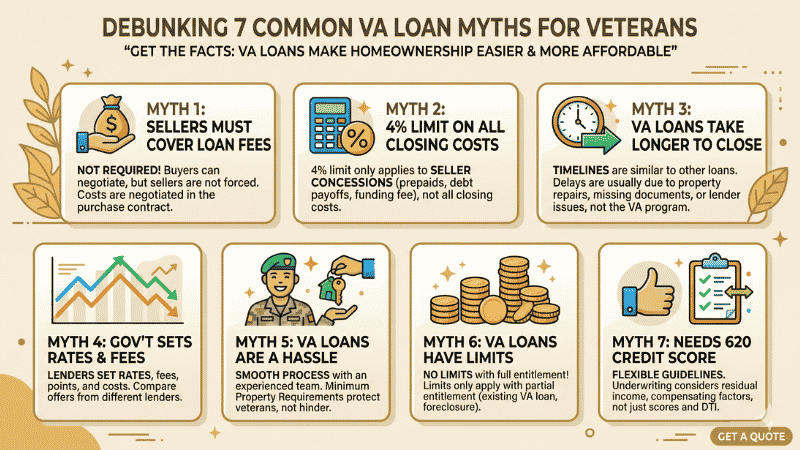
The seller is not required to cover the buyer’s VA loan closing costs. These costs are a standard part of the home-buying process and typically encompass various fees. Such fees include charges from the lender, title company, appraiser, recording fees, prepaid taxes, homeowners’ insurance, and other settlement expenses. This is just one of the common VA loan myths that can mislead buyers.
Buyers can negotiate seller credits in the purchase contract. This means the seller may agree to pay some of the vet’s allowed closing costs, but it must be part of the contract and approved during the loan process.
VA loan rules can be a bit flexible. Sometimes, sellers, lenders, real estate agents, or others can cover certain fees, as long as everything fits within VA guidelines. Just keep in mind that the VA doesn’t actually require sellers to pay the buyer’s closing costs; that’s something you can negotiate. It’s important to understand the difference between closing costs and seller concessions. Closing costs are the essential expenses incurred when purchasing a home. At the same time, seller concessions are additional agreements in which the seller assists the buyer with certain expenses. Veterans should be cautious of VA loan myths and carefully review the purchase contract, loan estimate, and any seller credits with a VA loan officer before submitting an offer.
Myth 2: Sellers Can Only Contribute 4% to Closing Costs
What Does the 4% Rule Really Mean?
The VA 4% rule does not mean the seller is limited to paying just 4% of all the buyer’s costs.
Regular closing costs and seller concessions are not the same. Closing costs include lender fees, title fees, recording fees, appraisal fees, and other standard expenses.
Seller concessions, which are often misunderstood due to VA loan myths, are distinct from the 4% limit on concessions. These additional costs that the seller can cover for the veteran may include prepaid taxes and insurance, the VA funding fee, settling the buyer’s debts, or providing a temporary interest rate reduction. Typically, these concessions are capped at 4% of the home’s fair market value. For example, if a home costs $300,000, the 4% seller concession limit would be $12,000. However, this does not always mean the seller is limited to $12,000 for all costs together. It is best to have the loan officer and real estate agent review the seller’s credit before finalizing the purchase contract. The way the credit is written in the contract matters.
Myth 3: VA Loans Take a Lot Of Time To Close
What Can Delay a VA Loan Closing?
VA loans do not automatically take longer to close. Delays usually occur due to paperwork, property issues, or lender overlays. Common delays include:
- VA appraisal timing
- Required property repairs or VA Minimum Property Requirements
- Missing borrower documents
- Title issues
- Slow homeowners insurance
- Purchase contract changes
- Extra lender overlays
- An inexperienced VA loan team
In most cases, the VA loan itself is not the problem. The closing gets delayed when the file is incomplete, the property needs repairs, or the lender does not understand VA guidelines well.
Myth 4: The Government Sets VA Loan Rates and Closing Costs
Why VA Loan Rates Vary by Lender
The VA does not decide your interest rate, lender fees, discount points, or closing costs. While the VA guarantees part of your loan, private mortgage lenders set their own prices and rules for approving loans. That is why it is important for veterans to look beyond just the interest rate. Pay attention to lender fees, discount points, total closing costs, credit score requirements, debt-to-income rules and the lender’s experience with VA manual underwriting. Sometimes a lower rate isn’t the best choice if it comes with high points, extra fees or tougher lending standards.
Myth 5: VA Loans Are a Hassle to Use
Is a VA Loan Harder to Get Than a Conventional Loan?
If the lender, real estate agent and buyer all understand how the process works, the VA loan is not more difficult than a conventional loan. “It’s important to have a team that knows the VA guidelines, the appraisal process, seller concessions and property standards.”
The home must meet VA appraisal and safety requirements, known as Minimum Property Requirements. These rules are not there to make the loan process harder. They are meant to protect veterans from buying homes with major safety, structural, or habitability problems.
Difficulty regarding VA loans is encountered by borrowers when the mortgage workers lack proper experience, or when the house requires some rehabilitation, or when the financial institution forces people to follow extra demands which exist outside of the official VA guidelines. Many people believe that acquiring a VA loan becomes a simple process that is equal to obtaining a conventional loan when a skilled group of workers manages the transaction.
Myth 6: VA Loans Have Loan Limits
Are There Limits on VA Loans?
If you have full VA entitlement, there is no loan limit. This lets eligible veterans buy more expensive homes without a down payment, as long as they qualify with the lender and the home’s value matches the price. Not all veterans have full entitlement. You might have partial entitlement if you already have a VA loan, have had a VA foreclosure or claim, or have not fully restored your VA benefit. If you have partial entitlement, county loan limits can still affect you. The lender will look at your Certificate of Eligibility, income, credit, debts, assets, entitlement status, and the property’s value to decide how much you can borrow. The main thing to remember is that VA loan limits depend on your entitlement. Veterans with full entitlement have different rules than those with partial entitlement.
Myth 7: VA Loans Require a 620 Credit Score and a Low Debt-to-Income (DTI) Ratio
Why Residual Income Matters on VA Loans
VA underwriting is not only about credit score and debt-to-income ratio. VA loans also focus heavily on residual income, which is the money left over after major monthly debts, housing payments, taxes, and other obligations. A veteran with a higher DTI may still qualify if the file has strong compensating factors, such as:
- Strong residual income
- Stable employment and income
- Good recent payment history
- Cash reserves or savings
- Low payment shock
- Strong Automated Underwriting System findings
This is why some veterans are denied by one lender but approved by another. VA guidelines may allow flexibility, but some lenders add overlays. An experienced VA lender will review the full file, not just the credit score or DTI ratio.
Veterans, Don’t Fall for These 7 VA Loan Myths! Let’s Set the Record Straight.
Contact us today to debunk these myths and see how a VA loan can help you secure your dream home.Why VA Loans Are Still the Best Option in 2026
VA loans remain a top choice for veterans looking to buy a home because they offer numerous advantages, including:
- No down payment requirement
- No private mortgage insurance (PMI)
- Competitive interest rates
- Flexible credit and DTI requirements
However, these myths can sometimes discourage veterans from taking advantage of their benefits. Knowing the facts can help you go through the home buying process confidently and avoid missing out on this fantastic opportunity.
Do Not Let VA Loan Myths Stop You From Buying a Home
VA loans offer some of the best mortgage benefits for eligible veterans, active-duty service members, and surviving spouses. However, many people hear old or incorrect information before they even apply. You do not need perfect credit, a low debt-to-income ratio, or a large down payment to qualify. VA loans can offer no down payment, no monthly PMI, flexible credit guidelines, and options for borrowers with higher debt-to-income ratios if the application is strong overall. It is important to work with a lender who knows VA rules, leftover income, loan checks, seller discounts, and any extra requirements. One lender might deny your application because of their own rules, while another could approve you under VA guidelines. Before you give up on a VA loan, have an experienced VA loan officer review your full application. This review can help you see your options, avoid common myths, and feel more confident about buying a home.
FAQs About VA Loan Myths:
Can You Use A VA Loan More Than Once?
Yes. A VA loan is not a one-time benefit. Eligible veterans, service members, and some surviving spouses may use the VA loan benefit more than once, as long as they have enough entitlement available or restore their entitlement after paying off a prior VA loan.
Can You Have Two VA Loans At The Same Time?
In some cases, yes. A borrower may have more than one VA loan at the same time if they have remaining entitlement and qualify based on income, credit, debts, and occupancy requirements. This often comes up when a veteran keeps a current home and buys another primary residence after a job transfer or relocation.
Do VA Loans Require Mortgage Insurance?
No. VA loans do not require monthly private mortgage insurance (PMI). The majority of VA borrowers must pay a one-time funding fee unless they meet the criteria for an exemption. This usually applies to certain veterans who have service-connected disability benefits. The VA says the funding fee helps lower the cost of the loan program because VA loans do not require monthly mortgage insurance or a down payment.
Can A Surviving Spouse Qualify For A VA Loan?
Yes, some surviving spouses may qualify for VA home loan benefits. Eligibility depends on VA rules, service history, and the surviving spouse’s status. Generally, borrowers are required to have a valid Certificate of Eligibility prior to applying for a VA loan.
Do VA Loans Have To Be Used For A Primary Residence?
Yes. VA loans are generally for primary residences, not vacation homes or pure investment properties. The borrower usually has to confirm that they plan to live in the house as their main home.
Can You Buy A Fixer-Upper With A VA Loan?
Yes, but the property must meet VA minimum property requirements. A home does not need to be perfect, but it must be safe, sound, and sanitary. If the property has major repair issues, the seller may need to address them before closing, or the borrower may need to explore a VA renovation loan.
This article about “7 VA Loan Myths Veterans Need To Know” was updated on May 22nd, 2026.