Credit score changes during underwriting process can affect a mortgage approval, interest rate, loan pricing, or closing conditions. Lenders may review credit again before closing to look for new debts, late payments, higher credit card balances, or other changes. A small change in score may not affect the loan, but a larger drop or new debt can create problems. Borrowers should avoid major credit changes until after closing.
How Credit Score Changes During Underwriting Process Can Affect a Mortgage
Credit scores fluctuate during the mortgage underwriting process. It is the amount and the reason that explain whether there will be an impact.
In some cases, the impact will be small or non-existent. In other scenarios, a considerable negative impact may include shifts in eligibility, pricing, mortgage insurance, or underwriting decisions.
A lender may have to re-evaluate a loan, even if the score remains the same, if there is new, unpaid debt, a collection, or an increase in balance. The CFPB supports the claim that a credit score and the information contained in a credit report impact a borrower’s mortgage rate and the borrower’s ability to secure a mortgage.
When Do Lenders Check Credit During the Mortgage Process?
Lenders generally review a borrower’s credit when the mortgage application is submitted. They may check credit again shortly before closing to determine whether the borrower has taken on new debt or experienced other material changes in credit. The second review does not always involve a completely new credit report or a newly calculated mortgage credit score. Depending on the lender, loan program, age of the original report, and circumstances of the file, the lender may use:
- A credit refresh
- Credit-monitoring alerts
- A soft credit inquiry
- An updated credit report
- A new credit report with updated scores
According to the Consumer Financial Protection Bureau, a lender may obtain a credit report when a borrower applies for a loan and again shortly before the loan closes. A pre-closing credit review may reveal:
- A newly reported credit-card balance
- A higher required minimum payment
- A recent credit inquiry
- A newly opened credit account
- A new auto, personal, or installment loan
- A late payment, collection, or other derogatory event
- A debt that was not disclosed on the mortgage application
A credit report generally does not identify every individual credit-card purchase. However, those purchases may result in a higher reported balance or minimum payment when the card issuer updates the credit bureaus.
Credit Report Updates vs. a New Credit Score
A lender checking for credit changes does not necessarily mean that a new mortgage credit score will be generated. A credit refresh or monitoring service may alert the lender to new inquiries, accounts, balances, or monthly obligations without producing a new set of scores. This distinction matters because new debt can affect mortgage qualification even when the borrower’s credit score does not change. If the lender discovers an additional liability before closing, the lender may need to:
- Verify the account and the required monthly payment
- Update the mortgage application
- Recalculate the borrower’s debt-to-income ratio
- Obtain supporting documentation
- Resubmit the loan through the automated underwriting system
- Determine whether the borrower still meets the loan requirements
Fannie Mae’s liability guidelines require lenders to account for additional liabilities discovered after the underwriting decision and through closing. Borrowers should promptly notify their loan officer of any new accounts, inquiries, debts, late payments, or other significant changes to their credit score during underwriting. Early disclosure gives the lender more time to determine whether the change affects eligibility, pricing, or the scheduled closing.
What Happens When Your Credit Score Drops During Underwriting
A decline in the credit score will not guarantee denial of the mortgage, but the lender will assess whether the borrower meets the criteria and conditions for approval.
Small Credit Score Changes
A minor score change may be immaterial and may not affect the borrower’s eligibility and pricing. The reason behind the change is important. A small voluntary credit line increase may be viewed differently from an underwriting score drop as a result of a new late payment or newly opened credit.
Falling Below a Required Credit Level
A larger decline becomes significant when it affects a threshold established by the loan program, mortgage product, mortgage insurer, investor, or lender. Many options may be available to both the lender and the borrower. The lender may have to resubmit the borrower’s information for automated underwriting. Documents may also be required. The lender may also have to restructure the loan. Alternatively, the lender may find other options for the borrower.
New Late Payments or Derogatory Credit
New late payments will also cause the lender to review the borrower’s application and information again. The borrower’s information will also be reviewed to determine why the new late payments occurred and whether the borrower still meets the credit requirements for the loan. Borrowers may also want to notify the lender early so that it does not become an issue during credit checks.
What Happens When Your Credit Score Goes Up During Underwriting
A higher credit score during underwriting does not automatically change the loan’s approval, interest rate, or locked pricing. However, if the new score moves the borrower into a more favorable pricing category, the lender may be able to use it after reviewing the updated credit report, underwriting findings, rate-lock terms, and applicable loan-program requirements. Repricing is not guaranteed. It is not recommended that borrowers open new accounts or make significant credit changes solely to improve their credit scores before closing. Any changes to your credit profile or new debt will be an underwriting issue.
Did Your Credit Score Drop During the Mortgage Process?
A lower score does not always mean denial, but it can change rates, PMI, DTI, or loan eligibility. We’ll review your updated credit and next steps.Can a Higher Credit Score Lower Your Mortgage Rate?
Yes. A higher credit score can result in a lower mortgage rate or better loan pricing, but an improved score does not automatically change the terms of a loan already in underwriting.
The CFPB states that borrowers with higher credit scores generally qualify for lower interest rates. Credit score is only one pricing factor, however. Loan type, down payment, loan-to-value ratio, property type, occupancy, market conditions, and lender pricing can also affect the final rate.
For Fannie Mae conventional loans, the representative credit score is used when determining applicable loan-level price adjustments. A higher score may reduce certain pricing adjustments if it moves the loan into a more favorable credit-score range. If the borrower’s credit score increases during underwriting, the lender must determine whether the new score can be used and whether repricing is available. This depends on the loan program, the lender’s policy, the rate-lock status, and the timing. Borrowers should not make unnecessary credit changes just to chase a better mortgage rate. If the score improves naturally during the credit score changes during the underwriting process, the loan officer can determine whether the improvement provides a pricing benefit.
New Debt Can Matter More Than the Credit Score Change
It is possible to create underwriting issues even if there are minimal changes to your credit score. One of the financial requirements when purchasing a vehicle, obtaining a new credit card, obtaining a personal loan, or increasing the payment on an existing loan is that the borrower’s debt-to-income ratio is within permitted levels. If a borrower has a new financial obligation, the lender will need to evaluate the borrower’s request based on that obligation. Fannie Mae mandates that its lending partners consider all items reported on the borrower’s credit report that were not represented on the loan application. Depending on the situation, the lending partner may request supplemental supporting documentation. To avoid delays in closing, borrowers must obtain approval from their loan officer before closing on new transactions that will likely increase their debt load.
Credit Score Changes During Underwriting Process on Fannie Mae and Freddie Mac Loans
Newer conventional loan minimum credit score requirements mean that older score criteria should not be relied upon.
Fannie Mae Desktop Underwriter
Fannie Mae’s Desktop Underwriter (DU) has no minimum credit score. DU’s system assesses borrower credit risk. DU does not evaluate borrower credit based on a minimum credit score. Credit scores still have influence. For pricing and related loan-level price adjustments, Fannie Mae uses the representative credit score. Therefore, an adjustment in the credit score can affect loan pricing and keep the loan eligible. Minimum credit score requirements apply to manually underwritten Fannie Mae loans. The current requirement is at least 620 for fixed-rate mortgages and 640 for adjustable-rate mortgages.
Freddie Mac Loan Product Advisor
Freddie Mac’s Loan Product Advisor (LPA) has no minimum Indicator Score if the Risk Class is Accept. LPA has already automatically assessed the borrower’s credit reputation. For other Freddie Mac loan transactions, minimum credit score requirements may apply. This is why credit score changes during the underwriting process should be evaluated on a case-by-case basis, considering the loan, the underwriting system, and the lender, rather than assuming a published minimum conventional credit score.
Credit Score Changes on FHA Loans
The credit criteria for FHA loans differ from those of conventional loans. For most FHA purchase loans, a minimum credit score of 580 allows borrowers to qualify for financing with a 3.5% down payment. FHA permits a maximum 90% loan-to-value ratio for borrowers with qualifying scores from 500 through 579. Scores of 580 or higher may permit the maximum 96.5% LTV, subject to the complete FHA file and lender requirements. A borrower’s credit score dropping below 580 can have a considerable impact on the required down payment and the loan structure.
FHA Automated Underwriting
FHA loans use the FHA TOTAL Mortgage Scorecard for the majority of forward mortgage loans. The underwriting system will either return an Accept or Refer. An Accepted decision does not fully approve the loan. The FHA requirements must still be met at closing.
FHA Manual Underwriting
Manual underwriting has different DTI guidelines. Borrowers with an FHA Minimum Decision Credit Score from 500 through 579—or without a usable credit score—generally may not exceed 31% housing DTI and 43% total DTI under manual underwriting. Borrowers with credit scores of 580 or higher might qualify for 31/43 without compensating factors, or at certain higher-ratio combinations when FHA’s required compensating factors are documented. Lenders may impose stricter credit-score or DTI requirements as overlays. Higher ratios require compensating factors, which must be documented by the lender.
How Long Mortgage Credit Reports Remain Valid
Early approval for credit documents does not guarantee they can be used in perpetuity.
For Fannie Mae loans, credit documents typically must not be more than 4 months old as of the note date. If a credit report becomes stale prior to closing, or if credit reporting must be resubmitted for DU, the lender may be required to obtain an updated report.
Underwriting guidelines for credit reporting vary by loan program, lender, loan type, and other factors. Due to longer closing periods, borrowers should expect that most documentation will need to be updated prior to loan closing.
Credit Disputes During Mortgage Underwriting
Borrowers have the right to dispute inaccurate credit information. However, initiating or resolving a dispute during mortgage underwriting can change the information the underwriting system evaluates and may require additional documentation. The effect depends on the loan program, the disputed account, the accuracy of the tradeline, and the automated underwriting findings. For a Fannie Mae loan evaluated through Desktop Underwriter, DU first assesses the file using all tradelines, including the disputed accounts. If DU issues an Approve recommendation while including the disputed tradelines, Fannie Mae generally does not require additional documentation or action regarding those disputes. If DU cannot issue an Approve recommendation that includes the disputed accounts, it may reassess the file without using those tradelines. If excluding them allows DU to issue an Approve recommendation, the lender must investigate whether:
- The borrower is responsible for the disputed account
- The account information is accurate and complete
- The borrower has documentation supporting the dispute
- The account’s monthly payment must be included in the debt-to-income ratio
If the account does not belong to the borrower or contains inaccurate information, the lender may request supporting documents. These could include creditor letters, account statements, bank records, canceled checks, identity-theft documentation, or evidence that the debt was paid. If the borrower is responsible for the account and the negative information is accurate and complete, the loan may no longer be eligible for delivery as a DU-approved loan. Manual underwriting may be considered when the transaction and loan program permit it. The complete requirements are available in the Fannie Mae DU credit-report analysis guidelines. Other mortgage programs, automated underwriting systems, and lenders may handle disputed accounts differently. Lender overlays may also require additional documentation beyond the minimum requirements of the agency guidelines. Borrowers should not ignore legitimate credit-report errors. However, they should discuss starting or removing a dispute with their loan officer before making changes during the mortgage process. Adding or removing dispute language can affect underwriting findings, documentation requirements, and potentially the credit information or score used for the loan.
Current Mortgage Credit Score Model Changes
Fannie Mae and Freddie Mac now permit approved lenders to use VantageScore 4.0 for eligible mortgages. Classic FICO models also remain in use. Although FHFA has approved FICO Score 10T for future use, Fannie Mae states that lenders will be notified when loans using FICO Score 10T become eligible for delivery. FHA has announced that VantageScore 4.0 and FICO Score 10T will become eligible for certain Title II forward mortgages with FHA case numbers assigned on or after January 1, 2027. Until that implementation date and the publication of applicable policy updates, lenders must continue following existing FHA credit-report and scoring requirements. Borrowers should ask their loan officer which scoring model will be used because a consumer score shown by an app may differ from the score used for mortgage underwriting.
Hypothetical Credit Score Changes During Underwriting Process
The following examples illustrate how credit score changes during underwriting process may be handled. They are not approval guarantees. The actual outcome depends on the borrower’s complete credit profile, debt-to-income ratio, loan program, automated underwriting findings, lender overlays, mortgage insurance requirements, and rate-lock terms.
Example 1: Small Score Drop With No New Debt
A borrower begins underwriting with a mortgage credit score of 681. Before closing, a newly reported credit card balance lowers the score to 675. The lender’s pre-closing credit review confirms that the borrower has no new accounts, no late payments, and no additional monthly debts. The required credit card payment has not increased sufficiently to materially affect the borrower’s debt-to-income ratio. The underwriter reviews the updated information and confirms that the borrower still meets the loan program’s eligibility and pricing requirements. Depending on the lender’s procedures, the file may not need to be resubmitted through the automated underwriting system. The loan may proceed without changes. However, the result depends on whether the lower score crosses an eligibility, pricing, mortgage insurance, or lender-overlay threshold elsewhere in the file.
Example 2: Score Drops After a New Late Payment
A borrower enters underwriting with a 622 credit score. A newly reported 30-day late payment on a credit card lowers the score to 598. The lender discovers the late payment through an updated credit report or pre-closing credit review. Because the change involves both a lower score and recent derogatory credit, the lender must determine whether the borrower still meets the loan program’s credit requirements. The underwriter may request a written explanation and supporting documents, update the credit information, recalculate any affected ratios, and resubmit the loan through the applicable automated underwriting system. If the file no longer receives an acceptable recommendation, the lender may have to restructure the loan, consider manual underwriting when permitted, evaluate another eligible program, or delay closing. The loan is not automatically denied solely because the score decreased. The final decision depends on the cause of the late payment, the updated underwriting findings, the borrower’s overall payment history, the loan program, and any lender overlays.
Example 3: Credit Score Improves Before Closing
A borrower begins underwriting with a credit score of 696. After lower credit-card balances are reported through the normal monthly reporting cycle, the borrower’s score increases to 720. The lender receives the higher score through an updated credit report. The loan officer then determines whether the new score is eligible for use and whether it moves the borrower into a more favorable loan-pricing or mortgage-insurance category. The lender may need to update the loan file, resubmit it through automated underwriting, and review the rate-lock terms before applying different pricing. An improved score does not automatically result in a new interest rate or a right to reprice the loan. The lender may offer improved pricing when its policies, investor requirements, and rate-lock terms permit it. In other cases, the existing approval and pricing may remain unchanged. The outcome depends on the entire loan file and the lender’s applicable repricing rules.
Before Closing Credit Checklist
A mortgage approval is based on the borrower’s documented financial profile. Until the loan closes, use this checklist to reduce the risk of unexpected credit score changes during underwriting:
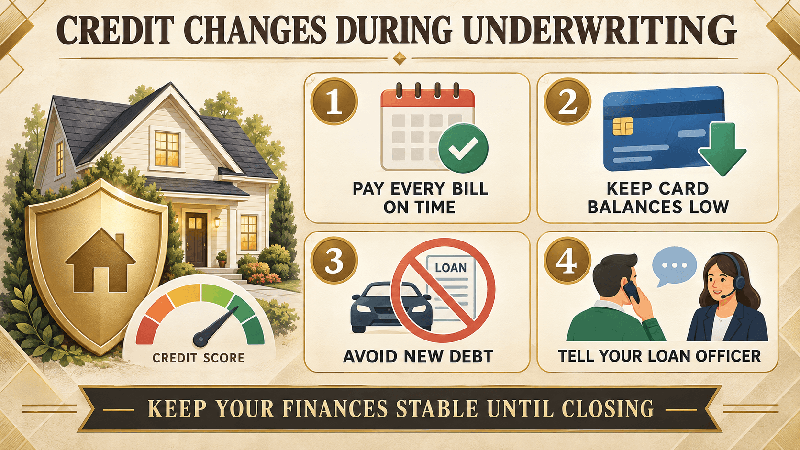
- Pay every account on time. A newly reported late payment can affect the credit score, automated underwriting findings, and loan eligibility.
- Keep credit-card balances stable or lower. Large purchases can increase reported balances, minimum payments, credit utilization, and the debt-to-income ratio.
- Do not finance a vehicle or another major purchase. A new auto loan, personal loan, furniture account, or installment payment may require the lender to recalculate the file.
- Do not open, close, or co-sign accounts without discussing the impact on the mortgage. A new inquiry, reduced available credit, or co-signed debt could affect underwriting even if someone else is expected to make the payments.
- Report new debt to the loan officer immediately. Do not wait for a credit refresh to reveal it. Early disclosure gives the lender more time to verify the payment, update the application, and determine whether the loan still qualifies.
- Protect the money needed for closing. Avoid using funds reserved for the down payment, closing costs, or required reserves to pay debts unless the lender has confirmed that the payment is necessary.
- Coordinate credit disputes and rapid rescores with the loan officer. Adding or removing a dispute, paying an account, or requesting an update does not guarantee a higher score and may create additional documentation requirements.
- Monitor account statements and credit reports for errors or fraud. Notify the creditor and loan officer promptly if an unfamiliar inquiry, account, balance, or late payment appears.
If an unavoidable expense or credit change occurs before closing, contact the loan officer before completing the transaction whenever possible. The loan officer can explain the potential impact on the mortgage, but the lender must still evaluate the updated information under the applicable loan program and underwriting requirements.
Keep Your Mortgage on Track Through Closing
Complete a quick application or send your scenario. We’ll review your credit changes, balances, new debts, score impact, and best path toward clear-to-close.Common Credit Changes That Delay Mortgage Approval
The team at Gustan Cho Associates has encountered borrowers whose mortgage approvals were delayed because their credit information changed between the initial application and closing. The problem is not always a major drop in credit score. A new payment, an inquiry, a reporting error, or a reduction in available closing funds can also require the lender to review the file again.
A Higher Credit-Card Balance Changes the Loan’s Pricing
We have seen credit-card issuers report higher balances while a mortgage is in underwriting. Even when the borrower did not open a new account or miss a payment, the higher utilization caused the mortgage score to decrease. When the new score crossed a pricing threshold, the lender had to determine whether the original pricing, mortgage insurance, and automated underwriting findings remained valid. This is why borrowers should avoid adding large balances to their credit cards before closing, including charges for furniture, appliances, moving expenses, or home improvements.
A New Auto Loan Is Discovered Before Closing
Some borrowers have financed or leased a vehicle after receiving a mortgage preapproval because they did not realize the new payment could affect their home loan. The new inquiry may first appear through credit monitoring. The lender must then determine whether the borrower opened an account, obtain documentation showing the balance and monthly payment, update the mortgage application, and recalculate the debt-to-income ratio. The file may also need to be resubmitted through the automated underwriting system. A borrower can create a qualification problem even when the new auto loan causes little or no immediate change to the credit score.
A Recently Reported Late Payment Requires Another AUS Review
Our team has also encountered files in which a late payment was reported after the initial credit report was obtained. A borrower’s explanation may help the underwriter understand what happened, but an explanation does not remove an accurately reported late payment. The lender may need an updated credit report, a written explanation, and supporting documentation. The loan may then need to be resubmitted through Desktop Underwriter, Loan Product Advisor, or the applicable government underwriting system. A new late payment can affect the automated recommendation, manual-underwriting eligibility, lender overlays, or the scheduled closing.
A Dispute or Incorrect Tradeline Requires Documentation
Credit reports do not always contain complete or accurate information. We have worked with borrowers whose reports included outdated balances, accounts that did not belong to them, or payment histories they believed were reported incorrectly. These situations may require creditor letters, account statements, canceled checks, bank records, identity-theft documents, or other evidence. Disputing an account during underwriting can also change how an automated underwriting system evaluates the tradeline. Borrowers should correct legitimate errors, but they should coordinate with their loan officer before adding or removing a dispute during the mortgage process.
The Credit Report Expires During an Extended Closing
A mortgage credit report cannot be used indefinitely. We have encountered extended transactions in which appraisal, title, property, construction, or other delays caused the original credit documents to become too old for closing. When the lender obtains updated credit information, new balances, payments, inquiries, or credit scores may appear. Borrowers are sometimes surprised to learn that the credit report used for their initial approval will remain valid until the loan closes. Maintaining stable credit remains important throughout an extended transaction.
Paying a Collection Reduces the Borrower’s Closing Funds
Some borrowers have paid or settled a collection account after applying for a mortgage because they assumed doing so would automatically improve their chances of approval. We have seen these payments reduce the funds needed for the down payment, closing costs, or reserves. Paying a collection does not guarantee an immediate increase in credit score, and the updated balance may not appear on the credit report before closing. Borrowers should not ignore valid debts, but they should ask their loan officer how a proposed payment could affect both underwriting and the money available to close.
A New Inquiry Appears Before the First Payment Is Reported
A newly opened account may generate a credit inquiry before the account balance and monthly payment appear on the credit report. We have encountered situations in which the lender saw the inquiry but could not initially determine whether the borrower had taken on new debt. The borrower may need to provide a creditor statement, financing agreement, proof that no account was opened, or documentation showing the new monthly payment. Until the lender confirms what happened, underwriting may not be able to finalize the loan. These situations demonstrate why borrowers should maintain a stable financial profile and communicate with their loan officer until the mortgage has closed. Credit score changes during underwriting are evaluated together with the borrower’s debts, payment history, assets, loan program, automated underwriting findings, and the lender’s requirements.
What Borrowers Should Avoid Before Closing
It’s essential to keep a stable financial profile once a mortgage is under review.
While your loan is being processed, choosing to finance a car or a personal loan, co-sign a loan, make large purchases using your credit, run up credit card balances, or close accounts without approval are all things that borrowers generally need to avoid. Missed payments and credit changes should also be avoided.
Since lenders look closely at existing debt obligations in evaluating a prospective borrower’s ability to pay off a mortgage, new obligations can affect mortgage qualification even if the credit score itself is little affected. The CFPB indicates that multiple checks undertaken for rate shopping within the permitted time frame will be treated differently by credit score models.
Steps to Take If Your Credit Changes During Underwriting
Just because there are changes to your credit does not mean the loan will be denied. If there are changes you feel are important, contact your loan officer to explain them. Based on the situation, they may need to update their records or take a closer look at your loan. Things to consider:
- Letting your loan officer know about your new obligation or even new accounts.
- If requested, provide your loan officer with proof regarding balances that have been paid off.
- Explain any new collection accounts or charge-offs.
- Do not pay collections or charge-offs to improve your loan file unless otherwise suggested by your loan officer.
- Don’t pay collections or charge-offs unless you are asked to do so.
- Inquire with your loan officer about how new credit may influence your chances of qualifying for the loan.
- Continue making all payments as required.
The potential problem is that, during the credit score changes during the underwriting process, there isn’t much time to address a lender’s underwriting concerns.
Final Thoughts On Credit Score Changes During Underwriting Process
Credit scores may fluctuate between application and closing on a loan. What is important is how changes in the borrower’s credit report, credit score, monthly debts, and payment history may affect the underwriting of the mortgage. Minor fluctuations may not impact the mortgage; new debt, late payments, and/or a downward trend on the credit score may be a concern for the lender. The best practice is to maintain consistent credit and remain financially stable until a mortgage loan closes. Discuss with your lender before making any large credit decisions.
FAQs About Credit Score Changes During Underwriting Process
Can a Mortgage Lender Deny a Loan After Clear to Close?
Yes, although it is uncommon. “Clear to close” means the lender has substantially completed underwriting, but the loan has not yet been consummated and funded. A material change involving employment, income, credit, debt, assets, insurance, title, or property could require another underwriting review. Borrowers should maintain the financial profile on which the approval was based until closing is complete.
Do Mortgage Lenders Verify Employment Again Before Closing?
Many lenders verify that the borrower is still employed shortly before closing. For example, Fannie Mae generally requires employment verification within 10 business days before the note date when employment income is used to qualify. If a borrower has resigned, been laid off, changed jobs, or had a pay cut, the lender needs to assess whether the income remains eligible.
Can a Large Bank Deposit Delay Mortgage Underwriting?
Yes. A large or unexplained deposit may require documentation showing the source of the funds, particularly when the funds are needed for a down payment, closing costs, or reserves. Depending on the source, the lender may request a gift letter, a sale receipt, a transfer history, a deposit record, or a written explanation. Funds that cannot be adequately documented may not be usable for qualification.
Does a Credit Freeze Affect Mortgage Underwriting?
A credit freeze does not lower a credit score, but it can prevent a lender or credit provider from accessing the frozen credit file. If the lender needs a new report, updated score, or additional credit information, the borrower may have to temporarily lift the freeze. Borrowers should ask their loan officer which credit bureaus must be accessible and how long the freeze should remain lifted.
Whose Credit Score Is Applied in a Joint Mortgage Application?
The answer depends on the loan program and the purpose for which the score is being used. For Fannie Mae loans with multiple borrowers, the lowest applicable borrower score generally serves as the representative credit score for loan-level pricing. Certain manually underwritten loans may use the borrowers’ average median score to determine minimum-score eligibility. Other loan programs may calculate the qualifying score differently.
Does a Soft Credit Check Before Closing Lower Your Credit Score?
No. A soft inquiry does not affect a consumer’s credit score. However, not every pre-closing credit review is necessarily a soft inquiry. A lender may use credit monitoring, a credit refresh, or a new credit report, depending on the loan and circumstances. Borrowers can ask their loan officer what type of credit review will be used.
This article about “Credit Score Changes During Underwriting Process: What Happens Before Closing” was updated on September 15th, 2026.