The Best Wholesale Mortgage Lenders for Non-Prime Loans: Your Complete Guide in 2026
Are you a borrower with less-than-perfect credit, self-employed, or recovering from a past financial hardship? If so, you’re not alone. Many borrowers like you are searching for the best wholesale mortgage lenders for non-prime loans who can help them achieve the dream of homeownership. Best wholesale mortgage lenders for non-prime loans help borrowers with bad credit, recent bankruptcy, high DTI, or non-traditional income qualify.
Access To Multiple Wholesale Mortgage Lenders
In this guide, we’ll break everything down in plain language. We’ll explain what non-prime loans are, why mortgage brokers offer better options than banks, and how Gustan Cho Associates helps match you with the best wholesale mortgage lenders for non-prime loans. In the following paragraphs, we will cover the best wholesale mortgage lenders for non-prime loans.
What Are Non-Prime Loans?

Alternative Income Documentation
One of the biggest reasons borrowers search for the best wholesale mortgage lenders for non-prime loans is the need for income documentation. Many self-employed people write off business expenses, so their tax returns show less income. Traditional mortgage programs may not reflect their real cash flow. ment loans, profit and loss statement loans, 1099 income loans, asset depletion loans, and DSCR loans for real estate investors.
Higher Debt-To-Income Ratio Flexibility
The debt-to-income ratio is one of the biggest reasons borrowers are denied. Traditional mortgage lenders may cap debt-to-income ratios lower than agency guidelines or add overlays that make approvals harder. Some non-prime wholesale mortgage lenders offer more flexible DTI options for certain borrowers.
What Are Wholesale Mortgage Lenders?
Some non-prime wholesale lenders offer more flexible debt-to-income options based on your credit score, assets, reserves, down payment, and other factors. This can help borrowers who have high incomes but higher monthly bills. traditional lenders avoid. These can include non-warrantable condos, condotels, mixed-use properties, unique homes, investment properties, and certain portfolio loan scenarios.
The property still needs to meet the lender’s requirements, but specialty wholesale lenders often provide more options than standard agency lenders.
These loans are a great backup for people when traditional and FHA loans aren’t available, giving borrowers the flexibility they need for different financial situations. Non-prime loans can help many folks reach their goal of owning a home, even if they face some unique challenges.
Who Are the Best Wholesale Mortgage Lenders for Non-Prime Loans?
The top wholesale mortgage lenders that focus on non-prime loans don’t deal with customers directly. Instead, they work with mortgage brokers to create loan programs that fit different needs. They offer options like bank statement loans that skip the tax return requirement, DSCR loans for real estate investors, and ITIN loans for those without documentation.
They even have jumbo loans for folks with lower credit scores and loans that don’t make you wait after a bankruptcy or foreclosure.
At Gustan Cho Associates, we connect with over 300 wholesale mortgage lenders. This helps us find financing solutions that are just right for your financial situation. With such a vast network, we can shop around for the best options and ensure you get a great deal that works for you.
Why Borrowers Need Non-Prime Mortgage Lenders
Choosing the right wholesale mortgage lender for non-prime loans can be the key to getting approved for a mortgage. Many borrowers do not meet traditional lending requirements. Some have recent late payments, lower credit scores, high debt-to-income ratios, past bankruptcy or foreclosure, self-employment income, bank statement income, or own unique property types. That does not always mean they cannot qualify for a mortgage. Often, they just need the right lender, loan program, and a smart underwriting approach.
At Gustan Cho Associates, We Help Borrowers Who Have Been Turned Down By Banks, Credit Unions, Online Lenders, And Retail Mortgage Companies
Many lenders only offer standard loan programs or add extra rules to FHA, VA, USDA, and conventional loans. We focus on helping borrowers find options through wholesale mortgage lenders, non-prime lenders, non-QM lenders, portfolio lenders, and specialty mortgage investors. This guide covers what wholesale mortgage lenders do, how non-prime loans work, who can benefit from these programs, and how Gustan Cho Associates helps borrowers find solutions when traditional lenders say no.
What Are Wholesale Mortgage Lenders?
Wholesale mortgage lenders work with mortgage brokers, correspondent lenders, or mortgage companies instead of advertising directly to the public. Borrowers do not apply directly to these lenders. Instead, they work with a licensed mortgage professional who has access to wholesale lending options.
Wholesale mortgage lenders can offer a wide range of mortgage products, including FHA, VA, USDA, conventional, jumbo, non-QM, bank statement, DSCR, asset depletion, and other non-prime mortgage programs.
For many borrowers, wholesale lending can offer more flexibility than a single retail lender, as a mortgage broker or lending team may have access to multiple wholesale investors rather than a single lender’s loan menu.
Wholesale Mortgage Lenders Versus Retail Mortgage Lenders
Retail mortgage lenders work directly with consumers under their own lending brand. Banks, credit unions, online lenders, and direct mortgage companies are examples of retail mortgage lenders. Wholesale mortgage lenders provide mortgage products through approved mortgage brokers and lending partners.
The consumer works with the broker or mortgage company, and that professional shops the borrower’s file across wholesale lending options.
The main advantage is choice. If one retail lender says no because of strict rules, a mortgage broker with access to many wholesale lenders can often find a lender that accepts lower credit scores, recent credit events, bank statement income, higher loan-to-value, or alternative documentation.
What Are Non-Prime Mortgage Loans?
Non-prime mortgage loans are mortgage programs designed for borrowers who do not meet traditional lending requirements or who need more flexible underwriting. These loans are sometimes called non-prime, non-QM, alternative, or specialty mortgage loans. Non-prime does not always mean bad credit. Even borrowers with excellent credit may need a non-prime mortgage if they are self-employed, have complex income, own several rental properties, need a DSCR loan, recently filed for bankruptcy, had a foreclosure, or are buying a property that does not meet standard guidelines.
Common Reasons Borrowers Need Non-Prime Loans
Borrowers may need non-prime mortgage loans for many reasons. Some have low credit scores or recent late payments. Some have recently completed a bankruptcy, foreclosure, deed-in-lieu, or short sale. Others are self-employed and cannot qualify using traditional tax return income. Non-prime loans may also help borrowers with high debt-to-income ratios, large tax write-offs, non-traditional income, gaps in employment, investment properties, non-warrantable condos, condotels, mixed-use properties, or jumbo loan needs that do not meet standard guidelines.
Best Wholesale Mortgage Lenders For Non-Prime Loans: What Makes A Lender Strong?
The best wholesale mortgage lender for non-prime loans is not always the one with the lowest advertised rate. The best lender is the one who can approve and close your loan based on your full credit, income, assets, property, and occupancy situation. A strong non-prime wholesale lender should offer flexible underwriting, clear guidelines, good communication, competitive pricing, quick processing times, and experienced underwriters who understand complex mortgage situations.
Flexible Credit Score Requirements
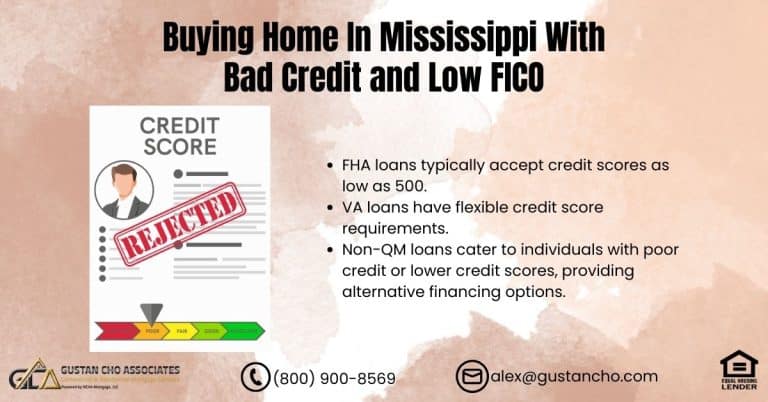
Many traditional mortgage lenders require higher credit scores than agency guidelines require. For example, VA guidelines do not set one official minimum credit score, yet many lenders impose overlays requiring a 620 or 640 score.
Non-prime wholesale mortgage lenders may offer programs for borrowers with lower credit scores, recent late payments, prior collections, charge-offs, or recent major credit events.
HUD, the parent of HUD, allows borrowers with scores as low as 580 for 3.5% down, but many lenders require higher scores. The exact terms depend on the borrower’s credit score, down payment, loan-to-value, reserves, property type, and overall risk profile.
Recent Bankruptcy And Foreclosure Options
Many borrowers believe they must wait several years after bankruptcy or foreclosure before buying another home. That may be true for traditional FHA, VA, USDA, or conventional loans, depending on the situation. However, some non-prime and non-QM mortgage programs may allow borrowers to qualify sooner after bankruptcy, foreclosure, short sale, or deed-in-lieu. These programs often require a bigger down payment, more reserves, and higher rates than traditional mortgages. Still, they can help borrowers who have recovered financially but do not yet meet standard waiting periods.
Why Mortgage Brokers Beat Banks for Non-Prime Loans
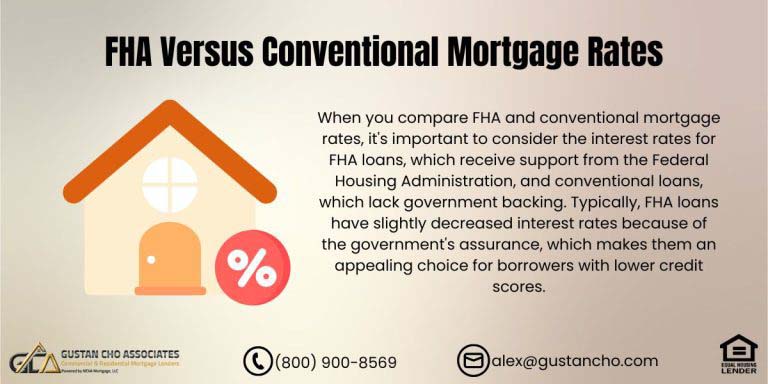
Many borrowers find that mortgage brokers often have an advantage over big banks when looking for non-prime loans. This is mainly because banks have strict rules, called lender overlays, that can make it harder for people to get loans. For example, even if the Federal Housing Administration (FHA) allows loans for those with a credit score 580, a bank might insist on a score of 620, which can shut out many qualified borrowers.
Mortgage Brokers Generally Get You The Best Rates On Non-Prime Loans
Mortgage brokers, like those at Gustan Cho Associates, team up with the best wholesale mortgage lenders for non-prime loans with more relaxed rules. This means they’re open to working with lower credit scores, can do manual approvals, have easier debt-to-income (DTI) ratios, and are willing to make exceptions for special situations in life. This kind of flexibility can help people get the loans they need more easily.
Why Borrowers Get Denied By Traditional Mortgage Lenders
Many borrowers assume a mortgage denial means they cannot qualify anywhere. That is not always true. A denial may only mean that the borrower does not meet that lender’s specific rules. At Gustan Cho Associates, we often see borrowers denied due to lender overlays, not because they are ineligible under the actual agency or investor guidelines.
Lender Overlays Can Cause Mortgage Denials
A lender overlay is an extra rule added by a mortgage lender on top of minimum program guidelines. For example, FHA may allow a lower credit score, but a lender may require a higher one. VA may not have a fixed minimum credit score, but the lender may require a score of 620 or higher. A wholesale investor may allow certain credit events, while a retail lender may not. Lender overlays are one of the most common reasons borrowers are told no, even when another lender may approve the same borrower.
Automated Underwriting Does Not Always Tell The Full Story
For FHA, VA, USDA, and conventional loans, lenders often use automated underwriting systems such as Desktop Underwriter, Loan Product Advisor, or FHA TOTAL Scorecard. An automated approval can be powerful, but it still depends on the lender’s overlays and the file’s structure. Some borrowers need manual underwriting, especially after certain credit events or when the automated system does not issue an approval. Not all lenders offer manual underwriting, and even those that do may still impose restrictions.
One Denial Does Not Mean Every Lender Will Say No
Mortgage guidelines vary by loan program and investor. A borrower denied by one lender may qualify with another lender that has different overlays, different wholesale channels, or more experience with non-prime mortgage loans. That’s why it helps to work with a mortgage company that understands both traditional and non-prime lending.
Gustan Cho Associates And Non-Prime Wholesale Mortgage Options
Gustan Cho Associates helps borrowers look at mortgage options from both traditional and non-prime lenders. We focus on helping people who may not fit the standard retail lending model.
Many borrowers come to Gustan Cho Associates after being denied by another lender. Some have lower credit scores. Some have had recent late payments. Some are self-employed.
Some have high debt-to-income ratios. Some have recently had bankruptcy, foreclosure, or other major credit events. Our goal is to review your full profile and find the mortgage program that best fits you.
No Lender Overlay Approach On Government And Conventional Loans
Gustan Cho Associates is known for helping borrowers qualify for government and conventional loans with no lender overlays when they meet agency guidelines and receive proper underwriting approval. This can be especially important for FHA, VA, USDA, and conventional borrowers who were denied by lenders with stricter in-house rules.
Access To Multiple Wholesale Mortgage Lenders
Working with a mortgage team connected to several wholesale lenders gives you more choices. Instead of being limited to one lender, your file can be matched to a lender or investor that fits your situation. This matters for borrowers who need non-prime loans, bank statement loans, DSCR loans, jumbo loans, non-warrantable condo financing, recent credit event options, or other specialty mortgage programs.
Experience With Difficult Mortgage Files
Non-prime lending requires more than submitting an application. The file must be structured correctly. Income must be documented properly. Credit explanations may be needed. Assets and reserves must be reviewed. Property eligibility must be checked. The right loan program must be selected early.
There are many types of non-prime mortgage loans. The right option depends on the borrower’s income, credit, assets, property, occupancy, and long-term goals.
Experienced mortgage professionals can spot potential issues before you get a pre-approval issued to you. Many experienced mortgage loan originators will not allow non-QM loans to proceed to processing and underwriting, and are offered by wholesale mortgage lenders.
Struggling with Traditional Loan Approval? Non-Prime Loans Can Help!
Contact us today to explore your options and see how we can help you secure the financing you need.Why Non-Prime Loans Usually Cost More Than Traditional Mortgages
Non-prime loans may carry higher interest rates, larger down payment requirements, and stricter reserve requirements than FHA, VA, USDA, or conventional loans. This is because the lender is taking on more risk or using alternative documentation. That does not make non-prime loans bad. It means borrowers should understand the loan’s costs and purpose before moving forward.
Higher Risk Usually Means Higher Pricing
Lenders price mortgage loans based on risk. Lower credit scores, recent credit events, higher loan-to-value ratios, non-traditional income, investment properties, and unique collateral can all affect pricing. You should compare real loan options, not just advertised rates.
Non-Prime Loans Can Be A Temporary Solution
For some borrowers, a non-prime loan is a stepping stone. They may use the loan to buy a home now and refinance later after their credit improves, their income documentation strengthens, or agency waiting periods expire. The key is to make sure your payment is affordable and your refinance plan is realistic.
Documents Needed For Non-Prime Mortgage Loans
Documentation depends on the type of non-prime loan. A bank statement loan requires different documents than a DSCR loan. A recent bankruptcy loan requires different documents than an asset depletion loan. Most borrowers should be ready to provide identification, credit authorization, bank statements, asset statements, income documents, business documents if self-employed, housing history, bankruptcy or foreclosure paperwork if needed, and property information.
Documents For Bank Statement Loans
Borrowers applying for bank statement loans may need 12 or 24 months of personal or business bank statements, business license information, CPA letters, profit-and-loss statements, and proof of business ownership.
Bank statement loans are popular with self-employed borrowers who cannot qualify using tax return income. Instead of using tax returns, the lender may review personal or business bank statements to calculate qualifying income.
This helps business owners, freelancers, contractors, consultants, and entrepreneurs whose tax returns do not show enough income after write-offs.
Documents For DSCR Loans
Real estate investors applying for DSCR loans may need a lease agreement, market rent schedule, property insurance quote, purchase contract, entity documents if buying in an LLC, asset statements, and property valuation documents. DSCR loans, also known as debt service coverage ratio loans, are designed for real estate investors. Instead of using the borrower’s personal income, the lender assesses the property’s rental income potential relative to the monthly housing payment. DSCR loans are helpful for investors who own several properties, write off income, or want a loan based on property cash flow.
Non-QM Loans After Bankruptcy Or Foreclosure
Some non-QM mortgage lenders offer loan programs for borrowers who have recently had bankruptcy, foreclosure, short sale, or deed-in-lieu. These programs may allow borrowers to qualify sooner than traditional agency waiting periods. The trade-off is usually a larger down payment, a higher rate, more reserves, and stricter loan-to-value limits.
Asset Depletion Mortgage Loans
Asset-depletion loans allow borrowers to qualify using eligible assets rather than standard employment income. These loans may help retirees, high-net-worth borrowers, business owners, or borrowers with strong assets but limited traditional income. The lender figures out a monthly qualifying income based on your eligible assets and the program’s rules.
ITIN Loans
ITIN loans help people who do not have a Social Security Number buy a home. These loans are designed for immigrants and non-residents. To qualify, borrowers need an Individual Taxpayer Identification Number (ITIN). This number proves their eligibility for taxes. Lenders use the ITIN to check a borrower’s creditworthiness and financial stability. This allows those who may struggle to get financing to have the chance to own a home. ITIN loans promote inclusivity in the housing market and help build credit history for those new to the American financial system.
Jumbo Loans with Low Credit Scores: Jumbo Non-Prime Mortgage Loans
Jumbo loans exceed standard conforming loan limits. Borrowers who need large loan amounts but do not fit traditional jumbo guidelines may need a non-prime jumbo mortgage. These programs can help borrowers with alternative income, recent credit issues, large loan amounts, or complex finances.
Non-Warrantable Condo Loans
A condo may be considered non-warrantable if it does not meet Fannie Mae or Freddie Mac condo requirements. This can happen because of investor concentration, litigation, commercial space, budget issues, or other project concerns. Non-warrantable condo portfolio loans and non-QM options may help borrowers finance condos that traditional lenders will not approve. They’re not for every borrower. If a borrower qualifies for FHA, VA, USDA, or conventional financing with good terms, that may be the better option. However, non-prime loans can help borrowers who are otherwise locked out of traditional lending.
Borrowers With Low Credit Scores
Borrowers with lower credit scores may need more flexible mortgage options. Some may qualify for FHA, VA, or another agency program, while others may need non-prime lending, depending on the full credit profile. A credit score is not the only factor in approval. Lenders also look at your payment history, credit depth, recent late payments, collections, charge-offs, housing history, debt-to-income ratio, assets, and reserves.
Borrowers With Recent Late Payments
Recent late payments can be a major issue with many mortgage lenders. Some lenders will deny borrowers automatically if there are late payments in the past 12 months, especially after bankruptcy or foreclosure. Some non-prime mortgage lenders may allow recent late payments if your overall file meets their guidelines.
Self-Employed Borrowers
Self-employed borrowers often need non-prime loan options because tax returns do not always show their real cash flow. Bank statement loans, 1099 loans, profit-and-loss statement programs, and asset-based programs can offer alternative ways to qualify.
Real Estate Investors
Real estate investors may benefit from DSCR loans, no-income investor loans, portfolio loans, and non-QM investment property options. These programs are especially helpful for investors who own several properties or prefer not to use traditional personal income documentation.orrowers With High Debt-To-Income Ratios A high debt-to-income ratio can prevent an otherwise strong borrower from getting approved. Some non-prime lenders offer more flexibility, especially if you have strong assets, reserves, equity, credit depth, or a larger down payment.
Borrowers Buying Unique Properties
Unique properties can make it more challenging to get a mortgage. Non-warrantable condos, condotels, mixed-use properties, and other special property types may require a wholesale or portfolio lender with more flexible guidelines. Jumbo loans go beyond the limits established by government-sponsored entities. They usually require a higher credit score.
Some lenders now offer jumbo loans to people with credit scores as low as 580, which is more accessible than traditional requirements.
This can help borrowers who have faced financial issues and are now ready to buy a more expensive home. Additionally, jumbo loans often do not require mortgage insurance, making them a cheaper option for those looking to buy luxury homes.
Documents After Bankruptcy Or Foreclosure
Borrowers with prior bankruptcy or foreclosure may need bankruptcy discharge paperwork, foreclosure documents, short sale settlement statements, trustee payment history, credit explanations, and proof of re-established credit.
How Gustan Cho Associates Helps Borrowers Find The Right Non-Prime Mortgage Lender
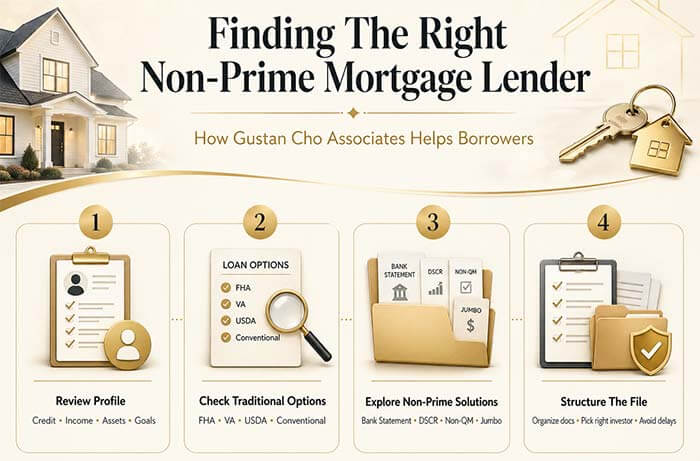 Gustan Cho Associates reviews your full mortgage profile before matching you with a loan program. Our goal is to find the best path to approval, whether that’s FHA, VA, USDA, conventional, jumbo, non-QM, bank statement, DSCR, or another specialty loan.
Step One: Review Credit, Income, Assets, And Goals
The first step is to understand your full situation. This includes your credit score, credit history, income type, employment history, assets, property type, occupancy, loan amount, down payment, and long-term goals.
Step Two: Identify Traditional Loan Options First
Non-prime loans are helpful, but they are not always the first choice. If you can qualify for FHA, VA, USDA, or conventional financing with better terms, that should be considered first. Alternative financing does not work; Gustan Cho Associates can review non-prime mortgage options. This may include bank statement loans, DSCR loans, non-QM loans after bankruptcy, asset depletion loans, jumbo non-prime loans, or portfolio mortgage programs.
Step Four: Structure The File Before Submission
A strong mortgage file should be organized before underwriting. This means reviewing your documents, identifying potential issues, selecting the right investor, and avoiding preventable delays.
Common Mistakes Borrowers Make When Searching For Non-Prime Mortgage Lenders
Many borrowers looking for the best wholesale mortgage lenders for non-prime loans focus only on rates. Rates are important, but getting approved comes first.
Applying With The Wrong Type Of Lender
Not every lender offers non-prime mortgage loans. A bank or retail lender may only offer standard agency products. If you do not meet those guidelines, that lender may deny your loan, even though another lender could offer a solution.
Assuming All Mortgage Lenders Have The Same Rules
Mortgage lenders do not all have the same rules. One lender may deny you for recent late payments, while another may allow them. One lender may not accept bank statement income, while another specializes in it. ing Too Long To Review Credit Borrowers should review their credit early. Credit disputes, late payments, collections, charge-offs, thin credit, authorized user accounts, and recent inquiries can all affect approval.
Not Understanding The Down Payment Requirement
Non-prime loans may require a larger down payment than traditional mortgages. The down payment depends on credit score, loan type, property type, occupancy, and the age of the credit event.
Ignoring The Long-Term Plan
A non-prime mortgage should fit your long-term financial plan. You should know if the loan is meant to be permanent or if refinancing later makes sense.
Are Non-Prime Loans Safe?
Non-prime loans can be safe when they are clearly explained, fully documented, and affordable for you. The issue is not the loan label, but rather that you do not understand the payment terms, risks, or refinance plan. A responsible mortgage lender should explain the pros, cons, costs, and alternatives before you commit.
Non-Prime Does Not Mean Subprime Like The Old Days
Today’s non-prime and non-QM mortgage loans are not the same as the risky subprime loans that contributed to the housing crisis. Modern non-QM lenders must still follow ability-to-repay rules and responsible lending standards. You still need to document your income, assets, credit, and ability to repay the mortgage.
Borrowers Should Understand The Payment
Your monthly payment must be affordable. You should review the principal, interest, taxes, insurance (if needed), HOA dues, and escrow requirements. The right loan is not just the one that gets approved. It’s the one you can comfortably manage.
Types of Non-Prime Loans Offered by Top Wholesale Lenders
The best wholesale mortgage lenders for non-prime loans offer a variety of programs. Here are a few popular ones:
Recent Credit Events (BK, Foreclosure, Short Sale)
Getting a loan can be hard if you have gone through major financial challenges like bankruptcy, foreclosure, or a short sale. However, many top wholesale mortgage lenders offer non-prime loans that let you secure financing without a waiting period after these events. This helps you get back on your feet and reenter the housing market sooner. These lenders give people with past credit issues a second chance at owning a home and achieving financial stability, which is important for rebuilding your credit history.
Manual Underwriting: A Lifeline for Many
Many banks use computers to decide if you can get a loan. If the answer is no, it can feel discouraging. However, some mortgage lenders use a different approach called manual underwriting. They allow real people to review your situation, even if your debt-to-income ratio is as high as 50%, which many banks do not accept. Gustan Cho Associates works with top mortgage lenders that specialize in non-prime loans. They help borrowers get loans when others say no, turning dreams that seem impossible into reality.
Need a Loan but Don’t Qualify for Traditional Financing?
Reach out now to learn how we can help you qualify for a non-prime loan and move forward with your home purchase or refinancing.Why Brokers Offer Lower Rates Than Mortgage Bankers
Remember that mortgage brokers often offer better interest rates than banks when looking for the best wholesale mortgage lenders for non-prime loans. Brokers can charge a maximum of 2.75%, while banks can charge much higher rates, sometimes 5% or more, without warning. This difference can save you money in the long run. At our company, we value honesty and transparency. When you work with us, you won’t find hidden fees. We make our money from what we’ve told you, so you can trust that you’re getting a great deal. Selecting the appropriate mortgage broker ensures that you can trust that you’re collaborating with someone who prioritizes your best interests.
How We Choose the Best Lender for You
At Gustan Cho Associates, we don’t push one-size-fits-all loans. Every borrower has a different financial story, and we match you with the right lender based on:
- Your credit score
- Debt-to-income ratio
- Employment status
- Recent credit events
- Property type and location
Because we work with the best wholesale mortgage lenders for non-prime loans, we can compare rates and guidelines to get you the best possible outcome.
Speed Matters: Our Fast-Track Options
If you want to buy a home quickly, look at the best wholesale mortgage lenders for non-prime loans. Some of these lenders have special fast-track options that can help you get what you need in no time. They offer 24-hour underwriting, which means they quickly check your loan details. You could even get same-day approvals, so you won’t have to wait long. Plus, with these lenders, you can often close your loan in 2 weeks or less. This way, you can move into your new home faster and without all the delays many banks face.
Our Preferred Lenders: The Silent Heroes
We want to shout out to the account reps, underwriters, and teams at our preferred wholesale mortgage lenders. These professionals:
- Work evenings and weekends
- Get tough files approved
- Keep your deal moving
- Care about closing your loan on time
You may never meet them, but they are why Gustan Cho Associates closes loans that other lenders deny.
What Are Lender Overlays?
When looking for the best wholesale mortgage lenders for non-prime loans, it’s good to know about overlays. Overlays are extra rules that some lenders add on top of the standard guidelines. For example, you can qualify for an FHA loan starting at a 580 credit score, although some lenders may raise that requirement to 620. Those extra requirements are called overlays. The good news is that we work with wholesale lenders that stick to FHA, VA, USDA, Fannie Mae, and Freddie Mac guidelines without those extra hurdles.
Latest Updates in 2026 for Non-Prime Lending
-
- Bank Statement Loans: Now available with just 12 months of statements and no P&L required in many cases, making it easier for self-employed individuals to qualify for loans.
- No Ratio Loans: Available for borrowers who want a home but don’t want to document income, streamlining the approval process for those with non-traditional income sources.
- New FICO Scoring Models Coming: These updated models will help more borrowers qualify by considering rent, utilities, and other bills along with traditional credit behaviors.
- No Waiting Period After Chapter 13 Discharge: Many of our lenders allow immediate qualification after a Chapter 13 discharge, providing faster access to homeownership for those recovering from bankruptcy.
- Interest-Only Options: Available again for qualified borrowers, these loans allow for lower initial payments, making homeownership more affordable for some buyers.
Who We Can Help
- Self-employed borrowers who can’t show tax returns
- Real estate investors needing no-income documentation
- People who had a recent bankruptcy or foreclosure
- Individuals with credit scores starting at 500
- Families recovering from financial setbacks
Ready to Get Started? Choosing The Best Wholesale Mortgage Lender For Non-Prime Loans
Choosing the best wholesale mortgage lender is not just about the rate. It’s about finding a lender who can approve and close your loan based on your full profile. A lower rate does not help if the lender cannot close your loan.
Review The Borrower’s Full Credit Profile
The lender should review more than the credit score. Recent late payments, mortgage history, bankruptcy history, foreclosure history, collections, charge-offs, disputes, credit depth, and authorized user accounts can all affect approval. A good mortgage professional will spot possible credit issues before submitting your application.
Match The Loan Program To The Borrower
A self-employed borrower may need a bank statement loan. A real estate investor may need a DSCR loan. A borrower with a recent bankruptcy may need a non-QM loan. A veteran may still qualify for VA financing with the right no-overlay lender. The best lender is the one that fits your actual situation.
Compare Rates, Fees, Down Payment, And Reserves
Non-prime mortgage loans usually have higher rates and fees than traditional loans. You should compare the full cost, including the rate, points, lender fees, down payment, reserves, mortgage insurance (if needed), and any prepayment penalties. Some non-prime loans have no prepayment penalty, while others may have one depending on the property type, occupancy, and program.
Check Turn Times And Underwriting Experience
Non-prime loans can be more complex than traditional loans. The wholesale lender should have clear requirements and reasonable processing times. Delays often occur when a lender does not understand your file or requests extra documents that could have been requested earlier.
Make Sure The Exit Strategy Makes Sense
Some non-prime loans are intended as long-term solutions. Others are short-term, helping you buy now and refinance into a lower-rate traditional mortgage later.
A borrower may use a non-QM loan after a recent credit event and refinance later after credit scores improve, waiting periods are met, or income becomes easier to document.
Don’t let bad credit or complex finances stop you from buying a home. Our team at Gustan Cho Associates specializes in working with the best wholesale mortgage lenders for non-prime loans to find a solution that fits your story. We understand what other lenders overlook. We see potential where others see problems. The top wholesale mortgage lenders for non-prime loans aren’t the ones you see on TV. They’re the ones working behind the scenes with trusted mortgage brokers like Gustan Cho Associates. If you’ve been turned down before or feel stuck, don’t worry—you’ve got options. Let us help you check them out.
Final Thoughts On The Best Wholesale Mortgage Lenders For Non-Prime Loans
The best wholesale mortgage lenders for non-prime loans are those who can match your real-life situation with the right mortgage program. For some, the best option may still be FHA, VA, USDA, or conventional financing with a no-overlay lender. For others, the best path may be a non-QM loan, bank statement loan, DSCR loan, jumbo non-prime loan, asset depletion loan, or portfolio mortgage program.
A mortgage denial from one lender does not always mean you cannot qualify. It may just mean you need a lender with different guidelines, better wholesale options, or more experience with complex mortgage files.
Gustan Cho Associates helps you review your options, understand your loan choices, and find mortgage programs that fit your credit, income, assets, property, and long-term goals. Borrowers who need a five-star national mortgage company licensed in 48 states with no overlays and and works with the best wholesale mortgage lenders for non-prime loans, please call us at 800-900-8569. Text us for a faster response, or email us gcho@gustancho.com.
Frequently Asked Questions About the Best Wholesale Mortgage Lenders for Non-Prime Loans:
What Are The Best Wholesale Mortgage Lenders For Non-Prime Loans?
The best wholesale mortgage lenders for non-prime loans are lenders that offer flexible mortgage programs for borrowers who do not fit standard agency guidelines. These lenders may allow lower credit scores, recent bankruptcy, recent foreclosure, bank statement income, DSCR investor loans, asset depletion, high loan amounts, or unique property types. The best lender depends on the borrower’s full credit, income, assets, and property profile.
What Is A Non-Prime Mortgage Loan?
A non-prime mortgage loan is a mortgage designed for borrowers who may not qualify for traditional FHA, VA, USDA, conventional, or jumbo financing. Non-prime loans may help borrowers with bad credit, recent late payments, self-employment income, bank statement income, high DTI, recent bankruptcy, prior foreclosure, or investment property financing needs.
Are Non-Prime Loans The Same As Non-QM Loans?
Non-prime and non-QM loans are closely related, but they are not always used interchangeably. Non-QM means the loan does not meet the requirements of the qualified mortgage box. Non-prime is a broader phrase often used for borrowers or loan programs outside traditional lending guidelines. Many non-prime loans are non-QM loans.
Can I Get A Mortgage With Bad Credit Through A Wholesale Lender?
Yes, some wholesale mortgage lenders offer loan programs for borrowers with bad credit or lower credit scores. Approval depends on the credit score, payment history, down payment, income, assets, property type, and loan program. Some borrowers may qualify for FHA, VA, or other traditional loans, while others may need non-prime mortgage options.
Can I Get A Non-Prime Mortgage After Bankruptcy Or Foreclosure?
Some non-prime mortgage lenders offer loan programs for borrowers who have experienced bankruptcy, foreclosure, a short sale, or a deed-in-lieu. These programs may allow borrowers to qualify sooner than traditional waiting periods, but they usually require a larger down payment, higher rates, and stronger reserves.
Are Bank Statement Loans Considered Non-Prime Loans?
Bank statement loans are often considered non-prime or non-QM because they rely on alternative income documentation rather than traditional tax returns. They are popular with self-employed borrowers, business owners, freelancers, and entrepreneurs who have strong cash flow but lower taxable income.
Do Non-Prime Mortgage Loans Have Higher Rates?
Yes, non-prime mortgage loans often have higher interest rates than traditional mortgage loans. The rate depends on credit score, down payment, loan-to-value, property type, occupancy, documentation type, and overall risk. Borrowers should compare the full loan terms, not just the interest rate.
What Documents Are Needed For A Non-Prime Mortgage?
Documents depend on the loan program. Borrowers may need bank statements, asset statements, tax returns, profit-and-loss statements, business documents, lease agreements, bankruptcy paperwork, foreclosure documents, credit explanations, and property information. A mortgage professional can explain the exact documents needed for the selected loan program.
Can Self-Employed Borrowers Qualify For Non-Prime Loans?
Yes, self-employed borrowers often use non-prime loans when tax returns do not show sufficient income. Bank statement loans, 1099 income loans, profit-and-loss statement loans, and asset-depletion loans may help self-employed borrowers qualify.
Is A Non-Prime Mortgage A Good Idea?
A non-prime mortgage can be a good option when the borrower cannot qualify for traditional financing and fully understands the payment, costs, terms, and long-term plan. It is important to compare traditional mortgage options first and then review non-prime loans if needed.
What Exactly Are The Best Wholesale Mortgage Lenders For Non-Prime Loans?
These lenders collaborate with mortgage brokers to provide specialized home loans for individuals with lower credit scores or distinct financial circumstances.
How Can The Best Wholesale Mortgage Lenders for Non-Prime Loans Help if My Credit is Bad?
They offer flexible loan programs that accept lower credit scores and financial issues like bankruptcies or foreclosures.
Can Self-Employed People Benefit from the Best Wholesale Mortgage Lenders for Non-Prime Loans?
Yes! They offer bank statement loans, so self-employed borrowers don’t need traditional documents like W-2s.
Why Should I Choose a Broker for the Best Wholesale Mortgage Lenders for Non-Prime Loans Instead of Going to a Bank?
Brokers can access lenders with easier approval rules and lower interest rates than banks.
Do the Best Wholesale Mortgage Lenders for Non-Prime Loans Offer Loans for Real Estate Investors?
Yes, they offer DSCR loans that use rental income from properties to qualify instead of personal income.
What if I’ve Recently Gone Through Bankruptcy or Foreclosure?
The best wholesale mortgage lenders for non-prime loans can help you get financing without long waiting periods after such financial events.
How Fast Can I Get Approved by the Best Wholesale Mortgage Lenders for Non-Prime Loans?
Many lenders offer quick underwriting and same-day approvals and can close your loan within two weeks.
What Are Lender Overlays, And Do The Best Wholesale Mortgage Lenders For Non-Prime Loans have Them?
Overlays are extra rules banks use, making it harder to qualify. The best wholesale lenders usually don’t have these overlays, making it easier for you to qualify.
This Guide About the “Best Wholesale Mortgage Lenders For Non-Prime Loans” Was Updated on April 29 2026.