Mortgage underwriters qualify borrowers by verifying the income, employment, credit, debts, assets, and property information used in the mortgage application. They also confirm that the loan meets the selected program’s eligibility and documentation requirements. An automated underwriting recommendation can guide the review, but it is not final approval. The lender must validate the submitted data, resolve required conditions, and confirm that the loan remains eligible through closing.
What Does a Mortgage Underwriter Do?
A mortgage underwriter reviews loan applications and determines if the loan meets the lender’s requirements. They review the supporting documents, confirm the information in the application, and identify any conditions that would prevent the loan from being funded. When borrowers ask, “How do mortgage underwriters qualify borrowers?”, underwriters determine the creditworthiness of the borrower by not looking at just one score or ratio, but looking at the entire file.
What Mortgage Underwriters Review?
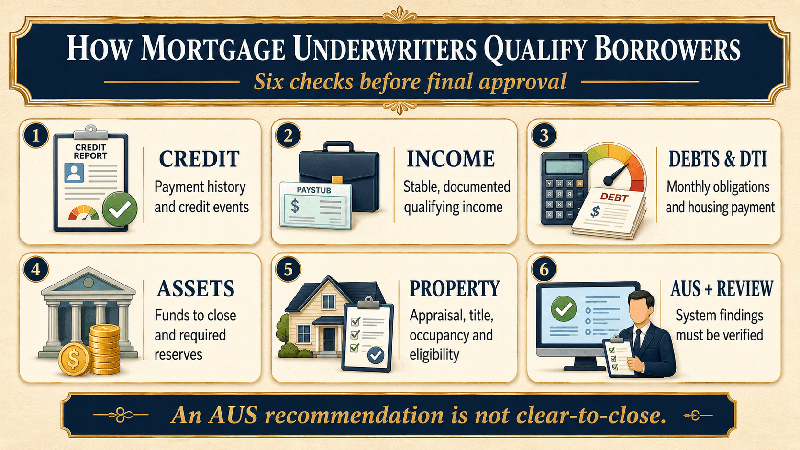
Mortgage underwriters review the following five major factors:
- Credit – recent credit, credit scores, collection accounts, late payments, and/or adverse credit history, bankruptcies, foreclosures, and all other credit-related issues.
- Income and Employment – verifiable income
- Debt-to-Income ratio – ratio of qualifying obligations to gross monthly income
- Assets and Funds to Close – bank statements showing sufficient funds and source of funds, loan closing costs, and reserve funds.
- Property – appraisal, property eligibility, occupancy, and compliance with the requirements of the loan program.
The underwriter will approve the loan, request more information, or deny it based on the factors reviewed.
Automated Underwriting vs. Manual Underwriting
An automated underwriting system reviews the initial data for many mortgage loan applications. Based on the data reviewed, the automated underwriting system will determine how well the loan file meets the loan program’s requirements and what supporting documents it may lack.
AUS evaluates submitted data and issues findings; the lender or underwriter verifies the supporting documents and data accuracy. Human underwriters will also review the loan file to ensure all documents are present. Any inconsistencies will also be addressed.
Manual underwriting is required in some instances. In a case of manual underwriting, the underwriter will use the program’s guidelines. Manual-underwriting requirements vary by FHA, VA, USDA, conventional, and lender policy. Some programs require specific DTI limits, reserves, or compensating factors; others use different risk tests.
How Underwriters Evaluate Credit History and Late Payments
When an underwriter evaluates a prospective borrower’s credit history, they review various factors in addition to credit scores. Some of these factors include the borrower’s payment history, the frequency and recency of late payments, the borrower’s overall credit history, and other significant credit events. For a borrower, late payments that occurred a while back are considered less important than recently repeated late payments. The underwriter assesses whether the borrower has a positive credit history and determines whether it is sufficient to meet the loan program’s criteria. Even with a credit issue or a low credit score, the borrower may still qualify for a loan.
How Mortgage Underwriters Verify Income and Employment
An important part of understanding how mortgage underwriters qualify borrowers is recognizing the difference between gross earnings and qualifying income. Gross earnings are what a borrower receives before taxes and other deductions. Qualifying income is the portion the lender can document, calculate, and reasonably expect to continue under the selected mortgage program.
Fixed base income generally comes from a predetermined salary or consistent hourly schedule. Variable base income occurs when hours or earnings fluctuate. Even salaried income may require additional review after a recent employment change, an extended absence, or when the borrower will begin work after closing.
Overtime, bonuses, commissions, and tips usually require a documented history and an analysis of recent trends. Fannie Mae recommends a two-year history but may permit income received for at least 12 months when positive factors support the shorter history. Stable or increasing income may be averaged, while declining income may need to stabilize before it can be used. Self-employment income requires a separate cash-flow analysis. Depending on the loan program and business structure, the underwriter may review personal and business tax returns, year-to-date profit-and-loss statements, balance sheets, business bank statements, and documentation showing that the business remains active. Income history and expected continuance are related but different. A history shows how long the borrower has received the income. Continuance addresses whether the income can reasonably be expected to remain available. A borrower’s current earnings alone may not establish qualifying income when the income is temporary, irregular, or declining. Documentation requirements vary by income type, mortgage program, automated underwriting findings, and lender guidelines. The underwriter must ultimately determine how much income is eligible to use—not merely how much appears on a pay stub, tax return, or bank statement.
Denied by Underwriting? Get a Second Opinion
A denial from one lender does not always mean you cannot qualify. We’ll review the full loan file and look for FHA, VA, USDA, conventional, jumbo, or Non-QM options.How Debt-to-Income Ratios Affect Mortgage Approval
Lenders look at DTI, which stands for Debt-to-Income. The qualifying monthly payments on a borrower’s debt are compared to the borrower’s gross monthly income. The ratio analysis is to determine whether the borrower can make their mortgage payment, given their other obligations. There isn’t a direct answer when discussing what DTI ratio would qualify for a mortgage. The answers depend on the type of loan program, the findings of the automated underwriting, your credit, your reserves, and whether the loan is being newly underwritten. Newly established debts could also disqualify you from a mortgage because your DTI ratio may need to be recalculated before you’re able to close on the mortgage.
How Underwriters Review Assets and Bank Statements
The asset review is another important part of how mortgage underwriters qualify borrowers. When assets are required, the underwriter verifies that the borrower has sufficient eligible funds for the down payment, closing costs, and any required post-closing reserves. The underwriter may review bank, investment, retirement, and other financial accounts to confirm:
- Account ownership
- Current and average balances
- Funds needed to complete the transaction
- Required reserves after closing
- Transfers between verified accounts
- Large or unusual deposits
- Evidence that funds were not obtained through an undisclosed loan
Gift funds, asset-sale proceeds, retirement funds, business assets, and other sources may be acceptable when permitted by the mortgage program and properly documented. The requirements depend on the loan program, transaction type, occupancy, and source of the funds. Not every deposit requires the same documentation. For example, Fannie Mae defines a large deposit as a single deposit exceeding 50% of the loan’s total monthly qualifying income. For a purchase transaction, the lender generally must document an acceptable source of funds when those funds are needed for the down payment, closing costs, or reserves. If the source cannot be documented, the lender may exclude the unsourced portion and determine whether sufficient verified funds remain. Different rules apply to refinance transactions. Borrowers should keep records of account transfers, gifts, asset sales, and other significant deposits. Clear documentation helps the underwriter confirm that the funds are eligible and reduces the likelihood of additional conditions or closing delays.
Agency Guidelines Versus Lender Overlays
 When you’re learning how to understand the process of qualifying a borrower, you must learn to differentiate program guidelines and lender requirements. FHA, VA, USDA, Freddie Mac, and Fannie Mae develop underwriting and eligibility requirements for their loan programs. Lenders can create their own requirements in addition to the minimum program requirements. These requirements, called lender overlays, are typically more restrictive. Because of lender overlays, a borrower who does not qualify with one lender may still meet the underlying program’s requirements and possibly qualify with one or more other lenders.
Automated Underwriting Does Not Equal Final Mortgage Approval
Automated underwriting is an important part of how mortgage underwriters qualify borrowers, but an automated underwriting system does not make the final loan decision on its own.
An AUS, such as Fannie Mae’s Desktop Underwriter or Freddie Mac’s Loan Product Advisor, evaluates the information entered by the lender. Depending on the system and loan program, the findings may provide a credit risk recommendation, indicate whether the loan appears eligible, and identify any documentation or conditions that must be satisfied.
The system does not independently prove that the information entered is correct. For example, an AUS may evaluate the income, debts, assets, occupancy, and property information submitted with the application, but the lender must still confirm that the supporting documents match those entries. An Approve/Eligible, Accept/Eligible, or similar recommendation is not the same as clear-to-close. It generally means the loan appears to satisfy the system’s risk and eligibility requirements based on the submitted information. The lender or underwriter must still verify the documents, review the property, resolve underwriting conditions, and confirm compliance with the applicable mortgage program. Material changes may require the lender to update the loan file and resubmit it through the AUS. These changes can include:
- New debts or increased credit balances
- Changes in employment or qualifying income
- Reduced assets or funds available for closing
- Changes to the loan amount, interest rate, or down payment
- A different property, occupancy type, or loan program
- New credit or property information
A resubmission can produce different findings. For that reason, borrowers should not treat an initial automated recommendation as a guarantee of approval. Final approval depends on verified documentation, completed underwriting conditions, an acceptable property, and a loan file that continues to meet program and lender requirements.
What Can Cause a Mortgage to Be Denied In Underwriting?
A mortgage is denied if the borrower, property, or loan does not meet the approval requirements. Typical reasons may include:
- Evidence of income cannot be verified.
- Debt-to-income ratio exceeds acceptable limits.
- Insufficient funds available for closing
- Undisclosed debt has been discovered.
- Significant credit changes made prior to closing
- Employment cannot be verified.
- The property does not meet program requirements.
- Required underwriting conditions are not satisfied.
For example, the lender must consider all liabilities of the borrower that impact the borrower’s ability to pay. An issue discovered during underwriting does not mean automatic denial of the loan. Resolving the issue may require additional documentation or, depending on the situation, a restructuring of the loan.
Example: How an Underwriter Reviews a 44% DTI
Assume a borrower has:
- Gross monthly qualifying income of $7,500
- Existing monthly debts of $900
- A proposed housing payment of $2,400
The housing payment includes applicable principal, interest, property taxes, homeowners’ insurance, association dues, and mortgage insurance. The calculation is simple:
- $900 in existing debts plus the $2,400 housing payment equals $3,300 in total monthly obligations.
- $3,300 divided by $7,500 in gross monthly income results in a 44% debt-to-income ratio.
A 44% DTI does not automatically approve or disqualify the borrower. Acceptable ratios vary by mortgage program, automated underwriting findings, lender requirements, and the borrower’s overall financial profile. The underwriter must still review the borrower’s income stability, credit, assets, loan program, automated underwriting findings, property, and applicable lender requirements. This example is for educational purposes only. Mortgage approval depends on the completeness of the borrower and property files.
How to Prepare Your File for Underwriting
The stability of a borrower’s finances during the period between application and closing will help ease the underwriting process. Before and during underwriting:
- Offer complete and accurate files
- Avoid opening new credit (unless necessary)
- Avoid making large, unidentified deposits
- Have enough eligible, documented funds to make the closing
- Report debts and financial obligations
- Avoid changing jobs and compensation structure without prior notice to the lender
- Be responsive while awaiting the requested additional files
The income used for qualification needs to be verifiable, and employment checks may be conducted before closing. Knowing how mortgage underwriters qualify borrowers helps applicants avoid issues that can delay the review of their loan applications.
Final Thoughts on How Do Mortgage Underwriters Qualify Borrowers
Understanding how mortgage underwriters qualify borrowers begins with recognizing that approval is based on the complete loan file—not on a single credit score, debt-to-income ratio, bank balance, or automated underwriting recommendation.
The underwriter verifies the borrower’s qualifying income, employment, credit, debts, assets, and funds needed for closing. The review also includes the property, appraisal, occupancy, loan terms, automated underwriting findings, and the requirements of the selected mortgage program. If information changes before closing, the lender may need to recalculate the loan or request additional documentation.
Borrowers can help reduce underwriting delays by providing complete records, responding promptly to conditions, avoiding unnecessary new debt, and discussing employment or financial changes with their loan officer before acting. Meeting a program’s minimum requirements does not guarantee approval. Final approval depends on verified documentation, an acceptable property, satisfied underwriting conditions, and a loan file that continues to meet all applicable program and lender requirements through closing.
FAQs About How Do Mortgage Underwriters Qualify Borrowers
Does a Mortgage Underwriter Contact the Borrower Directly?
In most cases, loan officers or processors do most, if not all, of the talking and document collection for the underwriter. Some lenders have other policies with an underwriter contact.
Does a Mortgage Underwriter Determine the Interest Rate?
No. The underwriter decides if a loan meets the underwriting criteria. Interest rates and loans are determined by the lender’s pricing and lock department, not the underwriter.
Can You Change Loan Programs During Underwriting?
In some scenarios, yes. A borrower can switch to a more appropriate loan program even while underwriting is in process. Depending on the new criteria, early underwriting may have to be redone and the file resubmitted.
Can an Underwriter Make Exceptions to Mortgage Guidelines?
Underwriters can’t completely disregard agency or program guidelines. Some guidelines may state that exceptions can be documented or a method may be used in an alternative manner. The loan has to fit with the given guidelines or lender criteria.
What Does Clear to Close Mean?
Clear to Close normally means the underwriter has approved the loan and the conditions, and now the file can begin the closing process. However, closing requirements still have to be met, and other closing-related tasks, underwriting disclosures, the title report, and other lender tasks must also be completed.
Are Co-Borrowers Reviewed Separately During Underwriting?
Yes. If more than one borrower exists on a loan, underwriting reviews the qualifying income, credit, assets, and debts for each borrower. After evaluating the co-borrowers, the underwriter reviews them collectively to determine whether they meet program requirements.
Can Seller Concessions Affect Mortgage Underwriting?
Yes. Seller closing cost credits and other seller concessions must fall within the program guidelines. The underwriter ensures that seller concessions are documented and do not adversely affect the transaction’s eligibility.
Related> What Do Underwriters Look For In Credit Scores And Credit Reports Related> What If Credit Scores Changes During Mortgage Approval Process?
This article about “How Mortgage Underwriters Qualify Borrowers Before Approval” was updated on August 24th, 2026.