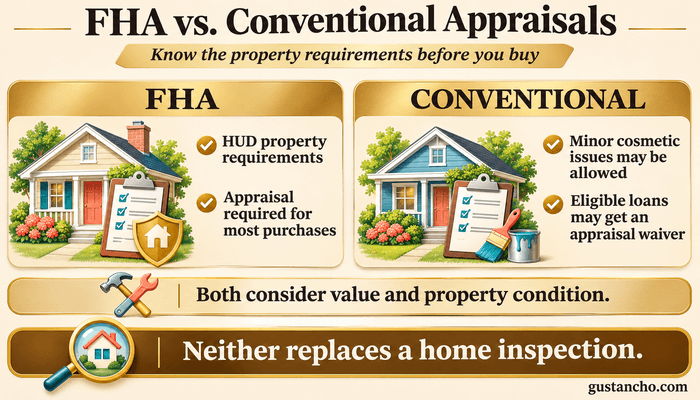
Quick answer: The difference between FHA appraisals versus conventional appraisals is essentially down to the property requirements and the range of valuation options available. Both will assess the property’s market value and its suitability as collateral for a mortgage. An FHA purchase appraisal has to meet HUD property requirements. A conventional conforming loan can accept a degree of deferred maintenance. Eligible transactions may qualify for an appraisal waiver or another form of valuation. A serious safety or structural issue would impact either loan. An appraisal in no way replaces a home inspection. This is a comparison of FHA purchase loans and conventional conforming loans which are eligible for Fannie Mae or Freddie Mac. Jumbo and portfolio mortgages will have different requirements, and individual lenders may have additional requirements.
What Is the Difference Between FHA and Conventional Appraisals?
Both types of appraisal help the lender evaluate the home as collateral. The appraiser considers comparable sales, location, size, design, condition, and market evidence to develop an opinion of market value. A traditional appraisal also involves observing the property; the scope differs for desktop and hybrid assignments. The key difference is the applicable property standard. FHA appraisers follow HUD requirements, while conventional conforming appraisals follow the relevant Fannie Mae or Freddie Mac rules.
FHA Property Requirements: Safe, Sound, and Secure
HUD’s Minimum Property Requirements (MPR) are the basic standards for homes with FHA insurance. Minimum Property Standards (MPS) apply to new construction and cover regulatory rules. The appraiser looks for obvious problems, and the lender decides if the property qualifies for FHA financing. Buyers mainly want to know whether the home is safe to live in, structurally sound, and sufficient to serve as collateral for the mortgage. In this context, security refers to the property’s value as collateral, not just to locks or alarms. For full details, check HUD Handbook 4000.1.
Conventional Loans and Minor Deferred Maintenance
Conventional loans also look at the property’s condition. Fannie Mae allows minor issues if they do not affect the home’s structure or safety and the appraiser includes them in the value. Cosmetic problems might lower the value but do not always make a home ineligible. Major problems may need repairs or a professional review. For more details, see Fannie Mae’s current appraisal guidelines. For instance, worn but still usable flooring might be allowed in both programs. However, exposed live wiring is a safety concern and may need to be fixed. These are just examples; the real decision depends on the home’s actual condition and the specific rules.
Which Property Problems Can Require Repairs?
An appraisal condition can require a repair, a specialist’s inspection, or other evidence before the lender accepts the property. The nature and severity of the problem matter more than a general description such as “older home” or “fixer-upper.”
Roof Condition
For FHA financing, the roof must be moisture-resistant and have at least 2 years of remaining physical life. If the appraiser reports less than 2 years remaining, the appraisal must be conditioned on a professional roofer’s inspection. The findings help determine what work is necessary. A leaking or seriously deteriorated roof can also create a conventional appraisal condition. Do not assume a conventional lender will accept it, as the FHA has a specific remaining-life requirement.
Peeling or Defective Paint
FHA treats defective paint in pre-1978 homes as a potential lead-based paint concern and requires correction under the applicable lead-based paint rules. For homes built in or after 1978, defective exterior paint must also be repaired when it exposes the underlying surface to weather. Conventional lenders may also require correction of paint-related hazards. Minor cosmetic paint damage and a significant health or weather-protection problem should not be treated as equivalent.
Electrical, Plumbing, and Structural Concerns
Unsafe electrical components, substantial leaks, serious water damage, nonfunctioning essential systems, or evidence of foundation movement can require attention under either program. The appraiser may identify a concern without being qualified to diagnose its cause. A licensed contractor, engineer, or other appropriate professional may need to evaluate it. Before agreeing to a repair plan, ask the lender which conditions must be resolved and what evidence will satisfy them. A contractor’s explanation, a completed repair, and an appraiser’s completion inspection serve different purposes.
Who Pays for Appraisal-Required Repairs?
The buyer and seller will negotiate between themselves, via the purchase agreement and any amendments, regarding who is responsible for the repair. An FHA repair condition does not in itself make the seller responsible for the cost. For a standard purchase loan, the work must be completed before closing unless the lender confirms an eligible alternative. Some programs allow specific deferred improvement or escrow arrangements, but this depends on the condition, the program, and the lender. A seller credit or a lower price alone will not fix a property eligibility issue. Fannie Mae details the permitted arrangements in its completion and deferred improvement requirements. Repair completion documentation states that the required work has been carried out. An appraisal update will look at whether the older appraisal is still valid. Completion of the repairs does not in itself extend the age limit of the valuation.
What Distinguishes an Appraisal from a Home Inspection?
An appraisal develops a value opinion and addresses the lender’s collateral requirements. A home inspection provides the buyer with a more detailed assessment of the home’s components and systems within the inspector’s agreed-upon scope. An FHA appraiser reports readily observable conditions. That observation is less comprehensive than a home inspection, as HUD explains in its guidance for FHA Roster Appraisers. An acceptable appraisal does not establish that the home has no hidden defects. Buyers can use a separate inspection to investigate the roof, plumbing, electrical system, foundation, moisture concerns, and other components in greater detail.
Can a Conventional Loan Qualify for an Appraisal Waiver?
Some conventional conforming loans may qualify for an appraisal waiver, while others still need a traditional, desktop, or hybrid appraisal. It’s important to remember these are different services and shouldn’t be treated as the same.
| Valuation option | What it involves |
|---|---|
| Traditional appraisal | An appraiser develops a value opinion using the required property inspection and analysis. |
| Desktop appraisal | An appraiser develops a value opinion using permitted data sources without personally inspecting the property. |
| Hybrid appraisal | An appraiser develops a value opinion using property information collected by another party, subject to program requirements. |
| Fannie Mae value acceptance or Freddie Mac ACE | Eligible transactions can proceed without an appraisal report when the lender accepts the automated offer. |
| Value acceptance + property data or ACE+ PDR | Eligible transactions require property-data collection without an appraisal report. |
Property data collection records the features and condition of a property, but it does not provide an appraiser’s opinion of value. A loan qualifies for an appraisal waiver based on the property, transaction type, loan details, available data, and automated underwriting results. The lender must accept the waiver offer and meet its requirements. Borrowers can’t request a waiver, and skipping the appraisal doesn’t replace a home inspection. FHA purchase loans usually need an appraisal from an FHA Roster Appraiser. If you switch from a conventional loan to FHA, don’t assume the appraisal waiver will still apply.
How Long Are FHA and Conventional Appraisals Valid?
FHA Appraisal Validity
An FHA appraisal is typically good for 180 days from its effective date. An eligible appraisal update can extend the appraisal period by 1 year from the original effective date (subject to HUD requirements). It does not start a new one-year period from the date of the update. Use the effective date from the appraisal report rather than the date the lender received it. If any repairs, construction, or title issues will delay the closing, check early with the lender whether an updated or new appraisal will be required.
Fannie Mae Appraisal Age and the Desktop Exception
For applicable Fannie Mae appraisals, the original valuation must be within 12 months of the note and mortgage date. An appraisal more than 4 months old generally requires an update, and that update must be within 4 months of the note date. A reported decline in value requires a new appraisal. Desktop appraisals have a separate rule: when the original appraisal is more than four months old, a new appraisal is required. The general update provision does not extend a desktop appraisal to 12 months. See Fannie Mae’s appraisal-age requirements and the corresponding age requirements in its current appraisal-reporting guidance linked above. These are Fannie Mae rules. The lender must confirm the applicable investor, appraisal type, reporting requirements, and any additional conditions for the loan itself, including whether it is a Freddie Mac or nonconforming mortgage.
Can an Appraisal Be Transferred When You Change Lenders or Programs?
Moving Between FHA Lenders
Changing FHA lenders does not automatically require another appraisal. The existing FHA appraisal and case information can generally be transferred through the applicable process. The receiving lender must still review the report, its age, any outstanding conditions, and the loan’s eligibility.
Moving Between Conventional Lenders
A conventional lender may accept an appraisal obtained by another lender when applicable independence, investor, and underwriting requirements are met. Acceptance is not automatic. The new lender remains responsible for the appraisal’s acceptability. Fannie Mae’s Appraiser Independence Requirements permit qualifying transfers.
Changing Between FHA and Conventional Financing
An FHA appraisal may be acceptable for a conventional loan if the receiving lender determines it meets the new program’s requirements. Changing from conventional to FHA requires an FHA-compliant appraisal assignment. An eligible FHA Roster Appraiser must satisfy FHA’s scope, reporting, and intended-user requirements, and the lender must document the conversion. HUD treats the FHA work as a new assignment. The appraiser determines whether the original inspection is sufficient or another FHA-compliant inspection is necessary. See Handbook 4000.1, section II.D.1.a, available through HUD’s handbook page. Ask the receiving lender about acceptance, additional work, fees, and timing before assuming the existing report will avoid another appraisal charge.
What Happens When the Appraisal Comes In Low?
For a typical purchase, the lender bases the loan-to-value calculation on the lower of the purchase price or appraised value. A low appraisal can therefore reduce the amount available to finance the purchase. For example, suppose the contract price is $310,000, and the appraisal is $300,000. If the price remains unchanged, the $10,000 gap generally must be covered with eligible funds in addition to the required down payment calculated using the lower value. Closing costs and other adjustments also affect the final cash needed. This simplified example assumes no price renegotiation or other financing arrangement.
FHA Amendatory-Clause Protection
Where the FHA amendatory clause applies, it protects the buyer from being obligated to complete the purchase or from losing earnest money if the required appraised-value condition is unmet. The buyer can still choose to proceed. HUD’s model amendatory clause explains this protection; its use and any exemptions depend on FHA requirements. A conventional buyer’s appraisal-contingency rights depend on the purchase contract. Review the applicable terms and deadlines with the real estate professional or attorney handling the transaction.
Renegotiation and Reconsideration of Value
The parties may negotiate a lower price, the buyer may cover an eligible gap, or the transaction may end under an applicable protection. If the report contains factual errors or overlooks relevant market evidence, the borrower can ask the lender to support a reconsideration of value. A request should identify specific errors or relevant comparable sales. It should not pressure the appraiser to reach a desired number. Ordering another appraisal to obtain a higher result or remove repair conditions is restricted by applicable program and independence requirements. Fannie Mae’s independence rules, linked above, describe when subsequent appraisals are permitted. A low value and required repairs are separate issues. A home can appraise at the contract price and still need repairs, while a well-maintained home can appraise below the agreed price.
What Should Buyers Check Before Making an Offer?
Discuss any concerns with your loan officer and real estate agent before choosing a financing option. Find out if the property fits the program, if a waiver is possible, and how inspections or repairs might affect closing. Schedule a home inspection, check the contract deadlines, and decide who will handle any needed work. Getting these answers will help you estimate costs and negotiate fair terms.
FAQs About FHA Appraisals Versus Conventional Appraisals
Does an FHA Appraisal Cost More Than a Conventional Appraisal?
Not necessarily. The fee varies by location and property, depending on the property’s complexity, appraisal scope, appraiser availability, and the lender’s request. You should ask for the estimated appraisal fee and whether there could be an additional fee for a separate completion inspection or an additional assignment. FHA doesn’t have one appraisal fee across the board.
Who Chooses and Orders the Appraiser?
The lender will arrange the appraisal via an independent process, sometimes through an appraisal management company. Payment of the appraisal fee in no way gives the borrower the right to select the appraiser or to dictate the value. Conforming conventional loans must meet the applicable appraisal independence requirements, and the FHA has its own appraiser selection rules.
Does an FHA Appraisal Stay with the Property if the First Buyer Cancels?
In some cases, an existing FHA appraisal can be used for a different borrower under HUD’s procedures. The lender would have to verify the case information, confirm that the appraisal is valid, identify any conditions that are still outstanding, and review the requirements of the new borrower. It is not a permanent valuation for all future sales. See the provisions on transferring existing appraisals in HUD Handbook 4000.1.
Can an FHA Buyer Purchase a Home Listed “as is”?
Potentially. An ‘as is’ listing is the seller’s statement in respect of the transaction and does not constitute a waiver of the mortgage property requirements. If repairs are required and the seller is not prepared to carry them out, the parties will have to consider whether another permitted arrangement or an eligible renovation scheme can address the work. A reduced purchase price in itself won’t obviate the need for a repair.
Does a Completed Appraisal Mean the Mortgage is Approved?
No. The appraisal concerns the property and its valuation. The lender still has to do the rest of the borrower review, the title review, the insurance review, and all the other loan condition checks. A good appraisal in no way guarantees that all of the closing requirements have been satisfied.
Final Thoughts on FHA Appraisals Versus Conventional Appraisals
It’s most helpful to compare FHA and conventional appraisals by looking at the specific home you’re interested in. The home’s condition, value, and whether it qualifies for a certain appraisal method can all affect repairs, how much cash you’ll need, and when you can close. Small cosmetic issues and bigger safety problems call for different choices. Before you agree to change your financing or make repairs, check with your lender to find out exactly what they need and what proof you’ll have to provide. Get a home inspection to look more closely at the property’s condition, and make sure you understand what contract protections you have if the appraisal or inspection results affect your deal.
This article about “FHA Appraisals Versus Conventional Appraisals: Key Differences” was updated on November 4th, 2026.