How Do Underwriters Approve Mortgage Loans? Complete Underwriting Guide
Mortgage underwriters confirm that the loan, borrower, and property fulfill the requirements of the selected loan program. Underwriters check the credit, income, employment, debts, assets, and appraisal, as well as the source of funds and title work, insurance, and the intended occupancy.
With most loans, an automated underwriting program checks the loan first and provides a recommendation. The underwriter is then responsible for ensuring that the information is input correctly and is documented.
Final approval is rare for most borrowers. The underwriter issues a conditional approval listing the outstanding requirements. The lender issues the clear to close when all requirements have been verified. Mortgage underwriters are required to comply with the Federal ability-to-repay requirements that mandate the documentation and verification of the borrower’s income, employment, assets, debts, and credit.
What is Mortgage Underwriting and How Does it Work?

Mortgage underwriters are more justified by loan documents, automated underwriting findings, applicable program guidelines, and any other lender requirements.
Underwriting will not start until the processor has collected documents from the potential borrower. Some lenders provide fully underwritten preapprovals for buyers prior to the signing of a purchase contract. Preapprovals are helpful, but not a formal loan commitment, as changes in the potential borrower’s credit, employment, income, assets, and debts, and/or the property will affect the formal loan commitment.
What Does a Mortgage Underwriter Do?
A Mortgage Underwriter Must Determine the Following:
- Is the potential borrower’s income stable and sufficient?
- Is the potential borrower likely to repay the loan?
- Can the potential borrower afford the new loan payment?
- Does the potential borrower have sufficient funds for the closing payment?
- Is the potential borrower’s property sufficient collateral?
- Does the potential borrower’s file comply with the mortgage program?
- Has the lender resolved the potential borrower’s conflicting, incomplete, or potentially inaccurate information?
The underwriter also protects the lender by preventing approval of a loan that does not comply with the lender’s guidelines. Fannie Mae has a distinct set of underwriting guidelines that cover the loan application, borrower underwriting, property underwriting, compliance and closing documents, government programs, and insurance. If mortgage underwriters do not follow the federal minimum lending guidelines as well as their investor mortgage lender overlays, that may mean that the mortgage loan is not salable. It may mean a mortgage loan needs to be kept in the house. The lender will be stuck with the loan until the borrower refinances or pays off the balance.
How Do Underwriters Approve Mortgage Loans?
Underwriters have the Five Cs of lending, which are credit, income, debt, collateral, and capacity, which they use to approve most loan applications. An excellent performance in one aspect of the evaluation does not compensate for major deficiencies in another.
Underwriters consider the applicant’s financials, the property, the loan request, and several other details to ascertain loan approval, repayment guarantee, and compliance with loan guidelines.
For instance, a borrower may have a strong credit score, but that alone cannot compensate for the lack of income stability/adequacy. While the borrower may finance a significant portion of the property value by way of a substantial down payment, that does not mitigate the risk associated with the borrower’s undisclosed obligations and/or an unsuitable property.
Credit History and Payment Behavior
The underwriter checks the borrower’s credit reports. The underwriter will check (among other things) the scores, the payment history, and the balances of the accounts, along with any recent credit inquiries, public records, and material derogatory credit events. While the credit score is important, it is not the only thing the underwriter will consider.
The Underwriter Will Also Consider:
- Recently, late payments,
- the history of mortgage or rent payments,
- accounts in collections or charge-offs,
- bankruptcy, foreclosure, or short sale,
- newly opened credit accounts,
- revolving accounts that are maxed out,
- disputed accounts,
- authorized user accounts,
- federal accounts and judgments,
- credit inquiries that cannot be explained.
- The underwriter is looking to see if the borrower has a history of willingness and the ability to pay their financial obligations on time and in full.
- Most mortgage lenders pull credit from all three major credit bureaus. How the score is determined for qualification may vary based on the number of applicants as well as the specific loan program.
Income and Employment Stability
The underwriter also has to determine how much of an applicant’s income can be considered for qualification. Income that is considered must be verifiable, relatively stable, and likely to continue in the future based on the rules of the particular loan program. Just because a certain amount has been deposited in the applicant’s bank account does not mean that the applicant will be allowed to qualify for a mortgage loan in the same amount.
Common Sources of Income Can Include Things Like:
- wages or salary
- overtime
- bonuses
- commissions
- income derived from self-employment or contracting
Social Security income
- income from pensions or retirement
- VA disability income
- income from rentals
- alimony or child support
- income from investments
- other repeatable income streams documented and verifiable
- Variable income can require more scrutiny.
- An underwriter may take an average of that income over a period deemed acceptable while assessing whether the income trend is stable or declining.
- Borrowers who are self-employed often must submit both personal and business tax returns, year-to-date profit-and-loss statements, balance sheets, and business bank statements, and may have to pay for third-party verification.
- The required documentation depends on the loan program and how income is calculated.
- Fannie Mae allows employment and income verifications to be done using documentation, verification of the employer, or approved third-party verifications.
- The current guide requires lenders to look into contradictory information that may impact the calculation of income.
Build an underwriter-ready file from day one
Organize income, assets, ID, and housing history to speed approvalsDebt-to-Income Ratio and Monthly Obligations
The debt-to-income ratio, or DTI, measures the ratio of all the borrower’s qualifying monthly debts to the borrower’s qualifying monthly income.
The Underwriter May Include the Following Obligations:
- Proposed principal and interest
- Property taxes
- Homeowners insurance
- Mortgage insurance
- Homeowners’ association dues
- Car payments
- Student loans
- Minimum credit-card payments
- Personal loans
- Alimony or child support
- Payments on other real estate
- Other repeatable obligations that may be program-related
- There is no universal maximum DTI for all borrowers and loans.
- It may depend on the mortgage program, findings from an automated underwrite, the borrower’s credit profile, reserves, residual income, type of property and its use, and any overlays by the lender.
- If the entire file shows strong compensating factors and the loan program allows it, a borrower with a higher DTI may still qualify.
- A lender may also set a lower DTI limit than would be set by the agency or program.
Assets, Down Payment, and Funds to Close
Underwriters must check that a borrower has sufficient acceptable funds for the down payment, for closing costs, for prepaid items, and for required reserves.
The Review May Consider:
- Checking and savings accounts
- Retirement accounts
- Investment accounts
- Gift funds
- Gift of equity
- Proceeds from the sale of another property
- Earnest-money deposits
- Down payment assistance
- Business funds
- Secured borrowed funds
- Other program-approved sources
- Underwriters may also review the source of large or unusual deposits.
- Cash that cannot be documented may be an unacceptable source of funds.
- Moving funds between accounts is not a concern.
- However, the borrower should keep records showing the origin of the funds and where they were transferred.
- Fannie Mae’s loan-application documentation includes credit reports as well as employment, income, and asset documentation.
Property, Appraisal, and Collateral
The approval is based on the borrower and the property. The appraisal allows the lender to assess the value, condition, and marketability of the property and determine its eligibility.
The Underwriter May Have to Verify That:
- The value supports the loan request.
- The property type is eligible.
- The necessary repairs are made.
- The home meets the required standards.
- The value is supported by the comparables.
- The expected occupancy is justified.
- The property is insurable.
- The title can be conveyed along with an acceptable first lien.
- All the condominium or homeowners’ association requirements are met.
- A borrower may possess outstanding credit and income but may still be denied or face delays if the property is not eligible for the loan program.
Mortgage Underwriting Standards & Lender Overlays
Mortgage underwriters may have to adhere to multiple layers of requirements. The first layer is the mortgage program. For example:
- Fannie Mae or Freddie Mac Guidelines May Apply to Conventional Loans
- FHA loans will comply with HUD guidelines
- VA loans will comply with the Department of Veterans Affairs.
- USDA loans will comply with the USDA Rural Development
- Jumbo and non-QM loans will comply with the investor guidelines.
- The second layer will be the findings of Automated Underwriting.
- The third layer will consist of lender overlays.
- A lender overlay is an additional requirement that a lender provides, beyond the agency or program guidelines.
Examples Can Consist of:
- More stringent credit score guidelines
- Lower maximum allowable DTI ratios
- Increased liquid reserve requirements
- Stricter manual underwriting guidelines
- More stringent conditions following bankruptcy or foreclosure
- More stringent conditions regarding charge-offs or collections
- Increased requirements for employment
- Additional restrictions based on property type
- The borrower can still be eligible for the loan program even if the lender issued a denial.
- The borrower most likely does not meet the specific lender’s overlay requirements.
- The VA, for instance, does not set a minimum credit score for a home loan guarantee, but individual lenders may set a credit score.
Federal lending guidelines are specific mortgage lending guidelines on particular loan programs. For example, FHA loans need to adhere to HUD Guidelines. Conventional loans need to adhere to Fannie Mae and Freddie Mac guidelines. VA loans need to adhere to the Department of Veteran Affairs guidelines. USDA loans need to adhere to USDA Rural Development guidelines. Most mortgage applications are submitted initially to an Automated Underwriting System (AUS).
Common Systems Are:
- Fannie Mae’s Desktop Underwriter (DU)
- Freddie Mac’s Loan Product Advisor (LPA)
- FHA TOTAL Mortgage Scorecard
- USDA Guaranteed Underwriting System (GUS)
- Fannie Mae notes that DU is an automation system that enables lenders to determine credit risk and the eligibility of a mortgage loan for sale to Fannie Mae.
- Freddie Mac’s Loan Product Advisor assesses the risk of the submitted mortgage and provides an Accept/Eligible result.
- A mortgage that receives an ineligible result may be eligible for manual underwriting if the program allows.
Is a Mortgage Guaranteed with AUS Approval?
No. Automated underwriting makes an approval based on the information input. A human underwriter is required to verify that the application data is supported by the borrower documentation and that the property, title, insurance, and the transaction meet the requirements.
Automated Approvals Can Change If:
- Qualifying income decreases
- New debt is added
- An appraisal comes in low, or the purchase price or loan amount decreases.
- Assets are not verified, nor is income or employment.
- The applicant’s credit report is modified, or the applicant has changes in their employment, or the applicant changes loan programs.
- The applicant submitted the loan application with incorrect, incomplete, or inconsistent information.
- The applicant’s loan file needs to be resubmitted with a new or updated loan application.
- Although AUS approval is a milestone in the loan process, it does not represent a final clear-to-close.
Mortgage Underwriting Process
Step 1: The Borrower Submits the Loan Application
The Borrower submits a loan application that includes income, employment, assets and liabilities, real estate owned, purpose of the loan, and property information. The loan officer uses the information provided to select and assess a loan program to which the borrower may qualify.
Step 2: The Loan Processor Checks the Application
The loan processor collects the documentation and checks the application for missing, outdated, or inconsistent information. A good loan processor may correct issues before the application is submitted to the loan underwriter, avoiding conditions and resubmissions.
Step 3: Submission of the Loan Application to AUS
The Lender submits the application data to the respective automated underwriting system. The AUS Findings may include documentation requirements, conditions, reserves, an appraisal, and risk assessment.
Step 4: Manual Underwriting
The Manual Underwriter checks the application, supporting documentation, and AUS Findings. The underwriter will review more than just the income and employment of the borrower. Factors like assets, debt, credit, occupancy, and transaction information are also considered. The underwriter will likely review the appraisal and title, insurance, and other information and documents about the property as they come in.
Step 5: The Underwriter Makes a Decision
The first decision will be one of the following:
- Approved
- Approved, with Conditions
- Pending/Suspended
- Denied
Most files that are submitted in full and meet the requirements are conditionally approved rather than receiving formal approval.
Step 6: Conditions Are Cleared
The loan processor and loan officer will submit the required conditions to underwriting. The borrower should send the required items as soon as possible but should not send incomplete or altered documents. New documents that raise more unanswered questions may create additional conditions. The CFPB has suggested that borrowers watch for messages from the lender and respond promptly to requests for documents.
Step 7: The Final Verification Process Begins
The lender will update credit, verify employment, review the final insurance, confirm that there have been no significant changes to the borrower’s financial position, and confirm that the borrower has the required funds to close.
Step 8: Clear to Close
The underwriter has signed off on all underwriting conditions, and the lender may complete all final steps in the closing process. Clear to Close does not mean the borrower may freely alter their financial situation before signing and funding the loan.
What Is Conditional Mortgage Approval?
If you received Conditional Approval, the underwriter has determined that your loan will be approved once certain requirements have been satisfied. Mortgage Conditions are a normal part of the mortgage process. They are not, by any means, a sign that your loan is in trouble.
Some Common Mortgage Conditions Are:
- Request for new pay stubs
- Request for updated bank statements
- Request for a written explanation
- Request for proof of large deposit
- Employment verification
- Proof of paid debt
- Homeowners insurance
- Appraisal requirements
- Title requirements
- Gifting paperwork
- Proof of completion of repairs
- Updated divorce or bankruptcy documents
- Proof of earnest money
- Proof of resolved disputed account
Conditions should be as clear as possible when stating what is required for the underwriter’s request. If you are unsure that the document you are submitting answers the underwriter’s request, you should reach out to your loan officer for clarification.
Can a Mortgage Be Denied After Conditional Approval?
The short answer is yes. Conditional Approval does not mean your loan has been approved.
The Following Could All Lead to a Final Denial After Conditional Approval Has Been Granted:
- Any condition of the underwriting process has not been met
- Employment is terminated or materially changed
- There is a decrease in your qualifying earnings
- New debt is incurred, resulting in a higher DTI
- There has been a deterioration of your credit
- The required assets have not been verified
- The source of your funds is not acceptable
- The property does not fulfill the requirements of the lending program
- Title issues are not resolved
- There has been an intentional misrepresentation of information
- There is a material change after the final verification
- You should not assume that your loan process is complete until after the transaction has closed and been funded.
What are the Primary Decisions for Mortgage Underwriting?
Approved
- An approval means the underwriter evaluated the loan against the applicable requirements and determined that it met all or most of them.
- Some administrative or closing items may still remain.
Approved With Conditions
- The loan is acceptable, with the required list of documents, explanations, property items, or final verifications that will meet the stated conditions.
Suspended or Pending
- The underwriter lacks the information necessary to either approve or deny the file.
- The lender will need the outstanding documents or verifications before a decision can be made.
Denied
- The loan is presumed not to meet the required guidelines, or the problem will be deemed unsolvable with the selected loan program.
- The borrower should ascertain whether a loan denial is due to an agency requirement, a lender overlay, a restriction of the selected loan program, or the file’s documentation.
How Underwriting is Distinct Across Loan Programs
Underwriting Conventional Mortgages
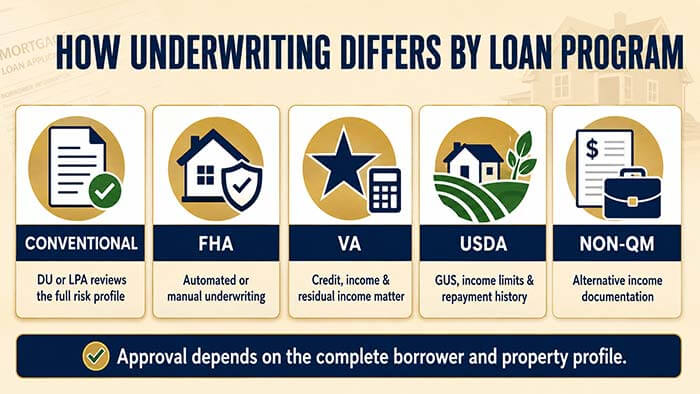
Conventional loans are underwritten mainly through Fannie Mae DU or Freddie Mac LPA. The complete risk profile is underwritten and reviewed by the systems and the underwriter, including credit, income, assets, liabilities, and property type and occupancy, loan-to-value, and other factors. An automated approval does not alleviate the lender’s responsibility to ensure that the submitted information is complete and verified accurate.
Underwriting FHA Mortgages
FHA loans are underwritten by private lenders and are guaranteed by the Federal Housing Administration. The FHA Single Family Housing Policy Handbook 4000.1 is the primary source of policy for FHA. FHA loans can be processed as either automated or manual underwrites. FHA financing can start as low as 500 with discretion on the overlays and down payment as little as 3.5%, but borrowers below 500 are ineligible.
VA Mortgage Underwriting
When assessing a VA loan, underwriters review the borrower’s credit history, income, and debt. VA loans require an evaluation of residual income. Residual income is the income that is left after all major expenses and after the estimated necessary expenses for basic living. VA loan residual income is not an automatic pass or fail for the borrower but is used as a guideline for underwriting.
USDA Mortgage Underwriting
Most USDA guaranteed loans are underwritten in GUS. USDA states that there is no program-wide credit score for its guaranteed loan program, but lenders must have assurance that the borrower is able and willing to pay debts.
Non-QM Mortgage Underwriting
Non-QM allows alternative documentation when the borrower cannot qualify under traditional agency guidelines.
Qualifying Income Can Be Documented Through Various Methods, Including:
- bank statements
- business bank statements
- P & L statements
- 1099 income
- asset depletion
- rental income
- other alternative documentation that is approved.
The non-QM loan programs have guidelines, and borrowers must be able to demonstrate their credit, income, assets, and ability to repay the loan.
How Long Does Mortgage Underwriting Take?
Most often, the first pass of underwriting is completed in a few days, but the full underwriting process can take much longer.
The Overall Timeline is Determined by the Following Factors:
- The initial file quality
- The availability of underwriters
- The complexity of the borrower’s income
- The number of properties
- Credit/Documentation issues
- The appraisal
- Insurance and title
- The speed conditions are submitted.
- If new questions are created by the documents
- If the loan is required to be submitted again to AUS
- If the underwriter is required to use their discretion
A complete W-2 file with documents will process quickly. However, a self-employed borrower, manual underwriting, multiple property borrowers, and a borrower with a recently discharged bankruptcy will require a more thorough review.
What are the Mortgage Underwriting Delays?
Many of the delays are created long before the file even reaches the underwriter.
Some of the More Common Delays Are:
- Incomplete Documents
- Missing documents, cropped screens, and unsigned tax returns can lead to multiple requests.
- Conflicting Information
- Addresses or employers that do not match, or if income or account balances are different, will require an explanation.
Unexplained Deposits
- A large deposit that cannot be explained will lead to an extended approval delay.
New Credit or Debt
- Purchasing furniture or large-ticket items can lead to changes in available funds.
Employment Changes
- Moving from w-2 to self-employment, or leaving with no pay, also changes the qualifying income.
Appraisal or Property Issues
- If the appraisal is lower than expected, or there are safety concerns about an ineligible property, then the loan cannot be completed.
Slow Responses
- Every unanswered request will extend the underwriting process.
- It is highly suggested that the borrower answer every request as quickly as possible, whilst making sure that the documents fully answer the request.
What Should Borrowers Avoid During Underwriting?
After beginning the underwriting process, it is advised that borrowers do not make major changes to their finances without consulting their loan officer first.
Borrowers Should Avoid the Following Actions:
- Opening new lines of credit
- Leasing or purchasing a new vehicle
- Co-signing for someone else’s loan
- Raising credit card balances
- Changing or quitting jobs without giving notice
- Moving funds that will be used for closing and documenting it
- Making large deposits that are not documented
- Cashing out or closing bank accounts or credit cards
- Late payments or spending money set aside for closing
- Altering the purchase contract without informing the lender
- Thinking that conditional approval is the same as final approval
Most changes and actions, even the ones that may seem small, may result in the loan having to be recalculated or resubmitted.
How Can Borrowers Make Underwriting Easier?
Borrowers should start the process by providing the lender with as complete and accurate information as possible. Borrowers should be sure to include every page of the requested documents, even if the page is blank. Keep copies of bank transfers, deposits, gift funds, earnest money payments, payments of debts, and letters of explanation.
Borrowers should be sure not to hide financial issues, as that may give the loan officer more options to solve the issue and mitigate the effect.
Financial issues that are presented during the underwriting process are much harder to resolve. Borrowers should definitely work with an experienced loan officer if they have a high DTI, have recently filed for bankruptcy, have variable income, or require a unique loan product.
Mortgage Underwriting Case Example
Consider a VA borrower with a 583-credit score, who has stable W-2 income, has monthly income from VA disability, and has a higher than preferred debt to income ratio.
One possible reason a lender would deny a loan or set a higher threshold on the DTI would be if the lender requires a score of 620 or above. That denial would not mean the borrower is in violation of the VA guidelines.
Another lender might look at the borrower’s entire file, which would go beyond the score, and look at payment history and income stability, residual income, rental history, and other compensating factors. Since VA guidelines do not set a minimum credit score, the second lender might approve the borrower, as the borrower meets VA guidelines and the second lender has not set a credit-score overlay. The most important thing to take away from this is that when a mortgage is denied, there needs to be an investigation into the reason for the denial. The borrower needs to be informed if the denial is due to the guidelines for that loan program or if the lender has set additional requirements.
Final Thoughts on How Underwriters Approve Mortgage Loans
Mortgage underwriters approve or deny a loan after they have confirmed the borrower has the ability to repay the loan, and if the entire transaction satisfies all of the requirements of the loan program and lender.
Gustan Cho Associates focuses on borrowers who were declined by other lending institutions, need softer underwriting, have a low credit score, a higher debt ratio, or require other mortgage solutions.
For a full breakdown on your mortgage opportunities, call 800-900-8569 or email gcho@gustancho.com. Gustan Cho Associates is open all days of the week and all hours of the day. All mortgages are subject to an underwriter’s discretion. Each program has its own set of guidelines, requirements, and other variables that may affect the final outcome. The purpose of this document is to educate and inform. It is not a promise to provide a mortgage.
Common Queries Regarding Mortgage Underwriting
Is the Decision to Approve a Mortgage Made by the Underwriter?
The underwriter decides whether a borrower’s credit can be approved based on the submitted documentation and whether the program’s and the lender’s other policies have been satisfied. Other divisions will be responsible for complying with quality control, closing, and other requirements as necessary.
Will Meeting with a Loan Underwriter Require That I Submit Proof of Employment?
The lender will confirm employment either directly or through a third-party service that has been approved. A final confirmation may be made as close as a few moments before the closing meeting to ensure that the borrower has not lost their job.
Will an Underwriter Check My Bank Account Before the Closing Meeting?
Underwriters will review bank accounts to verify the closing funds and reserves. Underwriters will also check for changes if a document that has been submitted has been verified after a balance change.
Do Underwriters Recheck Credit After Conditional Approval?
Before the closing, the lender may check the credit again or look for any new debt. If there is new or increased debt, missed payments, or other new credit requests, the loan will be evaluated again.
What is the Worst Thing a Mortgage Underwriter Can See?
There isn’t one worst thing. Those all can create problems: undisclosed debt, unexplained or inconsistent funds or documents, unstable income used for qualifying, major late payments, or incorrect application info.
Does Conditional Approval Mean the Mortgage is One Step Closer to Being Fully Approved?
Conditional approval means the underwriter will approve the loan if the stated conditions are met, but it is not full approval or a guarantee that the loan will close.
Can Other Lenders Give a Mortgage After Receiving an Underwriting Denial?
Potentially. If a different lender has a different loan program, utilizes a different set of minimum requirements, or allows manual underwriting, they could approve the loan, but they would have to ensure the borrower and property meet all the necessary requirements.
What Can Be Done to Speed Up Mortgage Underwriting?
Presenting the full file and all supporting documents, answering conditions quickly, maintaining the same job, and avoiding new credit and large undocumented transfers to your accounts can help speed up the process.
About the Author
Written by Gustan Cho, NMLS 873293 Gustan Cho is the Managing Director of Gustan Cho Associates, powered by Coast2Coast Mortgage, LLC, NMLS 376205. He and his team specialize in manual underwriting, assisting borrowers with prior credit events and high debt-to-income ratios, as well as mortgage applications denied by other lending institutions.