Mortgage Conditions From Underwriters During Conditional Approval
In this article, we will discuss and cover the mortgage conditions by underwriters on conditional loan approvals. Once the mortgage loan has been processed, it will be submitted to the mortgage company’s underwriting department.
Learn what mortgage conditions are, why underwriters require them, and how borrowers can clear these conditions after getting conditional approval.
It is then assigned to a mortgage underwriter. A mortgage underwriter will carefully look at borrowers’ loan applications. All loan documents submitted will be carefully reviewed and analyzed. In the following paragraphs, we will cover the mortgage conditions underwriters impose on conditional loan approvals.
What Are Mortgage Conditions?
An underwriter follows a process to move your mortgage from conditional approval to closing. Conditional approval means your loan will be approved once certain issues are resolved.
All mortgages include conditions, which are not necessarily signs of problems. Most involve requests for updated documents, missing information, or final verifications needed to complete the review.
At Gustan Cho Associates, we often help borrowers who have been declined by other lenders. Frequently, the issue is not borrower qualification but additional requirements, incomplete documentation, unclear explanations, or unresolved conditions.
What Does Conditional Approval Mean In The Mortgage Process?
Conditional approval is granted after the underwriter reviews your credit, income, assets, employment, debts, and property details. It means your loan will likely be approved if you provide the remaining required information. Conditional approval is issued after reviewing your complete loan application, even if re-approval occurs before full underwriting.
Conditional approval is an important milestone, but it is not final approval. All conditions must be satisfied before your loan can close.
Purpose of Conditions Associated with Mortgage Loans
All conditions must be met to ensure the borrower, property, and loan comply with guidelines. The underwriter verifies all information is accurate and complete before granting final approval.
Conditions Associated with Loan Verification May Include:
Consistency of Income
- The underwriter may request pay stubs, W-2s, tax returns, proof of employment, and explanations for employment gaps.
- Self-employed borrowers may need to provide business bank statements, profit-and-loss statements, and relevant tax records.
- The lender must confirm you have sufficient funds for the down payment, closing costs, and reserves.
- Bank statements are reviewed for large deposits, transfers, overdrafts, gift funds, and documentation of the source and duration of funds.
- Credit-related conditions may require you to provide letters explaining late payments, collections, charge-offs, disputes, bankruptcies, foreclosures, short sales, or court judgments.
- The underwriter may also request documentation showing that specific debts have been paid, settled, or discharged in bankruptcy.
- The loan must meet specific property requirements.
- Conditions may include a home appraisal, title report, homeowner’s insurance, required repairs, property taxes, flood certification, homeowners’ association documents, and a final inspection.
- Some mortgage conditions are technical and may involve resubmitting disclosures, signing documents, verifying Social Security numbers, correcting paperwork, or providing tax records.
- While requirements vary, many conditions are common across FHA, VA, USDA, conventional, jumbo, and non-QM loans.
Updated Pay Stubs
- Before the mortgage closes, underwriters may request the latest 30 days of pay stubs to confirm that the borrower is still working and earning the income used to qualify.
- Underwriters may request your most recent bank statements to confirm you still have the required funds.
- They may ask for explanations of large deposits, withdrawals, or overdrafts.
- You may need to provide a letter explaining credit inquiries, late payments, employment gaps, address history, negative credit, bank deposits, or unusual activity.
- Ensure each explanation is accurate and concise.
Verification Of Employment
- Before approving your loan, the lender may verify your employment by phone or other methods.
- Changing jobs, resigning, or reducing your work hours before closing can jeopardize your loan approval.
Appraisal Conditions
- An appraisal may be required to confirm repairs, collect missing information, identify property issues, or address value concerns.
- If repairs are needed, they must be completed and re-inspected before closing.
- Judgments, unpaid taxes, ownership discrepancies, unreleased mortgages, name inconsistencies, and title defects are title conditions that must be resolved before the lender will close the loan.
Gift Fund Conditions
- If you use gift money to buy a home, the underwriter may ask for a signed gift letter, the donor’s bank statement, proof that the money was sent, and proof that it was received by you or the closing agent.
Large Deposit Conditions
- Large deposits usually require explanation.
- The underwriter must verify the source of funds and confirm that they are permitted.
- Cash deposits are generally not accepted unless you provide appropriate documentation.
Credit Report Update Conditions
- If new debts appear, your credit score changes, or disputes are resolved, the lender will likely re-examine your file.
- New credit can impact your debt-to-income ratio and affect your loan approval.
The Following Documents Need To Be Complete Without Missing Pages And Up To Date:
- two years tax returns
- two-year W-2s
- 30 days’ paycheck stubs
- 60 days of bank statements
- credit report
Other Documents That Apply To Borrowers Such As The Following:
- bankruptcy paperwork
- foreclosure paperwork
- short sale paperwork
- divorce decree
- pension agreements
- child support paperwork, etc.
What is a Conditional Approval in Principle?

A conditional approval, in principle, is an initial agreement given by a lender or insurer that outlines their willingness to provide a loan or insurance policy, pending the fulfillment of certain conditions. It is sometimes called a “pre-approval” or “provisional approval.”
Here’s A More Detailed Explanation:
Preliminary Assessment:
- The lender or insurer evaluates the applicant’s initial information, such as credit history, income level, or health, to decide if the applicant appears to qualify for the loan or insurance product.
Stipulations Provided:
- The conditional approval comes with specific requirements or stipulations (underwriting conditions) that must be met before the final approval is granted.
For Instance:
- For a mortgage, it could require an official appraisal of the property.
- For a personal loan, you need verified income statements.
- For insurance, medical exams or more in-depth questionnaires might be necessary.
Final Approval:
- Once the applicant has met specific conditions, the lender or insurer will perform a final review to determine whether to approve or deny the application.
Final Approval – Clear-to-Close by Mortgage Underwriter
A clear to close is when the mortgage underwriter is ready to fund the home loan. Overall, conditional approval gives applicants an understanding of their position, enabling them to plan or make offers more confidently. However, it’s a final guarantee once all conditions are satisfied.
Most borrowers feel that they are totally approved once they get conditional mortgage approval. This is true but the keyword here is conditions.
Once a mortgage underwriter has reviewed all of the documents provided and feels comfortable borrowers qualify and meet all guidelines, the underwriter will issue a conditional loan approval.
What is the Difference Between Conditional Approval and Unconditional Approval?
The difference between conditional and unconditional approval is that additional requirements or conditions must be met before final approval is granted.
Conditional Approval:
Definition:
- An approval subject to the applicant fulfilling specific conditions set by the lender or insurer.
Example Conditions:
- Verifying income through recent pay stubs or tax returns.
- Providing additional documentation, like an appraisal report for a property.
- Passing a medical exam for an insurance policy.
Implication:
- The approval is still being determined, and the applicant must complete the required tasks before receiving the final offer.
Unconditional Approval:
- Definition: An unconditional approval confirms that all requirements have been met without further conditions.
- Final Stage: Once the applicant has unconditional approval, the agreement (loan or insurance policy) can proceed without additional requirements or reviews.
- Implication: This final approval often enables immediate action, such as finalizing a property purchase or initiating insurance coverage.
In essence, conditional approval is a step toward securing a loan or policy. In contrast, unconditional approval confirms that all conditions have been met and the agreement can be formalized.
Conditional Approval Received? Let Us Help You Clear Those Conditions Fast!
Your conditional approval is a great start, now let’s work on meeting the underwriting conditions to get you to the closing table. Contact us today to keep the process moving.
Additional Conditions After Submitting Mortgage Conditions
There are many times where underwriters will request additional conditions not requested on the initial conditional mortgage loan approval. This is when many mortgage loan applicants, mortgage processors, and mortgage loan originators get extremely frustrated.
A seasoned experienced competent mortgage underwriter should not request additional conditions after she issues an initial condition list. This is normally the case unless the mortgage conditions requested are incomplete or not the condition initially requested.
Most experienced mortgage processors will not submit incomplete conditions. It normally takes 24 to 72 hours for a mortgage underwriter to review mortgage conditions. Submitting incomplete mortgage conditions can cause delays in the mortgage application process. I can possibly cause delays in mortgage closing.
If additional conditions are requested, everyone has no other choice but to comply with the additional conditions request.
Clear To Close
Once the mortgage underwriter has reviewed all mortgage conditions, she will issue a clear to close. Once a clear to close has been issued, the mortgage docs are prepared by the mortgage lender and sent to the title company. The wire is sent to fund the mortgage loan.
What Is QC?
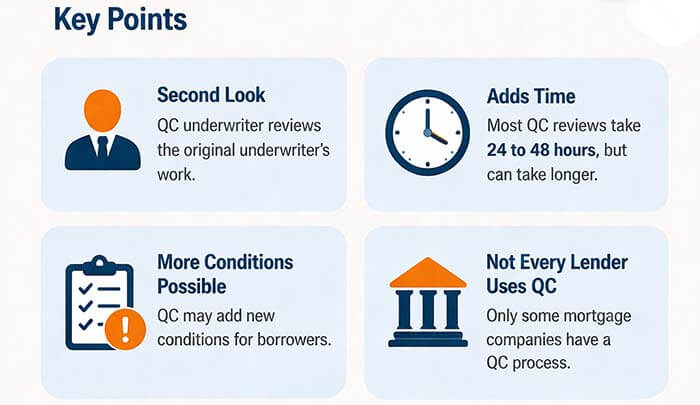
QC, or Quality Control, is another mortgage underwriting process after a clear to close has been issued by the original mortgage underwriter. A QC underwriter is assigned to overlook the work of the initial mortgage loan underwriting. Quality Control is not implemented by all mortgage companies.
Only a certain percentage of mortgage companies have a QC underwriting review process. A QC underwriter can come up with more conditions from the loan applicant. Most QC process takes 24 hours to 48 hours to complete.
However, it can take much longer. Borrowers applying for a home loan, find out if the mortgage company the file is being submitted to has a QC process. If they do, try to go to another lender that does not have a QC underwriting process. I have had an extremely bad experience where a whole mortgage file got delayed after the initial clear to close by a mortgage underwriter due to QC underwriting. Why have a mortgage underwriter issue a clear to close if it needs to be re-underwritten.
Prior-To-Document Conditions Versus Prior-To-Funding Conditions
Mortgage conditions vary in timing. Some must be resolved before loan documents are prepared, while others can be addressed closer to funding. Certain key conditions must be satisfied before you receive your loan documents. These usually relate to your income, available funds, credit, home appraisal, title issues, or loan eligibility.
Examples include missing pay stubs, unexplained large deposits, incomplete appraisal repairs, and unfinished title work.
Prior-To-Funding Conditions
Before loan funds are disbursed, most conditions must be satisfied. Some conditions arise after closing documents are prepared, but the lender retains the funds until they are met. These often include final employment verification, completing paperwork, obtaining funding approval, and finalizing title updates. The loan cannot be funded until all conditions are cleared.
Mortgage conditions are not always the same. Many borrowers become concerned when they encounter mortgage conditions, fearing that conditional approval signals a likely denial.
However, mortgage conditions do not indicate that the lender is seeking reasons to deny your loan or a reason to say no.
This is not the case. Mortgage conditions are a normal part of the loan review process. The underwriter must document the loan to meet agency, investor, and lender requirements. How you handle conditions is important. A good loan officer, processor, and underwriter can help you meet conditions efficiently and with less stress.
The Importance of Borrower’s Cooperation During the Mortgage Process
Borrowers should respond promptly to all lender requests and provide complete documentation to expedite the process. Underwriters typically require all pages of each document. For example, if your bank statement says, “page 1 of 6,” the lender expects all six pages, even if some are blank.
Screenshots are generally not accepted because they often lack your full account history, name, account number, or statement dates.
Don’t Move Assets Around Without Speaking with Your Loan Officer
Transferring funds between accounts can trigger additional requirements. Your loan officer may need to complete extra paperwork or provide documentation. Always consult your loan officer before making significant transfers.
No New Credit Accounts Before Closing
Do not open new credit accounts or finance major purchases before your loan closes. New credit or increased balances can affect your debt-to-income ratio and may prompt another loan review. Do not change jobs or work hours during this period. Changing jobs or work hours can jeopardize your loan approval. Always consult your loan officer before making employment changes.
Explain the Situation
If you need to provide an explanation, keep it concise and clearly state what happened, when, and where. Avoid lengthy or emotional explanations unless necessary. FHA loans help borrowers with lower credit scores or higher debt-to-income ratios get loans with smaller down payments.
Borrowers must meet many conditions, including credit checks, bank statements, gift funds, employment verification, appraisals, and property standards.
FHA loans are frequently not approved through automated systems and are instead reviewed manually. As a result, you may need to provide additional documentation regarding your payment history, savings, rental history, and other relevant details.
Qualifying and Getting Approved for VA Loans
VA loans are a strong mortgage option for many veterans, active-duty service members, and eligible family members. You may be required to provide a Certificate of Eligibility, a residual income review, a VA appraisal, proof of additional income, verification of military service, and evidence of savings.
VA loans differ in that residual income is a key qualification factor. Maintaining a substantial amount of income left over each month can help you qualify, even with a higher debt-to-income ratio.
Mortgage Conditions on Conventional Loans
For a conventional loan, you may need to provide proof of income, savings, a home appraisal, private mortgage insurance, a credit review, student loan payment calculations, and verification of savings.
Conventional loans are often evaluated using automated tools such as Desktop Underwriter or Loan Product Advisor, which determine required documentation. Occasionally, lenders may request additional documents even if Fannie Mae or Freddie Mac do not require them.
Mortgage Conditions on USDA Loans
USDA loans are available to eligible homebuyers in rural and suburban areas. Conditions include household income limits, a home appraisal, proof of savings and employment, and compliance with USDA automated review requirements.
For certain USDA loans, your application may be reviewed by additional government agencies depending on the lender’s policies and approval process. Alternative mortgage products are available for borrowers who do not meet traditional lending criteria, including bank statement loans, DSCR loans, asset depletion loans, ITIN loans, jumbo non-QM loans, and portfolio loans.
Non-QM loan conditions primarily focus on your bank deposits, business and rental income, property cash flow, savings, credit history, and the source of your down payment.
Because non-QM loans are more dependent on investor requirements, the necessary documentation can vary significantly among lenders.
Why Lender Overlays Matter With Mortgage Conditions
Lender overlays are extra rules added by a lender that go beyond the minimum agency guidelines. This is one of the biggest reasons borrowers get frustrated during underwriting. A borrower may receive approval from FHA, VA, USDA, Fannie Mae, or Freddie Mac but still be denied due to stricter internal lender policies. For instance, you might qualify for a loan with a credit score below the agency’s minimum, but a lender may require a higher score for approval.
Lower Debt-to-Income Limits
You may be approved by an automated system with a higher debt-to-income ratio, but the lender may impose a lower limit due to their own additional requirements.
Stricter Rules for Bank Statements
Some lenders may deny your loan if your bank statements reflect overdrafts, cash deposits, or withdrawals, even when you have provided explanations and documentation.
Every government loan program allows some underwriting flexibility, but not all lenders use it. Some companies do not accept applications requiring manual underwriting due to internal policies.
Gustan Cho Associates operates differently. If you are declined by other companies, you may still qualify with a lender that follows government and manual underwriting guidelines without additional internal restrictions. Conditional approval is a big step, but it is not the final one.
Reasons For Mortgage Loan Denial After Conditional Loan Approval
Loans Are Frequently Denied After Being Conditionally Approved For A Number Of Reasons:
- A borrower is unable to provide documentation of the income relied upon for the loan.
- A borrower lacks the necessary funds to close.
- The appraisal is either insufficient or does not meet the property’s requirements.
- A borrower incurs additional debt prior to closing.
- A borrower fails to provide an explanation for a large deposit, which remains unsourced.
- A borrower’s credit score decreases to a level that is below the minimum requirements of the loan program.
- There are unresolved title issues.
- A borrower no longer satisfies the requirements set forth by either an Automated Underwriting System (AUS) or manual underwriting.
What Happens After Mortgage Conditions Are Cleared?
To prevent these issues, be transparent with your loan officer, promptly provide any requested documents, and avoid significant financial changes, particularly before closing.
After you submit all required documents, the processor forwards them to the underwriter, who then verifies whether all conditions have been satisfied.
If all requirements are met under the underwriter’s standards, the underwriter can issue a “clear to close,” indicating the lender has approved your loan for closing. The closing department will then finalize documents, coordinate with the title company, and schedule your closing.
“Clear to close” signifies that you have received final underwriting approval. The underwriter has reviewed your credit, assets, and income, and all conditions have been fulfilled. Avoid making any financial changes during this period, especially if the lender needs to verify your employment. Lenders may also conduct a soft credit check or update their fraud review.
Final Thoughts:
Most mortgages have conditions for approval. When you receive conditional approval, your loan has reached an important milestone, but you still need to provide additional documents to finalize the loan. At Gustan Cho Associates, we help borrowers understand mortgage terms, resolve underwriting issues, and explore loan options if another lender declines their application.
Many mortgage denials result from additional lender requirements, disorganized files, or missing documents. With the right approach, conditional approvals can lead to successful closings.
If you have any questions on how FHA defines family member or borrowers who need to qualify for FHA loans with a lender with no overlays on government or conforming loans, please contact us at 800-900-8569. Text us for a faster response. Or email us at alex@gustancho.com. The team at Gustan Cho Associates is available 7 days a week, on evenings, weekends, and holidays.
FAQ: Mortgage Conditions by Underwriters on Conditional Approval
What are the Various Mortgage Conditions In Underwriting
- Mortgage conditions are the requirements the underwriter must meet to grant final loan approval.
- This may include newly updated pay stubs, statements, explanation letters, appraisal conditions, title paperwork, proof of insurance, and employment verification.
Is Being Conditionally Approved Positive
- Yes.
- Conditionally approved applications indicate a positive response, as the underwriter has reviewed the application and determined that the loan may be approved, provided the stated conditions have been met.
- However, this is not the final approval.
What is the Duration for the Clearing of a Mortgage Condition Approval
- The time it takes to clear a mortgage condition approval depends heavily on the nature of the condition and, more importantly, on how promptly the borrower, lender, employer, title company, insurance agent, and appraiser respond.
- Straightforward conditions are cleared much faster than those involving income, credit, appraisals, or title.
Can One Still Be Denied After Being Conditionally Approved?
- Yes. Conditions that would lead to a denial after one has been conditionally approved include: the stated conditions not being met, new debts having been incurred, a change in employment, funds being unverifiable, or the property not aligning with the loan requirements.
What is a Conditional Approval Established and Clear to Close Requirement?
- Conditional approval is when final approval is granted once the borrower satisfies additional requirements.
- Clear to close is acceptance of the final conditions by the underwriter and readiness of the loan to be disbursed with the signing of the final closing documents.
Do Underwriters Always Ask For Conditions?
- It is rare for a mortgage file not to include conditions.
- Even strong borrowers with the best credit and income are likely to face conditions related to document updates, appraisal reviews, title items, insurance, or final employment verification.
What Is Conditional Approval In Principle?
- A conditional approval, in principle, is a preliminary agreement by a lender or insurer to provide a loan or insurance policy.
- It is subject to the applicant meeting specific conditions before receiving final Approval.
- Often referred to as “pre-approval,” it involves a preliminary assessment based on initial information like credit history, income level, or health.
How Are Conditional Loan Approvals Issued?
- Conditional loan approval is issued after a mortgage underwriter thoroughly reviews the applicant’s submitted documents, such as income verification and credit reports.
- Suppose the underwriter feels confident that the borrower meets all guidelines. In that case, they will grant conditional Approval, meaning the borrower must meet specific conditions before finalizing the Approval.
What Is The Difference Between Conditional And Unconditional Approval?
- Conditional Approval involves requiring applicants to fulfill additional requirements, such as verifying income, providing an appraisal report, or passing a health check before receiving final Approval.
- Unconditional Approval confirms that all conditions have been satisfied, allowing the agreement to proceed to immediate action, like finalizing a property purchase or insurance coverage.
What Documents Are Needed For Conditional Approval?
- When submitting your application, you must furnish your tax returns for the last two years, W-2 forms, recent paycheck stubs that date back 30 days, bank statements that date back 60 days, and a credit report.
- Additional documents may include paperwork related to bankruptcy, foreclosure, short sales, divorce decrees, pension agreements, and child support paperwork.
What Happens If Additional Conditions Are Requested Offer Submitting The Initial Documents?
- Mortgage underwriters sometimes request additional conditions after reviewing the initial documents.
- These conditions can arise if the original documents need to be completed or do not fully meet the underwriter’s expectations.
- It’s important to comply with these additional requests promptly to avoid delays.
What Is A “Clear To Close”?
- A “clear to close” is issued when a mortgage underwriter reviews and approves all conditions.
- It signals that the loan is ready to be funded, and the mortgage documents are prepared and sent to the title company.
- At this stage, the wire is sent to fund the loan.
What Does QC Mean In Mortgage Underwriting?
- QC stands for Quality Control, a process where a QC underwriter reviews the initial underwriter’s work after issuing a clear to close.
- Not all lenders have this process, but those that do might uncover additional conditions that require fulfillment. This step may prolong the closing process, but it is necessary to guarantee that the highest quality standards are achieved.
If you have any questions about the above content, please contact us at Gustan Cho Associates at 800-900-8569. Or email us at gcho@gustancho.com. The team at Gustan Cho Associates is available seven days a week, including late evenings, weekends, and holidays.
- Related> What is clear to close?
- Related> Conditional approval
- Related> What is conditional approval?
This Guide About Mortgage Conditions by Underwriters on Conditional Approval Was Updated On May 21, 2026.
Conditional Approval on Your Mortgage? Let’s Work Together to Meet Underwriting Conditions!
Reach out today to understand the conditions and get your mortgage to the finish line.