Purchasing a home involves more than just the down payment. Throughout the mortgage process, borrowers typically face various out-of-pocket mortgage costs before reaching the closing stage. These may include the earnest money deposit, home inspection fee, appraisal fee, and, in some cases, fees related to credit reports or applications.
Additionally, high costs such as the down payment, closing costs, prepaid taxes, homeowners’ insurance, and mortgage insurance are generally settled at closing.
By understanding these out-of-pocket mortgage costs early on, you can avoid unexpected expenses, manage your budget
more effectively, and know which costs may or may not be refundable if the transaction doesn’t finalize. In this guide, we will detail the most common out-of-pocket costs that borrowers encounter during the mortgage process, the timing of each payment, and how seller concessions or lender credits can help lessen the total amount needed at closing.
When Do You Pay Out-of-Pocket Mortgage Costs?
Most out-of-pocket mortgage costs are paid at different stages of the home buying process. Some costs are paid before closing, while the largest expenses are usually paid on the day the loan closes. The earnest money deposit is usually paid shortly after the seller accepts your offer. This money is held in escrow and is normally applied toward your cash to close if the purchase moves forward. The home inspection fee is usually paid after the contract is signed and before the appraisal is ordered. This cost is typically paid directly to the home inspector and is usually not refundable. The home appraisal fee is usually paid after the loan application is started. Some lenders collect the appraisal fee upfront, while others include it in the final closing costs. Once the appraisal is completed, this fee is usually not refundable. The down payment and closing costs are normally paid at closing. These final funds may include your remaining down payment, lender fees, title charges, prepaid property taxes, homeowners’ insurance, escrow setup, and any other required settlement costs. If the transaction does not close, the borrower generally does not pay the final down payment or closing costs. However, any upfront out-of-pocket mortgage costs already paid, such as inspection, appraisal, or certain application-related fees, may not be refunded.
Down Payment and Closing Costs
The down payment required depends on the type of mortgage program.
- FHA Loans require 3.5% down payment
- Conventional Loans require 3% to 5% down payment
- USDA and VA Mortgages do not require any down payment and offer 100% financing
- Not everyone can qualify for VA Loans
- Borrowers need to be an active and/or retired member of the U.S. Military with Certificate Of Eligibility (COE)
- Non-QM Mortgages require 10% to 20% down payment
- Jumbo Loans require 10% to 20% down payment
- Investment Home Loans normally require 15% to 25% down payment
- Second homes require 10% down payment
- Condotels require 25% down payment
- Closing costs vary
- Most closing costs can be covered with a sellers concession by the seller and/or lender credit
In this blog, we will discuss when these costs are due and Borrowers Cost Out Of Pocket During The Mortgage Process. There are certain costs that home buyers need to pay prior to closing. These costs may or may not be refundable if the home purchase transaction does not go through.
Why a Strong Pre-Approval Helps You Avoid Wasted Out-of-Pocket Mortgage Costs
Getting pre-approved is one of the most important steps in the mortgage process—not just for shopping for a home, but for protecting your money. Getting a solid pre-approval can save you from dropping hundreds or even thousands on out-of-pocket mortgage costs that you could have dodged. Before you start home shopping, your loan officer should carefully review your credit, income, assets, and overall financial profile. This ensures you qualify for the loan program you’re targeting and can meet all requirements before moving forward.
When this step is rushed or done incorrectly, buyers may end up paying for expenses like home inspections, appraisals, and application fees—only to have their loan denied later.
A properly reviewed pre-approval reduces the risk of surprises during underwriting. It helps confirm that your income is stable, that your credit profile meets the guidelines, and that your funds for closing are properly documented. This level of preparation gives you confidence when making an offer. It protects the money you will spend early in the process. From a cost perspective, a strong pre-approval helps you avoid wasting non-refundable fees. Appraisal fees, inspection costs, and credit report charges are typically paid up front. They are not refunded if the transaction falls through. Making sure you are fully qualified before incurring these expenses is one of the smartest financial moves a homebuyer can make. In short, pre-approval is not just about getting a letter—it is about making sure you are financially ready, so every dollar you spend during the mortgage process moves you closer to closing, not puts your money at risk. The Home Shopping and Buying Process Once the home buyer is armed with a solid pre-approval letter, they can now shop for a home.
- Once they find a home they want to purchase, they enter into a real estate purchase contract.
- The home buyer needs to give an earnest money deposit.
- Earnest money deposits are one of the Borrowers Cost during the mortgage process.
- The earnest money is refundable if the buyer needs to back out of the deal due to contingencies listed on the real estate purchase contract.
- Earnest money can be anywhere between $500 to $5,000. The earnest money is used as part of the down payment.
Home Inspection and Real Estate Appraisal
Once both sellers and buyers signed the real estate purchase contract, the contract is submitted to the lender. A mortgage processor is assigned to the file. The mortgage processor’s role is to prepare the file to get it assigned to an underwriter. Home inspections are optional. It is highly recommended buyers invest the few hundred dollars in getting a home inspection. Home inspections are normally done prior to the home appraisal. Home appraisals are borrowers cost prior to closing. Once the home inspection comes back to the buyer’s satisfaction, the lender will order a home appraisal. The appraisal is another borrowers cost prior to closing.
What Are Out-of-Pocket Mortgage Costs?
Out-of-pocket costs are the expenses you pay out of your pocket while getting a mortgage. These costs are separate from the loan amount you borrow and your monthly mortgage payments later. They include fees for services, inspections, and other steps the lender requires before you can close the loan and own the home. Although some costs can be added to the loan balance or paid for by the seller, many of them are due from you right away.
Common Out-of-Pocket Mortgage Costs in the Process
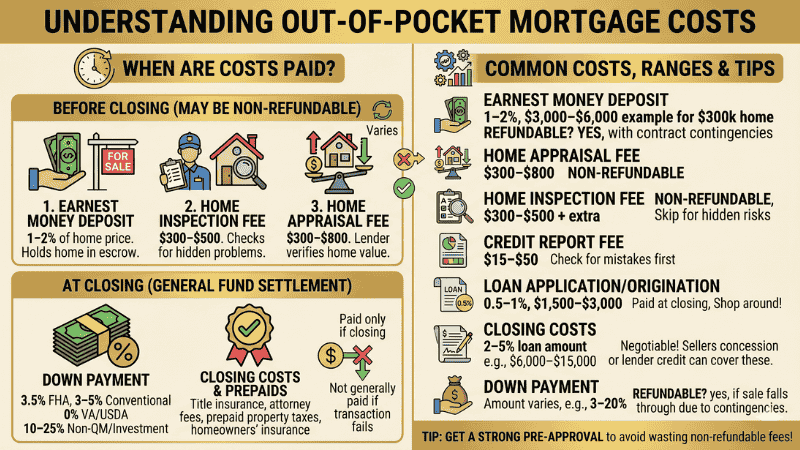 Below is a list of buyers’ most common out-of-pocket costs and price ranges based on U.S. averages in 2026. Knowing these can help you budget for a mortgage with less stress.
Earnest Money Deposit
- Cost: 1–2% of the home’s purchase price.
- For a $300,000 home, that’s $3,000–$6,000.
- Purpose: This is a good-faith deposit that shows the seller you’re serious.
- When It’s Paid: After the seller accepts your offer, you pay it.
- The money goes into escrow until the sale is final.
- Is It Refundable?: Yes, as long as you back out for a reason listed in your purchase agreement, like an inspection problem or loan denial.
- Tip: Always ask your agent to include contingencies in your purchase agreement to protect your deposit.
Home Appraisal Fee
- Cost: $300–$800.
- Purpose: The lender orders this to verify that the home’s value matches your desired mortgage.
- When It’s Paid: You pay for this after you apply for the loan, usually during underwriting, either upfront or at closing.
- Is It Refundable?: No, the fee is non-refundable even if your loan gets denied.
- Tip: If your lender permits, compare costs among appraisers, but ensure they are licensed and approved by the lender.
Home Inspection Fee
- Cost: $300–$500 (Extra inspections, like pest or radon, usually add $50–$150 each).
- Purpose: A home inspector examines the property for hidden structural, mechanical, or safety problems.
- When It’s Paid: After the purchase agreement is signed, but usually before the appraisal.
- Refundable?: Nope.
- The inspector still gets paid, whether or not the sale goes through.
- Tip: Skipping the inspection can seem like a good way to save money, but it might cause hidden problems that will cost you thousands later.
Credit Report Fee
- Cost: $15–$50 per borrower
- Purpose: The lender pulls your credit report to see whether you can handle the mortgage.
- When It’s Paid: During your loan application.
- Pay it upfront, or it could show up in the closing costs.
- Refundable?: Not refundable.
- Tip: Check your credit report for any mistakes before you apply.
- Fixing errors now can keep your credit score higher.
Loan Application/Origination Fee
- Cost: 0.5–1% of the loan amount.
- For a $300,000 mortgage, that’s around $1,500–$3,000.
- Purpose: This fee pays for the lender’s work processing and underwriting your loan.
- When It’s Paid: Usually at closing, although some lenders might ask for part of it upfront.
- Refundable?: Generally no, but always double-check with your lender.
- Tip: Shop around! Origination fees can differ greatly from lender to lender, and a lower fee helps lower your total cost.
Closing Costs
- Cost: 2–5% of the loan amount (example: $6,000–$15,000 on a $300,000 loan).
- Purpose: These cover fees like title insurance, attorney fees, recording fees, and escrow costs.
- When It’s Paid: Usually at the closing, but some fees might be paid beforehand.
- Refundable? Part of these costs may be negotiable, and the seller might agree to pay some.
- Tip: Ask your lender for a Loan Estimate within three days of applying so you can see a detailed list of the closing costs.
Prepaid Expenses
- Cost: The amount varies, usually $1,000–$3,000.
- Purpose: These include upfront payments for property taxes, homeowners insurance, and the first month’s prepaid interest.
- When It’s Paid: Paid at closing and placed in your escrow account.
- Refundable? These costs are not refunded once paid since they are for ongoing bills.
- Tip: Set aside enough to cover at least 1–2 months of property taxes and insurance so your escrow account stays funded.
Down Payment
- Cost: Usually 3–20% of the sales price (example: $9,000–$60,000 on a $300,000 home).
- Purpose: This is the upfront part of the home price you cover yourself, and the rest comes from the loan.
- When It’s Paid: Paid at closing, often by wire transfer or cashier’s check.
- Refundable? unless the sale falls through due to contingencies.
- Tip: Look into programs like FHA loans (3.5% down) or VA loans (0% down) for a smaller down payment.
Mortgage Insurance (If Needed)
- Cost: With FHA loans, you pay an upfront premium of 1.75% of the loan amount.
- So, on a $300,000 loan, that’s $5,250.
- The cost of private mortgage insurance (PMI) on conventional loans varies depending on the lender and loan features.
- Purpose: This insurance protects the lender if you can’t keep up with your mortgage payments.
- It’s a must if you put down less than 20% on a conventional loan or have certain government-backed loans.
- When It’s Paid : You pay the upfront premium at closing, though you can sometimes add it to the loan total.
- After that, you’ll see a monthly premium on your mortgage statement.
- Refundable? The upfront premium is not refundable.
- For PMI, you can drop it when your loan balance is down to 80% of your home’s original value.
- Tip: Save up for that 20% down payment to avoid PMI altogether on conventional loans.
Miscellaneous Fees
- Cost: Expect to pay between $100 and $500 for these.
- Purpose: These smaller charges cover courier deliveries, document prep, or notary services.
- When It’s Paid: The timing can vary, but you’ll likely pay them at closing.
- Refundable?: No, these fees are usually non-refundable.
- Tip: Review your Loan Estimate and Closing Disclosure to spot and question any surprising fees.
- Strategies to Manage Out-of-Pocket Costs: You can keep these costs from piling up by trying a few smart moves:
- Negotiate Seller Concessions: If the market favors buyers, ask the seller to contribute to closing costs or to cover some repairs.
- Shop Around for Services: Get quotes from different lenders, appraisers, and inspectors.
- A little comparison can save you big money.
- Apply for Assistance Programs: Check for first-time homebuyer programs and grants that help with down payments and closing costs.
- Budget Early: Aim to set aside 5–10% of your future home’s price to cover the initial expenses.
- Consider a No-Closing-Cost Loan: Some lenders allow you to roll closing costs into the loan.
- This raises your loan balance and monthly payments but lowers upfront cash.
Common Mistakes to Avoid
- Underestimating Costs: Missing small fees can add up and hurt your budget.
- Skipping Inspections: Saving on a few inspection dollars can lead to big repair bills later.
- Ignoring Loan Estimates: Always double-check the Loan Estimate and Closing Disclosure to catch surprise fees.
Making Financial Changes
Don’t buy big-ticket items or rack up new debt while processing your mortgage. Changes can jeopardize your approval.
Which Out-of-Pocket Mortgage Costs Are Refundable?
Not all out-of-pocket mortgage costs are handled the same way. Some costs may be refundable if the transaction does not close, while others are usually non-refundable once the service has been completed. The earnest money deposit may be refundable if the buyer cancels the contract for a reason allowed under the purchase agreement. Common examples include a failed home inspection, appraisal issue, financing contingency, or another contract-protected reason. However, if the buyer backs out without a valid contingency, the seller may be able to keep the earnest money. The home inspection fee is usually not refundable. The inspector is paid for completing the inspection, even if the buyer decides not to move forward with the home purchase. The home appraisal fee is also usually not refundable. Once the appraisal is ordered and completed, the appraiser must be paid, even if the loan is later denied or the property does not appraise for the purchase price. The down payment and final closing costs are different. These are normally paid at closing, not early in the mortgage process. If the loan does not close, the borrower generally does not pay the down payment or final closing costs because the transaction never reaches settlement. Understanding which out-of-pocket mortgage costs are refundable and which are not can help borrowers protect their money, ask better questions, and avoid surprises during the mortgage process.
How Much Will You Pay for Your Mortgage? Understand the Costs
We’ll help you navigate the financial side of homeownership and avoid surprises.Tips to Manage Costs
- Negotiate the Earnest Deposit: If you’re in a competitive market, you might need a higher earnest deposit to show you’re serious.
- But you can also ask the seller to reduce it if you’re willing to put in a higher down payment.
- Shop Local for Inspection and Appraisal: Not all inspectors and appraisers charge the same amount.
- Get a few quotes and check online reviews to find quality services that fit your budget.
- Ask for Seller Credits: Sometimes, sellers will agree to cover a portion of your closing costs to speed up the deal.
- If the home has been on the market for a while, don’t hesitate to ask for this perk.
- Consider a No-Closing-Cost Mortgage: Some lenders offer this option, but usually charge a higher interest rate.
- Run the numbers to see if it saves you money in the long run.
Stay Organized and Stay in Touch
- Track Every Receipt: Create a folder (digital or paper) for every receipt, quote, and estimate.
- This keeps you organized and helps you catch any mistakes on the final closing statement.
- Communicate with Your Loan Officer: Your loan officer is your best ally in the mortgage process.
- They can explain every line of your loan estimate and suggest ways to save money.
- Don’t hesitate to ask them your biggest questions.
Final Thoughts on Out-of-Pocket Mortgage Costs
Understanding out-of-pocket mortgage costs before you start the homebuying process can help you budget with confidence and avoid last-minute surprises. Some costs, such as the earnest money deposit, home inspection, and appraisal, may be due before closing. Higher costs, such as the down payment, closing costs, prepaid taxes, homeowners’ insurance, and escrow reserves, are usually paid at closing.
The key is knowing what you may need to pay, when each cost is due, and which expenses may or may not be refundable. A strong pre-approval, clear Loan Estimate, and proper budgeting plan can help you protect your money before making an offer.
At Gustan Cho Associates, our team helps homebuyers understand their mortgage options, estimate cash-to-close, and prepare for the out-of-pocket mortgage costs of buying a home. If you are planning to purchase a home, speak with a loan officer early so you know how much money you may need before and at closing.
Frequently Asked Questions About Out-of-Pocket Mortgage Costs:
What Are Out-of-Pocket Mortgage Costs When Buying a Home?
Out-of-pocket mortgage costs are expenses homebuyers pay upfront during the mortgage process. These may include the earnest money deposit, home inspection fee, appraisal fee, credit report fee, and sometimes application-related fees. Higher costs, like the down payment and closing costs, are typically paid at closing.
How Much Are Out-of-Pocket Mortgage Costs On Average?
Out-of-pocket mortgage costs vary depending on the home price and loan type, but most buyers should expect to pay 2% to 5% of the loan amount in closing costs, plus additional upfront fees like inspection and appraisal. In total, buyers often need to put down 3% to 10% of the home price to cover all upfront expenses.
What Is Included In Cash To Close?
Cash to close includes your total out-of-pocket mortgage costs due at closing, such as your down payment, closing costs, prepaid property taxes, homeowners’ insurance, and escrow reserves. It also accounts for any seller or lender credits that reduce the amount you need to bring.
When Do You Pay Out-of-Pocket Mortgage Costs?
Some out-of-pocket mortgage costs are paid before closing, such as the earnest money deposit, home inspection, and appraisal. The largest expenses, including the down payment and closing costs, are usually paid on the day of closing.
Are Appraisal And Inspection Fees Refundable?
In most cases, appraisal and inspection fees are not refundable. These services are completed regardless of whether the loan closes, so the borrower is responsible for paying them even if the transaction falls through.
Is It Possible To Include Closing Costs In The Loan?
Yes, in some cases, closing costs can be rolled into the loan through lender credits or specific loan structures. However, this usually results in a higher interest rate or loan balance. Some buyers also negotiate seller concessions to help cover out-of-pocket mortgage costs.
This article about “Out-of-Pocket Mortgage Costs: Avoid Costly Mistakes” was updated on April 23rd, 2026.
Planning Your Home Purchase? Know the Costs Upfront
We’ll guide you through the costs involved in securing a mortgage and purchasing your home.