In New Jersey, you can qualify for an FHA loan with a 580 credit score or higher and a down payment of just 3.5%. If your score is between 500 and 579, you may still qualify with a 10% down payment. Approval also depends on your income, employment, debt-to-income ratio, credit history, funds to close, and the property. HUD’s basic FHA guidelines apply nationwide, but New Jersey FHA lenders may impose stricter requirements known as lender overlays. Because New Jersey property taxes can significantly affect the monthly housing payment, buyers should request a complete preapproval based on the specific home and county, not just the purchase price.
What New Jersey Buyers Should Know About FHA Loans
Starting at just 3.5%, down payments for FHA loans in New Jersey open doors for more homebuyers. A score of 580 might get you approved under standard terms. When credit dips between 500 and 579, ten percent down could keep eligibility alive. These loans often bend further than typical ones when it comes to financial history. New Jersey buyers should also know that not every FHA lender follows the same rules. HUD sets the basic FHA guidelines, but some lenders add extra requirements called lender overlays. That is why one lender may deny a borrower while another lender may still be able to approve the same FHA loan.
2026 New Jersey FHA Loan Requirements
HUD sets the basic FHA guidelines nationwide, but individual New Jersey FHA lenders may apply stricter rules known as lender overlays. Meeting FHA’s minimum requirements does not guarantee approval. The lender must review the borrower’s complete credit, income, debt, assets, and property profile.
Credit Scores and Down Payments
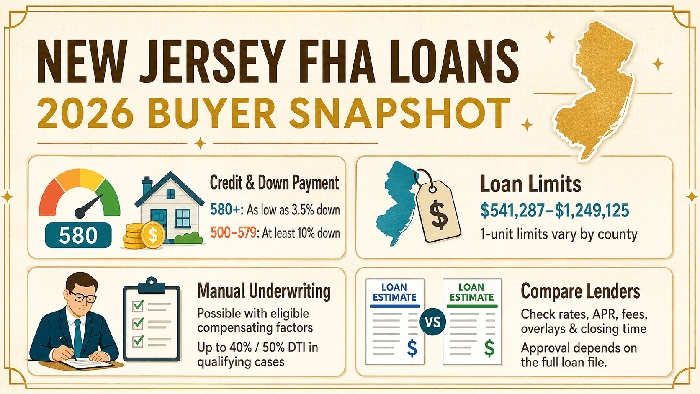
Under FHA guidelines, borrowers with a minimum decision credit score of 580 or higher may be eligible for up to 96.5% financing, which requires a down payment of at least 3.5%. Borrowers with scores from 500 to 579 are generally limited to 90% financing and must make at least a 10% down payment. Some lenders require a higher credit score or impose additional rules for recent late payments, collections, or manual underwriting. Down payment funds may come from the borrower’s savings, an eligible gift, an approved assistance program, or another source permitted by FHA.
Income and Employment
FHA borrowers must have verifiable, stable income that is reasonably expected to continue. Eligible income may include:
- W-2 wages or salary
- Overtime, bonuses and commissions
- Self-employment income
- Social Security or pension income
- Disability benefits
- Qualified rental or other documented income
Changing jobs does not automatically disqualify a borrower. However, the lender must review employment history, income consistency, and the likelihood that the income will continue. Depending on the income source, borrowers may need pay stubs, W-2s, tax returns, bank statements, benefit letters, or written employment verification.
Debt-to-Income Ratios
The debt-to-income ratio compares monthly obligations with gross monthly income. It includes the proposed mortgage payment, property taxes, homeowners’ insurance, FHA mortgage insurance, HOA dues, and recurring debts reported on the credit file. FHA does not establish a universal maximum DTI for every borrower. Loans that receive automated underwriting approval may qualify at higher ratios based on the overall application. Manually underwritten FHA loans generally use the following limits:
- Up to 31% housing DTI and 43% total DTI without compensating factors
- Up to 37% housing DTI and 47% total DTI with one eligible compensating factor
- Up to 40% housing DTI and 50% total DTI with two eligible compensating factors
Additional credit-score and compensating-factor requirements apply. Because New Jersey property taxes can substantially increase the housing payment, buyers should be preapproved using realistic taxes, insurance, and HOA dues for the specific property—not the purchase price alone.
Primary-Residence Requirement
An FHA purchase loan must generally finance the borrower’s principal residence. At least one borrower must move into the property within 60 days after signing the mortgage documents and intend to occupy it for at least one year, subject to limited exceptions. FHA loans cannot be used to purchase a vacation home or a property intended only as an investment. However, qualified borrowers may purchase an eligible two- to four-unit property with FHA financing if they occupy one unit as their primary residence.
FHA Appraisal and Property Standards
The property must receive an appraisal from an FHA-approved appraiser. The appraisal provides an opinion of market value. It reports whether the home appears to meet HUD’s minimum property requirements for safety, security, and structural soundness. Potential concerns may include:
- Roof leaks or structural damage
- Exposed wiring or unsafe electrical systems
- Missing utilities or nonworking mechanical systems
- Defective paint surfaces in homes built before 1978
- Water, septic, or drainage problems
- Unsafe access to the home
- Conditions that affect health or occupant safety
Required repairs may need to be completed before closing. A renovation loan, such as an FHA 203(k), may be an option for an eligible property needing substantial work. An FHA appraisal is not a substitute for an independent home inspection, so buyers should consider ordering both.
2026 FHA Loan Limits by New Jersey County
The 2026 FHA loan limit in New Jersey depends on the county and the number of residential units. For a one-unit property, county limits range from $541,287 to $1,249,125. These limits apply to FHA case numbers assigned from January 1 through December 31, 2026.
Bergen, Essex, Hudson, Hunterdon, Middlesex, Monmouth, Morris, Ocean, Passaic, Somerset, Sussex, and Union Counties
These counties use FHA’s high-cost maximum limits:
- One unit: $1,249,125
- Two units: $1,599,375
- Three units: $1,933,200
- Four units: $2,402,625
Atlantic and Cape May Counties
- One unit: $730,250
- Two units: $934,850
- Three units: $1,130,000
- Four units: $1,404,350
Burlington, Camden, Gloucester, and Salem Counties
- One unit: $630,200
- Two units: $806,750
- Three units: $975,200
- Four units: $1,211,950
Cumberland, Mercer, and Warren Counties
These counties use the FHA’s national floor:
- One unit: $541,287
- Two units: $693,050
- Three units: $837,700
- Four units: $1,041,125
FHA limits the base mortgage amount rather than the home’s purchase price. A buyer may purchase a more expensive home by contributing enough money to keep the base FHA loan within the county limit. The financed upfront mortgage insurance premium is generally added after the base loan amount is calculated. Qualified borrowers may use FHA financing for an eligible two- to four-unit property, but they must occupy one unit as their principal residence. A higher county limit does not guarantee approval. New Jersey FHA lenders must still evaluate the borrower’s credit, income, debt-to-income ratio, funds to close, and the property. Buyers should confirm the county and unit limits for the property with HUD’s official FHA mortgage-limit lookup. HUD’s 2026 FHA loan-limit announcement explains the national floor, high-cost ceiling, and effective dates.
New Jersey FHA Down Payment Assistance Programs
Qualified homebuyers may combine an FHA loan with assistance offered through the New Jersey Housing and Mortgage Finance Agency (NJHMFA). These programs can help cover eligible down payments and closing costs, but borrowers must meet both FHA and NJHMFA requirements.
NJHMFA Down Payment Assistance Program
The NJHMFA Down Payment Assistance Program offers eligible first-time homebuyers up to $15,000 in assistance, based on the county of the property. The assistance is structured as a second mortgage with:
- No interest
- No monthly payments
- A five-year forgiveness period
The borrower must continuously occupy the property as a principal residence for five years and meet the program’s other conditions for the assistance to be forgiven. For NJHMFA, a first-time buyer has not owned a primary residence in the last three years.
First-Generation Homebuyer Assistance
Qualified first-generation homebuyers may receive an additional $7,000. When combined with the standard NJHMFA assistance, eligible buyers may receive a total of $17,000 to $22,000, depending on the property’s county. The buyer must satisfy NJHMFA’s definition of a first-generation homebuyer and meet all applicable income, purchase-price, occupancy, and underwriting limits.
Important Eligibility Requirements
NJHMFA assistance must be paired with an eligible NJHMFA first mortgage and obtained through a participating lender. Not all New Jersey FHA lenders offer these programs. Assistance generally cannot be used to:
- Cover an appraisal shortfall
- Pay debts to qualify for the mortgage
- Finance property repairs or improvements
- Pay closing costs, customarily paid by the seller
Program availability, funding, and eligibility rules can change. Buyers should review the current requirements with an NJHMFA-participating lender before making an offer. A lender should also compare an NJHMFA-assisted loan with a standard FHA option because interest rates, fees, and repayment conditions may differ.
FHA Loans With Bad Credit in New Jersey
 Lending regulations can present significant challenges, particularly when credit scores are low. However, FHA loans provide an alternative pathway for borrowers who may face difficulties with traditional lending options. These loans are designed for individuals facing real-life financial hurdles, offering terms that provide access to funding when conventional lenders may decline.
Factors such as a dip in credit score, past missed payments, or historical credit issues may not necessarily impede progress. What is paramount is the current financial picture, including consistent income, employment stability, and overall financial habits, rather than a singular credit score.
Lenders consider various factors in an applicant’s financial profile, not just the credit score. Key elements include income stability, down payment size, and a history of timely bill payments. It’s important to understand that New Jersey FHA lenders may interpret guidelines differently, so a denial from one lender doesn’t mean that another will also deny your application. Each lender has its own rules and criteria.
Manual Underwriting on FHA Loans
FHA loans usually get their first look inside a computer-based approval tool. When that tool says no, there’s still a path forward – someone can step in and check things by hand. A real person might see details the machine missed, opening doors where code sees walls. Some folks in New Jersey who want a home might still get an FHA loan even if their credit score is low. One way through is having a lender look at things by hand instead of just using computer rules. When someone has little credit history, or too much debt compared to income, that human review could make a difference. Tough times in the past won’t block every door either. It often means handing over extra papers so the lender sees the full story. That effort might open up approval where it seemed shut before.
Take First Step Toward Making Your Dream A Reality
Apply Now And Get recommendations From Loan ExpertsWhy New Jersey FHA Lenders Have Different Overlays
HUD establishes the minimum FHA loan guidelines used nationwide. However, individual New Jersey FHA lenders may add stricter underwriting requirements known as lender overlays. These extra rules help lenders manage credit risk or meet the standards of the investors that purchase or insure their loans. Common FHA lender overlays may include:
- A minimum credit score above the FHA’s baseline requirement
- Lower maximum debt-to-income ratios
- Additional reserves after closing
- Stricter rules for recent late payments or overdrafts
- Longer waiting periods after bankruptcy or foreclosure
- Restrictions on manual underwriting
- Additional requirements for collections, disputed accounts, or employment gaps
- Limits on certain property types or down payment assistance programs
For example, FHA guidelines may permit a borrower with a 560 credit score and at least 10% down to be considered for financing. Different lenders have different requirements. For example, one lender may require a minimum credit score of 620, while another may follow FHA guidelines when reviewing applications. Meeting FHA’s minimum standards still does not guarantee approval because the complete loan file must satisfy all applicable underwriting requirements. An FHA denial from one lender does not always mean the borrower is ineligible everywhere. Before applying again, ask whether the denial resulted from a HUD requirement, a lender overlay, or a problem that can be corrected. A lender experienced with manual underwriting and lower-credit FHA loans may offer a different review, although rates, fees, and program availability can vary.
Common Reasons an FHA Loan Is Denied
An FHA loan may be denied even when the borrower meets the basic credit score and down payment requirements. New Jersey FHA lenders must evaluate the entire application, including credit history, income, debts, assets, occupancy, and the property. Some denials result from HUD requirements, while others are caused by lender overlays. Common reasons for an FHA loan denial include:
- High debt-to-income ratio: The proposed housing payment and monthly debt obligations may be too high relative to the borrower’s verified income. New Jersey property taxes, homeowners’ insurance, and HOA dues can significantly increase the total payment.
- Unstable or unverifiable income: Employment gaps, declining self-employment income, inconsistent overtime, or insufficient documentation may prevent the lender from using all reported income.
- Recent late payments: Late housing payments, repeated delinquencies, or newly opened past-due accounts may indicate that the borrower is not ready to take on a mortgage.
- Insufficient funds to close: The borrower may lack sufficient verified funds for the down payment, closing costs, or required reserves. Large deposits without an acceptable paper trail can also create problems.
- Credit-report issues: Unresolved disputes, federal debt, judgments, recent bankruptcy, or inaccurate information may delay or prevent approval.
- A high-risk underwriting result: The FHA TOTAL Mortgage Scorecard may return a Refer result. The loan might still qualify through manual underwriting, but only if the borrower meets the applicable HUD requirements.
- Property or appraisal problems: The home may appraise below the purchase price or have safety, structural, or habitability issues that must be repaired before closing.
- Occupancy concerns: FHA purchase financing generally requires the borrower to use the home as a principal residence. An application may be denied if the intended occupancy cannot be verified.
- An FHA loan-limit issue: The requested base loan amount may exceed the FHA limit for the county in New Jersey and the number of units.
- A lender overlay: One lender may require a higher credit score, lower DTI, or stronger payment history than FHA itself requires.
A denial from one lender does not always mean the borrower is ineligible for FHA financing. Borrowers should review the written adverse-action notice to identify the principal reasons for the decision. They can then determine whether the problem must be corrected or whether another lender may evaluate the file without the same overlay. Approval is never guaranteed, and the new lender must independently underwrite the complete application.
Documents Needed for an FHA Preapproval
To obtain an FHA preapproval, borrowers must document their identity, income, employment, debts, and funds needed for the transaction. Exact requirements vary based on the loan file, but New Jersey FHA lenders commonly request the following:
Identification and Personal Information
- Government-issued photo identification
- Social Security number
- Current address and housing history
- Contact information for current and recent employers
- Documentation of immigration or residency status, when applicable
Income and Employment Documents
W-2 employees may need:
- Pay stubs covering the most recent 30 days
- W-2 forms from the past two years
- Written or electronic verification of employment
Self-employed borrowers may need:
- Personal and business tax returns
- Year-to-date profit-and-loss statement
- Business bank statements or balance sheet
- Proof that the business remains active
Borrowers using Social Security, disability, pension, child support, alimony, rental income, overtime, bonuses, or commissions may need additional records showing the amount, history, and expected continuance of that income.
Asset and Down Payment Documents
Lenders commonly request:
- Bank statements covering the most recent two months
- Retirement or investment account statements, if those funds will be used
- Documentation for large or unusual deposits
- Proof of earnest money already paid
- Gift letter and evidence of the donor’s transfer, when using gift funds
- NJHMFA or other assistance-program documentation, when applicable
Do not move money between accounts or deposit large amounts of cash without first speaking with the loan officer. The lender must verify that funds used for the down payment and closing costs come from an acceptable source.
Credit and Debt Documents
The borrower must authorize the lender to obtain a credit report. Additional documentation may be required for:
- Student loans
- Bankruptcy, foreclosure, or short sale
- Judgments or federal debt
- Disputed accounts
- Child support or alimony obligations
- Recently paid debts
- Current mortgage or rental payment history
A written letter of explanation may be requested for employment gaps, late payments, credit inquiries, address differences, or other issues affecting the application.
Property Documents After an Offer Is Accepted
A borrower can receive an initial preapproval before selecting a home. Once an offer is accepted, the lender typically requires:
- Signed purchase contract and addenda
- Earnest-money deposit evidence
- Property address and tax information
- Homeowners insurance details
- HOA documents or dues, when applicable
- FHA appraisal and required property reports
A preapproval is not a final loan commitment. Verification of income, assets, credit, and employment may occur once more before closing, so borrowers should refrain from changing jobs, opening new credit accounts, or making significant purchases without first consulting their loan officer. Documentation requirements depend on the application and underwriting findings.
New Jersey FHA Approval Example
The following hypothetical example shows how lender overlays and New Jersey property taxes can affect an FHA application. It is for illustration only and does not guarantee approval. A first-time buyer wants to purchase a $400,000 single-family home in Middlesex County. The borrower has:
- A 604 credit score
- A 3.5% down payment of $14,000
- Gross monthly income of $10,000
- Monthly debt payments of $750
- Stable W-2 employment
- Verified funds for closing and reserves
- An estimated monthly housing payment of $3,300, including principal, interest, property taxes, homeowners’ insurance, and FHA mortgage insurance
The estimated housing DTI is 33%, while the total DTI is approximately 40.5%. The requested base loan amount is also below the county’s FHA loan limit. The first lender requires a minimum credit score of 620 and denies the application due to its lender overlay. Another lender reviews the same file under FHA guidelines, receives an acceptable automated underwriting result, and approves the loan subject to the appraisal and standard underwriting conditions. This example illustrates why a denial from one of the New Jersey FHA lenders does not always mean the borrower is ineligible for FHA financing. Buyers should ask whether a denial resulted from HUD guidelines, a lender overlay, or a correctable issue in the loan file. Actual rates, payments, underwriting findings, and approval decisions vary by borrower, property, and lender.
How to Compare New Jersey FHA Lenders and Loan Estimates
The lowest advertised interest rate is not always the least expensive loan. When comparing New Jersey FHA lenders, request an official Loan Estimate from several lenders using the same purchase price, down payment, loan term, property type, and rate-lock period. Because mortgage pricing can change daily, obtain the estimates as close together as possible.
Compare the Main Loan Terms
Review Page 1 of each Loan Estimate for:
- Interest rate
- Monthly principal and interest
- Estimated total monthly payment
- Whether the interest rate is locked
- Length of the rate-lock period
- Estimated cash needed at closing
- Prepayment penalties or balloon payments, if any
Property taxes, homeowners’ insurance, HOA dues, and FHA mortgage insurance must be included when estimating the complete monthly payment. Confirm that each lender used the same tax, insurance, and HOA assumptions, especially because New Jersey property taxes can significantly affect affordability.
Review Lender Fees, Points, and Credits
On Page 2, compare the lender-controlled charges in Section A, including:
- Origination charges
- Underwriting or processing fees
- Discount points
- Application fees
- Lender credits
Discount points require the borrower to pay more upfront in exchange for a lower interest rate. Lender credits generally reduce closing costs but may be accompanied by a higher rate. Ask each lender to show a similar option—such as a rate with no discount points—so the comparison is fair. Do not judge lenders solely by prepaid taxes, insurance premiums, or initial escrow deposits. These amounts may vary based on estimates and timing, but are generally not lender profit.
Compare APR and Five-Year Costs
The annual percentage rate, commonly known as APR, represents the interest rate along with specific loan expenses. It can help compare two FHA loans with similar terms, but it should not be the only deciding factor. Page 3 of the Loan Estimate also shows:
- Total principal, interest, mortgage insurance, and loan costs paid in five years
- Principal scheduled to be paid off in five years
- Annual percentage rate
- Total interest percentage
These figures can reveal whether a low advertised rate requires substantial upfront fees. Borrowers who expect to sell or refinance within a few years should calculate how long it would take for the monthly savings from discount points to recover the additional closing cost.
Compare More Than Price
A competitive rate is valuable only if the lender can successfully close the loan. Ask each lender:
- Do you impose a minimum credit score above the FHA’s requirement?
- Do you offer FHA manual underwriting?
- What are your maximum DTI requirements?
- Can you work with NJHMFA assistance programs?
- How do you review recent bankruptcy, foreclosure, or late payments?
- What documents remain outstanding?
- How long does underwriting typically take?
- Can the proposed lock period cover the expected closing date?
- What happens if the lock must be extended?
A lender with slightly lower fees may not be the right choice if its overlays make the borrower ineligible or its lock period does not provide enough time to close. The CFPB recommends comparing multiple Loan Estimates and considering both the loan’s cost and the lender’s ability to meet the required closing schedule. Borrowers can also use competing estimates to ask whether a lender will improve its pricing.
Steps From FHA Preapproval Through Closing
After receiving an FHA preapproval, the buyer can begin shopping for a home within the approved price range. A preapproval is not a final loan approval. The borrower, property, and transaction must still satisfy FHA and lender requirements.
1. Get a Document-Reviewed Preapproval
The lender reviews the borrower’s credit, income, employment, debts, and available funds. Buyers should confirm that the estimated payment includes realistic New Jersey property taxes, homeowners’ insurance, FHA mortgage insurance, and HOA dues, when applicable.
2. Make an Offer on an Eligible Home
Once the buyer selects a property, the real estate agent prepares an offer. The contract may include an FHA financing contingency, an appraisal contingency, home inspection terms, seller concessions, and a proposed closing date.
3. Submit the Contract and Updated Documents
After the offer is accepted, the borrower provides the signed contract, earnest-money documentation, and any updated income or asset records. The lender prepares the official Loan Estimate and updates the application using the property’s actual taxes, insurance, and other costs.
4. Complete the Home Inspection
A home inspection is optional under FHA rules but strongly recommended. It helps the buyer identify defects that may not be discovered during the FHA appraisal. The inspection and FHA appraisal serve different purposes.
5. Order the FHA Appraisal
An FHA-approved appraiser evaluates the property’s market value and reports whether it meets HUD’s minimum property requirements. If repairs are required, the buyer, seller, and lender must determine whether they can be completed before closing or handled through an eligible renovation program. If the appraised value is below the purchase price, the buyer may renegotiate the price, pay the difference with eligible funds, or cancel the contract under the applicable contingencies.
6. Complete Mortgage Underwriting
The underwriter reviews the entire loan file, including:
- Credit and payment history
- Income and employment
- Debt-to-income ratio
- Bank statements and funds to close
- Gift or assistance funds
- Purchase contract and appraisal
- Title, insurance, and property documents
- FHA automated or manual underwriting requirements
The underwriter may issue a conditional approval requesting explanations, updated statements, or additional documents. Buyers should respond promptly and avoid opening credit accounts, changing jobs, moving money without documentation, or making large purchases.
7. Satisfy Final Loan Conditions
After the requested conditions are submitted, the underwriter performs a final review. New Jersey FHA lenders may also reverify employment, assets, credit, and outstanding debts shortly before closing. A material change could affect the approval or delay the transaction.
8. Review the Closing Disclosure
The borrower must get the Closing Disclosure at least three business days before closing. It shows the final interest rate, monthly payment, closing costs, and cash needed to close. The borrower should compare it with the most recent Loan Estimate and ask about unexpected changes immediately.
9. Complete the Final Walk-Through and Closing
The buyer completes a final walk-through to confirm the property’s condition and any agreed-upon repairs. At closing, the borrower signs the mortgage documents, provides the verified cash to close, and receives the keys after the loan funds are received and the transaction is completed. Closing times vary based on the borrower, property, appraisal, title work, and underwriting conditions. Buyers should not schedule movers or make irreversible plans until the lender and closing agent confirm that the transaction is ready to close.
What to Do After an FHA Mortgage Denial
An FHA mortgage denial does not always mean you are permanently ineligible. The next step is to identify whether the decision resulted from an FHA requirement, a lender overlay, a property issue, or information that can be corrected.
Review the Denial Notice
Ask the lender for the written adverse-action notice and review the specific reasons for the denial. Common issues include excessive DTI, unverifiable income, insufficient funds, recent late payments, credit disputes, an unacceptable appraisal, or a lender-specific credit-score requirement.
Ask Whether a Lender Overlay Caused the Denial
HUD establishes FHA’s basic guidelines, but New Jersey FHA lenders may impose stricter requirements. Ask the loan officer:
- Was the denial based on an FHA guideline or a lender overlay?
- Did automated underwriting return an ineligible or Refer result?
- Could the application qualify through manual underwriting?
- Is the issue temporary, correctable, or specific to the property?
If an overlay caused the denial, another lender may evaluate the file differently. Approval is not guaranteed, and the new lender must independently underwrite the application.
Correct Problems Before Reapplying
Depending on the denial reason, the borrower may need to:
- Pay down debt to lower the DTI
- Correct inaccurate credit-report information
- Establish additional on-time payment history
- Document income, employment, or large bank deposits
- Save more money for closing or reserves
- Resolve disputed accounts or federal debt
- Choose a less expensive property
- Complete required repairs or renegotiate after a low appraisal
Avoid repeatedly applying without addressing the underlying issue because additional credit inquiries will not correct an unqualified loan file.
Request a Second Mortgage Review
A second opinion may be worthwhile when the first lender does not offer manual underwriting, requires a higher credit score, or applies stricter rules than FHA requires. Provide the new lender with the reason for the denial and complete documentation so the loan can be evaluated accurately. If the borrower cannot qualify immediately, request a written mortgage-readiness plan with clear targets for credit, debt, savings, and timing. This creates a practical path toward a stronger future application without promising approval.
Final Thoughts About New Jersey FHA Lenders
Finding the right FHA lender in New Jersey can make a big difference, especially if you have lower credit scores, a higher debt-to-income ratio, or past credit issues. FHA guidelines are flexible, but lender overlays can make approval harder with some lenders. Before giving up after one denial, it may help to get a second opinion from an FHA lender that understands manual underwriting and standard HUD guidelines. The right lender can review your full file, explain your options, and help you understand what steps may be needed before moving forward.
Frequently Asked Questions About New Jersey FHA Loans
Do You have to be a First-Time Homebuyer to Get an FHA Loan in New Jersey?
No. FHA loans are accessible to both first-time and returning homebuyers. However, NJHMFA assistance programs may have separate first-time buyer, income, purchase-price, and occupancy requirements.
Can a Seller Pay FHA Closing Costs in New Jersey?
Yes. The FHA permits the seller or another interested party to contribute up to 6% of the sale price toward qualifying closing costs, prepaid expenses, and discount points. Seller contributions cannot be used for the borrower’s required down payment or returned to the buyer as cash.
How Long do You Pay Mortgage Insurance on an FHA Loan?
For most FHA loans with an original loan-to-value ratio above 90%, mortgage insurance generally remains in effect for the loan term. If the original LTV is 90% or lower, annual mortgage insurance generally lasts 11 years. FHA mortgage insurance cannot usually be canceled early solely because of increased equity.
Can You have Two FHA Loans at the Same Time?
FHA generally limits borrowers to one FHA-insured principal residence at a time. Limited exceptions may apply for job relocation, an increase in family size, leaving a jointly owned home, or serving as a non-occupying co-borrower. The lender must document that the borrower meets the applicable exception.
Can You Buy a Condominium with an FHA Loan in New Jersey?
Yes, but the condominium must meet FHA requirements. The unit may be located in an FHA-approved condominium project, or it may qualify through FHA’s Single-Unit Approval process if the project meets specific eligibility standards.
Can a family member co-sign an FHA loan without living in the home?
FHA may permit an eligible family member to participate as a non-occupying co-borrower. The lender reviews that person’s credit, income, debts, and legal responsibility for the mortgage. Individual New Jersey FHA lenders and assistance programs may impose additional restrictions.
How do Student Loans Affect FHA Qualification?
FHA lenders must include outstanding student loans when calculating the borrower’s DTI. If the credit report shows a payment greater than zero, the lender may use that amount or an acceptable, documented payment. If the reported payment is zero, the lender generally uses 0.5% of the outstanding balance as the monthly obligation.
Can a Buyer Assume an Existing FHA Mortgage?
Yes. FHA-insured forward mortgages can be assumed, allowing a qualified buyer to take over the seller’s loan balance and interest rate. The buyer must undergo a review, and may need additional funds to cover any difference between the loan balance and the purchase price.
This article about “New Jersey FHA Lenders: FHA Loan Requirements and Options” was updated on July 30th, 2026.