Mortgage Loan After Foreclosure And Short Sale Guidelines
Many people believe that having a foreclosure or a short sale means they can never buy a home again. The truth is, you can get another mortgage if you wait the right amount of time, repair your credit, and follow the latest loan requirements. Each loan type and credit issue has its own waiting period and rules. If you have a steady income, pay your bills on time, and manage your debts, you can qualify for a new mortgage. FHA, conventional, VA, and USDA loans each have their own guidelines.
Learn about the updated 2026 rules for getting a mortgage after a foreclosure or short sale. This guide covers how long to wait, credit requirements, and who qualifies for FHA, VA, USDA, conventional, and Non-QM loans.
A foreclosure often damages your credit more than a short sale, since the lender takes back your home through the court system.
A short sale, or preforeclosure sale, happens when you sell your home for less than what you owe on your mortgage, with your lender’s approval. In a deed-in-lieu of foreclosure, you give the lender the home back to avoid foreclosure. Fannie Mae sees these situations differently and often allows you to get a new loan sooner after a short sale or deed-in-lieu.
Quick Answer: Mortgage Loan After Foreclosure
Yes—you can get a mortgage loan after foreclosure, often sooner than you think. Eligibility depends on the loan program and the date your foreclosure is legally completed (often the recorded transfer of title in county records), not the day you moved out. Typical waits are 2–7 years, and rebuilding clean recent credit is key.
What You’ll Learn
- The typical waiting periods for FHA, VA, USDA, and Conventional loans after foreclosure
- Which date starts the clock (and how to confirm it in county records)
- How foreclosure rules compare to short sale and deed-in-lieu timelines
- What changes when bankruptcy is involved (and why dates matter)
- The most common timeline mistakes that delay approvals (and how to avoid them)
- What lenders look for after foreclosure: re-established credit, DTI, and reserves
- Options if you’re still in the waiting period, including Non-QM alternatives
How Soon Can I Get a Mortgage Loan After Foreclosure?

Most people ask,
“How soon can I qualify for a mortgage loan after foreclosure?”
The answer depends on the type of loan:
However, the clock doesn’t start when you “gave the keys back.” It begins when the deed is officially recorded at the county recorder’s office. This is where many borrowers get confused.
How Long Do You Have?
Conventional Loan Waiting Period after Foreclosure, Deed-In-Lieu, or Short Sale
- For conventional loans like Fannie Mae, you usually need to wait about seven years after a foreclosure before you can get a new mortgage.
- For a bankruptcy, deed-in-lieu, preforeclosure sale, or short sale, the typical wait is four years..
- Major credit issues, such as foreclosure within the last seven years must be reviewed by the lender.
- Most lenders follow the standard wait times for Freddie Mac loans, but the final decision depends on the automated underwriting system findings.
FHA Loan Waiting Period after Foreclosure, Deed-In-Lieu, or Short Sale
- Under FHA loan guidelines, HUD guidance makes it clear that a borrower with a foreclosure within the last 3 years is typically ineligible for an FHA-insured mortgage.
- HUD’s guidance on short sales also makes clear that, in cases where the borrower was in default before the short sale, the treatment will differ from that of a borrower who was in default before the short sale and was.
- According to HUD, if a borrower was in default at the time of a short sale, they are ineligible for an FHA-insured mortgage for three years from the date of the sale.
- Borrowers undergoing active foreclosure may have alternative options.
- Because FHA regulations are subject to change and distributed across various handbooks and mortgagee letters, lenders must consult the most up-to-date rules.o ensure compliance.
VA Loan Waiting Period after Foreclosure, Deed-In-Lieu, or Short Sale
- VA loan rules do not automatically disqualify people with past credit problems, like bankruptcy.
- Lenders consider the reasons behind your credit issues and your overall situation.
- Unlike conventional loans, VA rules do not clearly state how long you must wait after a foreclosure or short sale, but they do require a two-year wait after bankruptcy.
- VA lenders can make exceptions and will look at whether you have improved your credit, have enough money left over each month, and have a good recent credit history.
- The lender has the final say.
- Because VA loans depend on both automated underwriting system findings and the lender’s judgment, do not focus only on a single number.
- Always check the latest VA loan guidelines.
USDA Loan Waiting Period after Foreclosure, Deed-In-Lieu, or Short Sale
- For USDA loans, if you had a foreclosure, deed-in-lieu, short sale, or mortgage charge-off in the last 36 months, it will count against you.
- If these events happened more than 36 months ago, they usually will not affect your chances.
- Most USDA loans require a three-year wait, but if your situation is more complex, you may need extra credit checks or an exception.
Non-QM Mortgage after Foreclosure, Deed-In-Lieu, or Short Sale
For some people, especially those with recent credit problems, who are self-employed or have unusual income, Non-QM loans can help you buy a home sooner than regular loans. Each lender has its own Non-QM rules, and many allow you to wait less time after foreclosure, bankruptcy, or a short sale. Non-QM loans usually need a bigger down payment, more savings, a better credit score, or higher interest rates. There is no set waiting period for Non-QM loans.
Foreclosure and Short Sale Mortgage Guidelines for FHA, VA, USDA, and Conventional Loans
For FHA loans, it matters whether you were current or behind on payments at the time of the short sale and if you had a real financial hardship. HUD says you cannot get a new FHA loan if you did a short sale just to get a better deal on another home. Lenders are often more flexible with short sales than with foreclosures, especially for conventional loans.
Fannie Mae requires a 4-year wait after a short sale or pre-foreclosure sale, but a 7-year wait after a foreclosure. It is important to know when your waiting period starts.
Usually, it begins on the date your foreclosure, deed-in-lieu, pre-foreclosure sale, or charge-off is officially completed, as shown in public records, credit reports, or settlement documents. This distinction matters because bankruptcy and foreclosure can overlap. Some loan programs treat them as separate events, while others focus only on the mortgage event. Bankruptcy does not end the waiting period for a subsequent foreclosure; lenders use the date required by their program guidelines.
How Soon Can You Buy After Foreclosure?
Waiting periods don’t have to stop you. Our team helps you understand the guidelines and qualify faster than you think. At Gustan Cho Associates, we specialize in approvals after foreclosure and short sale.
HUD Guidelines for Mortgage Loan After Foreclosure
FHA loans are a popular option for buying again after a foreclosure because their guidelines can be more forgiving than those of conventional financing. In most cases, borrowers must wait three years from the date the foreclosure is completed/recorded (verify the exact date your lender must use).
FHA also has flexible down payment rules. Many borrowers qualify with 3.5% down when their credit score meets FHA’s minimum guidelines, but lender minimums can be higher, and approval depends on the overall file—not just the score.
How HUD Underwriting Works After Foreclosure
If AUS Approves:
- You can usually move forward through the standard FHA process (income/asset verification, appraisal, and final underwriting).
If AUS Does Not Approve (refer/eligible): Manual underwriting may be possible—but it typically requires stronger “compensating factors,” such as:
- Clean recent payment history (especially housing payments)
- Documented cash reserves
- Low payment shock (new payment not dramatically higher than current rent)
- Stable income and solid documentation
- The strongest FHA files show a clear recovery pattern: re-established credit, no new major derogatory events, and consistent on-time payments since the foreclosure.
VA Guidelines for Mortgage Loan After Foreclosure
- VA loans can be one of the most flexible options for eligible veterans and active-duty service members after a foreclosure, short sale, or deed-in-lieu.
- In many cases, the typical waiting period is two years from the completion/recorded event date (verify the exact date your lender must use).
Important:
VA guidelines don’t publish a strict “no late payments allowed” rule the way some lender overlays do. However, that does not mean late payments don’t matter. Lenders still review your recent payment history and overall credit recovery, and your approval may depend on AUS findings (or a manual underwrite when applicable).
To Strengthen Your File, Focus On:
- Re-established credit (new tradelines paid on time)
- Clean recent housing history when possible (rent/mortgage verification)
- Stable income and acceptable DTI based on AUS/underwriting
VA loans also offer a major advantage: no down payment is required for many borrowers with sufficient entitlement, making it a strong path back to homeownership after a setback.
What To Do Next (VA Loan After Foreclosure)
If you’re approaching the two-year mark—or you’re not sure which date your lender will use—your next step is to confirm your timeline and strengthen your approval profile. VA loans can be flexible, but underwriting still rewards borrowers who show recent stability and a clear recovery story.
Quick VA Approval Checklist
- Confirm the event date: Ask your lender which foreclosure/transfer date applies and verify it in the county records.
- Check your COE/entitlement: Ensure your Certificate of Eligibility is available, and review your remaining entitlement.
- Rebuild with on-time credit: Add 2–3 tradelines if needed and keep all payments on time.
- Document housing history: Be ready to show 12 months of rent/mortgage payments (and avoid new late housing payments).
- Reduce DTI where possible: Pay down revolving balances, avoid new debt, and keep utilization low.
- Save reserves: Even small savings can help offset risk and strengthen the overall balance sheet.
- Get pre-approved early: A VA-specific pre-approval clarifies your timeline, price range, and any conditions before you shop.
USDA Guidelines for Mortgage Loan After Foreclosure
USDA loans can be a strong option for eligible buyers purchasing in USDA-approved rural and suburban areas. If you’ve had a foreclosure, short sale, or deed-in-lieu, USDA typically requires a three-year waiting period from the documented completion date of the event. Just as important as the waiting period is program eligibility. USDA approvals depend on more than credit alone—your file must meet USDA requirements for:
- Property eligibility: The home must be in a USDA-eligible location
- Household income limits: Total household income must fall within USDA limits for the area
- Credit and repayment ability: USDA typically looks for re-established credit and stable income
- DTI and documentation: Lenders review debts, payment history, and documentation to confirm affordability
USDA loans are also attractive because they often allow 0% down for qualified borrowers. If you’re unsure whether the home location or your household income qualifies, getting a USDA pre-approval early can save time and prevent surprises.
Conventional Loan After Foreclosure: Fannie Mae and Freddie Mac
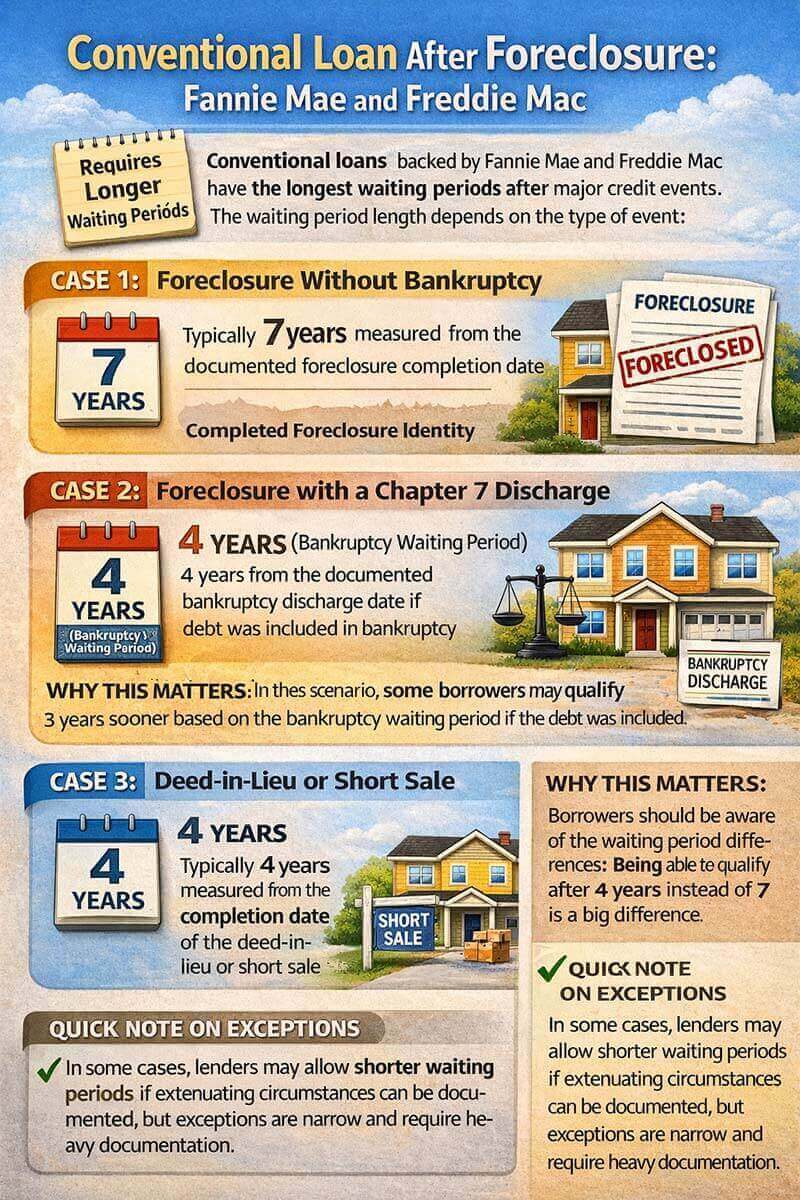
Conventional loans (typically backed by Fannie Mae or Freddie Mac) usually have the longest waiting periods after major credit events. What trips most borrowers up is that the waiting period can be measured from different “end dates” depending on whether the event was a foreclosure by itself, a bankruptcy, or a short sale/deed-in-lieu.
Case 1: Foreclosure Without Bankruptcy
In most conventional scenarios, a borrower is eligible again after seven years, measured from the completion date of the foreclosure as documented in the credit report or other foreclosure paperwork.
Translation: it’s not the day you moved out — underwriting looks for the documented completion date.
Case 2: Foreclosure with a Chapter 7 Discharge (same mortgage)
If the mortgage debt was discharged in bankruptcy, conventional guidelines may allow the bankruptcy waiting period to be used instead of the foreclosure waiting period when the lender can document that the mortgage obligation was discharged in the bankruptcy. If the lender cannot document that, then underwriting typically applies the greater (longer) of the bankruptcy or foreclosure waiting periods.
Why This Matters:
This is the scenario in which some borrowers can qualify based on the bankruptcy discharge date—but it depends on the documentation and the exact way the mortgage is tied to the bankruptcy.
Case 3: Deed-in-lieu or Short Sale (preforeclosure sale)
For conventional loans, a deed-in-lieu or short sale (preforeclosure sale) is commonly treated differently than a completed foreclosure. A typical waiting period is four years, measured from the completion date of the deed-in-lieu/short sale as documented.
Quick Note On Exceptions
In some cases, conventional programs may allow shorter waiting periods if extenuating circumstances can be documented, but these are narrower, heavily documented exceptions.
Mortgage Loan After Foreclosure: Recorded Date vs. Surrendered Keys
One of the biggest misunderstandings is when the waiting period clock starts.
- Wrong Assumption: The waiting period starts when you move out or give the bank your keys.
- Correct Rule: The waiting period starts on the recorded date when the deed officially transfers from your name to the lender’s name.
This is critical because recording can happen months (sometimes years) after you leave the property. Always confirm the recorded date with your county recorder’s office before getting a mortgage loan after foreclosure.
Side-by-Side Comparison of Waiting Periods
| Loan Program | Foreclosure | Short Sale | Deed-in-Lieu |
|---|---|---|---|
| FHA | 3 years | 3 years | 3 years |
| VA | 2 years | 2 years | 2 years |
| USDA | 3 years | 3 years | 3 years |
| Conventional (Fannie/Freddie) | 7 years | 4 years | 4 years |
Clock start reminder: In most cases, the waiting period is measured from the documented completion date of the event (often tied to recorded/public records). If you’re unsure, confirm the exact date your lender must use before you start house hunting.
If Bankruptcy Is Involved (Read This Before You Calculate Your Timeline)
Bankruptcy can change which date a lender uses to start your waiting period—especially for conventional loans.
Conventional Loans:
- If your mortgage was included in a Chapter 7 bankruptcy, the lender may be able to use the bankruptcy discharge date for the waiting period instead of the foreclosure completion date—but only when documentation supports it.
- If not, the lender may apply the longer timeline tied to the foreclosure event.
FHA/VA/USDA:
- Bankruptcy and foreclosure timelines can overlap, but lenders still rely on the documented event dates and your re-established credit afterward.
- The safest move is to have your lender confirm which date they must use for your file.
Best Practice:
If you have a bankruptcy and a foreclosure, ask your lender to review your credit report and public records, then confirm your earliest eligible date in writing (email is fine).
Common Mistakes Borrowers Make
Starting The Clock Too Early:
- Many borrowers mistakenly believe that the waiting period for loan eligibility begins when they vacate their property.
- In reality, this timeline starts from the date of the foreclosure being officially recorded, which can lead to confusion and delays in the loan application process.
Not Checking Credit Reports:
- Some lenders impose stricter rules than those mandated by government programs like HUD, VA, or USDA, which can limit a borrower’s options.
- It’s essential to research potential lenders thoroughly to find those who adhere strictly to the standard guidelines, thereby maximizing chances for approval.
Applying With Lenders Who Have Overlays:
- Some lenders impose stricter rules than those mandated by government programs like HUD, VA, or USDA, which can limit a borrower’s options.
- It’s essential to research potential lenders thoroughly to find those who adhere strictly to the standard guidelines, thereby maximizing chances for approval.
Not Re-Establishing Credit:
- After a foreclosure, borrowers need to establish new, positive credit accounts to demonstrate responsible financial behavior.
- A robust credit profile, showcasing recent good credit habits, is essential for lenders to consider them eligible for future loans.
How To Re-Establish Credit After a Housing Event
The best loan for you depends on your credit score, where you live, how much you can put down, your income, your savings, and, for VA loans, your benefits. You will also need to show documentation of your past foreclosure or short sale. It’s important to have someone review your personal situation to help you find the best option.
Check your credit reports carefully to ensure all information is accurate and coded correctly. Mistakes like wrong dates or codes can lead to your loan being denied.
Even if your foreclosure was a long time ago, underwriters will notice late credit card payments and may wonder if your credit is really fixed. Opening too many new accounts, running up high balances, or making big unexplained deposits before you apply can also hurt your chances. Start by finding out what kind of credit problem you had and when it ended. Check how long you have to wait for your loan type, and gather all the required documents. Work on paying your bills on time, lowering your credit card balances, keeping your job, saving money, and avoiding new problems on your credit report.
Incorrect Credit Report or Public Record Dates
Compare different loan programs, since some people get better deals with USDA, VA, conventional, or Non-QM loans, while others do better with FHA. Consider your most recent credit problem, whether you have special hardship reasons, and how steady your credit and income are. Conventional loans usually require a longer wait after foreclosure than after a short sale, while FHA, USDA, and VA loans may let you qualify sooner, each with its own rules and paperwork.
What Are Extenuating Circumstances?
Extenuating circumstances are rare, uncontrollable events that cause a sudden, major, and lasting loss of income or a big increase in expenses. Fannie Mae requires proof of these events. Examples include a serious illness, the death of a wage earner, or other major hardships not caused by poor financial decisions. A drop in property value or leaving a bad investment does not count.
If you want to use the extenuating circumstances rule to shorten your waiting period, be prepared to show proof like medical records, job-loss letters, disability papers, or insurance claims.
Not every lender will approve this, especially if they have stricter rules. Even after the waiting period, a low credit score can mean higher interest rates or make it harder to get approved. Many people also find it difficult to save money again after a short sale or foreclosure, which can make it hard to pay for reserves or closing costs.
How to Improve Your Credit Score After a Foreclosure, Deed-In-Lieu, or Short Sale
Start re-establishing credit after a foreclosure, deed-in-lieu, or short sale with secured credit cards. Get three to five secured credit cards. Open two to three credit rebuilder accounts. Have a family member with great credit and low credit utilization ratio add you as an authorized user. Conventional loans can be harder to get if you have low credit or little savings, while FHA loans often require more paperwork to show you have recovered. The stronger your financial recovery, the better your chances. FHA loans are good for people with lower credit or more debt, while conventional loans may work for those with improved credit. USDA loans are an option in rural areas after three years, and VA loans are a strong choice for veterans and service members.
What Do Underwriters Want To See Following A Foreclosure or Short Sale
Underwriters want to see that you have started using credit responsibly again and can manage a mortgage. Simply waiting out the required period is not enough. Fannie Mae requires you to rebuild your credit after events like bankruptcy, foreclosure, deed-in-lieu, preforeclosure sale, charge-off, or eviction, and to work on lowering your revolving debt. Lenders look for more than just a higher credit score—they also want to see steady income and at least two years of consistent employment. Even if you meet the basic requirements, recent late payments, high credit card balances, or unstable income can still pose problems. The waiting period is only part of the process; you also need to show that your financial hardship is in the past.
Buy Again After Foreclosure or Short Sale
Yes, you can own a home again. We help borrowers qualify for a new mortgage—even after foreclosure or short sale. Fast, stress-free, and with no lender overlays.
Alternatives If You Don’t Qualify Yet
If you’re still inside the waiting period for FHA, VA, USDA, or Conventional financing, you may still have paths to homeownership—but these options usually come with higher costs and more due diligence. The right choice depends on how recent the foreclosure was, your down payment, and how quickly you can rebuild qualifying credit.
Non-QM Loans (Possible Before the Waiting Period Ends)
Non-QM (Non-Qualified Mortgage) loans can work for borrowers who don’t fit agency guidelines or who are still within a required waiting period. Some Non-QM programs may be available sooner than government or conventional loans. However, approval is still not automatic, and terms vary by lender and product.
Typical Trade-Offs to Expect:
- Higher interest rates than FHA/VA/Conventional
- Larger down payment (often 10%–30%, depending on credit, reserves, and how recent the event is)
- More documentation or alternative documentation (bank statements, asset verification, etc.)
Best For: Borrowers who need to buy before the waiting period ends and have the down payment/reserves to qualify.
Owner Financing (Seller Financing)
- With owner financing, the seller acts like the lender, and you make payments directly to them—often with more flexible qualification standards than a bank.
Key Guardrails (very important):
- Get the terms in writing (rate, payment, balloon, late fees, escrow/taxes/insurance responsibility)
- Use a real estate attorney or title company to structure the note properly
- Confirm the home has a clear title and that you’re protected if the seller has an existing mortgage (risk of “due-on-sale” or seller default)
Best for: Buyers who can negotiate terms and want flexibility while rebuilding for an agency loan later.
Rent-to-Own (Use Caution and Verify Everything)
- Rent-to-own can help some buyers “lock in” a home and build a path toward ownership, but it’s also the option most likely to be misunderstood or structured unfairly.
What to Watch For:
- Make sure the purchase price (or how it’s determined) is clearly stated
- Confirm how much of the rent (if any) becomes a credit toward purchase
- Avoid large non-refundable option fees unless the contract is clear and reviewed
- Get an inspection and verify the seller’s title before paying extra upfront
- Understand what happens if you don’t qualify by the deadline
Best for: Buyers who have a realistic timeline to qualify and can verify the contract terms with professional help.
Smart Strategy (What Many Borrowers Do)
If your goal is an FHA/VA/USDA/Conventional loan later, many borrowers use the waiting period to:
- rebuild credit with on-time payments,
- reduce revolving balances,
- save reserves,
- and get a written eligibility date from a lender so they can plan confidently.
Why Choose Gustan Cho Associates?
Most lenders add overlays that make it harder for people to qualify for a mortgage loan after foreclosure. At Gustan Cho Associates, we have no overlays, meaning we approve loans using only HUD, VA, USDA, and Fannie Mae rules.
- Licensed in 48 states including DC, Puerto Rico, and the U.S. Virgin Islands
- Specialists in bankruptcy and foreclosure mortgage approvals
- Available 7 days a week, evenings, weekends, and holidays
- We close loans that mortgage lenders can’t
Start Fresh With Gustan Cho Associates
Don’t give up if you’ve been told you need to wait years before buying again. HUD, VA, USDA, and Fannie Mae rules are often more forgiving than lenders claim.
At Gustan Cho Associates, we specialize in helping borrowers get a mortgage loan after foreclosure with no overlays. Please contact us at 800-900-8569, text us for a faster response, or email us at gcho@gustancho.com.
Your foreclosure was a setback, not the end of your homeownership dreams. With the right team, you can buy a home again — often sooner than you think.
Frequently Asked Questions About Mortgage Loan After Foreclosure:
How Long After Foreclosure Can I Get a Mortgage Loan?
- Most programs require a waiting period measured from the foreclosure’s documented completion date.
- Typical guidelines are: FHA: 3 years; VA: 2 years; USDA: 3 years; and Conventional: 7 years.
What Date Starts the Waiting Period Clock After Foreclosure?
- Usually, the clock starts from the foreclosure completion/transfer-of-title date documented in public records (often tied to deed transfer or auction completion), not when you moved out or “gave the keys back.”
- Always verify the date your lender must use.
Can I Get an FHA Mortgage Loan After Foreclosure?
- Typically, yes—once you’ve met the 3-year waiting period after the foreclosure is complete (as documented).
- Approval still depends on credit recovery, income, DTI, and documentation.
Can I Get a VA Loan After Foreclosure?
- Often yes.
- A standard guideline is a 2-year waiting period after the foreclosure event is complete.
- Lenders still look for re-established credit and overall stability—VA flexibility doesn’t mean late payments “don’t count.”
How Long After Foreclosure Can I Get a Conventional Loan (Fannie Mae/Freddie Mac)?
- A typical guideline is 7 years after a completed foreclosure for a conventional loan.
- Some borrowers may qualify sooner only under narrow, well-documented circumstances.
Is a Short Sale the Same as a Foreclosure for Waiting Periods?
- It depends on the loan type. FHA and USDA often treat foreclosures, short sales, and deeds-in-lieu similarly (typically 3 years).
- In comparison, conventional guidelines commonly use 4 years for short sale/deed-in-lieu versus 7 for foreclosure.
Is Deed-in-Lieu Treated Like a Foreclosure?
- For FHA, deed-in-lieu is commonly treated similarly to foreclosure, with a 3-year ineligibility window tied to the transfer/ownership change date used for eligibility calculations.
- Conventional guidelines typically treat deed-in-lieu closer to short-sale timing (often 4 years).
What if My Foreclosure Happened During Chapter 7 Bankruptcy—Does That Change the Timeline?
- It can. Some conventional scenarios allow the waiting period to be measured from the bankruptcy discharge date rather than the foreclosure completion date, depending on documentation and how the mortgage debt was handled.
- This is case-specific—have a lender review your credit/public records.
What Credit Score do I Need for a Mortgage Loan After Foreclosure?
- Minimums vary by loan type and lender.
- FHA is often more flexible than conventional, but lenders may set higher internal minimums.
- VA can be flexible, but it still requires an overall approvable file (income, DTI, and recent payment history matter).
Can I Get a Mortgage Loan After Foreclosure with No Waiting Period?
- Agency loans (FHA/VA/USDA/Conventional) typically have waiting periods, but Non-QM loans may offer options sooner—often with higher rates and larger down payments.
- Terms vary widely, so compare carefully.
How Soon Can I Get A Mortgage After A Foreclosure?
- It depends on the loan program. Fannie Mae generally requires seven years after foreclosure.
- Regarding FHA, there is generally a three-year rule, while USDA has a three-year adverse-credit window.
How Soon Can I Get A Mortgage After A Short Sale?
- For Fannie Mae, a short sale or preforeclosure sale generally has a four-year waiting period.
- FHA treatment can vary depending on whether the short seller was current or delinquent at the time of the short sale.
Is A Short Sale Better Than A Foreclosure For Getting Another Mortgage?
- Usually yes. Regarding conventional financing, the waiting period after a short sale is generally shorter than that after a foreclosure.
What Are Extenuating Circumstances For Mortgage Approval?
- They are one-time events that are not the borrower’s fault that resulted in a temporary, dramatic, and prolonged drop in income, or a severe increase in debt.
- The lender is required to document this.
Can I Get An FHA Loan After A Foreclosure?
- Yes, most borrowers have been able to qualify again after the FHA waiting period and credit re-establishment.
- Historically, FHA has applied a 3-year waiting period after foreclosure, with limited exceptions for documented hardship cases.
Can I Get A USDA Loan After A Foreclosure Or Short Sale?
- USDA guidance generally considers a foreclosure, deed-in-lieu, short sale, or mortgage charge-off completed within the last 36 months to be a significant adverse credit.
- After 36 months, if the event has occurred, the borrower may still qualify if the rest of the file is strong.
This article about “Mortgage Loan after Foreclosure and Short Sale Guidelines” was updated on February 5th, 2026.
- Related> Qualifying Mortgage After Foreclosure
- Related> Mortgage After Deed In Lieu Versus Foreclosure
- Related> Home Loan After Foreclosure And Bankruptcy
Mortgage Loan After Foreclosure and Short Sale
Don’t let a past foreclosure or short sale hold you back. At Gustan Cho Associates, we make approvals possible when others say no. No overlays, no stress—just simple guidelines and fast approvals.