Government mortgages for owner-occupant homebuyers are designed to make buying a primary residence more affordable and more realistic. Backed by federal agencies, these home loans allow approved lenders to offer low down payment options, flexible credit requirements, and competitive mortgage rates. The most common government-backed loans are FHA, VA, and USDA. These mortgage programs are often a smart fit for first-time homebuyers, eligible veterans, buyers with lower credit scores, and borrowers seeking affordable financing for a primary home. In this article, you will learn how government mortgages work, who qualifies, and the key differences between FHA, VA, and USDA loans so you can decide which program may be right for you.
How Government Mortgages Work
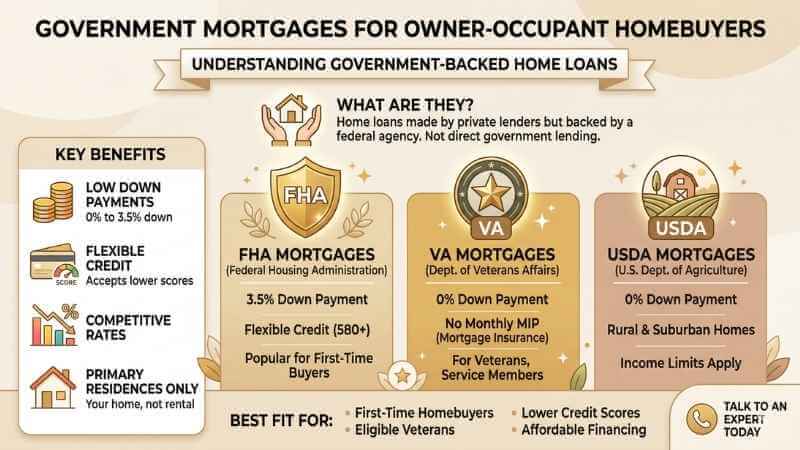
Government mortgages are home loans made by private lenders and backed by a federal agency such as the FHA, VA, or USDA. The government does not lend the money directly. It basically backs up a chunk of the loan, which lowers the risk for lenders. This makes it easier for eligible buyers to get approved with a smaller down payment or more relaxed credit requirements.
Key Features of Government Mortgages
- Low Down Payments: Depending on the program, you might be required to put down as little as 0%.
- Flexible Credit Score Standards: Some loans accept scores around 500 to 580.
- Competitive Rates: Government backing helps keep your interest rate lower than the average.
- Primary Residences Only: The loan is for your home, not your rental property.
- Streamlined Refinancing: Options exist to refinance another government-backed loan without too much hassle.
Why Are Government-Backed Loans Called Government Mortgages?

The government does not lend the money directly. Instead, private lenders such as banks, mortgage brokers, and mortgage companies originate and fund the loan. The federal agency backs a portion of the loan, making lenders more willing to approve borrowers who might not qualify for other types of loans.
That is why FHA, VA, and USDA loans are considered government mortgages even though they are made by private lenders.
Down Payment Requirements on Government Mortgages
One of the biggest advantages of government mortgages is that they often require a smaller down payment than many conventional loans. The exact amount depends on the loan program and the borrower’s eligibility.
- FHA loans require as little as 3.5% down for borrowers with qualifying credit scores. For buyers with lower credit scores, a larger down payment may be required.
- VA loans offer no down payment for eligible veterans, active-duty service members, and certain surviving spouses. This makes VA financing one of the most affordable paths to homeownership for qualified borrowers.
- USDA loans also allow zero down payment, but the home must be in a USDA-eligible area, and the borrower must meet household income limits.
Even when a government-backed loan requires little or no down payment, buyers still need to plan for closing costs, prepaid items, and any required cash reserves. Understanding the full upfront cost is just as important as knowing the minimum down payment.
Government Guarantee Promotes Private Lenders In Approving and Funding Government Mortgages
Due to the guarantee by the federal agencies, lenders can offer riskier loans to individuals with a low down payment at competitive mortgage rates. Homeownership by Americans promotes communities and businesses. Government-guaranteed loans offer homebuyers opportunities to qualify for a mortgage where they would otherwise not qualify in the open market.
Who Government Mortgages Are Best For
Government mortgages can be a strong fit for buyers who want to live in the home as their primary residence and need flexible financing options. These programs are often helpful for first-time homebuyers, borrowers with lower credit scores, buyers with limited down payment savings, eligible veterans, and households purchasing in USDA-eligible areas. FHA loans are often best for buyers who need a lower down payment and more flexible credit guidelines. VA loans are designed for eligible service members, veterans, and certain surviving spouses who want to buy with no down payment. USDA loans are a solid choice for buyers who qualify and are looking to buy in certain rural or suburban spots. They come with some perks, too, like no down payment if you meet the income limits. Choosing the right loan really boils down to a few things: your credit score, how much cash you have, whether you qualify for military benefits, your income, and the location of the property.
First-Time Buyer? Limited Credit?
Government mortgages make it easier to qualify for your new home.Government Mortgages vs. Conventional Loans
Government mortgages and conventional loans both help borrowers buy homes, but they are designed for different situations. Government-backed loans, such as FHA, VA, and USDA loans, are often easier to qualify for because they allow lower down payments and more flexible credit guidelines. Conventional loans are not backed by a federal agency, so lenders may apply stricter standards depending on the borrower’s credit profile, down payment, and overall risk.
For many owner-occupant homebuyers, government mortgages are a better fit when saving for a down payment is difficult or when credit is less than perfect.
FHA loans can help buyers who need flexibility. VA loans offer major advantages for eligible military borrowers, including no down payment in many cases. USDA loans can be attractive for qualified buyers in eligible rural areas. Conventional loans may be a better option for borrowers with strong credit, stable income, and a larger down payment. In some cases, conventional financing can reduce long-term borrowing costs, especially for buyers who want to avoid ongoing fees associated with certain government-backed loans. The best loan option depends on your credit score, cash available, property type, occupancy plans, and overall financial profile.
When a Government Mortgage Makes More Sense Than a Conventional Loan
Choosing between a government mortgage and a conventional loan often comes down to your financial profile and how much flexibility you need. A government-backed loan might be a great choice if your credit score isn’t the best, you don’t have much saved up for a down payment, or you’re looking for more flexible qualification rules. These programs are designed to help owner-occupant buyers who may not fit the tighter profile some conventional lenders prefer. An FHA loan may make more sense if you need a low down payment and more flexible credit guidelines. A VA loan may be the strongest option if you are an eligible veteran or active-duty service member because it can offer no down payment and no monthly mortgage insurance. A USDA loan may be a smart choice if the home is in an eligible area and your household income falls within program limits. A conventional loan may make more sense if you have strong credit, steady income, and enough savings to make a larger down payment. In that situation, conventional financing may offer fewer extra fees and more flexibility for certain property types. The best choice depends on your credit, cash to close, eligibility, and long-term homeowner goals.
How To Choose the Right Government Mortgage
The right government mortgage depends on your financial profile, eligibility, and the type of home you want to buy. FHA loans are often a strong option for buyers who need a lower down payment or more flexible credit requirements. VA loans can be ideal for eligible military borrowers who want to buy with no down payment and no monthly mortgage insurance. USDA loans may be a good fit for qualified buyers purchasing in eligible rural or suburban areas who meet household income limits. Before choosing a program, compare your credit profile, available cash, property location, and long-term housing goals. The best loan is not always the one with the lowest down payment. It is the one that fits your full financial situation and homeownership plans.
Key Features of Government Mortgages
- Low Down Payments: Depending on the program, you might be required to put down as little as 0%.
- Flexible Credit Score Standards: Some loans accept scores around 500 to 580.
- Competitive Rates: Government backing helps keep your interest rate lower than the average.
- Primary Residences Only: The loan is for your home, not your rental property.
- Streamlined Refinancing: Options exist to refinance another government-backed loan without too much hassle.
Government Loan Options for Owner-Occupants
FHA Mortgages (Federal Housing Administration)
FHA loans are popular for both first-time and returning buyers, allowing:
- 3.5% Down: You can qualify with a 580+ score, making homeownership more reachable.
- Manual Underwriting: If your finances are unusual, underwriters will consider more than just the numbers.
- Higher Debt Ratios: You can stretch your total debt payments slightly more than on standard loans.
- Mortgage Insurance: Expect a monthly MIP and possibly an upfront fee.
VA Mortgages (Department of Veterans Affairs)
VA loans are a benefit for those in military service and eligible surviving spouses, featuring:
- 0% Down Payment: You can finance the entire purchase price without an upfront payment.
- No Monthly MIP: Keep your monthly payment lower since no mortgage insurance fee exists.
- Competitive Rates: The government backing helps lenders keep rates attractive.
- Flexibility: Lower bar for credit and DTI ratios compared to standard mortgages.
USDA Mortgages (U.S. Department of Agriculture)
Focused on rural and some suburban homes, USDA loans provide:
- Zero Down Payment: You can obtain financing for the entire home price.
- Affordable Fees: The upfront and annual fees are often lower than FHA mortgage insurance costs.
- Income limits vary by county and change with family size.
- Choose a low-rate, fixed mortgage from a government program.
Why Government Mortgages Help Owner-Occupant Buyers
Government mortgages help many buyers become homeowners because they are built around affordability and flexibility. For buyers who plan to live in the home as their primary residence, these loans can make qualifying easier and reduce the cash required upfront.
One of the biggest benefits is the lower down payment requirement. FHA loans make it easier for eligible buyers to get a home with a low down payment. Plus, VA and USDA loans can even let some folks buy a house with no down payment! This can make a major difference for buyers with steady incomes who have not saved much for a home purchase.
Another key advantage is more flexible credit guidelines. Government-backed loans are often more forgiving than conventional mortgages for borrowers with less-than-perfect credit. FHA loans are especially known for helping buyers who need more flexibility, while VA loans can be a strong option for eligible military borrowers looking for easier qualification.
Government mortgages can also keep monthly payments more manageable.
VA loans do not require monthly mortgage insurance, which can lower the total payment for qualified borrowers. USDA loans also keep upfront costs low for eligible buyers in approved areas. While FHA loans do require mortgage insurance, they still give many borrowers a practical path to homeownership when conventional financing may be harder to qualify for. For many owner-occupant homebuyers, the biggest benefit is simple: these programs make homeownership possible sooner. No need to wait ages to save up for a bigger down payment or fix your credit score perfectly. There are loan programs out there that let buyers jump in right now, no matter their situation.
Owner-Occupants Get More Benefits
Enjoy lower rates, smaller down payments, and easier approval.Who Can Use Government Loans
Every government loan has specific rules:
- FHA Loans: At least a 580 score (or 500 with 10% down), a job history, and home occupancy.
- VA Loans: You must have served in the military, show a COE, and move in.
- USDA Loans: The house has to be in a rural zone, you have to meet income limits, and you have to live on the property.
Refinancing Options for Government Mortgages
Government-backed loans are great because they often have flexible refinance options for homeowners with FHA, VA, or USDA mortgages. These programs make it easier to refinance if you want to lower your interest rate, cut down your monthly payments, or switch to a more stable loan.
For homeowners with an FHA loan, the FHA Streamline Refinance may allow refinancing with less documentation than a standard refinance. In many cases, the process is simpler because the borrower may not need a full income review or a new home appraisal, depending on the situation and lender requirements.
For borrowers with an existing VA loan, the VA Interest Rate Reduction Refinance Loan (IRRRL) can help lower the rate and payment with a simplified process. This option is designed for eligible homeowners who already have a VA mortgage and want a more affordable loan. For homeowners with a USDA loan, the USDA Streamlined Assist Refinance can also reduce paperwork compared with a traditional refinance. This may help qualified borrowers lower their monthly payments without going through a full refinance. While these refinance programs can be helpful, they are not automatic approvals. Lenders still review eligibility, and the refinance should provide a clear benefit to the borrower.
Government Mortgages vs. Conventional Loans
Conventional mortgages work well for investors, but owner-occupants usually gain more from government loans. Here’s why:
- They need a smaller down payment.
- They welcome lower credit scores.
- Lenders get extra security from the government.
- Stronger borrowers with top credit might prefer a conventional option to skip the mortgage insurance that government loans require.
Government mortgages empower owner-occupant buyers to make homeownership practical. Whether powered by FHA, VA, or USDA, these loans help families, first-timers, and veterans overcome the affordability divide and secure a home to call their own.
Final Thoughts on Government Mortgages for Owner-Occupant Buyers
Government-backed loans can open the door to homeownership for many buyers who need flexible financing on a primary residence. By understanding how FHA, VA, and USDA loans work, you can better compare your options and choose the mortgage program that fits your needs. If you have questions about which government loan may be the best fit, speaking with a licensed mortgage professional can help you review your options.
Frequently Asked Questions About Government Mortgages:
Do I Have to be a First-Time Homebuyer to Get a Government Mortgage?
No. You do not have to be a first-time homebuyer to qualify for a government-backed mortgage. FHA, VA, and USDA loans can all be used by repeat buyers as long as the borrower meets the program’s eligibility, occupancy, and property requirements. USDA specifically states that its program is not limited to first-time buyers.
Can I Use an FHA, VA, or USDA Loan to Buy an Investment Property?
In most cases, no. Government-backed mortgages are intended for homes you plan to occupy as your primary residence. FHA defines an owner-occupant borrower as someone residing in the property as a principal residence, VA requires occupancy for most purchase loans, and USDA requires the borrower to personally occupy the home as a primary residence.
What is the Minimum Down Payment for a Government Mortgage?
It depends on the program. FHA allows qualified borrowers to buy with as little as 3.5% down. VA loans may allow 0% down for eligible borrowers. USDA loans also offer zero-down financing for qualified buyers in eligible areas who meet income rules.
What Credit Score Do You Need for a Government-Backed Loan?
There is no one-size-fits-all answer because lender standards still matter. FHA is known for more flexible credit requirements than many other loan types, and USA.gov notes that FHA has a lower credit-score requirement than most home loans. VA says borrowers must meet both VA and lender credit requirements. USDA guaranteed loans do not publish a single universal score on the program page. However, they do require income and occupancy eligibility, and lender overlays can still affect approval.
Are USDA Loans Only for Farms or Very Remote Areas?
No. USDA loans are not just for farms. They are for eligible residential properties in approved rural and some suburban areas. The home must be your primary residence, and household income generally cannot exceed 115% of the area median income for the guaranteed program.
Do Government Mortgages Always Require Mortgage Insurance?
No. FHA loans require mortgage insurance, and USDA loans include guarantee-related fees. VA loans do not have monthly mortgage insurance, which is one reason many eligible military borrowers prefer them.
This article about “Government Mortgages for Primary Residence Homebuyers” was updated on April 8th, 2026.