This guide covers how credit scores affect conventional loans. Two of the most popular mortgage loan programs today are FHA and Conventional loans. Conventional loans are not government loans like FHA, VA, USDA. Conventional loans are called conforming loans because they need to conform to Fannie Mae or Freddie Mac Guidelines. Credit scores play a major impact on the pricing of mortgage rates on all mortgage loan programs.
Credit scores play a larger factor on Conventional than FHA loans. There are many negatives how credit scores affect conventional loans. There are three major credit reporting agencies, also called credit bureaus.
They are Experian, Transunion, and Equifax. Each of these credit-reporting agencies has their own ways of analyzing a consumer’s credit and coming up with credit scores. Every consumer should have three credit scores, one from each credit bureau. Lenders will pull all three credit scores from each of the three credit reporting agencies. In the following paragraphs, we will cover how credit scores affect conventional loans.
How Credit Scores Affect Conventional Loans: Mortgage Rates, PMI, and Approval
Credit scores are the core of the conventional mortgage process. Many homebuyers think scores only determine whether you qualify, but they also affect your interest rate, private mortgage insurance, loan costs, down payment options, debt-to-income ratios, and automated approval. Conventional loans differ from government-backed loans such as FHA, VA, or USDA mortgages. Most follow rules from Fannie Mae or Freddie Mac, but many lenders add extra requirements called lender overlays.
Credit Score Ranges and Conventional Loan Impact
Fannie Mae’s current guidance states that credit score requirements depend on the loan type and underwriting path. Its recent policy updates removed the hard 620 minimum representative credit score requirement for certain new Desktop Underwriter loan casefiles created on or after November 16, 2025.
Freddie Mac’s guide also notes that a minimum Indicator Score is not required for certain Accept Mortgages. However, lenders may still impose their own minimum score overlays.
At Gustan Cho Associates, we often help borrowers who have been turned down by other lenders. Usually, the problem is the lender’s extra rules, not the guidelines from Fannie Mae or Freddie Mac.
What Is a Conventional Loan?
A conventional loan is a mortgage that is not insured or guaranteed by a federal government agency. Conventional loans are usually backed by Fannie Mae or Freddie Mac and are common for primary residences, second homes, and investment properties.
Conventional Loans Versus FHA Loans
Conventional loans usually benefit borrowers with strong credit. If your score is higher, you may get better rates, lower PMI, and more flexible loan terms. FHA loans, however, often help those with lower scores, higher debt, or recent credit problems.
Credit scores carry extra weight with conventional loans because lenders use them to measure risk. If your score is strong, you are seen as a safer bet and may enjoy lower costs. If your score is lower, you might still qualify, but you could face higher PMI premiums or stricter approval standards.
How Credit Scores Affect Conventional Loan Approval
Credit scores shape your path to conventional loan approval in several important ways. Your score can tip the scales on automated approval, influence your required down payment, impact PMI costs, and determine how much risk a lender is willing to accept.
Automated Underwriting System Approval
Most conventional loans are run through an automated underwriting system, also called AUS. Fannie Mae uses Desktop Underwriter (DU). Freddie Mac uses Loan Product Advisor (LPA).
The AUS reviews the borrower’s full mortgage profile, including credit score, credit history, income, assets, employment, debt-to-income ratio, reserves, loan-to-value, property type, and occupancy.
Having a lower credit score does not always mean you will be denied. If the rest of your application is strong, you may still get approved by the automated system. For example, good income, low debt, savings, steady work, and a larger down payment can help offset a lower score.
Credit Score Is Not the Only Approval Factor
Lenders do not base conventional loan approval solely on your credit score. They consider your entire financial profile. For example, a borrower with a 760 score but high debt and unstable income may have more difficulty qualifying than someone with a lower score but stronger finances in other areas.
Your credit score directly affects your mortgage rate. The higher your score, the better your rate will likely be. A lower score can make borrowing more expensive.
Applicants with higher credit scores are perceived as lower risk and may qualify for more favorable interest rates. This can reduce both monthly payments and the total interest paid over the life of the loan.
Lower Credit Scores Can Increase the Cost of Borrowing
You can still secure a conventional loan with a lower credit score but expect to pay a premium. Lenders may tack on higher rates, extra discount points, or both, raising your overall cost.
Why Mortgage Rates Are Different From Advertised Rates
Advertised mortgage rates online may not reflect the actual rate an applicant will receive. The final rate depends on the complete loan profile, including credit score, down payment, loan amount, property type, and other relevant factors.
Loan-Level Price Adjustments and Credit Scores
Loan-level price adjustments (LLPAs) are additional costs that can apply to conventional loans. LLPAs are based on things like your credit score, loan-to-value ratio, property type, loan purpose, and other risk factors.
Fannie Mae’s LLPA Matrix states that LLPAs are assessed based on loan features such as credit score, loan purpose, occupancy, number of units, product type, and other loan delivery factors. Freddie Mac uses a similar credit fee structure for eligible mortgages it purchases.
How LLPAs Affect Borrowers
LLPAs are not always shown as a separate fee. They might be included in your interest rate, charged as discount points, or built into the overall loan cost.
This means two people applying for the same loan on the same day could walk away with very different rates. For instance, someone with a 780-credit score might snag a much better deal than someone with a 660.
Credit Score and Loan-to-Value Work Together
Lenders typically evaluate credit scores in conjunction with the loan-to-value (LTV) ratio, which compares the loan amount to the property’s value. Applicants with lower credit scores and smaller down payments may incur higher costs than those with higher scores and greater equity.
How Credit Scores Affect Private Mortgage Insurance
Private mortgage insurance, or PMI, is usually required if you put down less than 20% on a conventional loan.
Higher Credit Scores Can Lower PMI
PMI costs for conventional loans are all about risk. A higher credit score can shrink your PMI premiums, which means a lighter monthly payment.
How Credit Scores Can Increase PMI
A lower credit score can push your PMI costs higher. Even if you land a decent interest rate, expensive PMI might make it tougher to qualify for your desired monthly payment.
PMI is part of your monthly mortgage payment, so it affects your debt-to-income ratio. If your PMI is high, it can lower your buying power or make it harder to get approved if you are close to the DTI limit.
Lower Credit Scores Can Increase the Cost of Borrowing
Different credit score ranges can affect your options for a conventional loan. These ranges are for general guidance only. Final approval depends on the automated system, lender rules, and your full application.
Excellent Credit Scores
With an excellent credit score, you are in a prime position for the best rates on a conventional loan. You could also enjoy lower PMI, smoother automated approvals, and a wider range of loan options.
Good Credit Scores
Applicants with good credit scores still have access to attractive conventional loan options. While you might not get the very lowest rates, strong finances can help you secure good terms.
If your credit score is fair, you may still qualify for a conventional loan, but your rates and PMI will probably be higher. Comparing conventional and FHA loans can help you find a better monthly payment.
The automated system may ask for more savings, a lower debt-to-income ratio, or a bigger down payment.
Some lenders may still deny the application due to their additional rules, even if agency guidelines are met. Credit scores can also affect the down payment needed for a conventional loan.
Low Down Payment Conventional Loans
Certain conventional loan programs permit low down payments for qualified applicants. However, lower credit scores may make it more difficult to secure approval for these options.
Larger Down Payments
A bigger down payment makes lenders more comfortable. If your credit score is lower, increasing your down payment, lowering your loan-to-value ratio, or saving more money can improve your chances of approval. Gift funds are often permitted with conventional loans and can be used to increase the down payment or cover closing costs. Proper documentation of these funds is required.
See How Your Credit Score Affects Your Loan
Your credit score can impact your conventional loan rate, PMI, down payment, approval options, and overall mortgage costs.
How Credit Scores Affect Debt-to-Income Ratio
Debt-to-income ratio (DTI) measures monthly debt obligations relative to gross income. Credit scores can influence the degree of flexibility allowed with DTI requirements.
If you have a higher credit score and a solid financial profile, the automated system may cut you some slack on DTI limits. While it is not a sure thing, it definitely works in your favor.
Lower Credit Scores May Require Lower DTI
Lower credit scores may necessitate a reduced DTI for approval. The automated system may also require lower debt levels, increased savings, or additional compensating factors.
Paying Down Debt Can Help More Than Raising Score Alone
Sometimes, tackling your debt does more than just nudge your credit score upward. Paying down credit card balances can improve your credit utilization, shrink your monthly payments, and give both your score and DTI a healthy boost.
How Credit History Affects Conventional Loans
Lenders evaluate more than just a credit score; they also review the entire credit report.
Late Payments
Recent late payments can throw a wrench in your conventional loan approval. Missed payments on mortgages, auto loans, or other big accounts raise red flags for lenders.
Collections and Charge-Offs
Paying off collections or charge-offs is not always required before closing, though these items can still impact loan approval. It is advisable to consult a mortgage professional before addressing old collections, as payment may update the credit report and alter the applicant’s profile.
Credit Disputes
Credit disputes can cause issues during the mortgage process. Some disputed accounts may need to be fixed before approval. This can affect your credit score, automated results, and underwriting. Being an authorized user on someone else’s account can help if the account is well managed with low balances and on-time payments, but it can hurt your score if not.
Credit Scores Used By Mortgage Lenders

All lenders use the middle credit score when qualifying a mortgage loan applicant: The middle score is what is used to qualify a mortgage loan applicant. Middle credit scores are what is used to determine what mortgage rate borrowers will get. The higher the credit scores, the lower the mortgage rates. The lower the credit scores the higher the mortgage rates.
Lenders view a mortgage loan applicant with a lower credit score as higher risk. This is the reason why they charge higher mortgage rates for a mortgage loan applicant with a lower credit score.
How credit scores affect conventional loans? How credit scores affect conventional loans are what determines the mortgage rates. Credit scores affect the pricing or mortgage rates for other loan programs but are especially more sensitive on conventional loans.
Understanding How Credit Scores Affect Conventional Loans
Credit scores play a significant role in determining the terms and conditions of conventional loans. A conventional loan is a mortgage that is not insured or guaranteed by a government agency, such as the Federal Housing Administration (FHA) or the Department of Veterans Affairs (VA). Instead, it is backed by private lenders and follows guidelines set by Fannie Mae and Freddie Mac, two government-sponsored enterprises.
How Credit Scores Affect Conventional Loans with Mortgage Rates
In this section, we will cover how credit scores affect conventional loans: Higher Credit Score = Lower Interest Rate: Borrowers with higher credit scores typically qualify for lower interest rates. Lenders view borrowers with higher credit scores as less risky, and therefore, they reward them with lower interest rates. Conversely, lower credit scores may result in higher interest rates to compensate for the perceived risk.
How Credit Scores Affect Conventional Loans on Getting Approved
Higher Credit Score = Easier Approval: A higher credit score improves your chances of loan approval. Lenders use credit scores to assess the likelihood of a borrower repaying the loan. A higher credit score indicates a more favorable credit history, making it easier to qualify for a conventional loan. Borrowers with higher credit scores may have more flexibility in negotiating loan terms and conditions. They may be eligible for larger loan amounts and more favorable repayment terms.
How Credit Scores Affect Conventional Loans on Down Payment
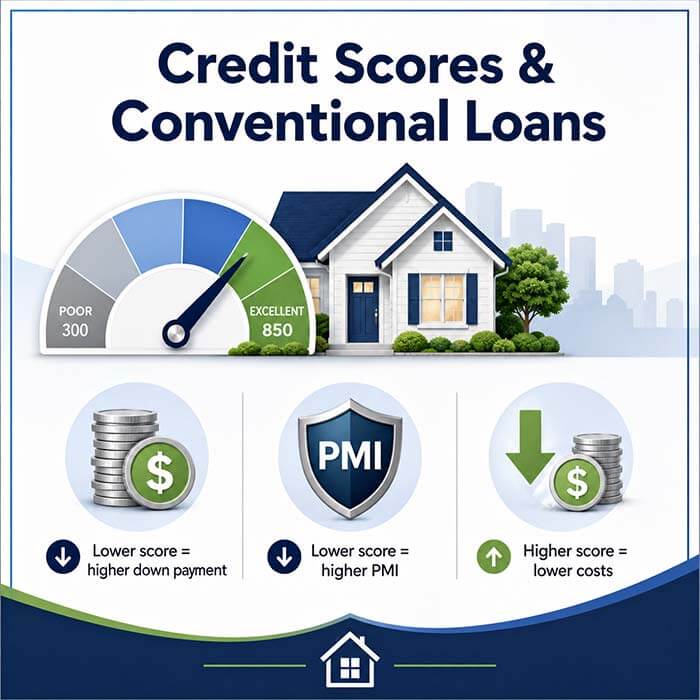
Lower Credit Score = Higher Down Payment: Borrowers with lower credit scores may be required to make a larger down payment. This is a risk mitigation strategy for lenders, as a larger down payment reduces their exposure to potential losses. Lower Credit Score = Higher PMI Premiums: If your credit score is on the lower side, lenders may require you to pay for private mortgage insurance (PMI). PMI protects the lender in case of default. Higher credit scores may result in lower PMI premiums or the possibility of avoiding PMI altogether.
Credit Score Thresholds
Minimum Credit Score Requirements: Conventional loans have minimum credit score requirements, and borrowers with credit scores below these thresholds may face challenges in obtaining a loan. The specific credit score requirements can vary among lenders and loan programs. It’s important for borrowers to be aware of their credit scores and take steps to improve them if necessary, before applying for a conventional loan. Monitoring your credit report, paying bills on time, and managing your credit responsibly can contribute to a healthier credit profile and improve your chances of securing a favorable conventional loan.
How Credit Scores Affect Conventional Loans on PMI Premium
Two factors that affect mortgage rates on conventional loans are credit scores and loan-to-value. Mortgages rates are more sensitive to conventional loans than any other loan program. FHA, VA, and USDA loans have government guarantee against borrowers’ default on their mortgage loans. However, the only guaranteed Fannie Mae and Freddie Mac Loans (Conforming Conventional Loans) has is the guarantee of the private mortgage insurance companies
Private mortgage insurance on conventional loans also check borrower’s credit scores and loan to value before they issue rates on private mortgage insurance
When consumers hear an advertisement on conventional loans, they normally quote par mortgage rates without any pricing adjustments. Par rates on conventional loans are the best mortgage rates offered by lenders to prime borrowers. Prime borrowers are borrowers with at least a 740 credit scores and with at least 20% down payment.
How Credit Scores Affect Conventional Loans on Loan Level Pricing Adjustments
There are pricing adjustments on conventional loans for every 20 Point drop: For example, a prime borrower with 20% down payment with a 740-credit score may be offered a mortgage rate of 4.0%. A borrower with 20% down payment with credit scores between 720 and 739 credit scores their mortgage rates may be 4.25%.
Again, if a borrower with 20% down payment has credit scores between 700 and 719 their mortgage rates may be 4.5%. Mortgage rates with 20% down payment with credit scores under 700 may be 4.75%.
These mortgage rates are just for illustration purposes only and do not reflect mortgage rates today. As for the question of how credit do scores affect conventional loans, this will be a perfect example on how credit scores affect conventional loans in a big way with regards to mortgage rates.
Rates on How Credit Scores Affect Conventional Loans Versus Other Loan Programs
Again, credit scores play a big impact on mortgage rates. We will discuss how credit scores affect conventional loans on pricing, down payment, private mortgage insurance, and getting an AUS approval. Lenders believe that a higher credit score borrowers have the fewer probability borrowers have of defaulting on their home loans.
Risk versus rewards is the model behind lenders charging higher mortgage rates on lower credit score borrowers. The higher the borrowers credit scores, the less risky they are to default on their loans.
The higher the credit scores the lower the lender can offer mortgage rates to borrowers with higher credit scores. How about FHA loans? With FHA loans, the same concept applies. However, credit scores and loan to value do not greatly affect FHA loans like they do Conventional loans. This because FHA loans are insured by the government against the borrower defaulting on their home loans.
Case Scenario How Credit Scores Affect Conventional Loans
Let’s take an example with FHA loans compared to the example on Conventional mortgage rates from the previous paragraph: Let’s assume that FHA par mortgage rates are 4.0%. To get this mortgage rate, the borrower may just need credit scores of 640. No matter how much higher borrowers’ credit is than the par credit score requirement of 640, the 4.0% par FHA mortgage rate will be the best rates available to the borrower.
On the flip slide, if the borrower has credit scores between 620 and 639, they may get a loan level pricing adjustment (LLPA) of 0.25%. Now the FHA mortgage rates for this borrower is 4.25% versus 4.0%.
If this borrower has credit scores between 600 and 619 then the borrower may get a mortgage rate of 4.5%. FHA mortgage rates for borrowers under 600 credit scores may yield 4.75%. Again, these mortgage rates are just for illustration purposes only and do not reflect today’s FHA mortgage rates. Loan-to-value does not have any impacts on FHA mortgage rates like they do with Conventional loans.
FAQs About How Credit Scores Affect Conventional Loans
What Credit Score Do You Need for a Conventional Loan?
- Many lenders still use 620 as a common minimum credit score benchmark for conventional loans, but current agency rules and AUS findings can be more nuanced depending on the loan type and borrower profile.
- Some lenders may require higher scores because of lender overlays.
Does a Higher Credit Score Lower Your Conventional Mortgage Rate?
- Yes.
- A higher credit score can help borrowers qualify for better conventional mortgage pricing.
- A credit score affects risk-based pricing, which can influence interest rates, points, and overall loan costs.
Can I Get a Conventional Loan with a Lower Credit Score?
- Yes, it may be possible, but approval depends on the full file.
- AUS findings, down payment, income, DTI, reserves, credit history, and lender overlay all matter.
How Does a Credit Score Affect PMI on a Conventional Loan?
- A credit score can strongly affect conventional PMI.
- Higher scores usually qualify for lower PMI, while lower scores can increase the monthly mortgage insurance cost.
Is FHA Better Than Conventional with a Low Credit Score?
- FHA may be better for some borrowers with lower credit scores or higher debt-to-income ratios.
- However, conventional may still be better for borrowers with strong compensating factors.
- The best choice depends on the full monthly payment and approval structure.
Can Lender Overlays Cause A Conventional Loan Denial?
- Yes.
- A borrower can meet Fannie Mae or Freddie Mac guidelines and still be denied by a lender because of overlays.
- This is why borrowers denied by one lender should consider getting a second opinion.
Don’t Let Credit Score Questions Stop You
Even if your credit score is not perfect, you may still have conventional or alternative mortgage options available.