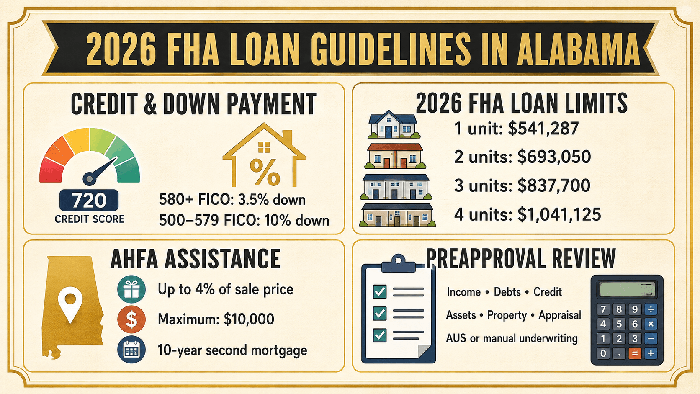
FHA loan guidelines Alabama can make buying a home possible for borrowers who may not fit conventional loan requirements. With a 580 credit score, the minimum down payment is generally 3.5%. Scores between 500 and 579 usually require a 10% down payment. The lender will also look at income, monthly debts, recent credit history, and the property before approving the loan.
FHA Credit Score and Down Payment Requirements
FHA loan guidelines in Alabama use the same minimum credit score and down payment rules that apply nationwide:
- A 580 credit score or higher typically requires at least a 3.5% down payment.
- A credit score from 500 through 579 generally requires a minimum 10% down payment.
- Borrowers with credit scores below 500 typically cannot qualify for FHA financing.
Meeting the minimum score does not ensure approval. The lender will also review recent payment history, income, monthly debts, available funds, and the automated underwriting findings. Some lenders impose higher minimum scores or other requirements known as lender overlays. The down payment may come from the borrower’s savings, eligible gift funds, or an approved down-payment assistance program. Every source must be documented. Buyers should also budget for closing costs, prepaid property taxes, homeowners’ insurance, and other expenses separate from the required down payment.
FHA Debt-to-Income Ratio Guidelines
FHA does not apply one debt-to-income ratio limit to every borrower. The acceptable DTI depends on the borrower’s credit profile, income, monthly obligations, and whether the loan receives an automated underwriting approval or requires manual underwriting. An automated approval evaluates the entire application through FHA’s TOTAL Mortgage Scorecard. A manually underwritten loan follows defined ratio limits. It may require documented compensating factors when the borrower exceeds FHA’s standard benchmarks.
FHA Automated Underwriting
Most FHA applications are evaluated through an automated underwriting system using FHA’s TOTAL Mortgage Scorecard. The system reviews the complete loan file, including credit, income, employment, assets, monthly debts, payment history, and the proposed housing expense. FHA does not publish a universal maximum DTI for all borrowers who receive automated approval. Two applicants with the same DTI can receive different findings because their overall financial profiles are different. Ratios such as 46.9% front-end and 56.9% back-end should not be treated as guaranteed limits or an automatic right to approval.
FHA Manual Underwriting
A loan may require manual underwriting when the automated system returns a Refer finding or when FHA rules require the lender to downgrade the file. Manual underwriting follows defined limits for the housing ratio and total debt-to-income ratio. The general FHA manual underwriting framework is:
- 31%/43%: Standard maximum for borrowers with a credit score of 580 or higher when no compensating factors are used. Borrowers with scores from 500 through 579, or without a credit score, are generally limited to this tier.
- 37%/47%: Available to borrowers with a credit score of at least 580 and one qualifying compensating factor, such as verified cash reserves, a minimal increase in housing expense, or sufficient residual income.
- 40%/40%: Available to borrowers with a credit score of at least 580 who meet FHA’s requirements for having no discretionary debt.
- 40%/50%: Available to borrowers with a credit score of at least 580 and at least two qualifying compensating factors.
Compensating factors must meet FHA’s definitions and be documented in the loan file. Reaching one of these maximum ratios does not guarantee approval, as the underwriter must still evaluate the borrower’s credit history, housing payment history, income stability, assets, and ability to manage the proposed mortgage payment.
2026 FHA Loan Limits in Alabama
All Alabama counties use the 2026 national FHA floor limits. The maximum base loan amount depends on the number of residential units in the property.
| Property type | 2026 FHA loan limit |
|---|---|
| One-unit property | $541,287 |
| Two-unit property | $693,050 |
| Three-unit property | $837,700 |
| Four-unit property | $1,041,125 |
These limits apply to FHA case numbers assigned on or after January 1, 2026. A borrower purchasing a two- to four-unit property must occupy one unit as a principal residence and meet the applicable FHA qualification requirements. The loan limit applies to the base FHA mortgage rather than the purchase price. A buyer may purchase a more expensive property by making a larger down payment, provided the base loan amount does not exceed the applicable limit.
FHA Mortgage Insurance and Closing Costs
FHA loans require upfront and annual mortgage insurance premiums. The initial premium typically amounts to 1.75% of the total loan amount. It can be paid at closing or added to the loan balance. The annual mortgage insurance premium is split into monthly payments, which are included in the mortgage payment. Costs vary based on loan term, amount, and original loan-to-value ratio. With a minimum down payment of 3.5%, annual mortgage insurance typically lasts for the life of the loan. If the original loan-to-value ratio is 90% or lower, it may end after 11 years. Closing costs are separate from the down payment and mortgage insurance. Under FHA loan guidelines in Alabama, buyers may need funds for expenses such as:
- Lender and underwriting charges
- FHA appraisal fees
- Title and settlement services
- Recording charges
- Prepaid interest
- Property taxes
- Homeowners insurance
- Initial escrow deposits
The seller may contribute up to 6% of the sale price toward qualifying closing costs and authorized expenses. Buyers may also use eligible gift funds, lender credits, or approved assistance, but every source of funds must be properly documented.
Alabama Down Payment Assistance
The Alabama Housing Finance Authority provides down payment assistance through the Step Up and First Step programs, offering qualified buyers up to 4% of the purchase price or $10,000, whichever amount is less. The assistance is not a grant. It is secured by a 10-year second mortgage and combined with the buyer’s 30-year first mortgage. The second-mortgage payment must be included when calculating the borrower’s debt-to-income ratio.
AHFA Step Up
Step Up is designed for moderate-income buyers who can afford a mortgage but need help with the down payment. First-time homebuyer status is not required, and the program does not use the same purchase-price limits as First Step. General Step Up requirements include:
- Qualifying income of $172,800 or less
- Minimum credit score of 640
- Maximum DTI of 45%
- Purchase of a new or existing Alabama home
- Occupancy as the borrower’s principal residence
- Completion of an approved homebuyer education course
- Application through an AHFA-participating lender
Step Up may be paired with an eligible FHA, VA, USDA, or HFA Advantage conventional mortgage.
AHFA First Step
First Step is a Mortgage Revenue Bond program that offers program-specific 30-year fixed mortgage rates. It is primarily intended for first-time homebuyers, although repeat buyers may qualify when purchasing in an eligible target area. First Step borrowers must meet AHFA’s credit and DTI standards, as well as federally established income and sales price limits. Those limits depend on the property’s location and whether it is in a target or non-target area. Eligible borrowers may receive up to 4% of the sales price, capped at $10,000, through the program’s 10-year second mortgage. The home must be located in Alabama and used as the borrower’s principal residence. Program requirements, income limits, sales-price limits, and interest rates can change. Buyers should have a participating lender confirm current eligibility before relying on AHFA assistance to complete the purchase.
Lower Credit Score? FHA May Still Be an Option
Alabama homebuyers with past credit issues, collections, bankruptcy, or higher DTI may still qualify through FHA, depending on the full loan file.FHA Property and Appraisal Requirements
The home must be safe, structurally sound, and suitable for occupancy. An FHA-approved appraiser will also confirm the property’s value and note conditions that may need to be repaired before closing. An FHA appraisal is mainly for the lender and does not replace a home inspection. Buyers may still want an independent inspection to assess the home’s condition more closely.
FHA Loans After Bankruptcy or Foreclosure
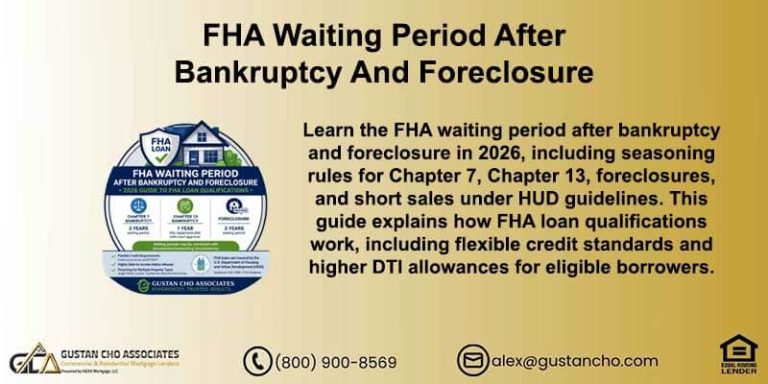
Past credit problems do not automatically rule out an FHA loan. The waiting period depends on what happened and when.
Chapter 7 Bankruptcy
The standard waiting period is two years from the discharge date. A shorter period may be considered in limited cases involving documented circumstances beyond the borrower’s control.
Chapter 13 Bankruptcy
A person can qualify for Chapter 13 relief after 12 months of the repayment plan, as long as all required payments have been made on time. Furthermore, court approval is also needed when the bankruptcy is still ongoing.
Foreclosure, Short Sale, or Deed-in-Lieu
The FHA usually requires that three years have passed since a foreclosure, a deed in lieu, or a short sale. However, some documented exceptions may permit a shorter waiting period.
FHA Guidelines for Collections and Charge-Offs
The Federal Housing Administration (FHA) does not require you to pay off all collection accounts before closing. If your non-medical collection accounts total $2,000 or more, the lender will handle the debt by paying it off, setting up a payment plan, or using a monthly payment equal to 5% of the total balance if no payment plan is available. Charge-offs are treated differently from regular collection accounts and usually do not have to be paid to qualify for FHA financing. Still, lenders will look at your overall credit history when reviewing your application.
FHA Loans Versus Conventional Loans in Alabama
FHA financing can be easier to qualify for when credit is less established or the borrower has a higher debt-to-income ratio. Conventional loans may be a better fit for borrowers with stronger credit and enough equity to avoid private mortgage insurance. The better option depends on the borrower’s credit, down payment, monthly debts, and the loan’s long-term cost.
FHA Guidelines Versus Lender Overlays
FHA sets the minimum rules for the loan program, but lenders can add stricter requirements of their own. These extra rules are known as lender overlays. A borrower who is turned down by one lender may still qualify elsewhere if the denial was caused by that lender’s internal guidelines rather than an FHA requirement.
Alabama FHA Approval Example
The following example is hypothetical and is provided only to show how FHA loan guidelines in Alabama could apply to a purchase transaction. It is not a commitment to lend or a guarantee of approval. Assume an Alabama homebuyer has a 660 credit score, earns $6,500 in gross monthly income, and has $500 in monthly debts. The borrower plans to purchase a primary residence for $250,000.
Estimated Funds Needed
- Purchase price: $250,000
- Minimum 3.5% down payment: $8,750
- Estimated closing costs and prepaid expenses: $7,000
- Total estimated funds needed: $15,750
- Possible AHFA assistance: $10,000
- Estimated borrower contribution: $5,750
The $10,000 in possible assistance represents 4% of the sales price, subject to AHFA’s maximum. The assistance would be provided through a 10-year second mortgage rather than a grant. The borrower would still need to meet AHFA’s credit, income, DTI, education, occupancy, and participating-lender requirements.
Estimated Debt-to-Income Ratios
Assume the total proposed housing payment is $2,100 per month. This estimate includes the first-mortgage payment, property taxes, homeowners’ insurance, FHA mortgage insurance, and the projected AHFA second-mortgage payment.
- Housing DTI: $2,100 ÷ $6,500 = 32.3%
- Total DTI: ($2,100 + $500) ÷ $6,500 = 40.0%
In this example, the loan would be submitted through the FHA’s automated underwriting system. Approval would depend on the complete file, including credit history, income stability, assets, sources of funds, property eligibility, and the FHA TOTAL Mortgage Scorecard findings.
Documents and Steps for Preapproval
An FHA preapproval gives an Alabama homebuyer an estimated price range before making an offer. The lender reviews the borrower’s credit, income, monthly debts, employment, and available funds in accordance with current FHA requirements. Documents commonly requested include:
- Government-issued identification and Social Security number
- Recent pay stubs
- W-2s or 1099s from the previous two years
- Federal tax returns when required
- Bank and investment-account statements
- Current mortgage or rental-payment information
- Documentation for Social Security, disability, pension, child support, or other qualifying income
- Gift-fund documents when someone is helping with the purchase
- Bankruptcy, foreclosure, divorce, or payment-plan documents when applicable
- AHFA documents if down-payment assistance will be used
The borrower first completes a mortgage application and authorizes the lender to review credit. The lender then verifies the submitted documents, calculates the proposed housing payment and DTI, and submits the loan through an automated underwriting system. If the file cannot receive an automated approval or FHA rules require a downgrade, the lender may review it for manual underwriting. Once the borrower meets the applicable requirements, the lender can issue a preapproval letter that shows the estimated loan amount and purchase price range. A preapproval is not final loan approval. The property, appraisal, title work, updated finances, and underwriting conditions must still be reviewed. Borrowers should avoid opening new credit, increasing credit-card balances, changing jobs, moving money without documentation, or making large purchases before closing. Any major financial change can affect the original preapproval.
Final Thoughts on FHA Loan Guidelines Alabama
FHA Loan Guidelines in Alabama can provide a path to homeownership for buyers with limited savings, lower credit scores, higher debt ratios, or a history of credit problems. However, meeting FHA’s minimum requirements does not guarantee approval. The lender must evaluate the complete financial profile and the property being purchased.
Buyers should get preapproved before making an offer, especially when manual underwriting or AHFA assistance may be needed. An early review can identify documentation problems, lender overlays, or expenses that could otherwise delay closing.
A denial from one lender does not always mean the borrower is ineligible for FHA financing. Another lender may reach a different decision if the original denial resulted from an internal overlay rather than an FHA requirement.
Frequently Asked Questions About FHA Loan Guidelines Alabama:
Do You have to be a First-Time Homebuyer to Get an FHA Loan?
No. FHA loans are available to both first-time and repeat buyers, provided the borrower and property meet FHA requirements.
Is the Seller Permitted to Pay Closing Costs on an FHA Loan?
Correct. The FHA guidelines allow interested parties, including the seller, to pay up to 6 percent of the sale price towards eligible closing costs and approved expenses.
Can I have More Than One FHA Loan at the Same Time?
Generally, FHA financing is intended for a borrower’s principal residence, so having two FHA-insured mortgages at once is limited to certain exceptions.
Can a Family Member Help Me Qualify Without Living in the Home?
FHA allows non-occupying co-borrowers in certain situations. The lender still has to document and qualify everyone who is obligated on the mortgage.
Can I Buy a Manufactured Home with FHA Financing in Alabama?
Yes, if the home and site meet the applicable FHA requirements. Manufactured homes must also comply with installation standards and applicable state and local requirements.
Is it Possible to Refinance an FHA Loan Into a Conventional Loan at a Later Date?
Yes. An FHA mortgage can later be refinanced into a conventional loan if the borrower meets the conventional lender’s credit, income, equity, and other qualification requirements.
Is it Possible to Use an FHA 203(k) Loan to Buy a Fixer-Upper in Alabama?
Yes. An FHA 203(k) loan can combine the home’s purchase price and eligible renovation costs into one mortgage. The borrower is required to use the property as their primary home, and the home, repairs, appraisal, contractors, and renovation budget must satisfy the applicable FHA and lender requirements.
This article about “FHA Loan Guidelines in Alabama: Requirements for Homebuyers” was updated on August 17th, 2026.