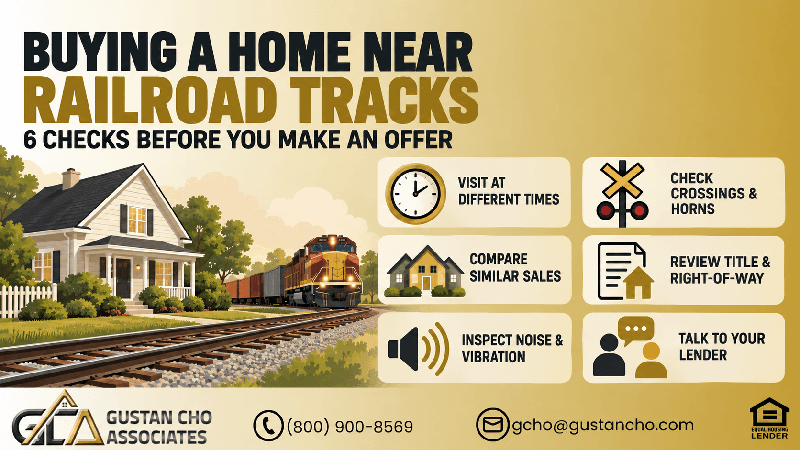
Buying a home near railroad tracks is not automatically a bad investment or a deal-breaker for a mortgage. The important questions are how often trains pass, whether nearby crossings bring horn noise, how much vibration reaches the home, and whether comparable sales support the price. Buyers should visit at different times, review the title and survey issues, and discuss the property with the lender before the appraisal.
Buying a Home Near Railroad Tracks: Benefits and Risks
Often, homes situated close to railroad tracks sell for less. This may be an advantage for buyers who otherwise wouldn’t be able to afford to live in certain neighborhoods or on certain pieces of land. It is possible that a home by the tracks could actually end up costing more. The benefits versus the risks of living close to the tracks include train noise and vibration, as well as potential resistance from buyers when the time comes to sell the home. It is acceptable to purchase a home by the tracks, as long as the price reflects the situation and the buyer understands the risks associated with train activity.
How Railroad Tracks Can Affect Home Value
There is no proven way to calculate the impact that living near a railroad track has on home value. Much of it depends on the property and the surrounding area. There are many variables that can impact home value. They include:
- The distance from the home to the tracks
- The frequency of train travel
- If the trains are freight or passenger trains
- How many crossings are there
- How loud the trains are
- If the tracks are visible from the house
- How interested are home buyers in purchasing real estate?
- How similar nearby homes have sold
For Fannie Mae appraisals, the appraiser must look at the surrounding area and consider the current or expected use. If that use is in conflict with the value of the property and how marketable it is, then that use must be taken into account for the appraisal. The appraiser must base decisions on actual data rather than on assumptions. For this reason, a blanket statement such as “railroad tracks decrease home values by 10%” should not be applied to every property.
How Appraisers Evaluate Homes Near Railroad Tracks
The appraiser should identify the railroad as an external influence and determine whether buyers in that market react to it. Comparable sales exposed to similar train activity are especially useful. A location adjustment should be based on market evidence rather than an assumed percentage.
Comparable Sales Matter
For most cases, appraisers rely on comparable sales to gauge how a given property’s location impacts a home’s value. At least three closed comparable sales are important in the sales comparison approach, though more may be used to support the value. Sales of homes in similar conditions and with similar external influences can help appraisers gauge how a given property’s proximity to a railway may affect it.
Marketability Matters Too
The presence of railways near a property can impact a property’s value as well as its potential for sale. For Fannie Mae, appraisers are tasked with evaluating the impact of a given property’s neighboring uses on a property’s value and marketability. Thus, a property’s proximity to a railway does not automatically make it an unsuitable property for financing a mortgage.
Can You Get a Mortgage on a Home Near Railroad Tracks?
Yes. As with most circumstances, a property adjacent to a railway does not prevent it from obtaining a mortgage. A property’s proximity to a railway does not prevent it from meeting the standards for mortgage financing. This includes meeting the appraisal financing standards.
Conventional Loans
For Fannie Mae conventional financing, the impact of next-door use is also considered in assessing a property’s value and marketability. If comparable sales support the value and the property otherwise aligns with traditional underwriting standards, financing is not precluded solely due to proximity to a rail line.
FHA Loans
Railroad tracks do not automatically make an existing home ineligible for FHA financing. The FHA appraiser must report relevant property conditions, and the lender must determine whether the property meets current FHA requirements. Buyers should have the lender review unusual location concerns before ordering the appraisal.
Other Mortgage Programs
VA, USDA, jumbo, and Non-QM loans may also have different appraisal and property requirements. Buyers should have their lender check the property to see whether railroad tracks or other external factors could affect the appraisal.
Does Distance From Railroad Tracks Matter?
Distance can play a large role in how a property can be used in practice; there is no firm national standard of practice requiring that every mortgage-financed home be a certain distance from an active rail line. A home that backs onto railroad tracks can be viewed differently from a home several blocks away. Visibility of a railroad can be affected by buildings, vegetation, and railroad crossings. Mortgage buyers should also determine how the railroad will affect the property’s value and overall marketability, rather than focusing on how far from a railroad the property is.
Freight Trains vs Passenger Trains
Freight trains, passenger trains, commuter trains, and even mixed-use trains each have their own unique schedules and impact the surrounding areas differently. Passenger trains carry fewer cars and therefore fewer customers, but can run more frequently over a given timeline. Before buying a home near railroad tracks, learn what kind of trains can be expected to use the tracks as part of their service. Don’t misconstrue a single passenger train as observed during a listing as an indication of ‘normal’ activity. Things to Evaluate:
- What type of rail service (Freight vs Passenger vs Commuter)
- The frequency at which trains cross your property
- Whether or not trains pass through at night
- Proximity of rail yards, switching stations, and other service-related facilities and equipment
- Presence of public crossings near the home
More than one inspection is required to figure out the exact impact of trains on a given property. Multiple inspections should include visits at all times, including nights and early mornings.
Will Railroad Tracks Affect Your Mortgage or Appraisal?
Homes near railroad tracks may raise questions about marketability, value, condition, and buyer demand. We’ll review your loan program and property details before closing.Train Horns, Railroad Crossings, and Quiet Zones
A home near a public railroad crossing may experience more horn noise than a home along a section of track without a crossing. Under the federal Train Horn Rule, locomotive horns generally must sound as a train approaches a public highway-rail grade crossing unless an authorized exception applies. The distance between the home and the crossing can therefore matter as much as the distance between the home and the tracks. Buildings, hills, trees, train speed, weather, and the direction the house faces may also affect how clearly the horn can be heard.
A Quiet Zone Does Not Mean No Train Horns
A quiet zone is an area where routine horn sounding at certain public crossings has been restricted after required safety measures and federal procedures have been completed. It does not mean trains will always pass silently. Federal regulations still permit locomotive engineers to sound the horn when they believe it is necessary to prevent injury, death, or property damage. Horns may also sound when crossing warning equipment fails, safety systems are temporarily out of service, railroad employees are working near the tracks, or railroad operating rules require a warning. Buyers should not rely solely on a listing agent’s statement that the property is in a quiet zone. Confirm the crossing’s status and visit the property when trains are likely to pass.
Find the Crossing’s DOT Number
The Federal Railroad Administration assigns an identifying DOT number to highway-rail crossings. If possible, record the DOT crossing number from the crossing information or locate the crossing through the FRA’s search tools. Buyers can enter the number into the FRA Highway-Rail Crossing Database. The database lets users search by location or railroad if the crossing number is unknown. The available inventory information can help identify the crossing and the associated railroad. However, database information should not be treated as a guaranteed train schedule or a measurement of the noise that will reach a particular home. The best approach is to combine official crossing information with visits to the property at different times, including early morning, evening, and nighttime when possible.
Train Horns, Railroad Crossings, and Quiet Zones
 Homes that exist adjacent to a public railroad crossing will experience a greater amount of sound than homes on a stretch of track without any crossing. In general, railroad crossing regulations dictate the sounding of train horns. However, per federal regulations, train horns can be required to be sounded more frequently for other reasons. Train horns can be sounded in response to a legally mandated order or an emergency, at the discretion of a train engineer.
A Quiet Zone Does Not Mean No Train Horns
Buyers should not assume a quiet zone guarantees complete silence. Train crews may still sound horns during emergencies or when required by other federal regulations or railroad operating rules. FRA maintains a railroad crossing database that interested parties can search.
Noise and Vibration Near Railroad Tracks
Noise levels can vary greatly from one property to another. Distance from the tracks matters, but it is not the only factor. Train frequency, speed, nearby crossings, rail yards, buildings, hills, trees, and the home’s construction can all change what a buyer hears and feels. The Environmental Protection Agency explains that excessive environmental noise can interfere with sleep, conversation, and other normal activities. This does not mean every home near railroad tracks creates a health problem. The actual effect depends on the type, level, frequency, and duration of the noise.
Check the Noise Inside and Outside
When buying a home near railroad tracks, visit the property at different times of the day. If possible, schedule visits in the evening, early morning, and on weekends. Listen from areas where noise may matter most:
- Bedrooms
- Main living areas
- Home offices
- Basements
- Backyards and patios
- Rooms facing the tracks
Check the sound with the windows open and closed. A home that seems quiet with closed windows may feel different during warmer months when the windows are open. Do not rely only on the seller’s description of train activity. Freight schedules may change, and one short showing may not reveal how often trains pass.
Do Not Assume Vibration Caused Property Damage
A buyer may feel vibration when a heavy train passes close to the property. However, the presence of railroad tracks does not prove that cracks, uneven floors, foundation movement, or other property conditions were caused by trains. A home inspector can evaluate visible conditions and recommend further review when needed. If there are signs of significant structural movement, the buyer may need an evaluation from a qualified structural engineer or another appropriate specialist.
Safety and Environmental Considerations
Living near railroad tracks does not automatically make a home unsafe or environmentally hazardous. However, buyers should investigate the specific location before making a decision. The Agency for Toxic Substances and Disease Registry identifies railways as a potential source of noise, air pollution, and safety concerns for nearby communities. These are general environmental indicators, not proof that a particular home has unsafe air, contamination, or another hazardous condition.
Consider the Type of Railroad Activity
A single track passing through a residential neighborhood may affect a property differently from a large freight yard or industrial loading area. When a rail yard or industrial property is nearby, buyers may want to investigate:
- Diesel locomotive activity
- Idling trains
- Loading and switching operations
- Truck traffic
- Outdoor lighting
- Stored materials
- Available state and local environmental records
- Planned industrial expansion
Buyers with specific concerns about air quality, soil conditions, water quality, or possible contamination should consult the appropriate local agency or a qualified environmental professional. A real estate agent, loan officer, or mortgage appraiser is not responsible for providing an environmental diagnosis.
Review Crossing and Property Access
Locate nearby railroad crossings and consider whether stopped trains could affect the buyer’s normal route to work, school, medical care, or emergency services. Children and pets should never enter railroad tracks or railroad property. Existing fencing should not be treated as proof of the legal property boundary or as permission to use railroad land. The goal is to investigate measurable conditions surrounding the property without assuming that every railroad location presents the same risks. The buyer should consider the actual train activity, surrounding land use, property condition, available public records, and personal tolerance for noise before proceeding.
What to Check Before Buying a Home Near Railroad Tracks
A daytime showing may not reveal how railroad activity will affect the property. Before making an offer, investigate the train schedule, nearby crossings, noise and vibration, property boundaries, comparable sales, and potential mortgage considerations.
Visit the Property at Different Times
Visit the home more than once if possible. A property that seems quiet on a weekend afternoon may feel very different early in the morning or late at night. Spend time both inside and outside the home. Listen from the bedrooms, main living area, home office, basement, backyard, and any room facing the tracks. Check the noise with the windows open and closed. If a train passes, pay attention to the horn noise, engine sounds, wheel noise, vibration, and how long the disturbance lasts. Never enter the tracks or railroad property while evaluating the location.
Identify Crossings and Train Activity
Find out whether the line carries freight, passenger, commuter, or mixed rail traffic. Ask how often trains pass and whether they operate overnight. Published passenger schedules may be helpful, but freight trains may not follow a public timetable. Locate nearby public railroad crossings. Homes close to a crossing may experience more horn noise than homes along a section of track without a crossing. Also check for rail yards, switching areas, loading facilities, and industrial property. A rail yard can create different concerns than a single track passing through a residential neighborhood. Do not assume a designated quiet zone guarantees silence. Engineers may still use train horns during emergencies, equipment failures, maintenance, or other situations allowed by federal regulations.
Review Comparable Sales
Ask your real estate agent to research recent sales of homes exposed to similar railroad activity. A home immediately beside active tracks should not automatically be compared to a home several blocks away without considering the difference in location. Look at:
- Final sales prices
- Time on the market
- Seller concessions
- Price reductions
- Distance from the tracks
- Proximity to railroad crossings
- Whether the comparable homes had similar noise and visibility
A comparative market analysis isn’t an appraisal, but it helps buyers assess whether the asking price matches the property’s location. The appraiser will make an independent decision using the most relevant market evidence available.
Check the Title, Survey, and Railroad Right-of-Way
A railroad right-of-way, easement, access area, or property boundary may affect how part of the land can be used. Do not assume that a fence, tree line, gravel area, or visible track marks the legal property boundary. Review the title search and recorded documents with the title company, closing attorney, or another qualified professional. A property survey may be helpful when the home borders railroad property or when the boundary is unclear. Buyers planning to add a fence, garage, shed, driveway, or other improvement should determine whether an easement or right-of-way could restrict the project. Requirements can vary by property and location.
Inspect for Existing Property Conditions
A mortgage appraisal is not a substitute for a home inspection. The appraiser evaluates the property for the lender, while a home inspector helps the buyer understand its physical condition. Look for visible cracks, uneven floors, foundation movement, loose windows, damaged masonry, or other conditions that may need further evaluation. The presence of railroad tracks does not prove that a property condition was caused by train vibration. A qualified home inspector can evaluate visible concerns and may recommend further review by a structural engineer or another specialist. Buyers should investigate significant problems before their inspection contingency expires.
Speak With the Lender Before Ordering the Appraisal
Tell the loan officer about the railroad location early in the mortgage process. Provide the property address and explain whether the home is directly beside the tracks, near a crossing, or close to a rail yard. Railroad tracks do not automatically prevent mortgage approval. However, the appraiser must consider whether the location affects the property’s value or marketability. Comparable sales exposed to similar railroad activity may be important. Discuss the property with the lender before paying for the appraisal, but remember that the lender cannot guarantee the appraisal result in advance. The buyer must still qualify for the mortgage, and the property must meet the applicable appraisal, title, insurance, condition, and loan-program requirements.
Home Purchase and Appraisal Example
A buyer purchases a home near an active railroad line for $325,000.
An appraiser reviews comparable sales in the same market and identifies similar properties near the railroad. The appraiser finds evidence supporting the contract price and believes the location should not create a marketability issue for the property.
In this example, The railroad won’t impact the buyer’s ability to get a mortgage. The property would still have to satisfy other requirements of an appraisal and loan program. If comparable sales show that homes next to the tracks consistently sell for less than those farther away, then the appraised value would be lower.
How Railroad Proximity May Affect Resale
Railroad tracks do not impact all neighborhoods equally. There are buyers who take no interest in homes near railroad tracks, no matter the price. On the other hand, buyers may be interested in a home with active railroad tracks if the location offers many attractions, such as a premium lot, a nice neighborhood, and a price well below other homes for sale in the area. Home prices affect the resale value of each home, and the resale value of homes near railroad tracks is affected in the same way. A homeowner near railroad tracks can sell their home faster by pricing it competitively with similar homes sold in the neighborhood.
Firsthand Experience Living Near Railroad Tracks
Two mortgage professionals who have worked with Gustan Cho Associates have firsthand experience living near railroad tracks. Their experiences show why buyers should evaluate the specific property instead of assuming every home near a rail line will present the same problems.
Michael Gracz’s Experience
Michael Gracz lived near railroad tracks for almost a decade. He said the train noise was difficult for his family at first, but they gradually adjusted to it.
The home’s lower cost and larger yard helped make the location worthwhile for his family. They also made improvements intended to reduce noise entering the home.
When Michael eventually sold the property, it took some time to find a buyer. The house ultimately sold for more than his original purchase price, but that result does not prove the railroad had no effect on its marketability. Appreciation, improvements, local housing demand, and the length of ownership may also have contributed to the final sales price.
Alex Carlucci’s Experience
Alex Carlucci also lived next to railroad tracks while living in New York. For his family, the lower housing cost made the trade-off acceptable, and they became accustomed to the train activity over time. That does not mean every buyer will adjust in the same way. Someone who works from home, sleeps lightly, has young children, or spends considerable time outside may view the same location differently.
What Their Experiences Can Teach Buyers
Buying a home near railroad tracks is a personal decision, but it should also be supported by careful research. Buyers should consider the purchase price, train frequency, nighttime activity, nearby crossings, indoor noise, vibration, comparable sales, and possible resale challenges. A short daytime showing may not reveal what living in the home will actually feel like. Visit the property at different times, remain inside long enough to experience a passing train, and review the location with the lender, home inspector, title company, and real estate agent before making a final decision.
Final Thoughts on Buying a Home Near Railroad Tracks
Buying a home near railroad tracks typically isn’t a dreadful purchase or a mortgage issue, but that doesn’t mean it is a good purchase either. There are many factors that go into making the determination. The property, the train activity, the prices of the other houses in the area, how much the buyer is willing to pay, and how much the buyer is willing to lose on evening commutes are all factors to consider.
The first thing a buyer should do is evaluate the severity of the property’s issues, rather than hoping for improvement. It’s unrealistic to believe that train activity will disappear, the railroad will shut down, or that someone will purchase the property in the future and not mind the inconvenience of living next to the train tracks.
As long as the price is acceptable relative to other homes on the market in the area and the buyer is aware of the property’s negatives, a home next to the railroad is a fair purchase. As long as the home appraises close to the amount the buyer is offering to pay, the mortgage situation should be fine.
Frequently Asked Questions About Homes Near Railroad Tracks
Can You Soundproof a House Near Train Tracks?
Train noise can often be reduced, but complete soundproofing may not be practical. Seal gaps around windows and doors first. Window inserts, laminated windows, solid-core exterior doors, added insulation, and sound-resistant drywall may provide further improvement. Heavy curtains can reduce echoes but may do little against train horns, low-frequency noise, or vibration. Buyers with serious concerns should consult an acoustic contractor before closing.
Can Unused Railroad Tracks Become Active Again?
Yes. Rusty rails or a long period without trains do not prove that a railroad line has been permanently abandoned. A line may be out of service, railbanked, or preserved for future use. Buyers can check the Surface Transportation Board Railroad Map Depot, state transportation records, local planning documents, and information from the railroad that owns the line.
Who Do I Call About Train Horn Noise?
Start by recording the date, time, location, and DOT number of the nearest crossing. Contact the railroad operating the train and the city or county transportation or public works department. An individual homeowner cannot create a federal quiet zone. That process normally must be handled by a qualifying public authority. Hearing a horn inside a quiet zone does not automatically mean a rule was broken, as engineers may sound horns when they believe a warning is necessary.
Does Homeowners Insurance Cover Train Derailment Damage?
The extent of coverage is determined by the policy and the reason for the damage. Certain types of direct physical damage may be covered, while contamination, ground movement, flooding, or environmental cleanup may be excluded or limited. Before buying a home near railroad tracks, request a written explanation from the insurance company regarding coverage for physical damage, debris removal, temporary housing, and potential contamination. Mortgage approval does not guarantee that every railroad-related loss will be insured.
Do Sellers Have to Disclose Nearby Railroad Tracks?
Seller disclosure requirements vary by state. Some disclosure forms require sellers to report known conditions that affect the property’s use or value, while others may not specifically mention railroad tracks or train noise. Buyers should review the completed property disclosure, ask direct questions about train activity, and investigate the location independently. A local real estate attorney can explain the disclosure rules that apply in the property’s state.
Can Railroad Tracks Lower Property Taxes?
Railroad proximity does not automatically create a property tax discount. The local assessor determines the taxable value under state and local rules. If an assessment does not appear to reflect the property’s railroad exposure, comparable sales of similar homes near the tracks may support an appeal. The homeowner should contact the assessor’s office for evidence requirements and filing deadlines.
This article about “Buying a Home Near Railroad Tracks: What Buyers Should Check” was updated on September 14th, 2026.