Yes, it may be possible to buy and sell a house while in Chapter 13 bankruptcy without waiting for discharge. However, selling the property, retaining or using the proceeds, and obtaining a new mortgage may require trustee consent, court approval, a plan modification, or a combination of these steps. The exact procedure depends on the confirmed plan, local bankruptcy rules, available home-equity exemption, proposed use of the proceeds, and the borrower’s mortgage qualifications.
Can You Sell a House During Chapter 13 Bankruptcy?
Yes. Filing Chapter 13 bankruptcy does not permanently prevent a homeowner from selling real estate. It may be possible to buy and sell a house while in Chapter 13 bankruptcy, but the required procedure depends on when the sale occurs, how the confirmed plan treats the property, applicable local rules, and the proposed use of the sale proceeds.
Before the Chapter 13 plan is confirmed, the home generally remains property of the bankruptcy estate. Selling estate property outside the ordinary course normally requires formal notice and compliance with the bankruptcy sale process.
The debtor’s attorney may need to file a motion to sell under 11 U.S.C. §363 and Federal Rule of Bankruptcy Procedure 6004. Creditors and other interested parties may receive notice and an opportunity to object before the sale can proceed. The procedure may be different after plan confirmation. Under 11 U.S.C. §1327, property ordinarily revests in the debtor when the plan is confirmed unless the plan or confirmation order states otherwise. Some Chapter 13 plans keep the property in the bankruptcy estate until discharge, dismissal, conversion, or another specified event. Therefore, confirmation alone does not answer the question of whether a formal sale motion is required. If the property is revested in the homeowner, some bankruptcy districts may require only notice to the trustee, rather than a motion seeking the court’s permission. Other districts may still require a motion when the sale affects the confirmed plan, pays liens being administered through the plan, distributes nonexempt proceeds, or requests authority to retain proceeds for another home. A sale free and clear of disputed liens may also require a separate court process. Trustee notice and court approval are not the same. The trustee may review the proposed price, mortgage payoffs, liens, closing costs, estimated proceeds, and the effect on creditors. However, a trustee’s lack of objection does not substitute for a court order when the Bankruptcy Code, a confirmed plan, a confirmation order, or local rules require one. Before listing the property or accepting a purchase offer, the homeowner should have their bankruptcy attorney review the confirmed plan and confirmation order and determine the procedure followed in that bankruptcy district. The attorney can identify whether the transaction requires notice, trustee consent, a formal motion to sell, a hearing, a plan modification, or separate authorization to obtain the replacement mortgage.
Do You Need Trustee or Court Permission to Sell?
Trustee approval and court approval are not interchangeable. Depending on the confirmed plan, confirmation order, local bankruptcy rules, and the property’s estate status, a homeowner seeking to buy and sell a house while in Chapter 13 bankruptcy may need to provide advance notice to the trustee, file a formal court motion, or both. The required procedure may include:
- Filing a motion to sell the property.
- Filing a motion to sell free and clear of liens.
- Notifying creditors and allowing time for objections.
- Attending a hearing if an objection is filed or the court requires one.
- Obtaining a court order before closing.
- Modifying the confirmed Chapter 13 plan to address liens, proceeds, or future payments.
A trustee may review the terms of the sale and choose not to object, but that does not substitute for a required court order. Federal Rule of Bankruptcy Procedure 6004 governs procedures for selling estate property, including notice, objections, reporting the completed sale, and signing transfer documents. The homeowner’s bankruptcy attorney should determine the exact procedure before the property is listed or a closing date is scheduled.
How a Chapter 13 Motion to Sell a House Works
When a formal motion to sell is required, the homeowner’s bankruptcy attorney generally files it with the court and serves the required parties. The motion explains the proposed transaction, identifies the liens and closing expenses, estimates the net proceeds, and states how those proceeds will be handled. Creditors and other interested parties may receive an opportunity to object before the court authorizes the sale. A practical document checklist may include:
- Executed real estate purchase contract.
- Legal description and property address.
- Proposed sale price and estimated market value.
- Buyer’s name and any relationship to the debtor.
- Listing agreement and real estate commission.
- Estimated settlement or closing statement.
- Mortgage, judgment, tax, and other lien payoff statements.
- Property taxes, assessments, and anticipated closing expenses.
- Calculation of estimated net sale proceeds.
- Proposed distribution or retention of the proceeds.
- Explanation of the replacement-home purchase, when applicable.
- Proposed modification of the confirmed Chapter 13 plan, if required.
Someone planning to buy and sell a house while in Chapter 13 bankruptcy should also disclose how much of the proceeds they want to use for the next down payment, closing costs, moving expenses, or reserves. Supporting documents may be required to show that the requested use is reasonable and will not undermine the repayment plan. Requirements vary by court and trustee. The Southern District of Ohio’s motion to sell and retain proceeds, for example, requests the sale price, property value, liens, commission, closing costs, estimated net proceeds, and the amount the debtor proposes to retain. The bankruptcy attorney should use the forms and procedures required by the court handling the debtor’s case.
How Mortgage Balances, Liens, and Chapter 13 Claims Are Paid
When a home is sold during Chapter 13 bankruptcy, the net proceeds are generally calculated by subtracting authorized debts and transaction expenses from the sale price. These deductions may include:
- First-mortgage payoff.
- Junior mortgages and other valid liens.
- Property taxes and assessments.
- Realtor commission.
- Title, attorney, recording, and customary closing costs.
- Court-authorized expenses.
- Any amount the court directs to the Chapter 13 trustee.
The remaining amount is the estimated net sale proceeds. However, the homeowner should not assume that the lender’s ordinary mortgage payoff statement includes all amounts being administered under the Chapter 13 plan. For example, the trustee may be curing prepetition mortgage arrears or paying another secured claim while the borrower makes current mortgage payments directly to the servicer. The trustee, mortgage servicer, title company, and the debtor’s bankruptcy attorney must reconcile these balances to ensure the claim is paid correctly and to avoid duplicate payments. Someone planning to buy and sell a house while in Chapter 13 bankruptcy should obtain current payoff figures and trustee instructions early. The sale order or closing instructions should identify which claims will be paid at closing, which payments will stop under the plan, and where any remaining proceeds must be delivered. Final distributions should follow the court order, confirmed plan, and applicable local procedures—not an informal estimate from the seller or title company.
What Happens to Sale Proceeds and Home Equity?
When homeowners buy and sell a house while in Chapter 13 bankruptcy, the sale price and the money they receive do not match.
- Gross sale price: The amount paid by the buyer.
- Home equity: The property’s value minus mortgage balances and other liens.
- Net sale proceeds: The amount remaining after mortgage payoffs, liens, taxes, commissions, and closing costs.
- Exempt proceeds: The portion potentially protected under the applicable homestead exemption and state law.
- Non-exempt proceeds: Funds that may be available to pay creditors through the Chapter 13 plan.
- Secured-claim funds: Amounts required to pay mortgages, tax liens, judgments, or other valid liens.
- Retained funds: Proceeds the debtor requests permission to keep for a replacement-home down payment, closing costs, moving expenses, or another necessary purpose.
A homestead exemption does not automatically guarantee that the homeowner can keep and spend all protected equity. Treatment may depend on the confirmed plan, the confirmation order, applicable state law, the exemption claimed, appreciation during the bankruptcy, the proposed use of the money, and whether the plan must be modified. The bankruptcy attorney should confirm how the proceeds will be distributed before closing.
Must Sale Proceeds Go Into the Chapter 13 Plan?
Not always. When homeowners buy and sell a house while in Chapter 13 bankruptcy, the treatment of net sale proceeds depends on the confirmed plan, the confirmation order, applicable exemptions, local law, court procedures, and the proposed use of the proceeds. Some or all of the proceeds may need to:
- Be delivered to the Chapter 13 trustee.
- Pay the remaining secured or priority claims.
- Increase payments to unsecured creditors.
- Be held until the court authorizes distribution.
- Pay off the remaining Chapter 13 plan balance.
- Be retained for documented necessary expenses.
- Fund a replacement-home down payment or closing costs when specifically authorized.
It is incorrect to say that all proceeds automatically go to the trustee. It is also incorrect to promise that a debtor automatically keeps all exempt equity. The debtor’s bankruptcy attorney should obtain clear instructions or a court order identifying how the money will be distributed before the sale closes.
Can You Qualify for a Mortgage While in Chapter 13?
FHA and VA loans may allow eligible borrowers to buy during Chapter 13 with proper payment history, trustee approval, and manual underwriting. Get a clear mortgage review.Homestead Exemptions and State-Law Differences
Homestead exemptions may protect some home equity from creditors, but the rules and protected amounts vary significantly by state. Some Chapter 13 debtors must use state exemptions, while others may be permitted to choose between state and federal exemptions. Under 11 U.S.C. §522, domicile during the 730 days before filing generally helps determine which state’s exemption laws apply. Someone planning to buy and sell a house while in Chapter 13 bankruptcy should not assume that protected equity will remain exempt after the sale. Some states protect sale proceeds only for a limited period or require that the proceeds be reinvested in another qualifying homestead. Before closing, the debtor’s bankruptcy attorney should confirm:
- Which exemption law applies.
- The available exemption amount.
- Whether post-filing appreciation is protected.
- Whether proceeds remain exempt after closing.
- Any reinvestment requirement or deadline.
The court, confirmed plan, local law, and applicable exemption rules ultimately determine how much the debtor may retain.
Can Selling the House Change the Confirmed Chapter 13 Plan?
Yes. Selling a home during an active Chapter 13 case may change how the confirmed plan operates. If the trustee has been curing mortgage arrears or paying another secured claim, those payments may need to stop after the debt is satisfied at closing. The sale may also affect:
- The required monthly plan payment.
- The percentage paid to unsecured creditors.
- The remaining plan duration.
- The amount needed for an early payoff.
- The debtor’s disposable-income calculation.
- The housing expenses are reported in the debtor’s budget.
- The treatment of net sale proceeds.
Someone planning to buy and sell a house while in Chapter 13 bankruptcy should not assume that paying the remaining scheduled installments will automatically complete the case. The trustee must calculate the actual amount required under the plan and applicable law. Under 11 U.S.C. §1329, a confirmed plan may be modified before payments are completed, including to change plan payments or account for a claim paid outside the plan. The bankruptcy attorney should determine whether the sale, distribution of proceeds, and replacement-home expenses require a formal plan modification.
Coordinating the Home Sale and New Purchase
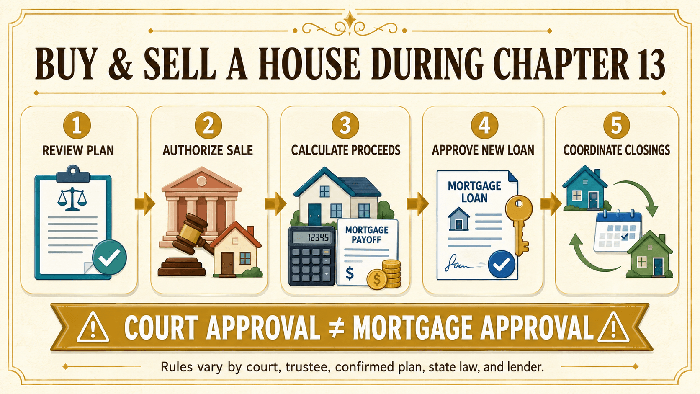
Trying to buy and sell a house while in Chapter 13 bankruptcy requires coordination among the bankruptcy attorney, trustee, mortgage lender, real estate agents, and title or closing company. Several separate approvals may be required:
- Bankruptcy authorization to sell the current home.
- Permission to retain or use the sale proceeds.
- Authorization to incur new mortgage debt.
- Final mortgage underwriting approval.
- Buyer financing and completion of the existing-home sale.
- Title clearance and payment of all liens.
- Approval of any required Chapter 13 plan modification.
These approvals do not replace one another. Court permission to sell does not guarantee that the borrower will qualify for the new mortgage. Likewise, a mortgage preapproval does not authorize the sale, use of proceeds, or creation of new debt during bankruptcy. The borrower should begin both the legal and mortgage reviews early. Each party needs the same sale price, payoff information, estimated proceeds, new loan terms, housing payment, and proposed closing dates. Coordinating these details before contracts and deadlines become binding can reduce the risk of delayed or failed closings.
Using Sale Proceeds for the Next Down Payment
Expected home equity cannot be treated as available down payment funds automatically. When borrowers buy and sell a house while in Chapter 13 bankruptcy, the sale proceeds generally become usable only after:
- The existing home closes, or the lender approves a simultaneous-closing structure.
- The court order or trustee procedure permits the borrower to retain and use the funds.
- The final closing statement documents the proceeds received.
- The mortgage lender verifies the source and availability of the money.
- Any required payment has been delivered to the Chapter 13 trustee.
The motion to sell or proposed court order should clearly state how much the debtor requests to retain for the replacement-home down payment, closing costs, moving expenses, and required reserves. The new mortgage lender may also require a court order, a final settlement statement, proof of deposit, and updated bank statements before counting the proceeds as verified assets.
Buying Before the Existing Property Closes
Buying the replacement home before the current property closes may be possible, but it is not a standard workaround. A borrower trying to buy and sell a house while in Chapter 13 bankruptcy may have to qualify with both housing obligations because the existing mortgage has not yet been paid off. Other concerns include:
- Expected sale proceeds may not be available for the down payment.
- Bridge financing, a HELOC, or other new debt may require separate bankruptcy authorization.
- The confirmed household budget may not support overlapping mortgage payments.
- A delayed or canceled sale could jeopardize the new purchase.
- The mortgage lender may require the existing property to close first.
This structure requires coordinated review by the bankruptcy attorney, the trustee, the mortgage lender, and the closing professionals. Before making an offer, the borrower should confirm whether the new loan can close first, how both payments will be evaluated, and which bankruptcy approvals are required.
Sale Contingencies and Coordinating Closing Dates
When borrowers buy and sell a house while in Chapter 13 bankruptcy, the replacement-home contract may need to be contingent on the sale of the current property. This can help prevent the new purchase from closing before the existing mortgage is paid and the sale proceeds become available. The timeline should allow enough time for:
- Bankruptcy notice and creditor objections.
- Any required hearing or court order.
- The sale order must become effective.
- Trustee payoff information and lien reconciliation.
- Mortgage underwriting and final closing conditions.
When practical, using the same title or closing team for both transactions can improve communication and help coordinate the transfer of authorized proceeds. The parties should avoid scheduling a closing before the required bankruptcy order is effective. Borrowers should also avoid nonrefundable deposits, moving expenses, or other binding commitments until the bankruptcy attorney confirms that the necessary authorization has been obtained.
Chapter 13 Sale and Replacement-Home Example
Hypothetical example only: A homeowner wants to buy and sell a house while in Chapter 13 bankruptcy.
- Current home sale price: $360,000
- First-mortgage payoff: $235,000
- Mortgage arrears or secured claims in the plan: $12,000
- Other liens: $8,000
- Commission and closing costs: $27,000
- Estimated net proceeds: $78,000
- Claimed homestead exemption: $60,000
- Amount proposed for the Chapter 13 plan: $18,000
- Amount requested for the next down payment: $45,000
- Replacement-home purchase price: $300,000
- New base mortgage: $255,000
- Estimated new housing payment: $2,300 per month
- Sale contingency: Replacement purchase depends on the current home closing first
- Court and trustee status: Trustee has reviewed the proposal without objection, but final court orders remain pending
- Plan modification: Required to address the paid mortgage claim and distribute the $18,000
The remaining retained funds would be requested for authorized closing costs, moving expenses, and reserves. This allocation is hypothetical and will vary by case, state, bankruptcy district, confirmed plan, exemption law, and court order.
Step-by-Step Process to Sell and Buy Another House
Borrowers planning to buy and sell a house while in Chapter 13 bankruptcy should coordinate the legal, mortgage, and closing processes in this order:
- Review the confirmed plan and confirmation order with the bankruptcy attorney.
- Determine which trustee and court procedures apply in the local district.
- Obtain a fully documented mortgage preapproval.
- Estimate mortgage payoffs, liens, closing costs, and net proceeds.
- Negotiate both contracts with appropriate sale and bankruptcy contingencies.
- File any required motions covering the sale, proceeds, new debt, and plan modification.
- Allow time for creditor objections, hearings, and court orders.
- Give the orders and trustee instructions to the lender and both closing teams.
- Complete the current-home sale and document every disbursement.
- Close the replacement purchase only after the required funds and authorizations are available.
- File the final closing statement and update the Chapter 13 plan or payment instructions when required.
Do not commit to an aggressive closing schedule until the bankruptcy attorney, mortgage lender, and closing professionals agree that the timeline is workable.
Final Thoughts on How to Buy and Sell a House While in Chapter 13 Bankruptcy
It may be possible to buy and sell a house while in Chapter 13 bankruptcy, but the transaction requires more coordination than an ordinary sale and purchase. The confirmed plan, local court procedures, lien payoffs, home-equity exemption, treatment of proceeds, and new mortgage qualifications must all work together.
Court authorization to sell does not guarantee approval for the replacement mortgage, and mortgage preapproval does not authorize the bankruptcy transaction. Before listing the current home or making an offer, the borrower should have the bankruptcy attorney and mortgage lender review the complete plan.
Starting early allows time for trustee instructions, required motions, creditor objections, title clearance, mortgage underwriting, and coordinated closing dates. The final structure should follow the court order, confirmed plan, and state law—not assumptions about how another Chapter 13 case was handled.
Frequently Asked Questions About Selling a House During Chapter 13
How Soon After Chapter 13 Discharge Can I Sell My House?
Federal bankruptcy law does not impose a general waiting period for selling a house after Chapter 13 discharge. However, confirm that the discharge has been entered, determine whether the case remains open, and resolve any surviving liens or title requirements before listing or closing.
Can I Sell a Jointly Owned House if Only I Filed Chapter 13?
Possibly, but every titled owner will generally need to participate in the sale. The bankruptcy case may affect only the debtor’s ownership interest, while state law, the form of ownership, exemptions, liens, and 11 U.S.C. §363 can affect how the property and proceeds are treated.
Can I Complete a Short Sale During Chapter 13 Bankruptcy?
A short sale may be possible, but the mortgage servicer and other lienholders must approve receiving less than the amounts owed. The debtor may also need trustee consent, court authorization, updated plan treatment, and professional tax advice concerning any canceled debt.
Can I Sell a Rental or Investment Property During Chapter 13?
Yes, subject to the confirmed plan, estate status, and local bankruptcy procedure. Because a rental or investment property may not qualify for the same homestead protection as a primary residence, more of its net equity could be available for creditors.
What Happens if the Buyer Backs Out After the Court Approves the Sale?
Notify the bankruptcy attorney, trustee, mortgage lender, and real estate professionals immediately. Because the approval may be based on a particular buyer, price, contract, and proceeds calculation, accepting another offer could require an amended motion, new notice, or another court order.
Will I Owe Capital Gains Tax When Selling During Chapter 13?
Chapter 13 bankruptcy does not automatically eliminate taxes resulting from a property sale. A qualifying homeowner may be able to exclude up to $250,000 of gain—or up to $500,000 for certain married couples filing jointly—under the conditions explained in IRS Publication 523.
What Happens if I Sell Property Without Telling the Trustee or Court?
An unauthorized sale may violate the confirmed plan, confirmation order, or local bankruptcy rules. It could delay the closing, create title and proceeds problems, and place the Chapter 13 case at risk, so the debtor should contact the bankruptcy attorney before signing a contract or transferring property.
This article about “How to Buy and Sell a House While in Chapter 13 Bankruptcy” was updated on August 20th, 2026.