

This guide covers HUD mortgage guidelines on having multiple FHA loans at the same time. One of the most frequently asked questions from homebuyers is can I qualify and get approved for multiple FHA loans at the same time. FHA loans are for owner-occupant primary homes. A homeowner can live in one property. There are instances where a homeowner need to relocate for one or more reasons and buy another home without selling the existing home.
Many Homeowners Need to Move to Another Home Due to the Following Reasons:
- Growing Family so they may need to move to a larger home
- Downsizing: Children may move out of the home to either go to college or start their own families so they may need to move to a smaller home
- Job Relocation: Homeowner may need to move to another home closer to their place of employment
- If you are a non-occupant co-borrower, you can qualify for an FHA loan as the main borrower
- If two people are on a current FHA loan but one of them needs to move out, they can qualify for an FHA Loan
In the following paragraph, we will cover the frequently asked question can a home buyer qualify for multiple FHA loans at the same time. We will discuss the HUD guidelines of qualifying and getting approved for multiple FHA loans at the same time.
About FHA Loans

Is it Possible to Have More Than One FHA Loan?
Most likely, no. HUD does not allow borrowers to hold more than one FHA-insured mortgage for a primary residence. FHA financing is intended to assist borrowers in purchasing a home to be occupied by themselves, and not to facilitate the purchase of rental properties.
FHA Single Family Housing Policy Handbook 4000.1 is the primary guide for FHA single-family financing policy. HUD refers to Handbook 4000.1 as the most comprehensive guide to FHA single-family housing policy.
There are exceptions that may allow a borrower to hold two FHA loans simultaneously. These exceptions generally apply in cases of relocation, an increase in family size, leaving a co-owned residence, and a non-occupying co-borrower.
Why Does HUD Restrict Borrowing to One FHA Loan?
FHA mortgage insurance is designed for loans on primary residences, not for multiple loans. HUD restricts FHA loans to prevent borrowers from using low-down-payment financing to purchase multiple properties. Borrowers are often confused in this area. You may own multiple properties. You may also be able to have an FHA loan for one home and conventional financing for another.
Restrictions apply only when you have multiple FHA-insured mortgages for homes you are purchasing to use as your primary residences.
FHA looks at the whole picture. In this case, the lender will look at where you currently reside, why you are planning to relocate, and whether the new home will serve as your primary residence. This lender will also consider the purpose of this transaction to determine whether this housing option is an actual need or an investment strategy.
Multiple FHA Loans – HUD’s Guidelines
All FHA loans are for primary residences. Borrowers cannot use an FHA loan to purchase a vacation home or an investment property. Because of this policy, HUD limits the period during which borrowers can hold multiple FHA loans. Most of the time, HUD will not approve multiple loans. HUD may approve a borrower with an FHA-insured mortgage who is applying to purchase another primary residence, provided the borrower will occupy the second primary residence.
HUD and FHA rules for multiple loans. Why are some borrowers approved for more than one FHA loan? What documents will support the process?
The primary consideration is not whether you are a current FHA loan holder, but whether you meet any of the exceptions outlined by HUD, whether the new home will be your primary home, and whether you can financially support both housing costs. FHA loans are created by private lenders and backed by the Federal Housing Administration, not directly funded by FHA. FHA loans allow down payments as low as 3.5% and are subject to county-specific limits.
Here are the Benefits of FHA Loans and Why it is so Popular:
- HUD requires a minimum 580 credit score for a 3.5% down payment home purchase FHA loan
- Debt-to-income ratio up to 46.9% DTI front-end: 56.9% DTI back-end to get approve/eligible per Automated Underwriting System
- Outstanding collections and charge-off accounts do not have to paid to qualify for FHA loans
- 2 year waiting period after Chapter 7 bankruptcy discharged date
- Consumers one year into a Chapter 13 Bankruptcy repayment period can qualify for FHA loans with Trustee approval via manual underwriting
- No waiting period after Chapter 7 Bankruptcy discharged date to qualify for FHA loans
- 3 year waiting period after foreclosure, short sale, and deed in-lieu of foreclosure to qualify for FHA loans
The FHA insured mortgage loan program is a wonderful vehicle for a first time home buyer. FHA loans are a great loan program for those home buyers who have had some prior credit problems have a chance in becoming homeowners again. FHA insured mortgage guidelines are much more lenient that conventional loan programs.
What Are the HUD Guidelines on Multiple FHA Loans at the Same Time
For those borrowers who have had a prior bankruptcy or foreclosure, they may qualify for FHA insured mortgage loans as long as they have passed their mandatory waiting periods.
Home Buyers Can Benefit from FHA Loans if They Have the Following:
- Less than perfect credit
- Higher debt to income ratios
- Outstanding collections
- Outstanding charge offs
- Judgments
- Tax liens
However, FHA loans are for owner occupant properties only.
Find Out If You Qualify for a Second FHA Loan
Wondering if HUD will allow you to keep your current FHA home and buy another? Call Gustan Cho Associates at 800-900-8569 and let our FHA experts review your situation.How Can One Qualify for Multiple FHA Loans at the Same Time
Borrowers can have more than one FHA loans at the same time under certain circumstances. A borrower can qualify for more than one FHA loans at same time. This holds true if they are relocating and establishing primary residency in an area or location that is beyond reasonable commuting distance. The relocation needs to be at least 100 miles or more from the work of employment. Out of state employment is a good reason. The borrower was or will be a non-occupant co-borrower with a joint interest in a real estate property that is purchased by other members of his or her family as their primary residence.
Situations When HUD Will Grant Approval for a Second FHA Loan
When it comes to FHA loans, HUD is more flexible. Although the exceptions that allow for multiple FHA loans are limited, they do exist. As with conventional loans, a lender will need to document the file and explain the borrower’s reasons for the new home, which is to be the primary residence.
Moving to a Different Community
A borrower may be granted another FHA loan if they have moved to a different area and made it their primary place of residence.
The relocation exception typically applies when the borrower has moved for a job-related reason, and their new primary place of residence is more than 100 miles from their previous primary place of residence.
This exception may apply when a borrower has taken a new job, been transferred to a new office, or moved to a new work location, making the existing FHA home no longer practicable as a primary home. The borrower does not qualify for the loan due to relocation. The lender must still review the borrower’s income, credit, debts, and assets, as well as the payment history of the existing FHA loan.
Growing Family
A borrower may be granted another FHA loan if they have additional legal dependents and the existing home is no longer adequate to house them. This exception is not granted if the borrower merely desires a larger home. The borrower must show that the household change now makes the existing home adequate. HUD also requires that the loan-to-value ratio on the primary residence be 75% or less, or that the borrower pay the loan in full. The value must be supported by a residential appraisal and may not be based on an online estimate or a tax assessment.
Vacating a Jointly Owned Property
A borrower may be eligible for another FHA loan if they are vacating a jointly owned primary residence, have no intent to return, and the current FHA home will continue to be occupied by a co-borrower. This is usually the case during a divorce, a separation, or a split of the household.
The lender will need to know who is staying in the home, who will be paying the mortgage, whether the departing borrower will actually be moving out, and whether the new home will be the borrower’s primary residence.
A non-occupying co-borrower on an FHA loan may be eligible for another FHA-insured mortgage on a new property that will be their primary residence. HUD allows a borrower with an FHA-insured mortgage on their primary residence to be a non-occupying co-borrower on other FHA-insured mortgages. This most commonly happens when a parent helps their child qualify for an FHA loan, or when another family member co-signs the loan without occupying the property. Co-borrowing does not remove the debt. The lender will still need to determine whether the mortgage payment will be counted in the borrower’s debt-to-income ratio.
What Are the Restrictions on Getting Multiple FHA Loans?
Borrowers cannot get an additional FHA loan simply to rent out their first home. FHA also does not allow mortgage borrowers to use a second FHA loan to purchase vacation homes, weekend homes, short-term rentals, or other investment properties.
Keeping the first FHA loan because of interest rates, moving closer to family, getting a bigger home, and similar reasons will not be sufficient on their own. A documented exception from HUD will be required for the borrower.
Co-borrowing does not remove the debt. The lender will still need to determine whether the mortgage payment will be counted in the borrower’s debt-to-income ratio.
Can You Rent Out Your Current FHA Home?
Yes, but renting your current home with an FHA loan does not mean you can buy another home with one. The new FHA loan must still satisfy HUD exceptions. The lender will consider whether the rental income is sufficient to qualify for the new loan. The lender will most likely require a rental agreement, the first month’s rent, and a security deposit; a history of the current mortgage; taxes; and other documentation that supports the move is real.
How Lenders Will Take FHA Loans Into Account When Reviewing Debt-to-Income Ratio
Even if a borrower meets a HUD exception, the lender must still confirm that the borrower can afford both home loans. One of the biggest issues with getting multiple FHA loans is the debt-to-income ratio.
If the existing FHA mortgage is kept open, the lender will typically count the entire mortgage payment unless FHA guidelines and documentation allow rental income or another offset to the mortgage payment.
The lender will also include the new mortgage payment, property taxes, homeowners’ insurance, mortgage insurance, HOA dues (if applicable), and any additional monthly obligations. Clients with high income, limited revolving credit, a positive housing payment history, and reserves are typically better positioned than those with high credit card indebtedness, late payments, and inconsistent income.
FHA Loan Multiple Approval Documents
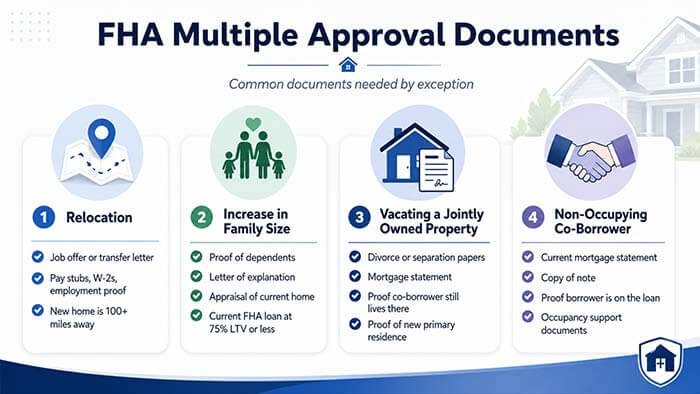
The specific documents depend on the exception. In cases of relocation, the lender may require a job offer, transfer letter, employment verification, pay stubs, W-2s, and proof that the new residence is more than 100 miles from the primary residence.
With an increase in family size, the lender may require proof of legal dependents, a letter of explanation, a current appraisal of the existing home, and evidence that the current FHA loan is at or below 75% loan-to-value.
When vacating a jointly owned property, the lender may require a divorce decree or separation agreement, proof of occupancy, a mortgage statement, evidence that the co-borrower will continue to reside there, and proof that the borrower is establishing a new primary residence. In a non-occupying co-borrower situation, the lender may require the current mortgage statement, the note, proof that the borrower is a loan participant, and other documents that support the borrower’s occupancy of the property.
FHA Loan Limits Still Exist
FHA loan limits still exist despite several exceptions. All new FHA loans must comply with the county loan limit for the property type secured by the loan.
For 2026, FHA’s floor for a one-unit forward mortgage will be $541,287. The one-unit high-cost ceiling will be $1,249,125. Loan limits do not affect a borrower’s ability to hold multiple FHA loans.
Limits simply indicate the maximum FHA-insured loan amount for a particular county and property. Other than the loan limit, FHA requirements regarding eligibility, occupancy, credit, income, assets, and underwriting will apply.
Common Reasons 2nd FHA Loan Gets Denied
Inability to meet one of the exceptions created by HUD, failure to provide a documented reason for relocating, or evidence that the relocation is an investment property will be grounds for denial of a second FHA loan.
Some lenders may deny a loan for an additional reason outside of FHA’s guidelines. Another may approve the loan in compliance with HUD guidelines.
if the borrower meets the exception and if the loan is sufficiently documented. Other common issues include a debt-to-income ratio that is too high, late mortgage payments, failure to provide a documented reason for relocation, insufficient equity to meet the family-size exception, disputed credit accounts, and unstable income.
Alternatives If You Cannot Get Another FHA Loan
Having difficulty getting a second FHA loan does not eliminate your financing options. If you have sufficient credit, income, and savings to meet a lender’s criteria, you could secure a Conventional loan. Other options include selling the FHA-backed property, refinancing the FHA loan into a conventional loan, taking out a bridge loan, or waiting until the first FHA loan is paid off. The best option depends on the available cash and equity, credit score, income type, property location, and timing of your move.
How to Improve Your Chances of Approval
You must first assess your payment history on your current FHA loan before considering taking out an additional FHA loan. Maintain on-time payments and avoid any new credit, significant cash inflows, or new debt prior to loan closing. The paperwork needs to be in order well in advance, and a well-documented file will make the process easier for the lender.
A well-organized file may include a letter of explanation for your move, a cite for the exception to the rule, and the reason the new property will be a principal residence.
The most critical factor is choosing a lender who understands the FHA guidelines for Multiple FHA Loans. Compared to a typical FHA loan, this file will need greater depth and detail. This will also require the lender to construct the file in a specific structure prior to the underwriter’s review.
Two Owner Occupant Properties
Borrowers can have a second owner occupant property financing and not sell an exiting property under certain conditions. There are instances where borrowers cannot sell their existing home and need to rent it and purchase a second home with another FHA loan.
If a Homebuyer is Exiting an Existing Owner Occupant Property and Buying a New Home, They Can Qualify for Another Owner Occupant Property Under the Following Conditions:
- They are upsizing to a larger home (30% or larger) due to a growing family
- They are down sizing to a smaller home due to becoming empty nesters
- There are no distance requirements as long as the exiting property has 25% equity
- However, they cannot move to a similar and like home nearby if the second primary home is similar in size as the exiting home
- If they are moving to a nearby home that is similar in value or square footage then they cannot qualify as an owner occupant home
- Similar homes on a second homeowner-occupant purchase will be considered investment homes
- Again, the only way to qualify for two FHA lans at the same time is to have a job relocation which is 100 miles or more.
- If a person needs to purchase a second home that is owner occupant and keep the exiting home as a rental, then they can have two FHA loans at the same time if the exiting home has 25% or more equity
- If the exiting home is FHA, the new owner occupant home purchase needs to be a conventional loan
- If the first home is conventional financing, then they can purchase the second home with an FHA Loan
If the second home purchase needs to be an FHA loan and the first home is FHA, then the exiting home needs to be refinanced into a conventional or another loan program. If a home buyer is a non-occupant co-borrower on another FHA loan, they can qualify to purchase an FHA loan as the main borrower on a new home. If two people are on an FHA loan as co-borrowers and one person want to leave that property and buy another home for themselves, they can qualify for an FHA loan.
Final Thoughts on Multiple FHA Loans
Most borrowers cannot take out multiple FHA loans. FHA financing is primarily for loans on principal residences, and HUD will not allow borrowers to use FHA mortgage insurance to finance the purchase of investment properties. A second FHA loan is possible if a borrower qualifies for a valid exception to the policy as outlined by HUD.
There are several exceptions to the policy, including relocation, a documented increase in family size, the vacating of a jointly owned residence, and cases involving a non-occupying co-borrower.
The policy is not solely concerned with whether a borrower has an FHA loan. It concerns whether the new residence is a true principal residence, whether the borrower has documented cause, and whether the file complies with FHA and the lender’s underwriting guidelines.
Qualifying fo Multiple FHA Loans at the Same Time with a Lender with No Overlays
Not all mortgage lenders have the same lending requirements on FHA loans. Even though a borrower meets HUD guidelines on HUD guidelines at the same time, the lender may not want to finance the borrower due to lender overlays. Lenders can have higher lending requirements than HUD agency mortgage guidelines. For more information on this topic or other mortgage-related topics, please contact us at Gustan Cho Associates at 800-900-8569. Text us for faster response. Or email us at gcho@gustancho.com. The Team at Gustan Cho Associates are available 7 days a week, evenings, weekends, and holidays.
FAQs: HUD Guidelines on Multiple FHA Loans at Same Time
Can I Have Multiple FHA Loans at the Same Time?
Yes, it’s possible to have more than one FHA loan at the same time, but some specific guidelines and circumstances allow this, such as relocating for work or having a growing family.
What Situations Allow Me to Get a Second FHA Loan?
You can get a second FHA loan if you’re moving to a new home due to a job relocation at least 100 miles away or need a bigger home because your family is growing.
Can I Keep My Current Home and Still Get Another FHA Loan?
Yes, you can keep your current home and get another FHA loan if the existing home has at least 25% equity or if you’re moving far away for work.
Do I Need to Sell My Current Home to Get Another FHA Loan?
Not necessarily. Suppose your situation meets HUD guidelines, like job relocation or needing a different-sized home. In that case, you may not need to sell your home to qualify for another FHA loan.
Can I Get a Second FHA Loan if My Current Home is Nearby?
Generally, you can only get a second FHA loan for a similar home near your current one if you have a valid reason, like job relocation far away.
What if I’m a Co-Borrower on an FHA Loan? Can I Get Another FHA Loan?
If you are a non-occupying co-borrower on an FHA loan, you are eligible to qualify as the primary borrower for a separate property with another FHA loan.
Do I Need Equity in My Current Home to Get Another FHA Loan?
If you want to keep your current home and get another FHA loan, your existing home should have at least 25% equity.
Can I Qualify for Multiple FHA Loans if I’m Downsizing?
Yes, if you’re moving to a smaller home because your kids moved out or you need less space, you can qualify for another FHA loan, but there are specific conditions to meet.
Can I Get Another FHA Loan if I Move Closer to My Job?
Yes, if you are moving over 100 miles from your current home due to a job relocation, you may qualify for a second FHA loan.
Are There Different Rules for Different Lenders When Getting Multiple FHA Loans?
Yes, some lenders may have stricter rules than HUD’s guidelines, so it’s important to work with a lender that doesn’t have additional requirements (overlays) when applying for multiple FHA loans.
If I Sold My Previous FHA Home, Can I Get Another FHA Loan?
Yes. If the previous FHA loan was paid off by a sale or refinance, borrowers may qualify for FHA financing for a new principal residence. The primary concern with multiple FHA loans is whether borrowers are keeping the existing FHA-insured mortgage and taking out another FHA-insured mortgage.
Will FHA Count My Spouse’s Existing FHA Loan?
Maybe. It depends on the loan, how the new loan is structured, title, occupancy, and state law. In community property states, a non-borrowing spouse’s debts may be considered. Lenders will evaluate the spouse’s FHA loan obligation and whether the new transaction complies with FHA occupancy and underwriting requirements.
Do I Need 25% Equity in My Current FHA Home?
You may need at least 25% equity using the increase-in-family-size exception. According to HUD, the current primary residence must be at 75% loan-to-value or lower, or have the mortgage paid down to that level, based on the current mortgage balance and a recent residential appraisal. (per HUD)
Can Rental Income From My First FHA Home Help Me Qualify?
Possibly, but rental income may help only if it complies with FHA and lender requirements. The lender may ask for a lease with rental payment documentation, a mortgage payment history, and other documentation to show that the home is being rented in a legitimate manner. Even if rental income is considered, the borrower must meet at least one valid exception for the second FHA loan.
Can I Buy a Duplex with an FHA Loan if I Already Have One?
When the borrower lives in one of the units as a primary residence, a duplex may qualify for FHA financing. However, the borrower must also satisfy one of HUD’s other FHA loan exceptions, as the first FHA loan is still open.
Can a Military Move Help with Another FHA Loan?
When a military move supports an actual relocation and the borrower will live in the new home as their primary residence, it may be possible. The lender will consider the borrower’s orders, the distance, the plans for occupancy, the borrower’s income and other debts, and whether the other FHA residence will stay open.
Can I Be a Non-Occupying Co-Borrower if I Already Hold an FHA Loan?
Yes, if a borrower has an FHA loan on their primary residence, they can be a non-occupying co-borrower on other FHA loans, per HUD. However, the lender must still be responsible for analyzing the borrower’s debt, income, credit, and repayment ability.
Why Would One Lender Deny a Second FHA Loan While Another Would Approve It?
One lender can have overlays more stringent than the FHA’s minimum requirements. Another lender might be more willing to review the file if the borrower meets a strong HUD exception and has strong documentation. The file still needs to meet the FHA requirements, but lender overlays can change the approval course.
This Guide on Multiple FHA Loans Was Written by Gustan Cho NMLS 873293, the Branch Manager of Coast 2 Coast Mortgage Lending, LLC DBA as Gustan Cho Associates, licensed in 48 states including Washington, DC, Puerto Rico, and the U.S. Virgin Islands.