This guide covers FHA facts versus fiction of qualifying for FHA loans. The U.S. Department of Housing Administration (HUD) is the parent federal agency of the Federal Housing Administration (FHA). FHA is not a lender. The role of the Federal Housing Administration is to insure FHA Loans originated and funded by private mortgage companies against the loss sustained by borrowers who default and foreclose on their FHA loans.
Over 80% of our borrowers at Gustan Cho Associates are folks who either got a last-minute mortgage denial or are stressing over their mortgage process.
Other borrowers are told they do not qualify even though they meed HUD Guidelines because the lender has overlays on FHA loans. In this guide, we will discuss FHA facts versus fiction on FHA loans. Why is it that so many lenders have different FHA Lending Requirements. What are FHA Facts Versus Fiction?. First-time home buyers and experienced homeowners alike may have misconceptions about what it means to get an FHA loan. Here are some of the most common facts and fictions about buying a house with an FHA loan.
The Truth About Qualifying for FHA Loans in 2026
Sorting out the truth from the myths about home loans can feel overwhelming. Many wonder if FHA loans are just for first-time buyers or if credit score is all that matters. Questions swirl around down payments, gift funds, student loans, past bankruptcies, and which properties qualify.
Although FHA loans offer flexibility, they come with their own set of rules. Knowing what’s real and what’s not empowers borrowers to make smarter mortgage choices.
FHA loans open doors for buyers who need a smaller down payment, have imperfect credit, or are looking for a fresh start after a foreclosure. Rather than lending money itself, the FHA insures loans from approved lenders, making homeownership more accessible. With as little as 3.5% down, buyers can use FHA loans to purchase homes with up to 4 units, as long as they meet the requirements.
Understanding FHA Loans
FHA loans are government-backed mortgages that provide protection if a borrower defaults. Lenders must follow strict standards to ensure borrowers are financially prepared, even though FHA loans are more flexible.
Both the lender and FHA have risk-management requirements. The main rules are outlined in HUD’s Handbook 4000.1, which is updated regularly.
FHA does not lend money directly; instead, FHA-approved lenders provide the loans, which are insured by the FHA. This matters for everyone involved, since borrowers must follow both the FHA’s guidelines and the lender’s requirements for income, paperwork, and risk evaluation.
Why Are FHA Facts & Myths Confusing Most Homebuyers
Many myths about FHA loans come from half-truths or misunderstandings. Some people think FHA loans are just for buyers with bad credit, or that anyone can get approved. Others assume you need a big down payment unless your credit is flawless. In truth, FHA approval depends on a mix of factors. Even buyers with past credit bumps can qualify if they meet waiting periods and show they’re financially stable. Knowing the facts is key when weighing your mortgage choices.
FHA Myth: You Need Perfect Credit to Qualify
Fiction. FHA was intended to expand the frontier of homeownership for borrowers unable to meet the funding requirements of conventional financing. HUD explains that FHA-insured mortgages have comparatively lower credit score requirements than the majority of standard loans, not to mention that FHA’s minimum required investment is 3.5 percent in most instances.
What Credit Score Myths Get Wrong About FHA Loans
Getting approved for an FHA loan is about more than just hitting a certain credit score. Many believe your score is the only thing that matters, but lenders look at the whole picture: your payment history, any recent late payments, collections, judgments, debts, job situation, savings, and your overall ability to repay the loan. Credit score counts, but it’s just one piece of the puzzle.
What Are The Down Payment and Credit Score Requirements on FHA Loans
HUD’s role is to promote homeownership to home buyers. This holds especially true for first time home buyers and buyers with less than perfect credit. HUD has made it possible for home buyers to purchase a home with very little down payment. Here are the down payment FHA FACTS Versus Fiction: 3.5% down payment for borrowers who have a 580 credit score.
Borrowers with under 580 FICO can qualify for FHA Loans with 10% down payment with approve/eligible per automated underwriting system findings. The minimum credit score allowed by borrowers to qualify for FHA loans is 500 FICO
Many borrowers are told they do not qualify for FHA loans by other lenders because they do not meet a 620 or 640 credit score. This is not correct. Many lenders will require a higher credit score requirement because they have lender overlays. Lender overlays are lending guidelines that are above and beyond the minimum HUD Agency Guidelines.
FHA Facts vs Fiction: Get the Truth About Approval
Stop believing myths—learn the real FHA facts versus fiction of qualifying for FHA loansWhy Are FHA Loans Popular Among Homebuyers
FHA loans are popular among homebuyers buying their first home and those with less-than-perfect credit due to their relatively lenient requirements. However, there needs to be more clarity about what it takes to qualify for FHA loans. Let’s clarify some common facts and fiction:
Understand the real FHA facts vs. myths pertaining to credit, down payment, gift funds, student loans, and approval that govern qualifying for FHA loans.
In order for FHA to insure and guarantee FHA loans, the lender needs to follow all HUD Lending Guidelines per HUD 4000.1 FHA Handbook. If the lender does not follow the FHA Guidelines, the FHA Loan will not be insured.
Fact: Credit Score Requirements
Fiction:
- You need a perfect credit score to qualify.
Fact:
- While FHA loans are known for accommodating lower credit scores, the minimum requirement can vary.
- A credit score of 580 or higher is required to qualify for the 3.5% down payment for an FHA home purchase loan.
- Option. If your score is between 500 and 579, you may still qualify with a 10% down payment.
Fact: Down Payment
Fiction:
- You need a large down payment.
Fact:
- FHA loans offer down payment options as low as 3.5% of the purchase price.
- This makes homeownership more accessible for those who may not have substantial savings for a down payment.
Fact: Debt-to-Income Ratio
Fiction:
- Your debt-to-income ratio doesn’t matter.
Fact:
- While FHA loans are more lenient than conventional loans, there are still limits on how much of your income can go toward debt payments.
- Typically, the maximum debt-to-income ratio allowed is 43%, although exceptions may sometimes be made.
Fact: Employment and Income Verification
Fiction:
- You don’t need to verify your income or employment.
Fact:
- Lenders will verify your income and employment as part of the loan approval process to want to ensure that you have a steady source of income to make your mortgage payments.
Fact: Property Standards
Fiction:
- FHA loans can be used to purchase any property.
Fact:
- FHA loans have specific requirements regarding the condition of the property being purchase.
- The property must meet certain standards to ensure it’s safe and habitable.
Fact: Mortgage Insurance
Fiction:
- FHA loans don’t require mortgage insurance.
Fact:
- FHA loans require an upfront mortgage insurance premium (MIP) and an annual MIP, regardless of the down payment amount.
- This insurance protects the lender in case the borrower defaults on the loan.
Understanding these facts can help you navigate qualifying for an FHA loan more confidently. Working with a knowledgeable lender who can guide you through the requirements and help you determine if an FHA loan is the right option for your homebuying needs is essential.
Are FHA Loans For Low-Income Borrowers or First Time Home Buyers?
Another common FHA FACTS Versus Fiction is that FHA Loans are NOT for low-income borrowers or first time home buyers. Alex Carlucci is a senior loan officer of Gustan Cho Associates Mortgage Group. This is what Massimo Ressa states about the type of borrowers who qualify for FHA Loans: Neither of these things are true. Home buyers CAN get an FHA loan as a low-income borrower or as a first-time home buyer, but you do NOT have to be one or both.
Are Home Appraisals And Home Inspections Required
Home appraisals are mandatory and required by lenders on both purchase and refinance transactions. An appraisal is not a home inspection. Home inspections are optional by home buyers. Home inspections are highly recommended for all home buyers. Appraisers do not thoroughly inspect the condition of the house
Appraisers only make sure that the subject property is in habitable condition and is safe and secure and all mechanicals is in proper working condition.
A home inspector will be more thorough and inspect the condition of the HVAC systems, plumbing, electrical, roof. Home inspectors will also check for any signs of cracked foundations, the life of the roof, signs of mold and termites, and other defects associated with the subject home. Home inspections are done prior to the appraisal. This way, the buyers can back out if they find anything wrong with the home. There is a big difference between an appraisal versus home inspections.
FHA Facts Versus Fiction of Qualifying for FHA Loans
Separate internet rumors from real HUD guidelines in minutesFHA Facts Versus Fiction on Collections and Charge-Off Accounts
HUD Guidelines does not require borrowers to pay outstanding collections or charge off accounts. Borrowers can qualify for FHA Loans with outstanding collections and charge off account. Please read more on this topic by clicking: FHA GUIDELINES ON COLLECTIONS AND CHARGED OFF ACCOUNTS. There is no waiting period after a timeshare foreclosure to qualify for FHA loans. HUD does not consider a timeshare foreclosure as a real estate foreclosure. Under the eyes of HUD, a timeshare is an installment loan. It is not a real estate loan.
FHA Myth: You Must Put 20 Percent Down
One big draw of FHA loans is the low down payment, but some buyers think this means they can skip closing costs. In reality, you’ll still need to cover closing costs, prepaid expenses, and other fees. The good news is, FHA lets you use money from savings, gifts, second mortgages, or most down payment assistance programs. Make sure you know which funds count and how much you’ll need to bring to the table.
FHA Myth: FHA Loans Are Only for First-Time Homebuyers
First-time homebuyers typically rely most on FHA financing, but any other buyer who meets the occupancy, credit, income, and property requirements can use it as well. FHA aims to guide consumers through homebuying and does not limit the use of its funds to first-time homebuyers. This misunderstanding can keep repeat buyers from exploring FHA loans, even though they might benefit from them. People who have faced tough credit situations may also discover that FHA loans offer a second chance.
FHA Myth: You Cannot Use Gift Funds on an FHA Loan
This is not true. Most buyers have misconceptions about the role of gift funds, but funds can be a powerful resource. According to HUD, the minimum required investment can be funded from a variety of acceptable sources, including gifts. Additionally, HUD outlines gifts of equity for family transactions. Also, FHA allows sellers and other interested parties to cover some of the borrower’s costs, as permitted by FHA guidelines.
How Gift Funds and Down Payment Assistance Can Help
Plenty of buyers earn a steady paycheck but don’t have enough saved up for every expense. This is especially true for first-timers, young couples, or anyone who’s just paid off old debts. For FHA applicants, gift funds or down payment help can speed things up. Just remember, every transfer needs to be clearly documented, and you’ll still need to show you can handle the monthly payments.
Impact of Debt-to-Income Ratios on FHA Approval
Many people think FHA always allows higher debt-to-income ratios, but that’s not the case. Debt ratios are still a big deal in the approval process. Lenders look at your monthly housing costs, other debts, and student loans. Even if your credit is solid, too much debt can mean a denial. Getting approved for an FHA loan is not a free pass.
FHA Myth: Student Loans Automatically Disqualify You
This is a myth. Student loans do not automatically result in a denial of an FHA loan, but they can impact your qualification. FHA has recently changed its Student Debt Policies through Mortgagee Letter 2021-13, which has affected how monthly obligations are evaluated. These changes were justified to increase access to mortgage loans while still allowing lenders to factor a student loan obligation into the underwriting process.
FHA Facts Versus Fiction On FHA Loans
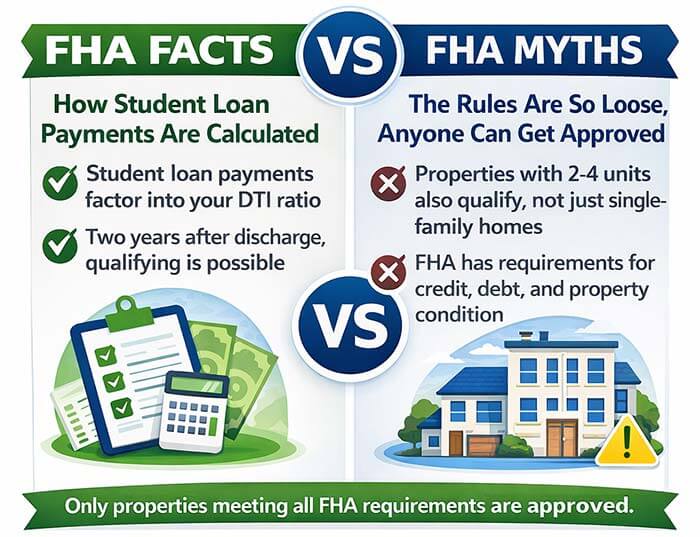
How Student Loan Payments Are Calculated for FHA
The key point for borrowers is that student debt is real. The main thing to know is that student loans count—they aren’t overlooked. Big student loan balances won’t automatically stop you from getting approved, but the payments do factor into your debt-to-income ratio. Student loans matter for FHA approval, but after two years since discharge, and sometimes even sooner, you could still qualify. Clear and accurate info. It’s important to know the facts about waiting periods after big credit events. The paperwork and timelines can change depending on your situation.
FHA Myths: The Rules Are So Loose Anyone Can Get Approved
Some think FHA loans are open to everyone, but you still have to meet certain rules. Even if you’ve had credit troubles, you might still be able to buy a home. Useable to Single-Family Homes. Not True. HUD states that one- to four-unit properties are eligible for FHA financing. This means people will be able to utilize FHA financing for properties that are not single-family detached homes, as long as they meet the occupancy and other property requirements.
Other Property Types Supported by FHA
Thanks to this rule, buyers can look at larger properties, such as duplexes, triplexes, or four-unit homes, as long as they live in one of the units. FHA loans make buying these types of properties easier with lower down payments than most other loans. Lenders still check your credit, income, job history, debts, and the property itself. Make sure you’re comfortable with the monthly payment, not just the minimum needed to qualify. It’s smart to talk to a lender early on. Knowing the real facts about FHA loans can make buying a home simpler and help your loan approval go more smoothly.
Importance of Facts About an FHA Loan When Analyzing Mortgage Alternatives
FHA Facts vs. Myths: Why Do Buyers Get Confused?
Homebuyers gain an edge when they know the difference between myth and reality. Understanding the facts about FHA loans lets you compare your options with confidence. While some think FHA loans are just for first-timers or those with bad credit, or that anyone can get one, the truth is, FHA loans have specific rules. They’re designed for buyers who might not qualify for conventional loans and often mean lower payments for those with flexible credit.
FHA Loans: The Right Way To Qualify
Getting the facts straight is the best way to bust FHA loan myths. When you know the real story, you can decide if an FHA loan fits your finances, timing, and plans.
FHA loans offer flexibility, but just because they’re government-backed doesn’t mean everyone gets approved. You still need to meet the credit, income, debt, and other requirements.
Some people miss out on FHA loans because they think you have to be a first-time buyer, have spotless credit, or put 20% down. These myths can keep qualified buyers from taking advantage of FHA benefits.
Qualifying For a FHA Loan During and After Chapter 13 Bankruptcy
Many borrowers get conflicting answers on HUD Guidelines in qualifying for an FHA Loan During and After Chapter 13 Bankruptcy. Here are the general rules in qualifying for FHA Loans after bankruptcy and foreclosure: There is a 2-year waiting period after Chapter 7 Bankruptcy discharge date. There is a 3-year waiting period after foreclosure, deed in lieu of foreclosure, short-sale.
What Are The Waiting Periods For Major Credit Events?
Home buyers can qualify for an FHA Loan during Chapter 13 Bankruptcy repayment plan one year into the payment plan with Trustee Approval with Trustee Approval. There is no waiting period to qualify for FHA Loans after Chapter 13 Bankruptcy discharge date. Any Chapter 13 bankruptcy discharge that has been seasoned for two years or less needs to be manually underwritten. If you have any questions on this blog or other mortgage topics, please contact us at 800-900-8569 or text us for faster response. Or email us at gcho@gustancho.com.
Frequently Asked Questions About FHA Facts Versus Fiction
Can I Qualify For An FHA Loan With Less Than 20 Percent Down?
Yes. HUD states that qualified borrowers may be able to buy with as little as 3.5 percent down, depending on eligibility and underwriting.
Are Gift Funds Allowed When Qualifying For FHA Loans?
Yes. FHA allows acceptable sources of funds, including gifts, and seller or other interested-party contributions may also be permitted under FHA rules and limits.
Do Student Loans Prevent FHA Loan Approval?
No. Student loans do not automatically disqualify a borrower, but they do count in the qualification process and can affect debt-to-income ratios.
Can You Get An FHA Loan After Bankruptcy?
Yes, in some instances. HUD states that lenders must document that 2 years have passed since the discharge date of a bankruptcy, with additional requirements in certain circumstances.