Debt settlement versus bankruptcy is a serious decision, especially if you want to buy or refinance a home in the future. Both options can help deal with overwhelming debt, but they affect your credit, mortgage approval, and recovery timeline in different ways. Debt settlement can cut down what you owe, but it also means you end up with missed payments, charge-offs, collections, accounts that are marked as settled, and a hit to your c
redit score. Bankruptcy may feel more severe, but mortgage guidelines often give borrowers a clearer path to qualify after discharge or, in some cases, while in a Chapter 13 repayment plan. For mortgage borrowers, the question is not just which option lowers debt faster. The bigger question is which option gives you the best chance to rebuild credit, meet lender guidelines, and qualify for a home loan when you are ready. This guide explains how debt settlement versus bankruptcy affects mortgage approval, waiting periods, credit recovery, and loan options.
How Debt Settlement Can Affect Mortgage Approval
Using debt settlement can lower what you owe, but it might cause issues when you’re trying to get a mortgage. From a lender’s perspective, a settled account may indicate that the borrower did not repay the full original balance as agreed. Even if the account now shows a zero balance, the credit report may still show late payments, charge-offs, collections, or a “settled for less than owed” notation.
Mortgage underwriters do not look only at whether the debt was settled. They also review what happened before and after the settlement.
They may look at how recent the late payments were, whether any collection accounts remain open, whether the account is disputed, whether the balance still reports, and whether the borrower has reestablished credit since the debt problem. Debt settlement does not always create a formal mortgage waiting period, the way bankruptcy does. However, it can still affect mortgage approval because it may lower credit scores, increase lender risk, and affect automated underwriting system findings. Some lenders may also have overlays that require a certain period to pass after major derogatory credit events, even if agency guidelines do not require a specific waiting period. Borrowers should also understand the possible tax impact. If a lender decides to forgive some of your debt, that amount might end up being taxed like income unless there’s a specific exception from the IRS that applies to your situation. This is why borrowers should speak with a tax professional before choosing debt settlement. When it comes to mortgage approval, the primary concern often extends beyond just debt settlement versus bankruptcy. The more significant factor is the overall credit profile following the settlement, which encompasses aspects like late payments, charge-offs, collections, recovery of credit score, debt-to-income ratio, income stability, and the borrower’s ability to receive an approve/eligible finding through Automated Underwriting Systems (AUS) or qualify via manual underwriting.
Bankruptcy And Mortgage Approval
Bankruptcy can impact mortgage approval, with Chapter 7 and Chapter 13 being treated differently. It’s essential for borrowers to grasp these distinctions, as the mortgage timeline, necessary documentation, and available loan options can vary based on the type of bankruptcy, as well as the discharge and dismissal dates, and the specific loan program in question. When considering debt settlement versus bankruptcy, it’s important to note that bankruptcy often provides a more straightforward process for borrowers. Since bankruptcy is managed through the court system, there’s typically a filing date, case number, discharge date, or dismissal date that lenders can reference. While bankruptcy isn’t without its challenges for credit, it generally offers mortgage underwriters a clearer timeline to assess.
Chapter 7 Bankruptcy: Clean Discharge But Clear Waiting Periods
Chapter 7 bankruptcy, also referred to as liquidation bankruptcy, involves selling assets to pay debts. It can wipe out many unsecured debts, such as credit cards, medical bills, and personal loans. Once the bankruptcy is discharged, the borrower is no longer legally responsible for many of the debts included in the case.
From a mortgage standpoint, Chapter 7 creates a cleaner break from past debt problems. The challenge is the waiting period. Many loan programs require the borrower to wait a specified period after the Chapter 7 discharge before qualifying for a new mortgage.
For example, if you’re considering conventional loans backed by Fannie Mae, you typically need to wait around four years following a Chapter 7 bankruptcy. This countdown begins from the date when your bankruptcy is either discharged or dismissed. Fannie Mae clarifies that the Desktop Underwriter (DU) checks whether you’ve fulfilled the required waiting period based on the relevant bankruptcy event date. It’s important to note that meeting this waiting period alone does not guarantee loan approval. Lenders will still evaluate factors such as credit scores, reestablished credit, income, debt-to-income ratio, assets, reserves, and automated underwriting results. Furthermore, when comparing options such as debt settlement versus bankruptcy, understanding these criteria can significantly impact your financial future.
Chapter 13 Bankruptcy: Mortgage Approval While In Repayment May Be Possible
Chapter 13 bankruptcy is different because the borrower does not immediately wipe out debts as in Chapter 7. Instead, Chapter 13 establishes a court-approved repayment plan that typically lasts 3 to 5 years. For mortgage borrowers, it’s important to understand the differences between debt settlement versus bankruptcy. Chapter 13 can provide more flexibility than many realize. For instance, FHA and VA borrowers may qualify for a mortgage while still under an active Chapter 13 repayment plan, provided they have made at least 12 months of on-time trustee payments, received trustee or court approval, and satisfy the lender’s mortgage requirements. This significantly contrasts with Chapter 7, where borrowers typically must wait for discharge before pursuing new financing. In Chapter 13, certain loan programs may allow financing while the repayment plan is ongoing, though these cases often require manual underwriting and rigorous documentation. Conventional loans usually treat Chapter 13 more strictly than FHA and VA loans. Fannie Mae distinguishes between a Chapter 13 discharge and a Chapter 13 dismissal. The waiting period is generally two years from discharge or four years from dismissal.
Bankruptcy Discharge Versus Bankruptcy Dismissal
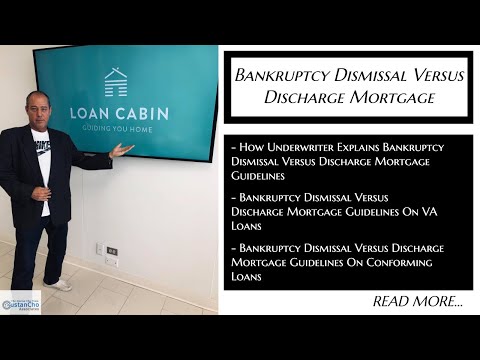
Borrowers often confuse a bankruptcy discharge with a bankruptcy dismissal, but they are not the same.
A bankruptcy discharge means the court has completed the bankruptcy process and released the borrower from legal responsibility for certain debts. This is generally the outcome lenders want to see because it shows the bankruptcy was completed.
A bankruptcy dismissal means the case was closed without the borrower receiving the full protections or discharge of bankruptcy. This may happen if the borrower did not complete the repayment plan, missed required payments, failed to provide documents, or did not follow court requirements. This difference matters for mortgage approval. A discharged bankruptcy may have a shorter or clearer mortgage waiting period than a dismissed bankruptcy. For example, Fannie Mae lists Chapter 13 bankruptcy waiting periods of 2 years from discharge or 4 years from dismissal. For borrowers comparing debt settlement versus bankruptcy, this is important. Bankruptcy may damage credit, but a completed bankruptcy can give lenders a documented end date. A dismissed bankruptcy, unresolved debt settlement, recent late payments, open collections, or disputed accounts can make the mortgage file more difficult to approve.
Debt Settlement Versus Bankruptcy: Key Differences
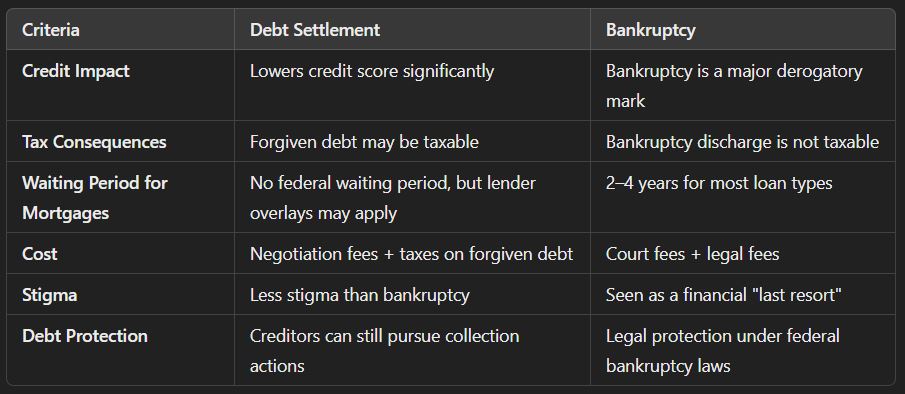
Mortgage Waiting Periods After Bankruptcy
Mortgage waiting periods after bankruptcy depend on the loan program, the type of bankruptcy, and whether the bankruptcy was discharged or dismissed. Borrowers should not assume every mortgage program uses the same rules. FHA, VA, USDA, conventional, and non-QM lenders can all review bankruptcy differently.
The waiting period typically begins from the date of bankruptcy discharge or dismissal, rather than from the original filing date. However, circumstances can become more complex, particularly in cases involving a mortgage, foreclosure, short sale, or deed-in-lieu.
Even after fulfilling the waiting period, the borrower must still meet qualification criteria, including credit score, payment history, income, debt-to-income ratio, assets, AUS findings, and lender overlays. This is particularly relevant when considering debt settlement versus bankruptcy, as both options have their unique implications on the waiting period and qualification requirements.
FHA Mortgage After Chapter 7 Bankruptcy
FHA loans generally require a waiting period after a Chapter 7 bankruptcy. The key date is usually the Chapter 7 discharge date. FHA may allow borrowers to qualify after the required waiting period if they have reestablished credit, avoided new major derogatory credit, and meet FHA underwriting guidelines. FHA approval does not solely depend on the date of bankruptcy. Lenders assess the borrower’s credit recovery, income stability, debt-to-income ratio, and automated underwriting findings. In addition, some FHA lenders may impose overlays that require higher credit scores, longer waiting periods, or more substantial compensating factors than FHA guidelines require. It’s also important to consider strategies such as debt settlement versus bankruptcy, as they can affect one’s financial standing. The primary reference for FHA single-family policies is HUD’s FHA Handbook 4000.1.
VA Mortgage After Chapter 7 Bankruptcy
VA loans can be more accommodating than many borrowers anticipate, but it’s essential to carefully examine bankruptcy situations. According to the VA buyer guide, there is generally a 2-year waiting period following a Chapter 7 bankruptcy discharge and a 1-year waiting period after a Chapter 13 discharge. However, the complete financial profile is crucial.
VA lenders often assess the circumstances surrounding the bankruptcy, whether the borrower has successfully reestablished credit, if housing payments have been made consistently, and if the borrower meets the VA’s residual income and debt-to-income criteria.
It’s important to note that even if a VA borrower meets the basic guidelines, they may still be denied if the lender has additional requirements. In this context, understanding debt settlement versus bankruptcy can also play a significant role in the decision-making process.
Conventional Mortgage After Bankruptcy
Conventional loans backed by Fannie Mae and Freddie Mac tend to have stricter waiting periods after bankruptcy than FHA or VA loans. For Fannie Mae, if you’ve filed for Chapter 7 bankruptcy, you typically face a four-year waiting period. Chapter 13 bankruptcy has different implications based on whether it was discharged or dismissed. Specifically, Fannie Mae considers a Chapter 13 discharge a two-year wait and a dismissal a four-year wait. Borrowers need to understand the difference between debt settlement versus bankruptcy. They need to know whether their bankruptcy was completed and discharged, or closed without discharge.
USDA Mortgage After Bankruptcy
USDA loans have specific rules regarding bankruptcy wait periods. According to USDA credit guidelines, if your Chapter 7 bankruptcy was discharged or dismissed more than 36 months ago, it is not considered bad credit for your loan application. Conversely, if it’s been less than 36 months, you may require a special credit exception, depending on GUS underwriting recommendations or a manual review. This means that USDA borrowers must carefully track both the bankruptcy date and the underwriting outcome. It’s also important to note that when evaluating options like debt settlement versus bankruptcy, borrowers may need to provide documentation explaining the reason for the bankruptcy, demonstrate that they have reestablished credit, and show that similar financial issues are unlikely to recur.
Mortgage During Chapter 13 Bankruptcy
Chapter 13 bankruptcy is different from Chapter 7 because, in Chapter 13, the borrower pays back their debts through a court-approved repayment plan. Some borrowers may qualify for a mortgage while still in an active Chapter 13 plan.
FHA and VA loans may allow mortgage approval during Chapter 13 if the borrower has made at least 12 months of on-time trustee payments, has trustee or court approval, and meets the lender’s underwriting requirements. These files often require manual underwriting and careful documentation.
When it comes to conventional loans, Chapter 13 is strict. According to Fannie Mae’s DU credit analysis, your loan application might not qualify if a Chapter 13 bankruptcy was discharged in the last two years, dismissed in the last four years, or if you filed it but it’s still pending for the last four years.
Non-QM Loans After Bankruptcy With No Waiting Period
Non-QM loans may offer mortgage options sooner after bankruptcy than FHA, VA, USDA, or conventional loans. Some non-QM lenders may allow financing shortly after bankruptcy discharge. In some cases, there may be no traditional waiting period. However, borrowers should not confuse “no waiting period” with easy approval. Non-QM loans usually require stronger compensating factors, such as a larger down payment, higher reserves, a lower loan-to-value ratio, stable income, and an acceptable explanation of the bankruptcy. Interest rates and costs may also be higher than agency mortgage programs.
Why Waiting Periods Are Only One Part Of Approval
The bankruptcy waiting period is only one part of the mortgage approval process. A borrower can meet the required waiting period and still be denied if the rest of the file is weak. Mortgage lenders may still review:
- Recent late payments after bankruptcy.
- Credit score recovery.
- Housing payment history.
- Collections, charge-offs, or disputed accounts.
- Debt-to-income ratio.
- Income and employment stability.
- Down payment and reserves.
- AUS findings.
- Manual underwriting requirements.
- Lender overlays.
For borrowers comparing debt settlement versus bankruptcy, this is one of the biggest differences. Bankruptcy often has clearer waiting-period rules, while debt settlement can be less defined and more dependent on how the credit report looks after the settlement. The best path depends on the borrower’s full profile, the loan program, and whether the lender follows agency guidelines without additional overlays.
Is Debt Settlement Worse Than Bankruptcy For Getting A Mortgage?
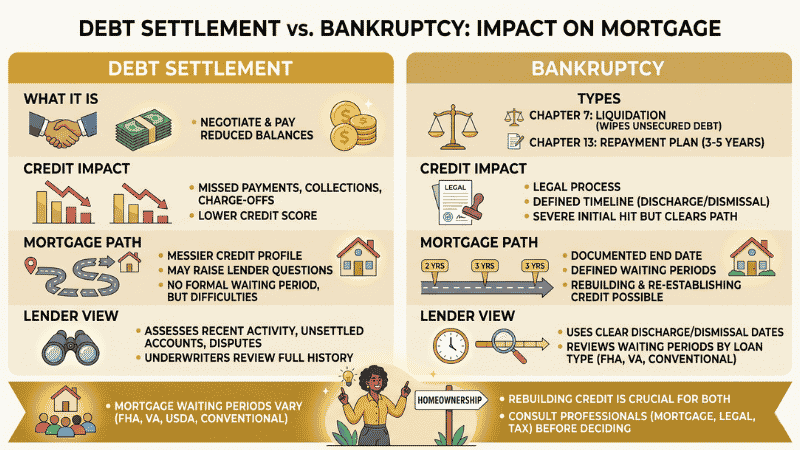
Debt settlement can sometimes be worse than bankruptcy for getting a mortgage because it may leave the borrower with a messier credit profile. Bankruptcy is serious, but it usually creates a clear legal timeline. There is a filing date, discharge date, dismissal date, and loan program waiting period.
Mortgage underwriters can review those dates and determine whether the borrower meets FHA, VA, USDA, conventional, or non-QM guidelines.
Debt settlement is not always that clean. A borrower may settle one account but still have other accounts reporting late payments, charge-offs, collections, disputes, or unpaid balances. Even if the settled account shows a zero balance, the credit report may still reflect that the borrower paid less than the original amount owed. That can raise questions for the lender about credit risk, financial stability, and whether the borrower has fully recovered.
Why Bankruptcy May Be Easier To Underwrite
Bankruptcy may be easier to underwrite because it gives lenders a documented endpoint. Once the bankruptcy is discharged, the borrower can focus on rebuilding credit, making on-time payments, saving money, and waiting out the required mortgage timeline.
For example, a borrower who completed Chapter 7 bankruptcy two or more years ago, rebuilt credit, avoided new late payments, and now has a stable income may be easier to approve for an FHA or VA loan than someone with recent debt settlements and active collection activity.
The bankruptcy itself is not good for credit. However, a completed bankruptcy can show that the debt problem was legally resolved. It helps the lender understand what went down and when the borrower began to bounce back.
Why Debt Settlement Can Be Harder For Mortgage Approval
Debt settlement can be harder because the credit damage may not happen all at once. Many borrowers fall behind before they settle. That means the credit report may show months of late payments before the final settlement is reached. A debt settlement file may also include:
- Settled-for-less-than-owed accounts.
- Recent late payments.
- Charge-offs.
- Open or closed collections.
- Credit disputes.
- Unpaid accounts are not included in the settlement.
- Recently updated derogatory accounts.
- Possible tax issues from forgiven debt.
This can make the mortgage file harder to approve because lenders are not only looking at the settlement. They are looking at the full credit history before, during, and after the settlement.
A Clean Bankruptcy May Beat Recent Debt Settlement
For mortgage approval, a clean bankruptcy discharge with reestablished credit may be better than a recent debt settlement with ongoing credit problems. This is one reason borrowers should not assume debt settlement is always the “safer” option just because it avoids bankruptcy. A borrower with a completed bankruptcy, no new late payments, stable income, and acceptable credit scores may have a clearer path to mortgage approval. A borrower with recent settlements, unresolved collections, disputed accounts, and low credit scores may need more time to rebuild before qualifying.
The Right Answer Depends On The Full File
Debt settlement versus bankruptcy is not a one-size-fits-all decision. Bankruptcy may be easier to document for mortgage approval, but it also comes with serious credit, legal, and financial consequences. Debt settlement may help some borrowers avoid bankruptcy, but it can create mortgage problems if it leaves recent derogatory credit behind. Mortgage approval depends on the full borrower profile, including credit scores, payment history, income, debt-to-income ratio, assets, reserves, AUS findings, manual underwriting rules, and lender overlays. Borrowers should speak with a mortgage professional, bankruptcy attorney, and tax advisor before deciding which option is best for their situation.
Debt Settlement vs. Bankruptcy: What’s the Best Path to Homeownership?
Contact us today to learn how these options can impact your mortgage approval.Choosing Between Debt Settlement Versus Bankruptcy
Making the right choice depends on your financial situation, future goals, and how quickly you want to recover.
Debt Settlement May Be Right If:
- Your total debt is relatively low.
- You can make a single large payment.
- You want to avoid the stigma of bankruptcy.
Bankruptcy May Be Right If:
- You have an overwhelming debt with no realistic way to repay it.
- You need immediate legal protection from creditors.
- You want a fresh financial start with clear guidelines for recovery.
Real-Life Example: Bankruptcy Path
James filed Chapter 7 bankruptcy after a job loss and unexpected medical bills made it impossible to keep up with his monthly debts. After his bankruptcy was cleared, he got serious about fixing his credit. He started making all his payments on time, keeping his credit card balances down, and steering clear of any new collections, charge-offs, or late bills. Two years later, James applied for an FHA loan. Because his Chapter 7 waiting period was complete, his credit had recovered, and he had a stable income, he qualified for an FHA mortgage with a 3.5% down payment. This example shows why bankruptcy may sometimes create a clearer path to mortgage approval than debt settlement. The key is not just the bankruptcy discharge. The borrower must also rebuild credit, avoid new derogatory accounts, and meet the lender’s full mortgage guidelines.
Rebuilding Credit After Debt Settlement or Bankruptcy
Recovering from debt settlement or bankruptcy takes time, but with the right steps, you can rebuild your financial health and qualify for a mortgage sooner.
Steps to Rebuild Credit:
- Check Your Credit Report: Ensure all debts included in your bankruptcy or settlement are marked correctly.
- Open a Secured Credit Card: Use it for small purchases and pay the balance in full each month.
- Keep Credit Utilization Low: Aim to use less than 30% of your available credit.
- Avoid New Debt: Focus on managing your current obligations before taking on more debt.
Mortgage Options After Debt Settlement or Bankruptcy
For borrowers recovering from financial hardships, there are several mortgage options available.
FHA Loans
- Adaptable credit criteria and minimal down payment choices (3.5%).
- Ideal for borrowers recovering from bankruptcy or debt settlement.
VA Loans
- Available to eligible veterans and active-duty service members.
- No down payment is required, and there are lenient credit guidelines.
Non-QM Loans
- No waiting period after bankruptcy or debt settlement.
- Higher down payment and interest rates apply.
Tips for Mortgage Approval in 2026
- Work with a Lender Who Understands Your Situation: Choose a mortgage lender with no overlays and experience helping borrowers with past financial hardships.
- Provide a Letter of Explanation: Be transparent about the situation that resulted in your financial difficulties and the actions you’ve taken to improve your situation.
- Show Stable Income: Demonstrating steady employment and income will reassure lenders of your ability to make payments.
Debt Settlement Versus Bankruptcy: Which Is Better?
For mortgage purposes, bankruptcy is often viewed more favorably than debt settlement because it provides a clear resolution to financial issues under federal law. However, the best choice depends on your individual circumstances.
Final Thoughts On Debt Settlement Versus Bankruptcy For Mortgage Borrowers
Debt settlement and bankruptcy can both affect mortgage approval, but lenders do not review them the same way. Bankruptcy may create a clearer path because mortgage guidelines often have defined waiting periods based on the loan program, bankruptcy type, and discharge or dismissal date.
Debt settlement may not always have a formal mortgage waiting period, but it can still create challenges. Settled accounts may leave behind late payments, charge-offs, collections, lower credit scores, possible tax issues, and lender concerns about whether the borrower has fully recovered financially.
Before choosing between debt settlement versus bankruptcy, borrowers should review their full credit report, income, monthly debts, savings, and homebuying timeline. The right option depends on the borrower’s full financial picture, not just which choice seems easier today. A mortgage lender familiar with FHA, VA, USDA, conventional, manual underwriting, and non-QM loan options can help determine what programs may be available after debt settlement or bankruptcy. If you are trying to buy a home after debt settlement or bankruptcy, Gustan Cho Associates can review your credit, income, assets, and loan options to help you understand the next step. Related> Is Debt Settlement Worse Than Bankruptcy?
Frequently Asked Questions About Debt Settlement Versus Bankruptcy:
Is Debt Settlement Better Than Bankruptcy?
Debt settlement may be better for borrowers with manageable unsecured debt who can afford to negotiate and pay reduced balances. Bankruptcy may be better for borrowers with overwhelming debt who need legal protection and a clearer financial reset. For mortgage approval, bankruptcy may be easier to underwrite because it has court documents, discharge dates, and defined waiting periods. Debt settlement can be messier if the credit report still shows late payments, charge-offs, collections, disputes, or unpaid accounts.
Is Debt Settlement Worse Than Bankruptcy For Getting A Mortgage?
Debt settlement can be worse than bankruptcy for mortgage approval if it leaves behind recent late payments, unsettled accounts, collections, charge-offs, or credit disputes. Bankruptcy damages credit, but it often gives lenders a clearer timeline because there is a filing date, discharge date, or dismissal date. A borrower with a completed bankruptcy and reestablished credit may be easier to approve than a borrower with recent debt settlements and ongoing derogatory credit. Bankruptcy also provides court-supervised rules and creditor protection that debt settlement does not.
Can I Buy A House After Debt Settlement?
Yes, you may be able to buy a house after debt settlement, but the full credit profile matters. Lenders may review when the accounts were settled, whether balances are still reported, whether there are open disputes, how recent the late payments were, and whether the borrower has rebuilt credit. Debt settlement does not always create a formal mortgage waiting period. However, lender overlays, low credit scores, recent late payments, and unresolved collections can still block approval.
How Long After Bankruptcy Can I Get A Mortgage?
The waiting period depends on the loan program and bankruptcy type. FHA and VA loans may allow borrowers to qualify sooner than conventional loans, especially after a Chapter 13 repayment history. Conventional loans often have longer waiting periods, and lenders may treat Chapter 7, Chapter 13 discharge, and Chapter 13 dismissal differently. Chapter 13 generally involves a court-approved repayment plan lasting three to five years.
Does Debt Settlement Hurt Your Credit More Than Bankruptcy?
Both can hurt credit. Debt settlement can damage credit because borrowers often fall behind before accounts are settled, and the credit report may show accounts settled for less than owed. Bankruptcy may stay on your credit report for a long time, but it also has the potential to disrupt the pattern of unpaid debts and assist the borrower in discovering a more effective way to recover. Experian notes that debt settlement can hurt credit, create fees, and have possible tax consequences.
Should I Talk To A Mortgage Lender Before Deciding Between Debt Settlement And Bankruptcy?
Yes. Borrowers planning to buy or refinance a home should speak with a mortgage lender before making a final decision. A lender can review credit, income, debts, assets, and mortgage timeline to explain possible FHA, VA, USDA, conventional, manual underwriting, or non-QM options. Borrowers should also speak with a bankruptcy attorney or tax professional because debt settlement and bankruptcy can have legal and tax consequences.
This article about “Debt Settlement Versus Bankruptcy Mortgage Guidelines” was updated on May 20th, 2026.