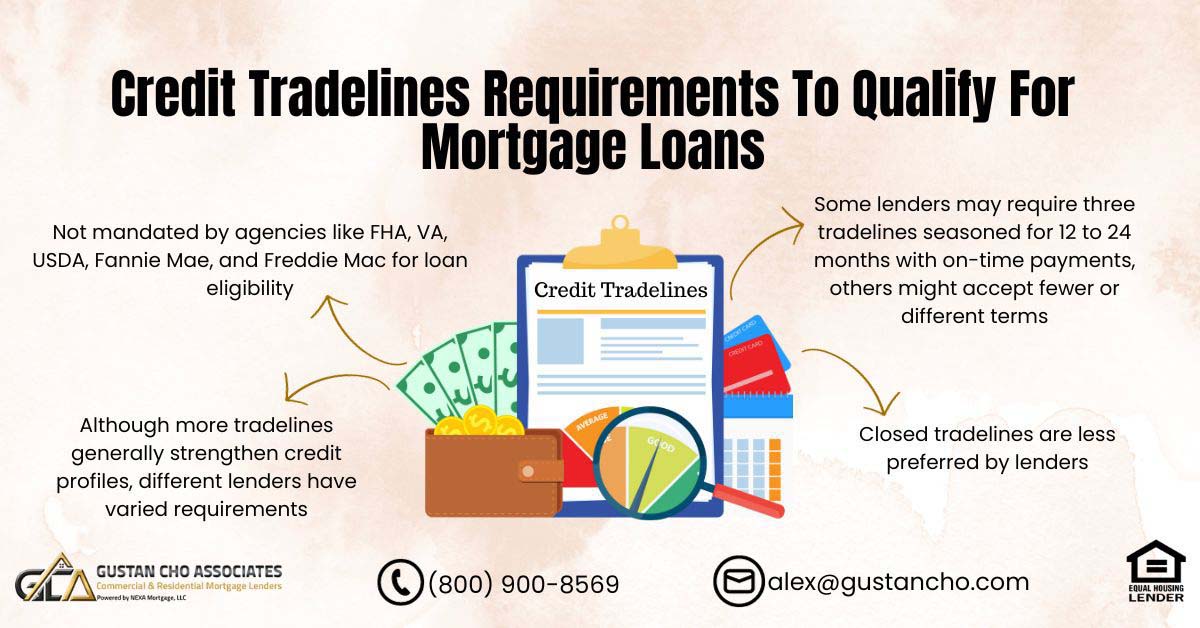
In this guide, we will delve into the credit tradelines requirements essential for mortgage loan application eligibility. The credit tradelines requirements on government and individual lenders set conventional loans. A credit tradeline’s duration is commonly acknowledged as a positive factor, and a track record of at least 12 months of consistent activity is generally viewed favorably in this context. There is no single number that applies to every loan program.
This guide outlines credit tradeline requirements for mortgage loan qualification, including FHA, VA, USDA, conventional, thin credit, and alternative credit options.
Some borrowers qualify with only a few tradelines if automated underwriting approves the file. Borrowers with no score or thin credit may need alternative credit references, rent history, or manual underwriting. It’s crucial to emphasize that agency guidelines do not regulate credit tradelines. Individuals applying for FHA, VA, USDA, Fannie Mae, and Freddie Mac loans are not obligated to possess a specific minimum number of credit tradelines. In the following paragraphs, we will cover credit tradelines requirements for a mortgage loan approval.
Mortgage Guidelines on Credit Tradelines Requirements

Credit tradelines requirements, commonly called lender overlays, represent supplementary lending criteria individual lenders establish. These criteria go beyond the baseline guidelines outlined by agencies such as FHA, VA, USDA, Fannie Mae, and Freddie Mac. It is not uncommon for lenders to enforce more stringent lending standards than those mandated by these agencies. Despite this, borrowers without credit tradelines may still qualify for government or conventional loans, subject to approval or eligibility determined by the automated underwriting system (AUS).
Introduction: Credit Tradelines Requirements to Qualify for Mortgage Loans
Credit tradeline requirements to qualify for mortgage loans are among the most misunderstood parts of the mortgage approval process. Many homebuyers think they need a long credit history, several open credit cards, and years of perfect payments before they can buy a home. That is not always true.
A tradeline is any credit account that appears on your credit report. This can include credit cards, auto loans, student loans, personal loans, mortgages, and other reported debts.
Mortgage lenders review tradelines to see how a borrower manages credit, pays bills, handles debt, and responds to financial obligations. However, every loan program is different. FHA, VA, USDA, conventional, and non-QM loans may treat tradelines differently. Some borrowers can qualify with strong credit scores and only a few tradelines. Others may need alternative credit references, manual underwriting, or a lender with no overlays.
Can You Get a Mortgage With Limited Credit Tradelines?
At Gustan Cho Associates, many borrowers come to us after being denied by other lenders because of thin credit, limited tradelines, no credit score, authorized user accounts, disputed accounts, recent credit events, or lender overlays. The good news is that limited credit does not always mean you cannot qualify for a mortgage.
What Are Credit Tradelines in Mortgage Lending?
A credit tradeline is an account listed on your credit report. Each tradeline usually shows the creditor name, account type, opening date, credit limit or loan balance, monthly payment, payment history, and current account status. Mortgage underwriters use tradelines to evaluate a borrower’s payment history. They want to know whether you pay on time, carry high balances, have recently opened new accounts, or have late payments, collections, charge-offs, or disputed accounts.
Why Credit Tradelines Matter When Qualifying for a Mortgage
Credit tradelines matter because they help lenders measure credit depth. A borrower with a 720-credit score and several established accounts may be viewed differently from a borrower with a 720-score based mostly on one new credit card. Mortgage approval is not based solely on credit score. Lenders also review income, debt-to-income ratio, assets, employment history, housing payment history, property eligibility, automated underwriting findings, and lender overlays.
Credit Score Versus Credit Tradelines
Your credit score is a number. Your tradelines explain the story behind that number. A borrower may have a good score but a thin credit file. Another borrower may have several tradelines but lower scores due to high credit card balances or recent late payments. Mortgage lenders review both the score and the underlying credit history. This is why two borrowers with the same credit score can receive different underwriting conditions.
How Many Credit Tradelines Do You Need to Qualify for a Mortgage?
There is no single universal tradeline rule that applies to every borrower and every mortgage program. Some borrowers qualify with only one or two reported tradelines if the automated underwriting system approves the file.
Other borrowers may need additional credit depth, especially if the file requires manual underwriting or nontraditional credit.
Fannie Mae allows certain loans for which no borrower has a credit score to follow its nontraditional credit history rules, and it also provides specific guidance for nontraditional credit references. The key question is not only how many tradelines you have. The bigger question is whether your overall mortgage file receives an approve/eligible finding, meets agency guidelines, and passes the lender’s internal requirements.
Traditional Credit Tradelines for Mortgage Loans
Traditional credit tradelines are accounts reported to the major credit bureaus. These are the easiest for lenders to review because they appear directly on the tri-merge credit report.
Common Traditional Tradelines
Common traditional tradelines include credit cards, auto loans, student loans, personal loans, retail store cards, installment loans, existing mortgages, and home equity lines of credit. The strongest tradelines are usually older accounts with on-time payment history, low balances, and stable usage.
Open Tradelines Versus Closed Tradelines
Open tradelines can help show current credit management. Closed tradelines may still help if they show strong payment history and remain on the credit report. A closed paid-as-agreed auto loan, student loan, or mortgage can still support a borrower’s credit profile. However, if a borrower has no active tradelines, some lenders may view the credit file as weaker.
How Credit Tradelines Help You Qualify for a Mortgage
Having multiple aged credit tradelines with a history of timely payments and low credit utilization ratio are considered compensating factors and is viewed favorably.
While credit tradelines requirements add complexity to the lending process, they only sometimes preclude borrowers with established credit tradelines from accessing various loan options.
The are additional credit tradelines is essentially an extra layer of security lenders use to assess a borrower’s creditworthiness. Even if an individual lacks traditional credit tradelines, such as credit cards or loans, they may still secure government or conventional loans if they receive approval or eligibility clearance through the automated underwriting system.
How Many Credit Tradelines Requirements to Qualify for Mortgage?
Lenders typically impose specific credit tradelines requirements as part of their criteria for loan approval. Generally, most lenders necessitate three credit tradelines that have a seasoning period of 12 to 24 months, with a crucial emphasis on consistent on-time payments. This requirement is commonly included in lender overlays, serving as a benchmark to evaluate an individual’s creditworthiness. For non-QM (Non-Qualified Mortgage) lenders, the stipulated credit tradelines requirements may vary slightly.
Mortgage Tradeline Requirements for Home Loan Approval
Typically, they may request either two credit tradelines with a longer 24-month seasoning period or three credit tradelines with a shorter 12-month seasoning requirement. These conditions underscore the importance of a borrower’s credit history and payment reliability, shaping the lending landscape for those seeking financing outside the conventional mortgage parameters. Adhering to these credit tradelines prerequisites becomes pivotal for individuals navigating the loan application process.
What Are Closed Credit Tradelines?
A closed credit tradeline denotes a scenario in which a consumer had a credit tradeline that is no longer active due to closure or full repayment, despite its existence in the past, spanning months or even years. Lenders commonly prioritize the examination of active and well-established open credit tradelines.
The longevity of a credit tradeline is generally regarded as advantageous, with a preference for those that have maintained activity for a minimum of 12 months.
In credit tradelines requirements, a closed credit tradeline signifies the cessation of activity on a previously held credit account through closure or full repayment, irrespective of its historical presence, extending over several months or years. Lenders typically emphasize the significance of actively maintained and firmly established open credit tradelines when evaluating a consumer’s creditworthiness.
What Are Credit Tradelines Requirements?
Credit tradelines pertain to the credit accounts of consumers reported to credit bureaus. Lenders generally consider a credit tradeline as an account with a minimum of 12 months of activity that is reported to the credit bureaus.
To illustrate, if a consumer possesses a Blue Sky Visa-secured credit card, the payment history associated with that card will be documented and displayed on their credit report.
Prequalify for a mortgage in just five minutes. Notably, most creditors report to the three major credit reporting agencies, namely TransUnion, Experian, and Equifax. These agencies play a crucial role in compiling and maintaining individuals’ credit histories.
What Does Credit Reports Consist Of?
The Credit Grantor Will Post the Following:
- credit limit
- credit balance
- minimum monthly payment
- date of last activity
- payment history
How Many Active Credit Tradelines Requirements by Mortgage Lenders
Mortgage lenders don’t set specific requirements regarding the number of credit tradelines borrowers must have. Having more credit tradelines generally strengthens a consumer’s credit profile. However, even a single late payment on a tradeline can negatively impact credit scores. Any derogatory report typically stays on a consumer’s credit report for 7 years.
Thin Credit Files and Mortgage Approval
A thin credit file refers to a borrower with limited reported credit history. This situation may arise when an individual avoids debt, pays primarily in cash, is new to the United States, has recently achieved financial independence, or has not utilized credit cards or loans. A thin credit file does not automatically disqualify a mortgage applicant; however, lenders may require more thorough documentation of the applicant’s payment history.
Can You Get a Mortgage with No Credit Tradelines?
Some borrowers may qualify for a mortgage without traditional credit tradelines. In such cases, the process typically requires alternative credit documentation or manual underwriting.
It may be possible to get a mortgage with no credit score. FHA, VA, USDA, and conventional loans may allow alternative credit or nontraditional credit in certain cases. Not every lender offers these options, so overlays matter.
FHA, VA, USDA, and conventional loans may provide options for borrowers with limited or no traditional credit. However, not all lenders offer these options, and lender overlays can present significant challenges. A borrower may satisfy agency guidelines yet still face denial if the lender imposes additional requirements, such as a minimum credit score, a specific number of tradelines, or a credit depth beyond what the agency mandates.
Know If Your Credit Tradelines Qualify
Thin credit, limited tradelines, authorized user accounts, and recent late payments can affect mortgage approval. Get your credit reviewed before applying.Alternative Credit Tradelines for Mortgage Loans
Alternative credit tradelines consist of payment histories that typically do not appear on traditional credit reports. These records may be used to demonstrate a borrower’s history of timely payments.
Examples of Alternative Credit Tradelines
Alternative credit references may include rent payments, utilities, cell phone bills, cable or internet bills, insurance payments, daycare payments, tuition payments, storage unit payments, or other recurring obligations. A documented history of housing payments is generally considered the strongest alternative credit reference. Rent or mortgage payment records can indicate whether the borrower has successfully managed obligations comparable to a new mortgage.
Nontraditional Credit Reports and Mortgage Approval
A nontraditional mortgage credit report may be used when a borrower does not have enough traditional credit reporting to produce a usable credit score or sufficient credit profile. HUD defines a Non-Traditional Mortgage Credit Report as a report designed to assess the credit history of a borrower who lacks the types of trade references that appear on a traditional credit report. This approach benefits borrowers who consistently pay bills on time but do not utilize traditional credit cards or loans.
FHA Credit Tradelines Requirements to Qualify for Mortgage Loans
FHA loans are frequently selected by borrowers with lower credit scores, higher debt-to-income ratios, prior bankruptcy or foreclosure, collections, charge-offs, or limited credit history.
HUD’s FHA Single Family Housing Policy Handbook 4000.1 is the main policy source for FHA origination and insurance endorsement requirements.
FHA does not require every borrower to have multiple long-established tradelines in every case. The file must meet FHA guidelines, receive acceptable underwriting findings, or meet manual underwriting requirements when applicable.
FHA Loans with Limited Credit
Borrowers with limited credit may still qualify for FHA financing if other aspects of their application are strong. Underwriters typically examine rent history, reserves, employment stability, debt-to-income ratio, and the presence of any recent derogatory credit.
FHA Manual Underwriting and Alternative Credit
If an FHA borrower does not receive automated approval, the file may need manual underwriting. Manual underwriting can require stronger documentation of payment history and compensating factors. Applicants with no credit score or thin credit often require a lender experienced in manual underwriting and one that does not impose unnecessary overlays.
Conventional Loan Credit Tradelines Requirements
Conventional loans adhere to Fannie Mae or Freddie Mac guidelines and may be more sensitive to credit score, credit depth, debt-to-income ratio, reserves, and automated underwriting findings.res a credit report for each borrower who has an individual credit record, and loans run through Desktop Underwriter have specific credit report requirements.
Conventional Loans with Limited Tradelines
Certain conventional loan applicants may qualify with limited tradelines if approved by the automated underwriting system. Applicants without a credit score may be required to follow nontraditional credit guidelines. Fannie Mae’s nontraditional credit guidance requires lenders to identify credit references covering the most recent consecutive 12 months when developing nontraditional credit history.
Fannie Mae Non-traditional Credit Guidelines
Fannie Mae allows non-traditional credit in certain cases, but the file must meet eligibility rules. One important rule is that reserve requirements may depend on whether the borrower can document housing payment history as one non-traditional credit reference. If housing history is documented, there may be no minimum reserve requirement under that rule; otherwise, 12 months of reserves may be required. Consequently, rent verification is particularly important for applicants with no credit score or limited tradelines.
VA Loan Credit Tradelines Requirements
VA loans are often flexible for eligible veterans, active-duty service members, and qualifying surviving spouses. VA guidelines do not set a universal minimum credit score requirement, and a lack of credit is not automatically viewed as negative. VA training materials state that VA has no minimum credit score requirement, lack of credit is not viewed as a negative, non-traditional tradelines or scoring models may be used, and there is no minimum number of tradelines.
VA Loans with No Credit Score
A VA borrower with no credit score may still be eligible if the lender can document an acceptable credit history and the borrower meets VA residual income, debt-to-income, assets, and overall underwriting requirements.
VA Manual Underwriting and Residual Income
VA manual underwriting can be highly effective when applied appropriately. Residual income is a critical compensating factor for VA loans. An applicant with limited tradelines but high residual income, stable employment, and a positive rent history may still present a strong application. However, not all lenders offer VA manual underwriting. Some lenders add overlays requiring a minimum credit score or minimum number of tradelines.
USDA Credit Tradelines Requirements
USDA loans are designed for eligible rural and suburban homebuyers who meet income and property eligibility requirements. USDA states that its guaranteed loan program has no credit score requirement, but applicants are expected to demonstrate their willingness and ability to manage debt.
USDA Loans with Limited Credit
USDA files may be underwritten through the Guaranteed Underwriting System, known as GUS, or manually underwritten. Credit expectations can vary depending on the underwriting path. USDA guidance notes that credit requirements may vary for loans underwritten with GUS compared to manually underwritten loans, and that lenders and investors may impose overlays, including credit score overlays.
USDA Alternative Credit Sources
USDA may allow a credit history to be developed from traditional and non-traditional sources in certain cases. USDA credit guidance states that when a credit score is below certain thresholds in direct program contexts, credit history may be developed from at least 3 sources, or 2 sources if one is rent or mortgage verification. Applicants are advised to verify whether they are applying under USDA Guaranteed or Direct program rules, as the requirements may differ.
Authorized User Tradelines and Mortgage Approval
Authorized user tradelines can help or hurt, depending on the file. An authorized user account is a credit account that allows the borrower to use someone else’s credit line without being legally responsible. Some applicants may have strong credit scores due to authorized user accounts, but possess limited credit established independently. Mortgage underwriters may scrutinize whether the applicant has personally managed credit obligations.
Are Authorized User Accounts Counted as Real Tradelines?
Authorized user accounts may appear on the credit report, but lenders may not always treat them the same as primary accounts. Underwriters may look for evidence that the borrower owns and manages their own credit.
If most of the borrower’s credit score comes from authorized user accounts, the lender may request additional documentation or place less weight on those accounts.
Authorized user tradelines may appear on your credit report, but underwriters may not always treat them the same as accounts you personally opened and managed. If most of your credit comes from authorized user accounts, the lender may ask for additional credit documentation.
Disputed Tradelines and Mortgage Approval
Disputed accounts can create problems during mortgage underwriting. A disputed tradeline may be excluded from credit scoring or may trigger underwriting conditions. Applicants are advised not to dispute accounts immediately prior to applying for a mortgage. Credit disputes should be reviewed with a mortgage professional, as removing a dispute may lower the credit score or alter the underwriting.
Importance of Timely Payments on Credit Tradelines
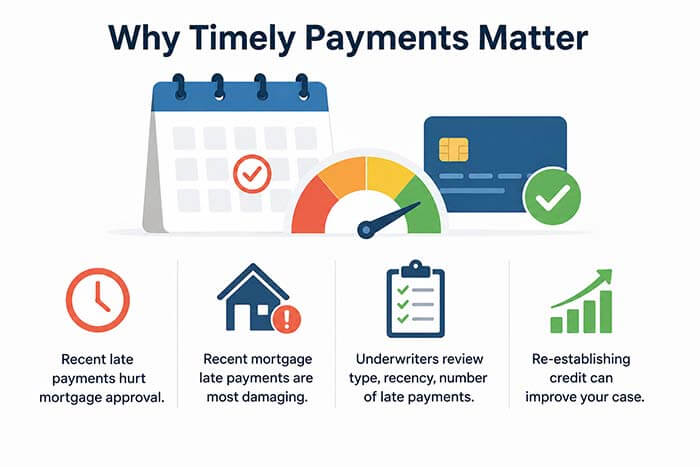
Late payments can affect mortgage approval, especially recent late payments. A 30-day late payment on a credit card is serious, but a recent mortgage late payment is usually more damaging. Underwriters care about the type of late payment, how recent it was, how many late payments occurred, and whether the borrower has re-established credit afterward.
Collections, Charge-Offs, and Tradelines
Collections and charge-offs are also tradelines. They show past credit problems and may affect approval depending on the loan program, the amount owed, the age of the account, and whether the account affects the debt-to-income ratio. Some loan programs do not require all collections to be paid. However, lender overlays may require payoff even when agency guidelines do not.
Revolving Tradelines and Credit Card Balances
Credit card balances can significantly impact credit scores. A borrower may have several good tradelines but still have lower scores because revolving balances are too high. Reducing credit card balances may improve credit scores more rapidly than opening new accounts. However, applicants should consult a mortgage professional before reallocating funds, as cash required for closing, reserves, and underwriting documentation are also important considerations.
Installment Tradelines and Mortgage Approval
Installment tradelines include auto loans, student loans, personal loans, and other fixed-payment accounts. These tradelines help show whether the borrower can manage structured monthly payments. Installment loans also affect the debt-to-income ratio. Even if the payment history is perfect, a large monthly payment can reduce mortgage buying power.
New Tradelines Before Applying for a Mortgage
Opening new credit before applying for a mortgage can create problems. New accounts may lower credit scores, increase monthly debt, trigger credit inquiries, and raise underwriting questions. Applicants intending to purchase a home are generally advised to avoid opening new credit cards, auto loans, furniture financing, personal loans, or buy now, pay later accounts unless specifically recommended by their loan officer.
Seasoning Requirements for Credit Tradelines
Seasoning means how long a tradeline has been open and reported. Older tradelines generally carry more weight than brand-new accounts. A credit card account opened 30 days prior is less beneficial than one with a 24-month history of on-time payments. Mortgage lenders generally prefer evidence of long-term credit stability over recent credit activity.
How Lender Overlays Affect Credit Tradelines Requirements
Lender overlays are extra rules added by individual lenders. This is one of the biggest reasons borrowers get denied. A borrower may meet FHA, VA, USDA, or conventional agency guidelines, but still be denied because the lender requires:
Common Tradeline Overlays
Some lenders require a minimum number of open tradelines, a minimum credit score, no manual underwriting, no non-traditional credit, no recent disputes, no recent late payments, or no borrower with limited credit history. These requirements are set by individual lenders and may not reflect agency guidelines. The distinction between lender and agency rules is significant.
Automated Underwriting Versus Manual Underwriting
Automated underwriting systems review the loan file electronically and issue findings. FHA loans may use the TOTAL Scorecard. Conventional loans may use Desktop Underwriter or Loan Product Advisor. USDA loans may use GUS. If automated underwriting approves the file, tradeline depth may be less of an issue. If the file must be manually underwritten, the underwriter may require stronger credit documentation and compensating factors.
Best Tradelines to Have Before Applying for a Mortgage
The most favorable tradelines are those that are well-established, consistently paid on time, maintain low balances, and are personally managed by the applicant.
Strong Tradeline Examples
Strong tradelines may include a credit card open for several years with low utilization, an auto loan with no late payments, student loans paid as agreed, a prior mortgage with a clean payment history, or a documented 12-month rent history.
Weak Tradeline Examples
Weak tradelines may include brand-new credit cards, maxed-out revolving accounts, authorized user accounts only, accounts with recent late payments, disputed accounts, or collection accounts.
How to Build Credit Tradelines Before Buying a House
Applicants with limited credit can enhance their mortgage profile prior to applying. The objective is to establish a responsible and well-documented credit history, rather than opening accounts indiscriminately.
Start With One or Two Simple Accounts
A secured credit card or a small installment loan may help build credit if managed appropriately. Maintaining low balances and ensuring timely payments are essential.
Keep Credit Card Utilization Low
Credit utilization is the percentage of your credit limit being used. Lower utilization can help improve credit scores.
Do Not Miss Payments
Payment history is one of the most important parts of credit. One recent late payment can hurt more than having fewer tradelines.
Document Rent and Alternative Credit
Applicants without traditional credit should retain documentation of rent, utilities, insurance, phone bills, and other recurring payments.
Documents Needed for Alternative Credit Tradelines
Borrowers using alternative credit may need to provide documentation showing 12 months of payment history.
Common Documents for Alternative Credit
Common documents include canceled checks, bank statements, landlord verification, utility payment records, insurance payment history, phone bills, internet bills, or written verification from a creditor. The specific documentation required varies by loan program, underwriting method, and lender.
Don’t Let Limited Credit Stop You
Some borrowers can qualify with limited tradelines, alternative credit, or compensating factors depending on the loan program and underwriting findings.Credit Tradelines Requirements After Bankruptcy
Borrowers can qualify for a mortgage after bankruptcy if they meet the waiting period requirements, have re-established credit, and meet program guidelines. Tradelines after bankruptcy are important because lenders want to see that the borrower has recovered financially and is managing credit responsibly.
Re-Established Credit After Bankruptcy
Re-established credit may include secured credit cards, auto loans, student loans, rent history, or other accounts paid on time after the bankruptcy discharge. The objective is to demonstrate a consistent and positive payment history following the credit event.
Credit Tradelines Requirements After Foreclosure or Short Sale
After foreclosure, deed-in-lieu, or short sale, mortgage approval depends on the loan program, waiting period, credit re-establishment, and overall risk profile. Applicants are advised to avoid incurring new late payments following a major housing event. Maintaining a clean payment history after foreclosure or short sale can facilitate credit recovery.
What Borrowers Should Avoid Before Mortgage Approval
Applicants are generally advised to avoid opening new credit accounts, maximizing credit card balances, co-signing loans, disputing accounts without professional guidance, closing longstanding accounts, making late payments, or transferring large amounts of undocumented funds. Minor changes to credit profiles can influence the results of automated underwriting systems.
Lender Overlays on Credit Tradelines Requirements
Lenders often have additional requirements known as overlays. While automated underwriting systems may approve borrowers, most lenders still demand three to four credit tradelines that have been established for 12 to 24 months, despite the system’s initial eligibility. However, Gustan Cho Associates stands out by not imposing lender overlays on government or conventional loans. Instead, they rely solely on the automated underwriting system’s findings. In this article, we’ll delve into lenders’ credit tradeline guidelines and overlays.
Do Mortgage Lenders Require Minimum Credit Tradelines?
Typically, lenders have their own set of requirements regarding Credit Tradelines. Those without specific requirements don’t necessitate credit tradelines but rely on the Automated Underwriting System (AUS) findings. Applicants needing tradelines but receiving approval through the Automated Underwriting System can potentially qualify with lenders not imposing additional requirements. Gustan Cho Associates, for instance, doesn’t have overlays on government and conventional loans.
Lender Overlays
Certain lenders impose their overlays that include minimum credit tradeline criteria. Typically, most lenders stipulate a minimum of 3 credit tradelines. However, certain lenders may demand 4 established credit tradelines, while others set even higher requirements. Additionally, some lenders mandate a 12-month seasoning for credit tradelines, whereas others insist on a 24-month seasoning period.
Do Lenders Require Credit Tradelines?
In addition to minimum credit tradeline criteria, lenders often impose credit tradeline seasoning requirements. Most lenders stipulate that mortgage applicants should demonstrate at least one year of consistent credit history for each tradeline.
For instance, if a borrower recently obtained a Visa credit card and has held it for only six months, it wouldn’t meet the required credit tradeline duration.
Lenders necessitate mortgage applicants to possess credit accounts with a clean payment record for a minimum of one year. Evaluating credit tradelines from the past year is how lenders gauge the risk levels associated with borrowers.
Credit Tradeline That Has Been Seasoned For A Year
For mortgage loan seekers lacking three credit tradelines seasoned for a year, there’s still a chance. Some lenders may consider exceptions given a robust credit profile in other respects, backed by compensating factors. These factors, such as minimal payment shock, reserves, or a secondary job not utilized for income, can play a pivotal role.
Non-Traditional Credit Tradelines
To substitute credit tradeline, we can use rental verification or non-traditional credit tradeline. Examples of non-traditional tradelines are the following:
- Cellular phone bill
- Cable
- Internet Bill
- Utility payment
- Other documented monthly payment bills that have been paid with a check and/or direct deposit for the past 12 months with no late payments
How Gustan Cho Associates Helps Borrowers with Tradeline Issues
Credit tradelines requirements to qualify for mortgage loans depend on the loan program, credit score, underwriting system, borrower profile, and lender overlays.
Some borrowers qualify with limited tradelines. Others may need alternative credit, rent verification, manual underwriting, or stronger compensating factors.
Gustan Cho Associates helps borrowers who have been turned down due to limited tradelines, thin credit, no credit score, manual underwriting, recent bankruptcy, prior foreclosure, collections, charge-offs, higher debt-to-income ratios, and lender overlays. Most applicants do not require a flawless credit profile. Instead, they benefit from selecting an appropriate loan program, employing a suitable underwriting strategy, and working with a lender knowledgeable about agency guidelines.
Credit Tradelines Requirements to Qualify for Mortgage Loans: Final Thoughts
A comprehensive review of credit, income, assets, and debt profiles is essential before determining mortgage eligibility. A thin credit file does not necessarily result in denial. Applicants without a credit score or with limited tradelines may still qualify for FHA, VA, USDA, conventional, or non-QM financing if the loan is structured appropriately.
Whenever rental payments are made or other monthly payments, please pay them by check so they can always be tracked and verified.
Cash payment is non-existent in the mortgage world. Mortgage lenders will always want to see canceled checks as proof of payment. To secure a mortgage without lender overlays on government and conventional loans, reach out to Gustan Cho Associates by dialling 1-800-900-8569. For a quicker response, send a text or email us at gcho@gustancho.com. Our team is at your service seven days a week, including evenings, weekends, and holidays.
Frequently Asked Questions (FAQ) About Credit Tradelines Requirements To Qualify For Mortgage Loans
What are credit tradelines requirements for mortgage loan applications?
Credit tradelines requirements, also known as lender overlays, are additional lending criteria individual lenders set beyond the baseline guidelines outlined by government agencies like FHA, VA, USDA, Fannie Mae, and Freddie Mac. These requirements are used to assess a borrower’s creditworthiness. However, government and conventional loans do not have specific minimum requirements for credit tradelines.
How many credit tradelines do I need to qualify for a mortgage?
Lenders typically require three credit tradelines with a seasoning period of 12 to 24 months for loan approval. The emphasis is on consistent on-time payments. Non-QM (Non-Qualified Mortgage) lenders may have slightly different requirements, such as two credit tradelines with a 24-month seasoning period or three tradelines with a 12-month seasoning requirement.
What are closed credit tradelines?
A closed credit tradeline refers to a credit account that is no longer active due to closure or full repayment, even though it existed in the past for several months or years. Lenders prioritize active and well-established open credit tradelines and often prefer those with a minimum of 12 months of consistent activity.
What do credit reports consist of?
Credit reports include information credit grantors provide, such as credit limits, balances, minimum monthly payments, dates of last activity, and payment history. These details help lenders assess a borrower’s creditworthiness.
How many active credit tradelines are required by mortgage lenders?
Mortgage lenders do not set specific requirements for the number of credit tradelines a borrower must have. Having more credit tradelines can strengthen your credit profile, but even a single late payment on a tradeline can negatively impact your credit score. Derogatory reports typically stay on your credit report for seven years.
Do mortgage lenders require minimum credit tradelines?
Lenders have their own requirements for credit tradelines. Some lenders rely solely on the Automated Underwriting System (AUS) findings and do not require specific credit tradelines. Others may have minimum requirements, often ranging from 3 to 4 tradelines with seasoning periods of 12 to 24 months.
What is the role of lender overlays in credit tradelines requirements?
Lender overlays are additional requirements imposed by some lenders, which may include minimum credit tradeline criteria and seasoning requirements. These overlays can vary between lenders, and not all lenders have them. Some lenders, like Gustan Cho Associates, do not impose overlays on government or conventional loans and rely solely on the AUS findings.
What is credit tradeline seasoning, and why is it important?
Credit tradeline seasoning refers to the duration for which a credit account has been open and active. Most lenders require at least one year of consistent credit history for each tradeline. Seasoning helps lenders assess borrowers’ risk and payment habits over time.
Can I qualify for a mortgage with less than three credit tradelines seasoned for a year?
Sometimes, borrowers with less than three credit tradelines seasoned for a year may still qualify for a mortgage. Lenders may consider exceptions if the borrower has a strong credit profile in other aspects and can provide compensating factors, such as minimal payment shock, reserves, or additional income sources.
What are non-traditional credit tradelines?
Non-traditional credit tradelines can be used as substitutes for traditional credit accounts. Examples include rental verification, cellular phone, cable, internet, utility, and other documented monthly bills paid with checks or direct deposits for at least 12 months without late payments. These can help borrowers establish creditworthiness in the absence of traditional credit tradelines.