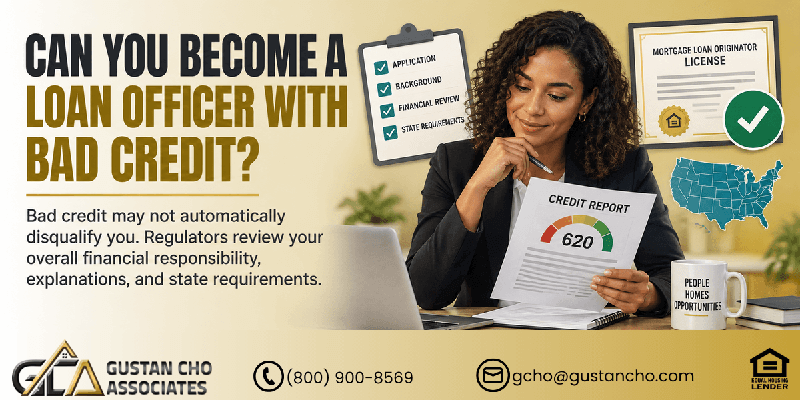
Can you become a loan officer with bad credit?
Yes. Bad credit doesn’t disqualify you from becoming a state-licensed mortgage loan originator. The SAFE Act does not establish a universal minimum credit score. However, every state regulator must evaluate an applicant’s financial responsibility, character, and general fitness under that state’s standards. Unresolved judgments, tax liens, serious delinquencies, collection patterns, foreclosure deficiencies, or other unpaid obligations may lead to additional questions, licensing conditions, or denial.
Does NMLS Require a Minimum Credit Score for Loan Officers?
While the SAFE Act outlines the process for becoming a state-licensed mortgage loan originator, it does not specify a minimum credit score for NMLS applicants. There is no universal federal minimum credit score and no automatic federal pass/fail score. Typically, the state regulator assesses the applicant’s overall financial responsibility and their character and fitness to hold the license.
Credit Score vs. Financial Responsibility
While a regulator can deny an MLO license for various reasons, a low score alone is not an automatic federal disqualifier, but the underlying credit history may affect a state regulator’s decision. More often than not, state regulators assess the context of credit issues such as outstanding obligations, judgments, tax liens, delinquencies, foreclosures, and bankruptcies. If you are asking, “Can you become a loan officer with bad credit?” you should really focus less on credit score and more on which financial issues are problematic and will need an explanation.
How Is Credit Evaluated for an MLO License?
Typically, applicants for a state MLO license authorize NMLS to obtain a credit report for licensing purposes.
NMLS Credit Report Authorization
Generally, an applicant does not provide a personal credit report to the regulator. Credit authorization is routed to NMLS, and subsequently, the report is made accessible to the state licensing authority. The credit assessment is independent of the criminal background assessment.
Who Makes the Licensing Decision?
NMLS provides the system used for application processing; however, the final determination of the license is not within NMLS’s jurisdiction. The reviewing state regulatory agency determines if the applicant meets the state’s financial responsibility and licensing requirements. As a result, requirements may vary by state.
What Credit Issues Could Impact an MLO License?
Not all adverse credit events are viewed equally. Typically, the financial issue’s nature and timing, whether it is resolved, and the applicant’s response are of primary interest.
Judgments
Unresolved judgments are scrutinized more. Regulators may require proof that the judgment has been satisfied, is the subject of a dispute, or is the subject of an acceptable payment arrangement.
Tax Liens
Liens resulting from federal or state taxes may raise questions concerning financial responsibility. Proof of payment, a payment plan, or other evidence of the obligation’s resolution may be required.
Collections and Serious Delinquencies
Patterns of serious delinquency and collections may be of more concern than older, isolated collection accounts. Regulators will look at whether the applicant has chronic serious delinquency and whether other debts are being managed.
Foreclosure & Bankruptcy
Neither event is an automatic federal disqualifier by itself, but a state may consider its circumstances when evaluating financial responsibility. Regulators will look at the circumstances and the applicant’s financial condition before and after the transaction.
Licensing Rules for MLOs Vary by State
There is variance among state MLO licensing requirements. The SAFE Act identifies the minimum federal standards, and state regulators are free to define the requirements for their review of financial responsibility as they see fit. For example, what constitutes an acceptable credit history can differ among state regulators.
Review State Specifications
Those seeking licensure in multiple states should carefully review the NMLS licensing checklist and the regulatory requirements for each jurisdiction. Approval in one state is not an indication that other states will also grant approval.
Documents You May Need to Explain Credit Problems
A state regulator may request supporting documents when an MLO applicant’s credit report shows unresolved debts, public records, serious delinquencies, foreclosure, bankruptcy, or other financial problems. The documents required will depend on the state, the credit issue, and the applicant’s circumstances. Applicants may need to provide:
- Satisfaction or release of judgment: A court-filed satisfaction, creditor release, settlement agreement, or other record showing how the judgment was resolved.
- Tax-lien documentation: A lien release, proof of payment, current installment agreement, or payment history showing that the applicant is complying with the agreement.
- Proof of repayment arrangements: A signed payment agreement accompanied by recent bank statements, canceled checks, receipts, or creditor statements confirming that payments were made as agreed.
- Collection or charge-off records: Settlement letters, paid-in-full letters, dispute results, creditor correspondence, or documentation explaining why the account remains unpaid.
- Bankruptcy documents: The bankruptcy petition, schedules, discharge or dismissal order, repayment plan, trustee records, and other documents requested by the regulator.
- Foreclosure or short-sale documents: Closing statements, foreclosure records, deficiency-balance information, settlement agreements, or proof that any remaining obligation was resolved.
- Hardship documentation: Records supporting circumstances such as job loss, illness, divorce, death in the family, business failure, natural disaster, or another event that contributed to the credit problems.
- A written letter of explanation: A concise statement describing what happened, when it happened, what caused the problem, how it was addressed, and why the same problem is unlikely to continue.
Organize the documents by creditor or account so the regulator can easily match each explanation with the corresponding item on the credit report. Dates, balances, account numbers, payment arrangements, and resolution details should be consistent across the credit report, written explanation, court records, and supporting documents.
Important: Do not omit an account, judgment, bankruptcy, foreclosure, regulatory action, or other disclosure because you believe it is old, disputed, resolved, or unimportant. Information submitted with the application should be complete and consistent with the MU4 filing and the records available to the regulator. Providing an explanation or supporting documentation does not guarantee licensing approval. However, a complete and well-organized response can help the state regulator understand the circumstances and determine whether the applicant satisfies that state’s financial-responsibility requirements.
Ready to Start a Career as a Mortgage Loan Officer?
Learn the steps from NMLS education and testing to fingerprints, licensing applications, sponsorship, and getting ready to originate mortgage loans.State-Licensed vs. Federally Registered Loan Officers
The processes for some mortgage loan officers can differ significantly.
State MLO Licensing
Generally, Mortgage Loan Originators (MLOs) who are employed by independent mortgage companies and other nonbank lenders are required to obtain a separate state MLO license through NMLS. Generally, these applicants must meet the requirements and obtain a state license, which includes completing the necessary education and examination requirements, a criminal background check, and credit authorization.
Federally Registered MLOs
In contrast, mortgage loan officers employed by federally chartered banks, credit unions, and certain subsidiaries are required to register through NMLS and therefore do not obtain a separate state MLO license. The employment requirements and registration processes for state MLOs differ significantly, an important consideration when assessing employment opportunities, especially since some state MLOs may be subject to different credit review processes.
Other SAFE Act Requirements for Becoming a Loan Officer
There are other considerations beyond credit when talking about becoming licensed. State-licensed mortgage loan originators satisfy the requirements set by the SAFE Act, as well as any additional requirements the state adds.
Pre-Licensing Education
Applicants must take at least 20 hours of NMLS-approved pre-licensing education. This must include at least:
- 3 hours of federal law and regulations
- 3 hours of ethics
- 2 hours of nontraditional mortgage lending
- 12 hours of other approved education
Some states require additional education specific to that state.
SAFE MLO Test
Applicants must score at least 75% on the SAFE MLO test. Individuals must wait the prescribed time set by the NMLS before taking the test again if they fail.
Criminal Background Check
Federal minimum standards generally prevent an applicant from receiving a state MLO license if the applicant was convicted of, pleaded guilty to, or pleaded no contest to a felony during the seven years preceding the application. A felony involving fraud, dishonesty, breach of trust, or money laundering is disqualifying regardless of when it occurred. Expunged and pardoned convictions do not, by themselves, affect eligibility under the federal standard. State requirements may be more restrictive.
MLO License Application
As directed, applicants enter their information into NMLS to complete the individual license application. The applicant must disclose their personal history and make required disclosures. State regulators review the applications to determine if the applicants have satisfied the licensing requirements.
What Happens if a Regulator Questions Your Credit?
Just because a state regulator questions your credit doesn’t necessarily mean that your application for a license will be denied. Usually, the regulator asks for more information before making a decision. The applicant should be prepared to explain an outstanding credit judgment, tax obligation, bankruptcy, foreclosure, collection account, or a pattern of late payments. The regulator may request documents showing that the obligation was paid, resolved, disputed, or placed under an acceptable payment plan.
- A copy of your payment agreement, if you have one;
- Bankruptcy, if applicable;
- Court records relating to the situation,
- Documentation showing a financial hardship, and
- Documentation showing that the situation has been resolved.
The regulator makes the final call on an applicant’s financial responsibility, character, and general fitness. 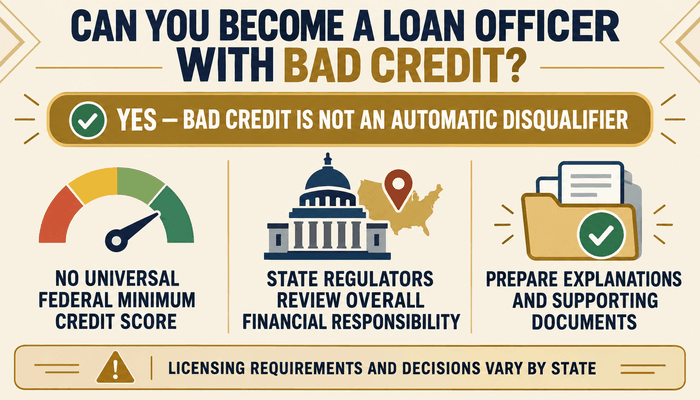
How to Prepare a Credit Explanation for an MLO License
If a regulator requests a written explanation, keep it factual and specific. Explain what happened, when it happened, what caused the financial problem, and what has changed since then. If an obligation is being repaid or has been resolved, provide documentation supporting that statement. Avoid blaming creditors or giving a long personal history that does not address the regulator’s concern. A useful explanation should make three points clear:
- What caused the credit problem
- How the problem was addressed
- Why is the same problem unlikely to continue
Applicants should answer every licensing item completely and provide the documents requested by the regulator.
What I Learned Applying for MLO Licenses With Derogatory Credit
First-person account by Gustan Cho, NMLS 873293. This experience reflects licensing applications from prior years. Current requirements and decisions remain state-specific. I learned firsthand that obtaining a mortgage loan originator license with derogatory credit is possible, but approval is never guaranteed.
Before entering the mortgage industry, I owned and managed several apartment buildings. Back in 2008, when the housing and financial markets crashed, I took a big hit financially. My credit report contained serious derogatory items, including unpaid obligations, judgments, and foreclosures.
I knew my credit history could raise questions about my financial responsibility. However, I completed the required pre-licensing education, passed the national SAFE MLO test, and moved forward with my state licensing applications.
My Experience Applying in Illinois and Florida
When I applied for an MLO license in Illinois, the regulator reviewed the problems appearing on my credit report. I was required to explain the circumstances that caused the derogatory credit and the steps I had taken to address my financial situation. Illinois ultimately approved my application. I later applied in Florida and was approved as well. Those approvals did not mean the states ignored my credit history. They reviewed my application under their respective standards and considered more than a numerical credit score. My explanations, disclosures, licensing qualifications, and overall circumstances were part of the review.
Why My Wisconsin Application Had a Different Outcome
My experience in Wisconsin was different. At that time, my application was affected by unresolved debts. I was informed that payment arrangements would be needed before the application could receive favorable consideration. I could not afford the requested repayment arrangements at that point, and my Wisconsin application was not approved. This experience showed me why approval in one state does not guarantee approval in another. Each state regulator applies its own standards when evaluating financial responsibility, character, and general fitness. The condition of the applicant’s credit report at the time of review also matters. Applicants should not assume that Illinois, Florida, Wisconsin, or any other state will reach the same decision today. Regulations, agency procedures, and individual circumstances can change.
Obtaining Additional MLO Licenses
After receiving my initial approvals, I continued working in the mortgage industry and later obtained MLO licenses in additional jurisdictions. My experience demonstrates that the answer to “Can you become a loan officer with bad credit?” can be yes. However, the answer depends on the specific credit problems, whether obligations remain unresolved, the documentation provided, and the standards of the state reviewing the application. Prior approval does not guarantee subsequent approval, and prior denial does not necessarily mean an applicant can never qualify.
What I Would Do Before Applying Today
Based on my experience, I would take the following steps before submitting an MLO license application:
- Review all three credit reports. Identify judgments, tax liens, collections, charge-offs, foreclosures, bankruptcies, late payments, and other unresolved obligations.
- Read the state licensing checklist. Do not assume that every state follows the same financial-responsibility standards.
- Address unresolved debts when possible. Obtain satisfaction letters, releases, settlement documents, or written payment agreements.
- Keep proof of every payment. If a payment plan is required, maintain bank statements, canceled checks, receipts, and written confirmation from the creditor.
- Prepare a concise credit explanation. Explain what happened, when it happened, what caused it, how the problem was addressed, and why it is unlikely to happen again.
- Make consistent and complete disclosures. Information in the written explanation should agree with the credit report, MU4 filing, court records, and other documents submitted to the regulator.
- Respond promptly to licensing requests. If a regulator issues a license or requests additional documentation, answer every question and submit the requested records by the deadline.
The most important lesson from my experience is that applicants should not try to hide or minimize their credit problems. A complete, truthful, and well-documented explanation gives the regulator the information needed to evaluate the application fairly. Bad credit does not automatically end a prospective loan officer’s career. However, unresolved financial obligations, incomplete disclosures, or unsupported explanations can make approval considerably more difficult.
What to Do if an MLO License is Denied or Conditioned
If a state regulator denies an application or imposes conditions on a license, applicants should carefully examine the reasons for denial in the written decision before reapplying. The steps the applicant will take will be based on the reasons for the regulator’s decision. Depending on the reason for the decision, the applicant may need to:
- Satisfy an existing debt
- Provide missing information
- Amend the application
- Complete the additional requirements of the state
- follow the state’s procedures for reconsideration, hearing, or appeal
- wait until a previously imposed restriction is removed
A denial in one state should be addressed when applying in other states. Applicants must respond honestly to NMLS disclosure questions and disclose regulatory actions when applicable. Since the procedures for licensing and appeals, as well as the time for their completion, may vary by state, applicants should follow the instructions of the regulator who is reviewing their application.
Final Thoughts About “Can You Become a Loan Officer with Bad Credit?”
Having bad credit does not automatically bar you from becoming a mortgage loan originator. While the SAFE Act establishes no minimum FICO score for state MLO licensing, state regulators help determine financial responsibility, character, general fitness, and the circumstances identified in the applicant’s credit report.
Prospective applicants with poor credit histories should review their credit report, address any remaining issues by resolving them or documenting them on the report, and be prepared to answer regulators’ questions.
The key point is that the decision to license an MLO is not made using a credit score as a standalone measure. Each state has its own requirements and standards in addition to the SAFE Act minimum standards.
Frequently Asked Questions About How to Become a Loan Officer With Bad Credit
Does the NMLS Credit Check Lower Your Credit Score?
No. The credit report obtained through NMLS for an MLO licensing application is treated as a soft inquiry and should not lower your credit score. This licensing inquiry differs from the hard credit inquiry commonly used when someone applies for a mortgage, credit card, auto loan, or other new debt.
Can a Mortgage Company See My NMLS Credit Report?
State regulators generally cannot disclose information from an applicant’s NMLS credit report to anyone other than the person named on the report. However, a mortgage company may conduct its own employment screening or request a separate consumer report with the applicant’s authorization. Licensing approval and employment approval are separate decisions. A state may approve an MLO license, but a mortgage company is not required to hire or sponsor that person.
What Should I Do if My Credit Report Is Frozen or Contains Errors?
An applicant may need to lift a security freeze before authorizing the NMLS credit report. If the credit report contains inaccurate information, dispute the error directly with the credit-reporting agency and keep copies of the dispute, supporting documents, and results. Do not dispute accurate information solely to improve the appearance of the report. If an application is already under review, explain the disputed item to the regulator and provide documentation showing that a formal dispute is pending.
Can I Apply for an MLO License Before Finding a Sponsoring Mortgage Company?
It depends on the state. An applicant can generally obtain an NMLS identification number, complete pre-licensing education, and pass the SAFE MLO test before finding an employer. Some states allow an applicant to complete the licensing review without an active sponsorship, but the license may remain inactive or otherwise unavailable for mortgage origination until an authorized company sponsors the MLO. Other states may require a company relationship during the application process. Review the applicable state licensing checklist before submitting the application.
Can Bad Credit Affect the Renewal of an Existing MLO License?
Yes, it may. Licensed MLOs generally must continue meeting the applicable standards for financial responsibility, character, and general fitness. A new credit report is not automatically required for every renewal in every state, but a regulator may request updated credit information, explanations, or proof that a payment arrangement remains current. An MLO experiencing a new bankruptcy, judgment, tax lien, foreclosure, or serious delinquency should review the state’s disclosure and renewal requirements rather than waiting until the renewal deadline.
Can Unpaid Student Loans or Past-Due Child Support Affect an MLO License?
There is no universal federal rule stating that student-loan debt or child-support arrears automatically disqualify every MLO applicant. However, a default, judgment, garnishment, unresolved arrears, or repeated failure to meet financial obligations may affect a state regulator’s financial responsibility review. Applicants should be prepared to provide a current payment agreement, rehabilitation documents, court orders, account statements, and proof of recent payments. State requirements vary, so the applicant should review the licensing checklist and instructions for each jurisdiction.
This article about “Can You Become a Loan Officer With Bad Credit in 2026?” was updated on September 16th, 2026.