

A recent increase in income can help you qualify for a mortgage, but only if the lender can show that the higher income is stable and likely to continue. Mortgage underwriters do not automatically reject a borrower just because their income has recently increased. What matters most is how the increase happened, how well it is documented, and whether the income fits standard mortgage guidelines. For many W-2 borrowers, a raise, promotion, or move from part-time to full-time status can strengthen a mortgage application. However, underwriters will usually review pay stubs, W-2s, verification of employment, and overall job history to decide whether the new income can be used for qualifying. The goal is not just to confirm that you earn more now, but to determine whether that higher income is reliable enough to support a monthly mortgage payment.
How Mortgage Underwriters View a Recent Increase in Income
Mortgage underwriters do not automatically deny a borrower because of a recent increase in income. In many cases, a raise, promotion, or move from part-time to full-time work can help strengthen a mortgage application. What matters most is whether the new income is fully documented and likely to continue.
Underwriters review more than just your current pay rate. They usually look at your recent pay stubs, W-2s, verification of employment, and overall work history to decide whether the higher income can be used for qualifying. Their job is to determine whether the income is stable enough to support the mortgage payment over time.
Not every type of income increase is viewed the same way. A permanent raise or promotion with the same employer is often easier to use than income from overtime, bonuses, or commissions, which may require a longer history before they can be counted fully. A recent job change can also require closer review, especially if the borrower changed industries or compensation structure. For borrowers, the key point is simple: a recent increase in income can help, but only when the lender can verify that the higher earnings are real, ongoing, and consistent with mortgage guidelines.
The Good and the Not-So-Good
A recent increase in income can improve your mortgage application, but it does not automatically mean the lender will use the full higher amount right away. Higher documented income can reduce your debt-to-income ratio and improve your ability to qualify. That can make a real difference for borrowers who were previously close to a program limit. The challenge is that mortgage underwriters do not base approval on income alone. They also look at how the income is earned, how long it has been received, whether it is likely to continue, and whether it meets the loan program’s qualifying rules. A permanent raise or promotion may be easier to use than income from bonuses, overtime, commissions, or a brand-new position with little pay history. In other words, higher income can help, but only if it is properly documented and accepted as qualifying income by the lender and the mortgage program.
What Documents Do Underwriters Need to Verify a Recent Increase in Income?
The documents needed will depend on how your income is earned and how the recent increase in income happened. In general, underwriters want to see proof that the higher income is real, documented, and likely to continue. For a W-2 employee who received a raise or promotion, underwriters will usually review recent pay stubs showing the higher pay rate, W-2 forms, and a verification of employment from the employer. If the raise came with a title change or promotion, the lender may also want written confirmation that the new pay is permanent rather than temporary.
For a borrower who recently moved from part-time to full-time status, the lender will usually want to confirm the new full-time hours, current pay rate, and start date of the full-time position. In this situation, recent pay stubs and employer verification are especially important.
For income based on bonuses, overtime, or commission, the review is often more detailed. Because this income can vary, underwriters may look for a longer history to determine whether it is consistent enough to count as qualifying income. In these cases, year-to-date earnings and prior income records matter more. For self-employed borrowers, the review differs from that for standard W-2 wage earners. Underwriters typically review personal and business tax returns, current profit-and-loss statements, and, sometimes, recent bank statements to determine whether the higher income reflects a true, ongoing trend. The key point is that underwriters do not just want proof that you are making more money now. They want the documents that show the increase is stable enough to use for mortgage qualification.
How a Recent Pay Increase Can Affect Your Debt-to-Income Ratio
Your debt-to-income ratio, often called DTI, is one of the main numbers lenders review when deciding whether you qualify for a mortgage. It compares your monthly debt payments to your gross monthly qualifying income. In simple terms, it helps the lender decide whether the mortgage payment fits your overall financial picture. A recent increase in income can improve your DTI because a higher qualifying income can make your monthly debts look smaller in proportion to what you earn. That can help borrowers who were previously close to a program’s maximum allowed ratio. However, lenders do not calculate DTI based on income that is only claimed or too recent to verify. They use qualifying income that is documented and accepted under mortgage guidelines. That means a raise, promotion, or change to full-time status may help, but only if the underwriter can confirm the income is stable and likely to continue. For borrowers, the practical takeaway is this: a pay increase can strengthen a mortgage application, but it only improves DTI when the lender can use that higher income in the file.
A Note for Self-Employed Borrowers
Self-employed income is reviewed differently from regular W-2 income. Instead of focusing mainly on a recent raise or promotion, lenders usually review tax returns, business income trends, and current financial documents to determine whether the income is stable enough to qualify. Because of that, a recent increase in self-employed income is usually not evaluated the same way as a recent employer pay increase.
How To Strengthen Your Mortgage Application After a Recent Pay Increase
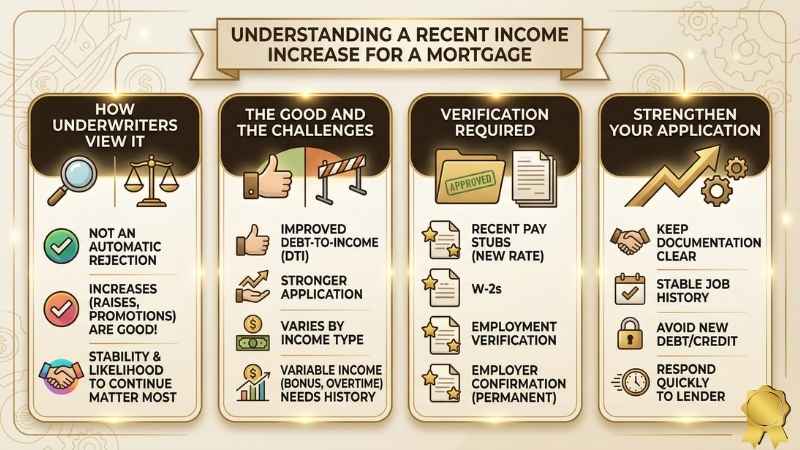 If you have a recent increase in income, the best way to strengthen your mortgage application is to keep your documentation clear and your overall financial profile stable. Make sure your recent pay stubs reflect the higher income, be prepared to provide W-2s and employment verification, and respond quickly to any lender requests for additional paperwork. If the increase came from a raise, promotion, or move to full-time status, it also helps to show that the new income is permanent and likely to continue. At the same time, avoid taking on new debt, opening new credit accounts, or making major financial changes before closing, since those steps can offset the benefit of the higher income. The stronger and more consistent your file looks, the easier it is for the underwriter to evaluate the recent pay increase.
Borrowers Who Go From Part-Time too Full Time Recently
What happens if an employee started out with a company part-time, then eventually went to full time, and then got a promotion recently with a recent increase in income. If all this happened in the past two years and the employee did not have an employment gap, the new recent income increase will be used as qualified income.
On this case scenario, the employee’s previous wages were steadily increasing. So it is obvious that one year of W-2 earnings was substantially less than the most recent W-2 earnings.
With the recent increase in income, the underwriter will base the most recent increase in income as the income to qualify the borrower. An offer employment letter and written verification of employment will be required.
Higher Income, Bigger Home?
See how underwriters treat recent income increases and what it means for your buying power.Don’t Mortgage Underwriters Average the Past 2 Years W-2s?
Many homebuyers who had irregular jobs or recent increase in income think they do not qualify for a mortgage loan because they believe underwriters averages their two years wages. That is the case with 1099 wage earners or self-employed wage earners but not with W-2 wage earners. Let’s take an example of a recent mortgage loan I closed:
- Borrower A has a credit score of 587.
- Since his credit scores were under 620, the maximum debt to income ratio allowed under FHA guidelines is capped at 43% DTI to get an approve/eligible per Automated Underwriting System Approval.
- If his credit scores were over 620, the maximum DTI allowed on FHA loans would have been 46.9% front-end and 56.9% back-end.
Case Scenario on Borrower Qualifying for an FHA Loan
Borrower A worked for XYZ Company in 2023 and 2024 full time and made $10.00 per hour.
- In January 2025, Borrower A changed jobs to ABC Company as a part-time employee and made $12.00 per hour.
- However, due to the hard work Borrower A did for ABC Company, the company changed Borrower A’s part-time status to full time in April 2025 and his new full-time hourly rate was now $17.00 per hour.
- What income will the mortgage loan underwriter use to qualify Borrower A?
- The answer to this question is that the mortgage lender will go off the $17.00 per hour wage in qualifying this borrower’s mortgage loan application.
- The underwriter needs to confirm via a written verification of employment that the current status of Borrower A’s employment is a full time.
- Also, the borrower needs VOE that his employment is likely to continue for the next 3 years.
- 30 days of paycheck stubs will be required prior to closing from the date of the start date of his new full-time position.
- The previous 2 years of irregular income does not come into play in this case scenario.
Recent Increase in Income Due To Promotion
Mortgage Borrowers who could not qualify for a mortgage loan before because of high debt to income ratios and have had a recent increase in income due to promotion or a job transfer can now qualify. The day borrowers get a recent increase in income is the day they can apply for a mortgage loan application. However, borrowers cannot close on mortgage loan until they have provided the underwriter with 30 days paycheck stubs on new position.
Frequently Asked Questions About Recent Increase in Income:
Can a Recent Pay Raise Help Me Qualify for a Mortgage?
Yes, a recent increase in income can help if the lender can document the higher income and determine that it is likely to continue. A permanent raise is generally easier to use than temporary or irregular income.
Will an Underwriter Use My New Salary Right Away?
Sometimes, yes, but not automatically. Underwriters usually want to verify the new pay through recent pay stubs, employment verification, and the overall job history before deciding whether the higher salary counts as qualifying income.
Can I Qualify for a Mortgage if I Recently Changed Jobs for Higher Pay?
You may still qualify, especially if the new job is in the same line of work and the income is well-documented. A recent job change does not always disqualify a borrower, but it can lead to closer review of stability and continuity.
Does Moving From Part-Time to Full-Time Help With Mortgage Approval?
It can, but the lender will usually want proof of the new full-time status, pay rate, and start date. The more clearly the move to full-time employment is documented, the easier it is for the underwriter to evaluate.
Do Lenders Count Bonus, Overtime, or Commission Income After a Raise?
They often do, but those income types are usually treated differently from base salary. Many lenders look for a history of receiving bonuses, overtime, or commission income and for evidence that it is likely to continue before using it for qualification.
What Documents Do I Need to Prove a Recent Increase in Income for a Mortgage?
Most borrowers should expect the lender to review recent pay stubs, W-2s, and a verification of employment. Depending on how the income increased, the lender may also want an employer letter, year-to-date earnings, or additional documentation for variable income.
This article about “Recent Increase in Income: How Mortgage Underwriters View It” was updated on April 1st, 2026.