Part-Time Income To Full-Time Income Mortgage Guidelines
There are strict rules regarding the part-time income to full-time income mortgage guidelines. For part-time income to be used, borrowers need two years of consistent part-time income. Besides the two-year seasoning requirement, lenders want to be convinced that the likelihood of the part-time income continuing for the next three years is extremely likely.
Qualifying for a mortgage with multiple jobs is possible if you’ve worked each one for at least two years. Lenders will request written verification from employers, probing about the continuity of the part-time work.
Borrowers can qualify for a mortgage with multiple part-time and full-time jobs as long as they have been on each job for two years. Lenders will want written employment verification from the employer. The employer will be asked if the part-time is likely to continue for the next three years. In the following paragraphs, we will cover part-time income to full-time income mortgage guidelines.
What Determines Qualified Income Going from Part-Time Income to Full-Time Income

Your income must be consistent. Your part-time and overtime earnings should have been stable for the past two years and should continue for the next three years. Lenders prefer borrowers who have a reliable history of income.
When assessing if you can pay a new mortgage, underwriters will focus on your ability to repay. Your income must not fluctuate or decrease to be counted. This also applies to overtime income. You must have earned overtime for the last two years to include overtime as part of your income. Underwriters need to be confident that you will keep earning overtime for the next three years.
How Do Underwriters Determine the Full-Time Income Status of Borrowers?
Borrowers working at least 30 or more hours per week are considered full-time employees. Income can be used as a full-time income. The borrower needs to be classified as a full-time wage earner. You cannot be classified as part-time if you work 40 hours a week and are considered full-time. However, a minimum of 30 hours is needed weekly to be considered full-time income.
Lenders will also need written employment verification stating that the employee is a full-time employee and the likelihood of employment continuing for the next three years is very likely.
Lenders want to see a continuation of income for the next three years to qualify borrowers. In this article, we will discuss and cover how mortgage borrowers can qualify for a mortgage by going from part-time to full-time and how long they need to be employed full-time. Lenders want to see the borrower’s ability to repay their new housing payments and other bills.
Can Part-Time Income Be Used To Qualify For A Mortgage?
Yes, part-time income can be used to qualify for a mortgage if the borrower has a documented history of receiving the income and the lender determines the income is likely to continue. For FHA loans, HUD guidance allows employment income from part-time employment as effective income when the borrower has worked a part-time job uninterrupted for the past two years and the current position is reasonably likely to continue.
FHA also states the income is generally averaged over the previous two years, although a documented pay-rate increase may allow a 12-month average of hours at the current pay rate. (HUD)
For VA loans, VA guidance states that overtime, part-time, and bonus income should be documented as consistent over a 2-year period and likely to continue. VA also notes that if this income has been received consistently for 12 months and is likely to continue, the underwriter may choose to use it to offset debt. (Home Loans VA)
Part-Time Income Versus Full-Time Income For Mortgage Approval
Part-time income and full-time income are treated differently because full-time income is usually easier to document. A full-time salaried job or guaranteed 40-hour hourly position is often more predictable than a part-time schedule.
A full-time employee may have a fixed salary or a regular hourly schedule. A part-time employee may work 18 hours one week, 25 hours the next week, and 12 hours the week after that. That creates income fluctuation.
When a borrower moves from part-time income to full-time income, the lender needs to know whether the new full-time income is permanent or temporary. A written verification of employment, recent pay stubs, W-2 forms, and employer confirmation may be required.
Can A New Full-Time Job Count For Mortgage Qualification?
A new full-time job can count toward mortgage qualification when the borrower has a stable employment history, and the new job aligns with the borrower’s work background.
For example, a borrower who worked part-time as a nurse’s aide and then became a full-time nurse’s aide with the same employer may have a stronger case than a borrower who recently changed industries with no prior history.
A new full-time job is not automatically a problem. The issue is whether the job is stable, whether the income is verified, and whether the borrower has a reasonable employment history.
Same Employer Part-Time To Full-Time Income
Moving from part-time to full-time with the same employer is often the cleanest scenario. The lender can verify the borrower’s work history, start date, position change, current hourly rate, and full-time status.
This can help the loan file because the borrower did not change employers or industries. The borrower simply increased hours or moved into a full-time role.
The lender may request a written verification of employment stating the borrower is now full-time, the number of hours expected each week, the hourly rate or salary, and whether the employment is likely to continue.
New Employer Part-Time To Full-Time Income
Moving from part-time employment to a full-time job with a new employer can still work, but the lender may review the file more carefully. The underwriter will want to see whether the borrower’s new full-time position is related to prior work experience, education, training, or career history.
For example, a borrower who worked part-time in medical billing and then accepts a full-time medical billing position with a new employer may have a logical employment transition.
However, if a borrower was part-time in retail and recently became full-time in a completely unrelated commission-based sales role, the lender may require more documentation or may not use all income until a longer history is established.
Part-Time Income Converted To Full-Time Hourly Income
Hourly income can be used when the borrower has a verified hourly rate and documented hours. If the borrower is now full-time hourly, the lender may verify the hourly rate and expected weekly hours.
If the borrower’s hours fluctuate, the lender may average the income rather than use a straight 40-hour calculation. This is especially important when the borrower has not yet built a long history at the higher full-time schedule.
A borrower who earns $25 per hour and is guaranteed 40 hours per week may find it easier to qualify than a borrower who earns $25 per hour but works anywhere from 25 to 40 hours depending on business demand.
Part-Time Income Converted To Full-Time Salary Income
A part-time employee who becomes a full-time salaried employee may find it easier to qualify because salary income is usually more predictable. If the employer verifies the borrower is a full-time salaried employee, the lender may be able to use the salary amount if the employment is stable and properly documented. The underwriter may still review the borrower’s prior employment history, but a verified full-time salary can simplify the income calculation.
When Lenders’ Average Part-Time Income
Lenders often average part-time income when the income varies from pay period to pay period. This protects the loan file from using income that may not continue. If a borrower earned part-time income for two years, the lender may average the income over that period. If the income increased, the lender may review whether the increase is stable and supported by documentation. If income declined, the lender may use the lower current income or exclude it if it appears unstable.
Why Income Trending Matters
Income trending is one of the most important parts of mortgage underwriting. The underwriter wants to know whether income is increasing, stable, or declining. Increasing income is usually positive if it is documented and likely to continue.
Learn how part-time income can become full-time qualifying income for a mortgage and what lenders need to approve it. Stable income is also acceptable when properly verified.
Declining income can create problems because the lender may not be able to use the higher historical average. For example, if a borrower made $30,000 in part-time income two years ago, $24,000 last year, and is currently trending lower, the lender may not use the two-year average because the income is declining.
Documentation Needed For Part-Time Income To Full-Time Income
Borrowers should be prepared to clearly document their income. The lender may request recent pay stubs, W-2 forms, written verification of employment, tax returns when needed, and a letter explaining the change from part-time to full-time. The employer may need to confirm the borrower’s current position, start date, pay rate, full-time status, average hours, and likelihood of continued employment. A clean paper trail can make the difference between loan approval and loan denial.
Verification Of Employment For Part-Time To Full-Time Income
A verification of employment, also called a VOE, is one of the most important documents in this type of file. The VOE helps the underwriter confirm whether the borrower is truly full-time and whether the income is expected to continue. A strong VOE may show the borrower’s date of hire, job title, full-time status, hourly rate or salary, average weekly hours, year-to-date income, prior-year income, and probability of continued employment. If the VOE is vague, incomplete, or shows inconsistent hours, the underwriter may require additional documentation.
Recently Switched to Full-Time? See If Your Income Qualifies for a Mortgage
Apply Online And Get recommendations From Loan ExpertsCan A Borrower Qualify If Full-Time Income Just Started?
A borrower may qualify if their full-time income has just started, but it depends on the loan program, the borrower’s employment history, and how the income is structured.
If the borrower has a strong history in the same field and the new full-time income is guaranteed salary or guaranteed hourly income, the lender may be able to use it.
Mortgage underwriters review job history, income stability, hours worked, the likelihood that income will continue, and whether the lender has additional overlays. If the borrower just started full-time hours after a long period of inconsistent part-time work, the lender may average the income or require a longer history.
Part-Time Income Versus Full-Time Income For Mortgage Approval
Mortgage guidelines for transitioning from part-time to full-time income can be confusing because borrowers often believe a job promotion or a new full-time schedule automatically qualifies them for a larger mortgage. In reality, mortgage underwriters look at more than the current pay rate.
At Gustan Cho Associates, many borrowers come to us after another lender denied their loan because the lender would not count part-time income, second-job income, overtime, bonus income, or recently increased hours.
The good news is that part-time income can often be used to qualify for a mortgage when it is properly documented and meets mortgage program guidelines. The key question is not only whether you now earn a full-time income. The real underwriting question is whether the income is stable, verifiable, and likely to continue.
What Does Part-Time Income To Full-Time Income Mean?
Part-time income to full-time income means a borrower previously worked part-time hours but now works full-time, or the borrower has moved from a part-time to a full-time position. This can happen with the same employer or a new employer. A borrower may say, “I now work 40 hours per week,” but the lender may ask, “How long have you been working 40 hours, is the full-time position permanent, and can the employer verify it will continue?”
Conventional Loan Guidelines On Part-Time Income To Full-Time Income
Fannie Mae, Freddie Mac, FHA, and VA all place heavy emphasis on income stability and documentation. FHA’s Handbook 4000.1 is HUD’s consolidated source for FHA single-family policy, and VA guidance states that, over time, part-time and bonus income generally need a consistent history and likelihood of continuance. For mortgage purposes, this situation matters because the lender must decide which income amount to use for loan qualification. The borrower may currently be earning a full-time income, but the underwriter still needs to determine whether the new income is stable enough to be used.
Why Part-Time Income Creates Mortgage Approval Problems
Part-time income can create mortgage approval problems because it is often considered variable income. Variable income does not always have the same number of hours every week. One month may be strong, while the next month may be lower. Underwriters do not only look at what the borrower earns today.
Why One Lender Says No And Another Lender Says Yes
Mortgage underwriters look at the income pattern. If the income has been inconsistent, declining, seasonal, or recently changed, the lender may average the income rather than using the current higher amount. This is where many borrowers get frustrated. They know they can afford the payment because they are now working full-time hours. However, the underwriter must follow the rules of the loan program and determine whether the income can be reasonably expected to continue.
Part-Time Income To Full-Time Income With Two Jobs at Same Time
When applying for a mortgage, it’s important to understand how different job types affect your income eligibility. If a borrower has two part-time jobs, both must have been held for at least 24 months to qualify their income. If one of these jobs is at least 30 hours a week, it can be considered full-time, allowing the borrower to combine this part-time income to full-time income when applying. For those with two full-time jobs, as long as both positions have been held for two years, the income from both can be counted. In all cases, confirmation of employment is required from Human Resources to verify whether the jobs are part-time or full-time.
Going From Part-Time Income To Full-Time Income Earner
When a borrower transitions from part-time income to full-time income, the requirements vary depending on whether they stay with the same employer or move to a new one.
Staying with the Same Employer
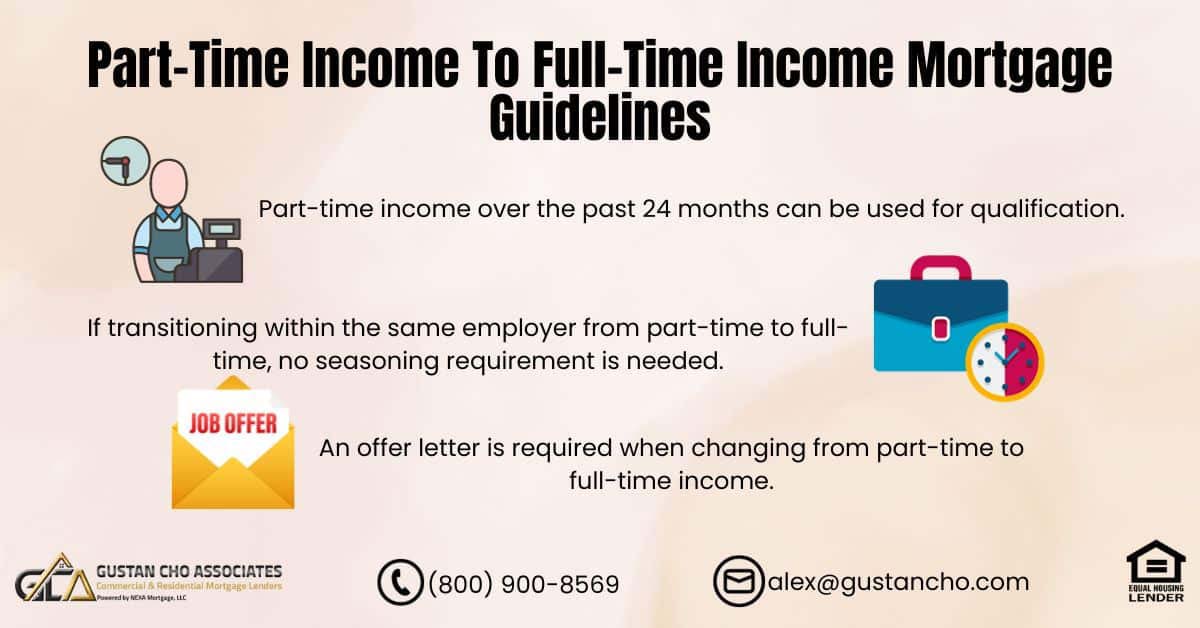
If the borrower stays with the same employer and moves to full-time work, they won’t have to wait around for any seasoning requirements for their new job. In this situation, the part-time income won’t be added to the new full-time income, and they’ll need an offer letter to show that their status has changed.
Moving to a New Employer
If the borrower gets a full-time job with a new company, they can still qualify for a mortgage as long as they have proof of part-time income for the last 24 months. They’ll also need an offer letter from the new employer to show they’re officially employed full-time.
How is Full-Time Employment Determined Going From Part-Time Income To Full-Time Income?
When moving from part-time to full-time work, borrowers may face a complicated income verification process for loans.
What is a Verification of Employment (VOE)?
A Verification of Employment (VOE) confirms a borrower’s job status, title, and income. It typically includes:
- Employer Information: The employer’s name and contact details.
- Employment Dates: The start date of the job and the end date, if applicable.
- Job Title: The borrower’s current position.
- Income Details: The borrower’s salary, hourly wage, and bonuses.
- Job Type: Whether the job is full-time or part-time.
Lenders use this information to evaluate a borrower’s ability to repay the loan. To make the process easier, borrowers should gather these documents in advance and make sure they meet the lender’s requirements.
Going From Full-Time Income To Part-Time Income or 1099
When transitioning from part-time income to full-time income, one crucial step involves obtaining verification from the employer regarding the shift in employment status. This verification confirms the commencement of a new phase where the full-time income takes precedence as the primary source. Unlike scenarios where part-time earnings are blended or averaged into the equation, the focus solely rests on this fresh full-time income, which holds weight in mortgage considerations.
Can Part-Time Income And 1099 Income Be Used To Qualify For A Mortgage?
On the other hand, juggling both full-time and part-time roles brings its own set of requirements. For both employments to contribute as qualifying income, a steadfast commitment of two years in each role is necessary. Any gaps in employment history must be diligently addressed, demanding a consecutive six-month period of full-time engagement to ensure the inclusion of that specific tenure within the scope of qualifying income. This stipulation emphasizes the significance of consistent and continuous work in both capacities to meet mortgage eligibility standards.
The Importance of Employment History to Get Mortgage Approval
Lenders often look at your employment history to assess your ability to repay the loan. If you have a solid work history, even if it includes part-time work, it can enhance your mortgage application. Your DTI ratio compares your monthly debt payments to your monthly income. A higher income from a full-time job can lower your DTI, making you a more attractive borrower. Your credit score plays a significant role in mortgage qualification. Ensure your credit score is in good shape, as a higher score can lead to better mortgage terms and higher chances of approval.
The Down Payment and Mortgage Types
Down payment and mortgage loan types are the two biggest factors in determining mortgage rates. The amount you can put down as a down payment also matters. A larger down payment can make you a more appealing candidate for a mortgage.
It’s important to note that every lender may have slightly different criteria for mortgage approval, so it’s a good idea to shop around and compare offers from multiple lenders.
Different loan programs have varying requirements. Some may be more lenient with income requirements, while others may have stricter criteria. Mortgage rates on owner-occupant primary homes are lower than investment home loans:
FHA Guidelines On Part-Time Income To Full-Time Income
FHA loans are popular for borrowers with lower credit scores, higher debt-to-income ratios, and limited savings. FHA also allows flexible income documentation, but the income must still be stable and likely to continue.
For part-time employment, FHA guidance states the borrower generally needs an uninterrupted two-year history of part-time employment, and the current position must be reasonably likely to continue.
FHA also states that income is averaged over the previous two years, with certain exceptions when a pay rate increase is documented. This means FHA borrowers should not assume a recent increase in hours will automatically qualify them at the higher income level. The lender must document the income correctly.
Conventional Loan Guidelines On Part-Time Income To Full-Time Income
Conventional loans follow Fannie Mae or Freddie Mac guidelines. These loans generally require the lender to analyze stable monthly income, employment history, income type, and documentation.
For conventional loans, the key issue is whether the income is stable, whether it can be verified, and whether the borrower’s employment profile supports using the income for qualification.
Freddie Mac’s Guide Section 5303.4 addresses automated income assessment using employed income data, and Fannie Mae’s Selling Guide and Desktop Underwriter resources allow lenders to use verified employment and income documentation in the underwriting process.
VA Guidelines On Part-Time Income To Full-Time Income
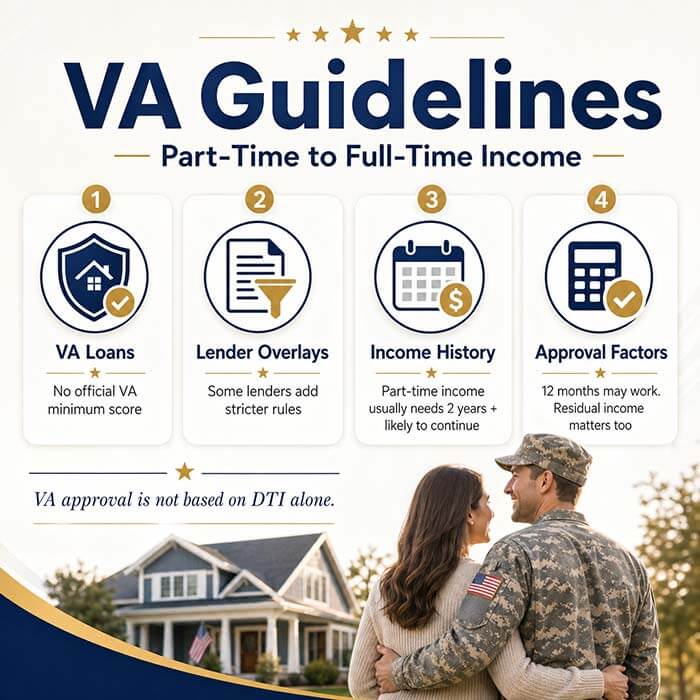
VA loans are excellent mortgage options for eligible veterans, active-duty service members, and surviving spouses. VA loans do not have a stated minimum credit score from the VA, but lenders often impose their own overlays.
For part-time income, VA guidance states that overtime, part-time, and bonus income should generally be consistent over a two-year period and likely to continue.
VA also gives underwriters some discretion when income has been received consistently for 12 months and is likely to continue, especially when offsetting debt. VA loan approval is not based only on the debt-to-income ratio. Residual income also matters. This can help some VA borrowers qualify even when their debt-to-income ratio is higher than other programs allow.
USDA Guidelines On Part-Time Income To Full-Time Income
USDA loans are for eligible rural and suburban homebuyers who meet income and property eligibility requirements. USDA lenders also review stable and dependable income. Part-time income may be considered if it is documented, stable, and likely to continue. However, USDA also has household income limits, so income is reviewed both for repayment ability and program eligibility. Borrowers using USDA financing should work with a loan officer who understands both qualifying income and household income calculations.
Mortgage Lender Overlays On Part-Time Income
Lender overlays are additional rules created by individual lenders. These rules go beyond minimum agency guidelines. One lender may closely follow FHA, VA, USDA, Fannie Mae, or Freddie Mac guidelines. Another lender may require stricter documentation, longer income history, higher credit scores, or lower debt-to-income ratios. This is why one lender may deny a borrower while another lender can approve the same borrower. At Gustan Cho Associates, we specialize in helping borrowers who were denied by other lenders due to overlays.
Why One Lender Says No And Another Lender Says Yes
A borrower may be denied by one lender because the lender will not count recently increased income, part-time income, second-job income, or variable income. Another lender may approve the borrower if the income meets agency guidelines and is properly documented. Mortgage approval is not only about guidelines. It is also about lender interpretation, underwriting experience, and overlays. This is especially true for borrowers with part-time, overtime, bonus, or commission income, multiple jobs, recent job changes, or non-traditional employment patterns.
Common Part-Time Income Mortgage Scenarios
Many borrowers have real-life employment situations that do not fit perfectly into a simple income box. Some borrowers work part-time while attending school and then move into full-time employment. Others work two part-time jobs. Some borrowers start part-time and later receive more hours. Others work a full-time job plus a part-time second job. Each scenario needs to be reviewed individually. The lender must decide whether the income is stable and whether it can be used to qualify.
Worried About Your Job History? See If You Qualify for a Mortgage
Apply Online And Get recommendations From Loan ExpertsTwo Part-Time Jobs Instead Of One Full-Time Job
A borrower may qualify with two part-time jobs if both jobs are stable, documented, and likely to continue. The lender may average the income from both jobs or analyze each job separately. The main issue is whether the borrower has a history of working multiple jobs. If the borrower recently took on a second part-time job to qualify for a mortgage, the lender may not count it unless the borrower has a sufficient history.
Full-Time Job Plus Part-Time Second Job
A full-time job plus a part-time second job can strengthen a mortgage file if the part-time second job has a stable history. The full-time income may be used as the qualifying income base, while a part-time second job may be added if it meets the guidelines. Borrowers should not assume a new second job will be counted immediately. Underwriters usually want to see a history of receiving the second-job income and proof that it is likely to continue.
Seasonal Part-Time Income
Seasonal part-time income can sometimes be used if the borrower has a history of receiving it year after year. Examples may include tax-season work, holiday retail work, summer employment, construction-related seasonal income, or school-year employment. The lender will review whether the income is recurring and predictable. Sporadic seasonal income may not be usable.
Gig Work And Part-Time Income
Gig work may not be treated the same as W-2 part-time income. If the borrower receives 1099 income, app-based income, contract income, or self-employment income, the lender may need tax returns and a self-employment income analysis. This can be more complex than a W-2 part-time job. Borrowers with gig income should speak with a mortgage loan officer before applying because write-offs on tax returns can reduce qualifying income.
Part-Time Income After College Or Training
Borrowers who worked part-time while in school and then moved into full-time employment may still qualify. Education or training may help support the employment history if the new full-time job is related to the borrower’s degree, certification, or field of study. For example, a borrower who worked part-time during nursing school and then became a full-time nurse may have a strong employment story.
Part-Time Income After A Career Change
A career change may be acceptable if the borrower’s new full-time income is stable and well-documented. However, the lender may look more closely if the new job is unrelated to the borrower’s prior work history. The more consistent the career path, the easier it is to explain the income. A major industry change may require more documentation.
Debt-To-Income Ratio And Part-Time Income
Part-time income can make a major difference in the debt-to-income ratio. If the lender can count the income, the borrower may qualify for a higher loan amount. If the lender cannot count the income, the borrower may need to lower debts, increase the down payment, choose a lower purchase price, or use a different loan program. The debt-to-income ratio is one of the biggest reasons part-time income matters. Even a few hundred dollars per month in qualifying income can change the approval outcome.
How To Strengthen A Mortgage File With Part-Time Income
Borrowers can strengthen a mortgage file by staying with the same employer, avoiding job gaps, keeping all pay stubs, saving W-2 forms, avoiding large unexplained deposits, reducing debt, and not opening new credit before closing. Borrowers should also avoid changing jobs during the mortgage process unless they speak with their loan officer first. A job change before clear to close can delay or derail the loan.
What Borrowers Should Not Do Before Mortgage Approval
Borrowers should not quit a job, reduce hours, switch from W-2 to 1099 income, open new credit, finance a vehicle, make large unexplained cash deposits, or assume income will count without speaking to the lender. Mortgage approval is based on verified information. A sudden change in income, employment, or credit can create new underwriting conditions.
Why Pre-Approval Matters With Part-Time Income
A strong pre-approval is critical when a borrower has part-time income or has recently moved to full-time income. A quick pre-qualification is not enough. The lender should review pay stubs, W-2s, employment history, and income documentation before the borrower starts shopping for a home. This helps avoid surprises after the purchase contract is signed.
How Gustan Cho Associates Helps Borrowers With Part-Time Income
Gustan Cho Associates helps borrowers who have been denied by other lenders due to overlays, income calculation issues, or complex employment histories. Many borrowers are told they do not qualify when the real issue is that the lender does not want to work with complex income. We review the full file, evaluate the correct loan program, and determine whether the income can be used under agency guidelines. Borrowers with part-time income, full-time income changes, overtime income, second-job income, bonus income, commission income, 1099 income, or recent employment changes should get a full mortgage review before giving up.
Mortgage Lender Overlays On Part-Time Income
Before applying for a mortgage, it’s advisable to assess your financial situation, create a budget, and consider how the transition from part-time income to full-time income impacts your ability to afford monthly mortgage payments. Consulting with a financial advisor or mortgage professional can also provide valuable insights into your situation.
Working with a mortgage broker or loan officer can help you navigate the process and find a mortgage that suits your financial situation.
If you have any questions about part-time income to full-time income mortgage guidelines and how does FHA define family member or borrowers who need to qualify for FHA loans with a lender with no overlays on government or conforming loans, please contact us at Gustan Cho Associates at 800-900-8569. Text us for a faster response. Or email us at alex@gustancho.com. The team at Gustan Cho Associates is available 7 days a week, on evenings, weekends, and holidays.
Frequently Asked Questions About Part-Time Income To Full-Time Income Mortgage Guidelines
What are the Guidelines for Using Part-Time Income to Qualify for a Mortgage?
Borrowers can use part-time income to qualify for a mortgage, but they need a two-year consistent part-time income history. Lenders also want assurance that the part-time income will likely continue for the next three years.
Can I Qualify for a Mortgage with Multiple Part-Time and Full-Time Jobs?
Yes, borrowers can qualify for a mortgage with multiple part-time and full-time jobs if they have been on each job for at least two years. Lenders will request written employment verification from each employer to assess the continuity of part-time work.
How does Moving from Part-Time Income to Full-Time Income Affect Mortgage Eligibility?
Moving from part-time income to full-time income can enhance mortgage eligibility by increasing income stability, a crucial factor for lenders. Both part-time and overtime earnings must have remained consistent for the past two years, with an expected continuation for the next three years.
What Factors do Underwriters Consider when Determining Full-Time Income Status?
Borrowers working at least 30 hours per week are considered full-time employees. Underwriters require written employment verification confirming full-time status and the likelihood of continued employment for the next three years.
Can I Use Both Incomes if I have Two Part-Time Jobs?
If a borrower has two part-time jobs, both incomes can be used if they have been employed by each job for at least 24 months. If one job has a minimum work hour of 30 per week, it is considered full-time, and both incomes can be used accordingly.
How does Transitioning from Part-Time Income to Full-Time Employment Impact Mortgage Qualification?
If a borrower has had part-time income for the past 24 months and transitions to full-time employment with the same employer, there is no seasoning requirement. The new full-time income is used for qualification, and an offer letter of employment is required.
What Happens When Going from Full-Time to Part-Time or 1099 Income?
When transitioning from part-time income to full-time income or 1099 income, verification from the employer is necessary. The new full-time income takes precedence; only the income from the new full-time job is considered for mortgage qualification.
How do Gaps in Employment Affect Mortgage Eligibility When Using Both Full-Time and Part-Time Incomes?
For borrowers juggling full-time and part-time roles, a commitment of two years is necessary for both incomes to contribute to qualifying income. Any gaps in employment history must be addressed, requiring a consecutive six-month period of full-time engagement.
How Important is Employment History in Mortgage Approval?
Lenders often consider employment history when assessing the ability to repay a mortgage. A solid work history, even if it includes part-time work, can enhance mortgage applications. A higher income from a full-time job can improve the Debt-to-Income (DTI) ratio, making the borrower more attractive to lenders.
What Factors Determine Mortgage Rates?
The two biggest factors in determining mortgage rates are the down payment amount and the type of mortgage loan. A larger down payment can make a borrower more appealing, and different loan programs have varying requirements. It’s essential to shop around and compare offers from multiple lenders, as criteria may vary.
This Guide About “Part-Time Income To Full-Time Income Mortgage Guidelines” Was Updated on April 26, 2026.