Mortgage rate adjustments are changes lenders make to the price of a home loan based on the risk they believe a borrower poses to the transaction. In simple terms, borrowers with stronger credit, lower debt, and larger down payments usually qualify for better pricing, while borrowers with higher risk factors may pay more through a higher rate, extra fees, or both.
Many homebuyers do not realize that mortgage pricing varies from lender to lender. Two borrowers can apply for the same type of loan and still receive different terms.
That is because mortgage rate adjustments are often based on factors such as credit score, loan-to-value ratio, property type, and whether the loan is for a purchase, a rate-and-term refinance, or a cash-out refinance. Understanding mortgage rate adjustments is important because even a small pricing change can affect your monthly payment and the total cost of borrowing over time. If you know what causes these adjustments, you can take steps to improve your profile before applying. In this guide, we will explain how mortgage rate adjustments work, what factors affect them most, and what borrowers can do to qualify for better mortgage terms.
What Are Mortgage Rate Adjustments?
Mortgage rate adjustments are pricing changes lenders use to account for risk on a home loan. In many situations, these changes are referred to in the mortgage world as loan-level price adjustments (LLPAs) for conventional loans backed by Fannie Mae or Freddie Mac. Instead of offering every borrower the exact same rate and cost, lenders adjust pricing based on the overall risk of the file.
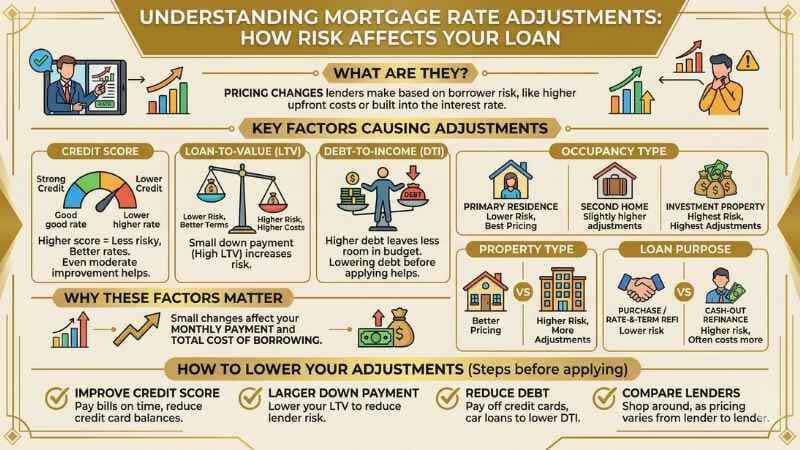
These mortgage rate adjustments can show up in two main ways. They may appear as higher upfront costs at closing, or they may be built into the interest rate through slightly more expensive pricing. Either way, the result is the same: borrowers with higher-risk profiles usually pay more than borrowers with stronger credit and lower-risk loan characteristics.
Several factors can trigger mortgage rate adjustments. The most common include credit score, down payment amount, loan-to-value ratio, occupancy type, property type, and loan purpose. For example, a borrower buying a primary residence with strong credit and a larger down payment will usually receive better pricing than a borrower with lower credit, a smaller down payment, or a cash-out refinance. For borrowers, the most important thing to understand is that mortgage rate adjustments do not always mean a loan is out of reach. They affect the cost of financing. Knowing how mortgage rate adjustments work can help you compare loan options more intelligently and take practical steps to improve your loan terms before you apply.
How Credit Score Affects Mortgage Rate Adjustments
Your credit score plays a huge role in how mortgage rates are set. Basically, if you’ve got a higher credit score, lenders see you as less risky and are more likely to offer you better rates. On the flip side, if your credit score is lower, you could end up with higher rates or more costs upfront. This does not mean a borrower with lower credit cannot qualify. It simply means the loan may cost more. Even a modest improvement in a score before applying can sometimes lead to better mortgage pricing.
How Loan-to-Value Affects Mortgage Rate Adjustments
Loan-to-value, or LTV, is the percentage of the home’s value that you are borrowing. A higher LTV usually means a smaller down payment and more risk for the lender. As a result, mortgage rate adjustments are often higher when the borrower puts down less money. For example, a borrower putting 3 percent down will often receive more pricing adjustments than one putting 20 percent down. A lower LTV usually helps reduce risk and improve loan terms.
How Debt-to-Income Ratio Affects Mortgage Rate Adjustments
Debt-to-income ratio, or DTI, compares your monthly debt payments to your gross monthly income. A higher DTI can make lenders more cautious because it may leave less room in your budget for a mortgage payment. From a borrower’s point of view, the takeaway is simple: the more debt you carry compared to your income, the harder it may be to qualify for the best pricing. Paying off debts or increasing documented income before applying may help lower your overall risk profile.
Why Cash-Out Refinances Usually Cost More
Cash-out refinances often come with higher mortgage rate adjustments than home purchase loans or rate-and-term refinances. That is because the borrower is taking equity out of the home, which lenders usually view as a higher-risk transaction. In simple terms, a borrower using a cash-out refinance may pay more than someone using the same property for a purchase loan or a standard refinance with no cash back.
Why These Factors Matter Together
Mortgage rate adjustments are not based on a single factor. Lenders look at the full picture. A borrower with strong credit but a small down payment may still have some pricing adjustments. A borrower with a larger down payment but higher debt may also face additional costs. The good news is that borrowers can improve many of these factors before applying. Raising a credit score, lowering debt, increasing income, or making a larger down payment can all help reduce mortgage rate adjustments and improve overall loan pricing.
How Occupancy Type Affects Mortgage Rate Adjustments
Occupancy type can affect mortgage rate adjustments because lenders view some properties as riskier than others. In general, borrowers get the best pricing on a primary residence, which is the home they plan to live in full-time. Lenders usually see primary homes as lower risk because borrowers are more likely to stay current on the mortgage for the home they live in every day.
A second home may be subject to higher mortgage rate adjustments than a primary residence. While second homes are not considered as risky as investment properties, lenders still view them differently because they are not the borrower’s main home.
An investment property usually carries the highest mortgage rate adjustments of the three. That is because lenders often view rental or non-owner-occupied properties as riskier, especially during financial hardship. When borrowers face budget pressure, they are generally more likely to protect the mortgage on their primary residence before a rental or vacation property. For borrowers, the simple takeaway is that occupancy matters. A borrower buying a primary residence will often qualify for better pricing than someone buying a second home or investment property, even when the credit score and down payment are similar.
Occupancy Type Can Change Your Rate—Check Your Pricing
Owner-occupied, second home, and investment properties often price differently. Get a quick review of your occupancy type, credit, and down payment to see how it impacts your rate and payment.How to Lower Mortgage Rate Adjustments
Borrowers cannot always eliminate mortgage rate adjustments, but they can often reduce them by improving the factors lenders look at most. The goal is to present a lower-risk profile before applying for a home loan. One of the best ways to lower mortgage rate adjustments is to improve your credit score. Paying bills on time, reducing credit card balances, avoiding new late payments, and correcting errors on your credit report may help you qualify for better mortgage pricing.
A larger down payment can also help. Putting more money down lowers your loan-to-value ratio, which often reduces the lender’s risk perception. In general, borrowers with more equity or a lower loan-to-value ratio tend to receive better terms.
Lowering your debt can also make a difference. Paying off credit cards, car loans, or other monthly obligations may improve your debt-to-income ratio and strengthen your overall mortgage profile. It is also smart to compare loan offers from multiple lenders. Mortgage rate adjustments and pricing can vary, so shopping around may help you find a more competitive option. Most importantly, borrowers should focus on the factors they can control before applying. Improving credit, lowering debt, saving for a larger down payment, and reviewing credit reports for errors can all help reduce mortgage rate adjustments and lower the total cost of financing.
How Mortgage Rate Adjustments Affect Your Loan Costs
 Mortgage rate adjustments affect how much a borrower pays for a home loan. In some cases, the cost shows up as a higher interest rate. In other cases, it appears as higher upfront pricing at closing. Either way, mortgage rate adjustments increase the total cost of financing. For borrowers, even a small pricing change can make a meaningful difference. A slightly higher rate can raise the monthly payment and increase total interest paid over time. Higher upfront costs can also affect the amount of cash a borrower needs at closing. That is why mortgage rate adjustments matter so much. They do not always prevent mortgage approval, but they can change affordability. Understanding what drives these adjustments can help borrowers prepare before applying and make better decisions when comparing loan options.
Credit Scores and Mortgage Rate Adjustments
Credit scores really influence mortgage rates. If you’ve got a higher credit score, lenders see you as a safer bet, so you usually get better rates. On the other hand, if your score is on the lower side, you might still get a loan, but you’re more likely to deal with higher rates or extra costs upfront.
The reason is simple. Lenders use credit history as one way to gauge a borrower’s likelihood of repaying a loan on time. A stronger credit profile often leads to more favorable terms, while a weaker profile can result in additional pricing adjustments.
For borrowers, this means even a moderate credit score improvement can matter. Moving from a lower to a higher score range may reduce mortgage rate adjustments and improve affordability. That is why many borrowers review their credit before applying, pay down revolving debt, and correct reporting errors to strengthen their mortgage profile. The key takeaway is that a credit score does not just affect approval. It can also affect the cost of the loan. Understanding that connection can help borrowers take practical steps before applying for a mortgage.
How Property Type Affects Mortgage Rate Adjustments
Single-family homes usually receive better pricing than multi-unit properties because lenders often view multi-unit properties as carrying more risk. In general, the more complex the property, the more likely it is that mortgage rate adjustments may increase.
Final Thoughts on Mortgage Rate Adjustments
Mortgage rate adjustments can make a meaningful difference in the total cost of a home loan. Borrowers with stronger credit, lower debt, larger down payments, and lower-risk occupancy types often qualify for better pricing. At the same time, higher-risk factors may lead to added costs.
The good news is that many of these factors can be improved before applying. Reviewing your credit, lowering debt, saving for a larger down payment, and comparing loan options can all help you reduce mortgage rate adjustments and improve affordability.
The most important step is understanding how mortgage pricing works before you apply. When borrowers know what affects their loan terms, they are in a better position to compare offers, ask better questions, and choose the mortgage that fits their financial goals. Have questions about mortgage rate adjustments? Speaking with a knowledgeable mortgage professional can help you understand how credit, down payment, and loan type may affect your loan pricing.
- Related> Improving Credit Scores To Qualify For Mortgage
- Related> Mortgage Rates And Credit Scores
- Related> Mortgage With 580 Credit Scores
Frequently Asked Questions About Mortgage Rate Adjustments:
What Are Mortgage Rate Adjustments?
Mortgage rate adjustments are pricing changes lenders make based on the risk of the loan. They can raise your borrowing costs by increasing interest rates, adding higher upfront fees, or both. On conventional loans, these pricing changes are commonly called loan-level price adjustments, or LLPAs.
Do Lower Credit Scores Cause Higher Mortgage Rate Adjustments?
Yes. Borrowers with lower credit scores are usually considered riskier, which often results in higher mortgage rates than for those with better credit. It doesn’t necessarily mean you can’t get a loan, but it might cost you a bit more.
Does a Bigger Down Payment Reduce Mortgage Rate Adjustments?
Usually, yes. A larger down payment lowers your loan-to-value ratio, thereby reducing lender risk. In many cases, that can lead to better mortgage pricing than a loan with a very small down payment. Fannie Mae’s 97% LTV guidance also shows that very high-LTV lending is treated differently from lower-LTV lending.
Are Mortgage Rate Adjustments Higher on Investment Properties?
In many cases, yes. Lenders often apply higher pricing adjustments to investment properties and to some higher-risk property types than to primary residences. Fannie Mae also notes LLPAs for certain property types, including multiple-unit properties and some condo projects.
Why Do Cash-Out Refinances Often Have Higher Mortgage Rate Adjustments?
Cash-out refinances usually cost more because the borrower is taking equity out of the home, which lenders often view as a riskier transaction than a purchase loan or a limited cash-out refinance. That added risk can lead to higher pricing.
Can I Lower the Mortgage Rate Adjustments Before I Apply?
Yes, sometimes. Borrowers can reduce mortgage rate adjustments by improving their credit score, lowering debt, saving for a larger down payment, and comparing multiple lenders. CFPB says credit scores are one of the factors that can affect mortgage pricing, and broader mortgage pricing also reflects lender costs and loan risk.
This article about “Mortgage Rate Adjustments For Higher Risk Borrowers” was updated on April 10th, 2026.