Lending Guidelines on Employment Gaps for Mortgage Approval
This blog addresses the eligibility criteria for obtaining a mortgage and securing approval despite having experienced employment gaps within the last two years. Lenders have informed numerous borrowers that mortgage qualification is contingent on maintaining the same job for the preceding two years.
Employment gaps can affect mortgage approval. Learn how lenders review job history, income stability, and work gaps for home loans.
Contrary to this notion, it is optional to have continuous employment in the same position for the past two years to be eligible for mortgage loans. What is essential for homebuyers is a thorough two-year work history, which only sometimes requires consecutive employment in the same job for the entire duration. It’s crucial to recognize the distinction between the two.
Layoffs, Business Closures, And Career Changes
A frequently asked question is whether I qualify for a mortgage if I had some gaps in employment and multiple jobs in the past two years. The answer is YES, you CAN. As long as you have not had a gap in employment for longer than six months, you will qualify for a mortgage if you have a full-time job. This holds even with gaps in employment.
Mortgage Approval with Employment Gaps
Gustan Cho Associates takes pride in assisting clients with job gaps, job changes, credit issues, high debt-to-income ratios, tips and commission, and many other income scenarios. Mainly, a client can be qualified for a program with a good setter, good documentation, and good positioning.
You are eligible for a mortgage loan through Gustan Cho Associates even if you have experienced employment gaps in the last two years. Having an employment history over the past two years is optional to meet the mortgage qualification criteria.
Agencies like HUD, VA, USDA, Fannie Mae, and Freddie Mac require a 2-year employment history, but continuous employment is optional according to their guidelines. The subsequent paragraphs will elaborate on qualifying for a mortgage despite employment gaps in the past two years.
Can I Get a Mortgage With Employment Gaps?

Borrowers remain eligible for mortgage approval despite experiencing employment gaps within the last two years. Gaps do not hinder approval support in employment during this period. You can still qualify for a mortgage even if you’ve held multiple jobs. While mortgage underwriters may be concerned about frequent job changes, this should encourage you as it does not impede adherence to agency mortgage guidelines.
How Employment Gaps Affect Mortgage Review
Mortgage underwriters may downgrade borrowers from an automated underwriting approved status to a manual underwrite using underwriting discretion due to gaps in employment or having multiple jobs in the past two years.
If you are told you are getting downgraded from AUS approved to manual underwrite, you will need to transfer your file to other lender with no lender overlays. Gustan Cho Associates has no overlays on government and conventional loans.
Employment gaps in the past two years will allow you to secure approval for a mortgage loan. Why do some borrowers face mortgage loan denials due to not being continuously employed in the same job for the past two years? The answer lies in lender overlays, which we will explore in the following paragraphs, specifically focusing on employment gaps.
Employment Gaps Lending Guidelines For Mortgage Approval
Having gaps in your employment history doesn’t necessarily disqualify you from mortgage approval. A part of people’s history includes employment gaps due to external factors like business closures, seasonal employment, military service, medical leave, family leave, maternity leave, training, relocation, school, career changes, or personal reasons. Lenders are mostly concerned with whether your employment is current, stable, verified, and likely to continue.
Employment Gaps and the Importance of Documentation
Job gaps can raise numerous concerns when assessing the stability and sufficiency of a borrower’s income. According to Fannie Mae’s guidelines, inclusion of income cannot rely solely on uncertainty, and therefore, it must demonstrate a history of stability and a high degree of certainty of continuation.
When extending loans, mortgage lenders examine credit history, employment, income stability, existing assets, debt, and risk assessment.
At Gustan Cho Associates, we find that many clients submit applications to other lenders and receive instant denials due to concerns about job gaps, job changes, or employment for less than 2 years. Most of the time, the problem lies with the lender and not with the agency guidelines. Most lenders practice imposing their own ‘overlays’ on FHA, VA, USDA, Fannie Mae, and Freddie Mac guidelines.
What Are Gaps in Employment?
Gaps in employment refer to periods of job loss or employment that do not or did not provide qualifying income. Job gaps can be defined as a week or years. Underwriters consider gaps in employment history to gauge income consistency. But lenders are not solely focused on history. They are predicting whether the client’s income will continue after the mortgage closes.
What Are Overlays on Employment Gaps By Lenders?
Most lenders impose additional criteria regarding employment gaps within the last two years. Housing agencies establish uniform mortgage guidelines for employment gaps. Despite agency guidelines permitting employment gaps in the preceding two years, mortgage approval may still hinge on individual mortgage company requirements. Borrowers must adhere to the specific criteria set by their chosen mortgage company to qualify, and having employment gaps is generally discouraged.
What Is Considered An Employment Gap For Mortgage Approval?
One important fact many borrowers do not realize is if you had gap in employment for longer than six months and return back to work to the same job, there is no waiting period after returning to work to qualify for a mortgage.
Lender overlays refer to the situation where a mortgage lender maintains standards that surpass the minimum guidelines set by HUD, VA, USDA, Fannie Mae, and Freddie Mac.
Both government and conforming agency guidelines allow for employment gaps within the past two years, with a condition that the gap is at most six months. In such cases, there is no waiting period for a new job, except for the requirement to provide a paycheck stub before closing. However, if the employment gap extends beyond six months, the borrower must have been in their new job for six months before qualifying for a mortgage.
What Is An Acceptable Employment Gap For a Mortgage Approval?
This section will address common questions about employment gaps and their impact on mortgage loan approval for both government and conventional loans. Employment gaps can arise for various reasons, and each instance is unique. Individuals may take time off work for diverse reasons, such as layoffs or job termination.
Career changes often necessitate a break for individuals returning to school. Some may opt for a hiatus after receiving a more lucrative job offer, while others may take an extended break to enhance their skills for a better career.
Employment gaps is not a problem when it comes to get a mortgage loan approval. Lenders require an overall two year work history and not past two years of consecutive work experience. Schooling counts as work experience. Full time students with no work experience can qualify for a mortgage if they have been in school full time for two years preceding getting a job. Regardless of the reason, each employment gap situation is distinctive and remains acceptable for mortgage approval.
Can You Buy a House With Gaps in Employment?
One common inquiry at Gustan Cho Associates pertains to the possibility of purchasing a home despite having gaps in employment. Indeed, it is feasible. Having fewer than six months of employment gaps helps your mortgage eligibility. However, if the gap exceeds six months, you must have been in your current job for at least six months.
A person can be off the workforce for the past ten years and get a full-time job and qualify for a mortgage after being in the new full-time job for six months.
The borrower just need to list the two years of job experience they had ten years ago before they did not work for the ten years. Nevertheless, some lenders may stipulate that employment gaps are not permissible, requiring mortgage applicants to have remained in the same job for the past two years. If a lender denies qualification due to employment gaps within the last two years, contact us at Gustan Cho Associates.
Can You Get Declined For a Mortgage Due To Employment Gaps in The Past Two Years?
Yes, you can get declined for a mortgage due to employment gaps in the past two years by a lender with overlays. Even though the agency mortgage guidelines state you can qualify for a mortgage with gaps in employment in the past two years, the lender can have their lending requirements.
We are a licensed lender operating in 48 states, including Washington DC, Puerto Rico, and the U.S. Virgin Islands, without imposing additional requirements on government and conventional loans.
Every lender can have their lending requirements higher than the agency guidelines. These higher lending guidelines by the lender are called overlays. However, just because one lender says NO can’t mean another with no overlays will approve you with employment gaps. Gustan Cho Associates does not have lender overlays in employment gaps in the past two years.
Mortgage Approval With Seasonal Employment Gaps
Seasonal workers may have normal employment gaps every year. This can apply to construction workers, teachers, agricultural workers, hospitality workers, union workers, and other seasonal employees. Seasonal employment is not automatically a problem if the lender can document a history of receiving seasonal income and the likelihood that it will continue.
Seasonal Income Needs History
Seasonal income usually needs a history. The lender may review W-2s, tax returns, year-to-date income, unemployment compensation if applicable and eligible, and employer verification. The key is consistency. If the borrower has worked seasonally for several years and the income is predictable, the lender may be able to use it.
Gaps Are Expected In Some Industries
In some industries, gaps are normal. An underwriter may view a seasonal layoff differently from unexplained unemployment. Borrowers should explain the nature of the work and provide documentation showing that the employment pattern is normal.
How Long of a Job Gap is Acceptable for a Mortgage?
An employment gap is generally defined as a period in the most recent employment history during which there is no employment or verifiable income. Some examples include taking leave for health reasons or to care for others, relocation, temporary employment, educational pursuits, or a transition from the military. Not all employment gaps are equal. For example, a three-week gap in the same field is viewed differently than an eight-month gap in a commission-based role.
What is the Importance of Employment Gaps to Lenders?
Mortgage lenders focus on employment gaps due to income verification requirements. Borrowers must demonstrate the ability to repay the loan. If there are gaps, underwriters may request additional documentation before making a decision. According to Fannie Mae, borrowers who have employment gaps within the previous year may appear to have unstable employment, and as a result,s lenders are required to conduct a detailed analysis of employment stability. Employment gaps do not automatically disqualify borrowers. Lenders analyze the reasons for the gap and confirm that the borrower now has stable employment.
Job changes and employment gaps
Job changes and employment gaps are distinct. Job changes involve moving between employers, while employment gaps refer to periods when the borrower was not working. There have been numerous documented cases of borrowers who have changed jobs and still qualified for a mortgage. According to Fannie Mae, such borrowers may still have sources of stable income. Changing from one source of income to another within a particular line of employment may, in general, still provide a stable source of employment.
Is it Possible to obtain a Mortgage with Employment Gaps?
Yes, obtaining a mortgage with employment gaps is possible. The gap must meet expectations for duration, reason, employment type, and qualifying income. Borrowers with job changes may still qualify for FHA, VA, USDA, conventional, and non-QM loans. Each aspect of the loan must satisfy the requirements of automated underwriting, the underwriter, and the investor.
Gaps in Employment May Not Hinder Acquisitions
Employment gaps are common. Many workers change jobs with short breaks in between. Typically, a letter of explanation and sufficient income documentation are required. For example, if a worker resigns on March 15 and starts a new job by April 1, this is usually not an issue. The lender will verify employment and collect pay stubs and any necessary explanations.
Gaps in Employment Require More Extensive Evidence
A prolonged period of unemployment can be problematic. Lenders must explain the implications, and borrowers need to demonstrate how their experience and income relate to the new employment. While employment gaps can negatively affect your application, strong work history and thorough income documentation can offset this. Compensating factors include relevant experience, a favorable debt-to-income ratio, good credit, and substantial savings.
Acceptable Employment Gaps for Mortgage Approval
Crucially, current stable employment is of utmost importance after an income gap. The lender’s interest is in understanding whether the borrower is employed, is compensated, and is expected to continue to earn that income. Among Freddie Mac’s income rules, the lender must assess whether the income is stable and predicted to continue. This is determined by employment and income history, as well as an assessment of the borrower’s general circumstances. Concerns about employment gaps are reduced when there is strong evidence of stable employment and income.
Mortgage Gaps Review
Underwriters review employment gaps by evaluating the complete employment history. Their primary goal is to assess the borrower’s ability and commitment to repay the mortgage.
To judge the borrower’s income, underwriters review the loan application, pay stubs, verified income (such as W-2s and tax returns), employment verification, credit information, and any unexplained or justified income gaps.
The past two years ofs of compliance are considered, mortgage programs are almost definitive of employment. This is not to say that two years mean the borrower is a company employee, but rather that it is representative of the general alternatives the borrower has been subject to over the past two years. Borrowers can qualify with less than 2 years of employment, provided they have a stable job and a reasonable employment history. This can include a borrower who a) changed jobs in the same field, b) graduated and started work in the field of study, c) returned to work after a documented period, or d) changed from military service to a civilian job.
Employment Gap Explanation Letter
Employment gaps are typically addressed in an employment gap explanation letter. This letter should be direct, factual, and concise. The letter should explain gaps in chronological order, state the reason for not working, the date employment resumed, and the type of employment (full-time, part-time, salaried, hourly, or self-employed). The letter should be factual and not defensive. Common reasons include layoffs, company closures, medical or maternity leave, school, relocation, family transitions, or seasonal work.
Employment And Income Verification
The lender is required to verify the borrower’s total employment and income if that income total is used to qualify the borrower for a mortgage loan. Fannie Mae notes that, for mortgage loan qualifying, the total employment income must be verified.
The total can be verified through the borrower, the employer, or a third-party employment verification vendor. The underwriter could verify employment with low paperwork.
Some of the documents to verify employment include the borrower’s most recent pay stubs, a signed employment description, a verbally confirmed employment description before closing, an offer letter, the borrower’s tax returns, and year-to-date earnings for self-employed borrowers.
FHA Employment Gaps Lending Guidelines
FHA loans are excellent for borrowers with poor credit, high debt-to-income ratios, low credit scores, and few funds for the down payment. For borrowers with employment gaps, FHA loans can still be a good option if the borrower can provide evidence of consistent income. Compared to the conventional loan overlays, FHA guidelines are considerably less strict. However, not all FHA lenders follow the same internal standards. Some lenders set overlays that restrict borrower job gaps.
FHA Loans and Employment Gaps
FHA lenders are concerned with verifying the borrower’s income and their ability to repay the loan. A borrower with an employment gap may be required to demonstrate that they have returned to work and that their income is expected to persist. The FHA Handbook 4000.1 is HUD’s formal definition of single-family housing policy for the FHA. HUD says the FHA Handbook is a complete reference for guidance on deriving policies for the origination, underwriting, servicing, and endorsement of mortgages. Employment gaps in FHA files vary widely and depend on whether underwriting is automated or manual. These should be thoroughly reviewed before the borrower signs a purchase contract.
Return to Employment After an Employment Gap
A borrower may continue their employment after an employment gap if it complies with all requirements. Returning to employment in the same line of work may strengthen the file by demonstrating continuity. A nurse who took family leave and then returned to work may have a more favorable employment history than a person who was unemployed for a period and then took a new, commission-based job in a different line of work.
FHA Manual Underwriting and Employment History
Certain FHA loans have manual underwriting. If the automated underwriting process does not provide an outcome of approve/eligible and the borrower has certain credit or income situations, the case may fall into manual underwriting.
Employment gaps on a manual underwriting file may have a more significant impact on the underwriter’s analysis, as the borrower’s capacity to repay the loan must be examined more closely.
Compensating factors, such as reserves, a low payment shock, a stable history of residence, residual income, and a clear explanation for the employment gap, will become more significant.
Employment Gaps with a Conventional Loan
Loans that are backed by Fannie Mae and Freddie Mac are examples of conventional loans. Compared to FHA loans, the requirements for conventional loans with gaps in employment, recent work history, and variable income are more stringent. To obtain a conventional loan, a person may not be required to have two consecutive years of work history. However, the person must have a stable, verifiable income stream expected to continue.
Fannie Mae Employment Gap Policy
As Fannie Mae explains, a lack of employment over the last 12 months can indicate unstable employment. Consequently, a lender can determine that a borrower’s interest is reasonably expected to continue, requiring the lender to scrutinize the borrower’s job. This applies predominantly to the borrower who was recently laid off, took a job leave, changed jobs, or had a long career job absence. The underwriter will be looking for some semblance of a stable job and a clear explanation.
Freddie Mac Employment and Income Criteria
To satisfy Freddie Mac’s employment criteria, the borrower must be able to demonstrate stable income. Freddie Mac’s employment and income criteria must be considered, and the lender must determine that the employment and income used to qualify the borrower are reasonable and achievable. For employment gap borrowers, the lender can consider current employment, historical employment, reasonable stability, and whether the borrower’s current employment was a part of previous work experience/education.
Employment Gaps and Conventional Loans
Conventional loans are possible after employment gaps, provided the loan is well-documented. Approval is more likely for borrowers with stable income, good credit, low debt-to-income ratios, and sufficient reserves. Risk factors include recent employment gaps, poor credit, high debt-to-income ratios, low reserves, new or unstable jobs, commission-based income, or limited employment history.
VA Loan Employment Gap Rules
VA loans can be one of the better mortgage options for veterans, active-duty service members, and veterans’ surviving spouses. With potentially higher-than-average flexibility and no minimum credit line requirement, VA loans can be a significant option for military personnel. VA loans can still be approved even with employment gaps, as long as the borrower has consistent income, falls within an acceptable range of residual income, and provides adequate documentation.
Explaining the Employment Gap with VA loans
VA loans require that employment for the last 2 years be verified, and employment gaps be explained by the borrower. While gaps in employment may seem too risky for a VA loan, they are not reasons for an automatic denial. As long as the borrower provides adequate documentation of the employment gap along with a reasonable explanation, a VA loan can still be issued.
Veterans Returning To Civilian Employment
Veterans often transition from military service to civilian employment. This transition can create a gap or a job change. VA underwriters understand that military-to-civilian transitions happen, but the lender still needs to document the borrower’s current income. A veteran who starts a civilian job related to their military experience may have a stronger file than a borrower entering a completely new field with variable income.
VA Loans With Less Than Two Years On The Job
VA borrowers may qualify with less than 2 years of on-the-job experience. The lender must determine that the income is stable and likely to continue. Supportive documentation may include an offer letter, employment verification, military experience, education, training, or prior work history in a related field. For VA loans, residual income can also play a major role. A borrower with high residual income may have a stronger file even if there was a previous employment gap.
USDA Loan Employment Gaps Guidelines
USDA loans are designed for eligible rural and suburban homebuyers who meet USDA property and income eligibility requirements. USDA loans can offer 100% financing for qualified borrowers. Like FHA, VA, and conventional loans, USDA lenders review income stability and employment history. Employment gaps may need to be explained and documented.
USDA Income Stability Requirements
USDA lenders want to know that the borrower has stable income and can afford the mortgage payment. A borrower with recent employment gaps may need to provide a written explanation and proof of current employment. The lender may also review household income for USDA eligibility, not just qualifying income for the mortgage payment. This makes income documentation especially important on USDA loans.
Rural Homebuyers With Recent Employment Gaps
USDA borrowers with employment gaps should avoid assuming they are automatically disqualified. The loan file depends on the borrower’s current employment, income type, debt-to-income ratio, credit profile, and automated underwriting findings. A borrower who recently returned to full-time work in the same field may have a better chance than one who just started a new variable-income job.
What Documentation Is Needed For Employment Gaps?
Comprehensive documentation is essential for mortgage approval when employment gaps exist. Strong supporting documents help underwriters review and make informed decisions. Borrowers are advised to disclose employment gaps proactively.
Lenders require borrowers to proactively disclose employment gaps. Lenders verify employment history, income, and tax records, often using third-party sources.
Explaining gaps upfront helps prevent delays during underwriting. Include the dates of the gap, the reason for the gap, and the current employment status. The letter should be short, factual, and easy to understand.
Example:
“I was laid off from ABC Company on March 15, 2025, due to a companywide reduction in force. I began my new full-time position with XYZ Company on July 1, 2025, in the same industry. My current position is full-time, permanent, and my income is expected to continue.” The letter does not need to be emotional or overly detailed. It needs to answer the underwriter’s question.
Pay Stubs, W-2s, And Verification Of Employment
Most employed borrowers will need recent pay stubs, W-2s, and verification of employment. The lender may also complete a verbal verification of employment before closing. If the borrower recently started a new job, the lender may request the offer letter, first pay stub, written verification of employment, or proof that the borrower has started work.
Offer Letters, School Records, Medical Records, Or Layoff Letters
Depending on the reason for the employment gap, supporting documents may help. Examples include layoff notices, school transcripts, diploma or certificate records, medical leave documentation, relocation documents, military discharge or transition paperwork, or a job offer letter. Borrowers should provide only the documentation requested by the lender, as submitting additional paperwork may prompt further questions.
Common Reasons For Employment Gaps
The main concerns are whether the explanation is reasonable and whether the borrower’s current income is stable. Business closures are common reasons for employment gaps. A borrower who was laid off and later returned to the same field may still qualify. Career changes can be more complex. If the borrower changed industries, the lender may need to determine whether the new income is stable enough to use.
Medical Leave, Family Leave, Or Maternity Leave
Medical, family, and maternity leave can create employment gaps. These situations are often explainable with proper documentation. If the borrower has returned to work, the lender may verify current employment and income. If the borrower is still on leave, the lender may need documentation showing the expected return date and income terms.
School, Training, Military Service, Or Relocation
Going to school or completing job training may help explain an employment gap. If the borrower’s new job is related to education or training, the file may be stronger. Military service and relocation can also explain job gaps. The lender will document the timeline and current income.
Employment Gaps And Different Types Of Income
Not all income is treated the same. A borrower with a salary job after an employment gap may be easier to approve than one with variable income.
Salary Income After Employment Gaps
Salary income is often easier to document because it is fixed and predictable. If the borrower is full-time and salaried, the lender can usually calculate qualifying income based on the current salary, provided the job is verified and likely to continue.
Hourly Income After Employment Gaps
Hourly income can be straightforward if the borrower works a consistent full-time schedule. If hours vary, the lender may need a history of earnings to calculate the income. Borrowers with fluctuating hourly income after a recent employment gap may need additional documentation.
Overtime, Bonus, And Commission Income After Employment Gaps
Overtime, bonus, and commission income usually require a history before they can be used for mortgage qualification. A borrower who has just returned to work and wants to use new overtime or commission income may have difficulty using it immediately. The base income may be usable, but variable income may need more history.
Self-Employment After Employment Gaps
Self-employment after an employment gap can be more difficult. Most traditional mortgage programs require a history of self-employment income, often documented through tax returns. Borrowers who recently became self-employed after being unemployed may need a non-QM loan, bank statement loan, or additional time to build a qualifying income history.
How To Strengthen Mortgage Approval With Employment Gaps
Applicants with employment gaps should focus on preparing a thorough and well-documented loan file to reduce perceived risk and support the underwriting process.
Stay In The Same Line Of Work
Staying in the same line of work is one of the best ways to overcome an employment gap. If the borrower was a teacher before the gap and returns to teaching, the underwriter can see continuity. A same-field job change is usually easier to explain than a complete career change.
Avoid New Debt Before Closing
Borrowers with employment gaps should avoid opening new credit accounts, financing vehicles, co-signing loans, or increasing credit card balances during the mortgage process. New debt can raise the debt-to-income ratio and create additional concerns for underwriters, especially if there is already an employment gap to address.
Keep Strong Bank Reserves
Bank reserves can help strengthen the file. Reserves are funds left over after the down payment and closing costs. Borrowers with employment gaps and low reserves are seen as higher risk than those with several months of mortgage payments saved. Adequate reserves show financial stability.
Get Fully Underwritten Before Shopping For A Home
Borrowers with employment gaps should consider getting fully underwritten before shopping for a home. A basic pre-approval may not be enough if the file has job gaps, recent employment changes, or variable income. A fully underwritten pre-approval lets an underwriter review income, employment history, credit, assets, and documentation before the borrower signs a contract.
Lender Overlays On Employment Gaps
One of the biggest problems borrowers face is lender overlays. A borrower may meet FHA, VA, USDA, Fannie Mae, or Freddie Mac guidelines but still get denied because the lender has stricter internal rules.
What Are Lender Overlays?
Lender overlays are extra requirements created by individual lenders. For example, agency guidelines may allow a borrower with an employment gap if the file is properly documented, but a specific bank may require two full years with the same employer. That extra rule is not always an agency rule. It may be the lender’s overlay.
Why One Lender May Deny While Another Lender Approves
Two lenders may reach different decisions on the same borrower. One may deny a loan due to a recent job gap, while another may approve if the borrower has stable income and meets guidelines. Borrowers should consider alternative lenders if denied.
No-Overlay Mortgage Lenders Can Make A Difference
Gustan Cho Associates is known for helping borrowers who were denied by other lenders because of overlays. Employment gaps, recent job changes, lower credit scores, higher debt-to-income ratios, bankruptcy, foreclosure, and unique income situations do not automatically mean the borrower cannot qualify. The right lender can make a major difference.
Mortgage Approval After Being Laid Off
A layoff does not automatically disqualify you from mortgage approval. The timing matters. If the borrower is currently laid off and has no qualifying income, mortgage approval may not be possible until the borrower returns to work or has another eligible income source. If the borrower was laid off in the past and is now back to work, approval may be possible.
Getting Approved After Returning To Work
Borrowers who return to work after a layoff should gather pay stubs, W-2s, the layoff notice, if available, and a letter explaining the employment gap. If the new job is in the same line of work and income is stable, the file may be easier to approve.
What If The New Job Pays More?
A higher-paying new job can help, but the lender still needs to verify that the income is stable. Salary income may be easier to use immediately than variable income. Borrowers should not assume that higher income automatically fixes the file. The income type and documentation matter.
What If The New Job Pays Less?
A lower-paying new job can still be acceptable if the borrower qualifies with a lower income. The lender will calculate the debt-to-income ratio based on the eligible qualifying income. If the borrower no longer qualifies because income dropped, options may include paying down debt, adding a qualified co-borrower, choosing a lower purchase price, or exploring another loan program.
Mortgage Approval After Maternity Leave Or Medical Leave
Maternity leave and medical leave can create employment gaps or temporary changes in income. These situations need to be documented carefully. The lender may need to know whether the borrower has returned to work, when the borrower is expected to return, and whether the borrower’s income will continue.
If The Borrower Has Returned To Work
If the borrower has returned to work, the lender can verify employment and current income. The file may include pay stubs, employment verification, and a letter explaining the leave.
If The Borrower Has Not Returned Yet
If the borrower has not yet returned to work, the lender may need additional documentation. Approval depends on the loan program, the return-to-work date, income continuation, and underwriting requirements. Borrowers on leave should speak with a mortgage professional before making an offer on a home.
Employment Gaps And Automated Underwriting System Approval
Many mortgage approvals are run through an automated underwriting system. FHA uses TOTAL Scorecard. Fannie Mae uses Desktop Underwriter. Freddie Mac uses the Loan Product Advisor. Automated underwriting can approve borrowers with employment gaps, but the lender must still properly document income and employment.
Approve/Eligible Does Not Remove Documentation Requirements
An approved/eligible finding is strong, but it does not mean the lender can ignore employment gaps. The underwriter must still verify income, employment, assets, credit, and all conditions required by the automated findings.
Manual Underwriting Requires Stronger Explanation
Manual underwriting may require a more detailed explanation of employment gaps. The underwriter may also look more closely at compensating factors. Borrowers with manual underwriting should avoid adding risk layers before closing.
What Borrowers Should Not Do With Employment Gaps
Borrowers with employment gaps should be careful during the mortgage process. A small mistake can delay or damage approval.
Do Not Hide The Employment Gap
Borrowers should never hide a job gap. Lenders verify employment and income. If the underwriter finds an undisclosed gap, it can create distrust and delay the file.
Do Not Start A New Commission Job Without Asking First
Commission income may require a history before it can be used. A borrower who leaves a salary job and starts a commission job during the mortgage process can create a serious approval problem.
Do Not Change Jobs During The Mortgage Process Without Guidance
Changing jobs before closing can delay the file or cause denial. Borrowers should speak with their loan officer before changing employment, even if the new job pays more.
Here Are The Agency Mortgage Guidelines For Employment Gaps
Fannie Mae Guidelines On Conventional Loans
Employment History:
- Fannie Mae generally looks for a two-year employment history. However, there may be allowances for gaps in employment or changes in employment.
Recent Employment:
- Borrowers should have a stable, continuous, and verifiable employment history.
Gaps in Employment:
- Employment gaps of less than six months usually do not require special consideration.
- Gaps exceeding six months up to 12 months may be acceptable if the borrower can demonstrate a stable income and employment history before and after the gap.
Documentation:
- Borrowers with recent gaps in employment may be required to provide a written explanation for the gap and possibly supporting documentation.
Freddie Mac Guidelines On Conventional Loans
Employment Stability:
- Freddie Mac emphasizes the stability of employment and income.
Gaps in Employment:
- Similar to Fannie Mae, shorter employment gaps are generally more acceptable.
- Gaps exceeding six months may be considered, especially if the borrower has a stable employment history before and after the gap.
Additional Documentation:
- Borrowers with employment gaps may need to provide additional documentation, such as a written explanation and proof of income during the gap period.
Consideration of Other Factors:
- Freddie Mac considers compensating factors, such as a strong credit history and substantial cash reserves, to offset concerns related to employment gaps.
Get a Mortgage With Employment Gaps
Apply For A Mortgage Loan Today!How Do You Justify Employment Gaps?
A frequent question we receive pertains to justifying employment gaps. Mortgage underwriters typically request a letter of explanation regarding any periods of unemployment. However, it’s important not to panic. There’s no definitive right or wrong response for these letters. While most lenders prefer to see a consistent two-year employment history, lacking this isn’t necessarily a deal-breaker.
Guidelines on Employment Gaps When Applying For a Mortgage
Gustan Cho Associates ignores employment gaps less than six months. Even if you changed careers in the past two years and have more than one employment gap, you will qualify for a mortgage. Mortgage lenders need to use their discretion that the ability for continued employment in the next three years is likely.
In facilitating mortgage loans, I regularly assist borrowers with employment gaps. Demonstrating a stable work history, particularly with the same employer, is crucial for mortgage lenders and other creditors.
Some banks and mortgage companies may impose additional requirements, such as two years of continuous employment with the same employer, but these are not universal mortgage guidelines. This article explains how to obtain a mortgage despite employment gaps in the past two years.
Gaps In Employment In The Past Two Years
Mortgage applicants may possess a history of holding various positions and experiencing employment gaps within the last two years yet still be eligible for home loans. A two-year timeframe with employment gaps could be considered a specific mortgage lender overlay. Still, it is important to note that this is not a compulsory guideline outlined by Fannie Mae, Freddie Mac, VA, USDA, or HUD.
Letter of Explanation For Gaps in Employment
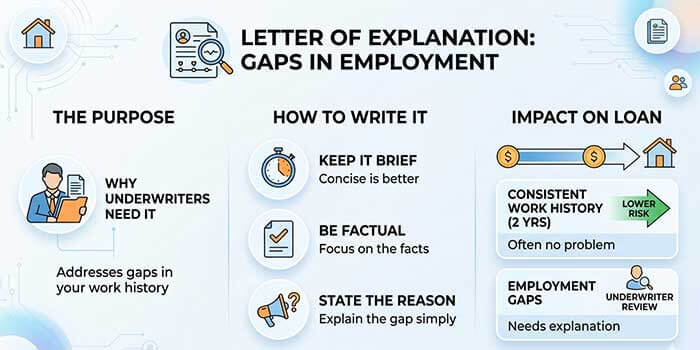
If mortgage loan applicants have gaps in employment, mortgage underwriters will need a letter of explanation as to why they have employment gaps. John Strange of Gustan Cho Associates explains how to write a letter of explanations to mortgage underwriters: A letter of explanation to mortgage underwriters should not be a lengthy blog or have too much information. Just make the letter’s content of explanation short, to the point, and facts.
Letter of Employment Gap Explanation
Mortgage underwriters prefer concise letters and may need more time for lengthy explanations. A brief statement in the letter of explanation is generally satisfactory. Meeting the criteria for a mortgage loan is generally unproblematic for individuals who have maintained consistent employment for two years, even with multiple jobs. Nonetheless, the impact of employment gaps on qualifying for mortgage loans should be considered.
Mortgage Lenders That Accept Mortgage With Employment Gaps
If you encounter challenges with a mortgage underwriter due to employment gaps, please get in touch with us at Gustan Cho Associates. If the underwriter continues to impose new conditions even after you’ve provided a letter of explanation, it indicates their reluctance to approve the mortgage loan.
Letter Of Explanation For Employment Gap
Mortgage underwriters will ask for a letter of explanation for employment gaps. This is totally routine and normal. Most underwriters will just want a letter of explanation and file the LOX away in the file. Other underwriters will analyze and dig into the gap in employment and scrutinize the new job and look for a way to deny the loan.
The Importance of Employment History Re-employment
For individuals with six or more months of employment gaps, eligibility for a mortgage loan requires a continuous full-time job for at least six months. Those with gaps in employment lasting less than six months may still qualify for a mortgage with a new full-time job, provided they present a full-time employment offer letter. Additionally, obtaining clearance to close requires the submission of 30 days’ worth of paycheck stubs from the current employer.
Reasons For Gaps In Employment
There are various reasons for gaps in employment. There are many reasons why people have gaps in employment:
- It can be maternity leave
- It could be personal time off due to divorce or death in the family
- It can be military deployment or being in school full time
Some folks decide to work part-time, which turns into a full-time job.
Importance of Income Stability For The Next Three Years
Lenders’ main concern is that the mortgage loan borrower has income stability when they apply for a mortgage. Lenders want to see borrowers have a stable income and can repay their mortgage. The ability to repay the new mortgage is what all mortgage underwriters need to determine. Things they look out for is declining income, and a written verification of employment. Mortgage underwriters want to feel confident the borrower has the ability to repay for the next three years.
Stable Employment and Its Mortgage Leverage
Mortgage Lenders want to feel confident that borrowers have a solid, stable job and income stability for the next several years where the mortgage loan does not go into default. Past work history is a good indicator of future job stability. Lenders will need to feel confident that the borrower’s employment and income will likely continue for the next three years.
Does HUD Require Two Years of Employment History?
The Federal Housing Administration does not require two years of continuous employment history. Overall two-year employment history is required on all loan programs. Full-time schooling counts as full-time employment history.
Many borrowers feel they do not qualify for a mortgage loan because they have extended employment gaps. Or because they had short-term jobs or job hopped.
Homebuyers do not have to worry about having extended gaps in employment to qualify and get pre-approved for a mortgage. Borrowers are eligible to qualify for a mortgage with an extended gap in employment as long as they have been in the new job for six months.
Waiting Period To Get Mortgage With Extended Employment Gaps
The gap in employment waiting period guidelines are as follows: There is no waiting period with a gap in employment for less than six months. There is a six-month waiting period for starting a new job with a gap in employment longer than six months. If there is an employment gap over six months and the person goes back to work full-time in the same job, there is no waiting period requirement on the job they went back to.
Common Reasons For Employment Gaps
As long as the gap in employment is less than six months, there is not waiting period on the new job. If the employment gap was longer than six months, then there is a six month waiting period at the new job. 1099 wage earners need to wait two years.
Suppose borrowers can show six months of full-time continuous employment history and get employment verification from the employer that the likelihood of continuous full-time employment is promising. In that case, borrowers will qualify for a mortgage loan. We need to document two years of employment history, but the employment history does not have to be continuous.
Lending Guidelines on Employment History
The following is from the HUD Handbook 4000.1 says about income and employment stability for mortgage loan borrowers. Gaps in employment longer than a month require a letter of explanation, as mentioned earlier. Dale Elenteny of Gustan Cho Associates explains how lenders analyze employment gaps:
School, Training, Military Service, Or Relocation
If employment gaps were caused by full-time schooling, then transcripts need to be provided to the mortgage underwriter. In most instances, proving continued employment likeliness is not an issue unless the industry goes downhill. The probability of continued full-time employment is mortgage lenders’ most important concern. The past employment history is used as an indicator of continued full-time employment.
Connect you with lenders who specialize in mortgages for borrowers with employment gaps
Apply Online And Get recommendations From Loan ExpertsEmployment and Changes in Employment
HUD also recommends that mortgage underwriters favor mortgage loan applicants who often change jobs within the same employment field due to income and benefit considerations such as job promotions or advancement in their fields. The bottom line is that HUD encourages job hoppers regarding FHA mortgage loan qualifying purposes.
Medical Leave, Family Leave, Or Maternity Leave
Employment gaps are not always a bad thing. Sometimes, women need to take maternity leave and take a break from work. There are instances where people need to take time off to go to school for additional training to get more knowledge. An example of how job changes become a compensating factor is when a person changes jobs for better opportunities.
For example, let’s take an actual case scenario at Gustan Cho Associates. A person joined the U.S. Army at 18 years old. After serving four years as a Military Policeman in the Army, he became a campus security officer at Harper College in Palatine, Illinois.
After working at Harper College as a Campus Security Guard, he was hired at a local police department as a dispatcher. After a few years, the person became certified as a Chicago Police Officer. Here is a case of changing jobs multiple times, and between changing jobs, there were job gaps. However, these people changed jobs to further their careers, which is a compensating factor.
Gaps In Employment For Conventional Loans
Conventional mortgage lenders are slightly more strict when it comes to employment gaps. Most conventional mortgage lenders do want to see continuous full-time employment. However, employment gaps are not a deal-breaker. Any employment gaps under six months are allowed with only the most recent paycheck stub from the new employer.
How Gustan Cho Associates Helps Borrowers With Employment Gaps
Gustan Cho Associates helps borrowers who have been denied by other lenders because of employment gaps, recent job changes, credit issues, debt-to-income ratio concerns, bankruptcy, foreclosure, or lender overlays. Our team reviews the full borrower profile, not just one issue. Employment gaps are only one part of the loan file. Many borrowers can qualify when the file is structured correctly from the beginning.
We Review Agency Guidelines Before Saying No
Many borrowers are told no too quickly. At Gustan Cho Associates, the goal is to review whether the borrower meets FHA, VA, USDA, conventional, or non-QM guidelines before assuming the file cannot be approved.
We Help Borrowers Prepare The Right Documentation
The right documentation can make the difference between approval and denial. Borrowers with employment gaps may need a clear letter of explanation, proof of current employment, pay stubs, W-2s, verification of employment, or supporting documents for the reason behind the gap.
We Work With Borrowers. Other Lenders Turn Away
Gustan Cho Associates is known for helping borrowers who could not qualify at other lenders. Many denials happen because of overlays, not because the borrower is truly ineligible for a mortgage.
Final Thoughts On Employment Gaps: Lending Guidelines For Mortgage Approval
Employment gaps can affect mortgage approval, but they do not automatically prevent a borrower from qualifying for a home loan. The lender needs to understand why the gap happened, how long it lasted, whether the borrower has returned to work, and whether the current income is stable and likely to continue.
Borrowers with employment gaps should work with a mortgage team that understands FHA, VA, USDA, conventional, and non-QM lending guidelines. The right loan program and the right documentation can make a major difference.
Gustan Cho Associates helps borrowers with employment gaps, recent job changes, credit challenges, higher debt-to-income ratios, and prior mortgage denials. A job gap does not always mean the dream of homeownership is over. In many cases, it simply means the file needs to be structured correctly from the start.
Work With A No-Overlay Mortgage Lender
Gustan Cho Associates has no lender overlays on gap in employment. Borrowers with extended employment gaps are eligible for a mortgage. We have no overlays on government and conventional loans. Gustan Cho Associates also has dozens of no-income verification mortgage loan programs available.
For any employment gaps of six or more months, the mortgage lender wants to see six or more months in their current job. Borrowers who need to qualify for a mortgage with a direct lender with no overlays on government and conventional loans can contact us at alex@gustancho.com. The team at Gustan Cho Associates is available seven days a week, evenings, weekends, and holidays.
Frequently Asked Questions (FAQ) – Employment Gaps Lending Guidelines For Mortgage Approval
How Long Of An Employment Gap Is Allowed For Mortgage Approval?
There is no single answer for every loan program and every borrower. Short employment gaps are usually easier to explain. Longer employment gaps may require stronger documentation, current stable employment, and a clear explanation.
Do I Need Two Years At The Same Job To Get A Mortgage?
No, most borrowers do not need two years at the same job. Lenders usually review a two-year employment history, but borrowers can often qualify after changing jobs, returning to work, or starting a new job if the income is stable and properly documented.
Do Employment Gaps Hurt FHA Loan Approval?
Employment gaps can affect FHA loan approval, but they do not automatically cause a denial. FHA borrowers may qualify after employment gaps if they have stable current income and meet FHA underwriting requirements.
Can I Get A Conventional Loan With Employment Gaps?
Yes, borrowers can get conventional loan approval with employment gaps. Fannie Mae and Freddie Mac lenders must analyze whether the borrower’s current income is stable, predictable, and likely to continue.
Do VA Loans Allow Employment Gaps?
VA loans can allow employment gaps, but the borrower must generally explain them in writing. VA guidance states that employment should be verified for a two-year period, and any employment gaps should be addressed by the applicants.
What Should I Write In An Employment Gap Letter Of Explanation?
Your employment gap letter should include the dates of the gap, the reason for the gap, your return-to-work date, and your current employment status. Keep it factual, simple, and honest.
Can I Qualify For A Mortgage After Being Laid Off?
Yes, you may qualify for a mortgage after being laid off if you have returned to work and your current income is stable and verifiable. If you are still unemployed and have no qualifying income, you may need to wait until you have an eligible income again.
Does Changing Jobs Before Closing Hurt Mortgage Approval?
Changing jobs before closing can delay or hurt mortgage approval, especially if the new job is in a different field or has variable income. Always speak with your loan officer before changing jobs during the mortgage process.
Who Can Help Me Get Approved With Employment Gaps?
Gustan Cho Associates helps borrowers with employment gaps, recent job changes, credit challenges, bankruptcy, foreclosure, high debt-to-income ratios, and lender overlay issues. A mortgage denial from one lender does not always mean you cannot qualify.
Can I Qualify For A Mortgage If I’ve Had Multiple Jobs And Employment Gaps In The Last Two Years?
Yes, you can still qualify for a mortgage even if you’ve had gaps in employment or held multiple jobs in the past two years. As long as the employment gaps are not longer than six months, and you have a full-time job, you are eligible for a mortgage
Is It Mandatory To Have Continuous Employment In The Same Position For The Past Two Years To Be Eligible For A Mortgage?
No, continuous employment in the same position for the past two years is not mandatory for mortgage qualification. Agencies like HUD, VA, USDA, Fannie Mae, and Freddie Mac require a two-year employment history, but continuous employment is optional according to their guidelines.
Why Do Some Borrowers Face Mortgage Denials Due To Not Being Continuously Employed In The Same Job For The Past Two Years?
Mortgage denials due to employment gaps may be attributed to lender overlays. Lender overlays are additional criteria imposed by some lenders that go beyond the standard guidelines set by government agencies. It’s crucial to understand the lender’s specific criteria when applying for a mortgage.
What Are Lender Overlays, And How Do They Impact Mortgage Approval With Employment Gaps?
Lender overlays refer to additional criteria imposed by a mortgage lender that surpass the minimum guidelines set by HUD, VA, USDA, Fannie Mae, and Freddie Mac. While agency guidelines permit employment gaps of up to six months, some lenders may have stricter requirements, leading to potential mortgage denials.
How Can I Justify Employment Gaps When Applying For A Mortgage?
Mortgage underwriters may request a letter of explanation for any periods of unemployment. It’s important to provide a concise and factual letter, addressing the reasons for the employment gaps. Lenders typically want assurance of continued full-time employment in the next three years.
Can You Get Declined For A Mortgage Due To Employment Gaps In The Past Two Years?
Yes, some lenders with overlays may decline mortgage applications due to employment gaps. However, lenders’ requirements vary, and it’s possible to find lenders with no overlays that are more flexible in considering employment history.
Are There Waiting Periods For Getting A Mortgage With Extended Employment Gaps?
Yes, there may be waiting periods depending on the length of the employment gap. Gaps of less than six months generally have no waiting period. For gaps exceeding six months, a continuous full-time job for at least six months may be required to qualify for a mortgage.
What Documentation Is Needed For Mortgage Approval With Employment Gaps?
Documentation requirements may vary, but providing a letter of explanation for employment gaps and, if applicable, transcripts for periods of full-time schooling may be necessary. Additionally, proof of income stability and employment verification may be requested by mortgage underwriters.
This Guide Atbout Employment Gaps Lending Guidelines For Mortgage Approval Was Updated On April 26, 2026.