Is getting an unsecured credit card after bankruptcy possible? Yes, you may qualify for an unsecured credit card after bankruptcy, but approval is never guaranteed. Some card issuers accept applicants who are rebuilding credit, while others may require more time or a stronger credit history. Unsecured credit card approval can depend on your income, payment history, existing debt, recent credit applications, bankruptcy details, and the issuer’s own requirements. Because no security deposit is required, available cards may initially have lower credit limits, higher interest rates, or added fees. Before applying, check whether prequalification is available, compare all costs carefully, and avoid submitting several applications within a short period.
What Is an Unsecured Credit Card?
An unsecured credit card is a revolving credit account that does not require a cash security deposit. The card issuer determines the credit limit based on the applicant’s credit history, income, existing debt, recent applications, and repayment ability. Unsecured credit card approval is never guaranteed because each issuer has its own eligibility and underwriting requirements. Cardholders may make purchases as long as they remain within their available credit limit. They must make at least the minimum payment each month, although paying the full statement balance can help avoid interest on purchases when the card offers a grace period.
How Unsecured Cards Differ From Secured Cards
The main difference is the security deposit. A secured credit card generally requires a refundable deposit, which often determines the initial credit limit. The deposit protects the issuer if the cardholder fails to repay the balance. An unsecured card does not require this deposit. Both types of cards can help establish a positive payment history when the issuer reports account activity to the credit bureaus. Before applying, consumers should confirm which bureaus receive reports and compare the APR, annual fee, credit limit, and upgrade options. A secured card may be easier to obtain for someone with limited credit or rebuilding after bankruptcy. However, neither a deposit nor a particular credit score guarantees approval.
Why Unsecured Cards May Have Higher Fees After Bad Credit
An issuer may view an applicant with damaged or limited credit as presenting a greater repayment risk. As a result, unsecured cards marketed to people rebuilding credit may have higher APRs, lower credit limits, annual fees, account-opening fees, or monthly maintenance charges. Not every unsecured card has these costs, so applicants should review the card’s rates and fees before applying. Pay close attention to whether fees reduce the available credit at account opening. A card with a $300 limit and substantial upfront fees may provide very little usable credit. Compare several offers, look for prequalification that does not require a hard credit inquiry, and avoid cards with unclear or excessive fees. The best rebuilding card is generally one with transparent terms, affordable costs, and regular reporting to the major credit bureaus.
What Credit Card Issuers Review Before Approval
Credit card issuers use their own underwriting standards to decide whether to approve an application and what credit limit or terms to offer. Unsecured credit card approval may depend on several factors, including credit history, income, existing debt, recent applications, and bankruptcy history. No single credit score or financial factor guarantees approval.
Credit History and Recent Payment Activity
An issuer may review how long the applicant has used credit and how consistently payments have been made. Late payments, collections, charge-offs, defaults, and other negative information may affect the decision. Recent payment activity can be especially important. A pattern of on-time payments may show improving credit management, but it does not immediately erase older negative information. Issuers may also review whether accounts are currently past due and how recently serious credit problems occurred.
Income and Ability to Pay
Federal rules generally require credit card issuers to consider an applicant’s ability to make the required minimum payments before opening an account or increasing a credit limit. An issuer may review the income or assets reported on the application, as well as current financial obligations. Income does not appear on a standard credit report, so applicants must provide accurate and current information. A higher income does not guarantee approval, and having a limited income does not automatically result in denial. The issuer considers whether the applicant appears able to manage the proposed account in accordance with its underwriting requirements.
Credit Utilization and Existing Debt
Credit utilization is the percentage of available revolving credit currently being used. For example, a person with $2,000 in total card limits and $1,000 in reported balances has a 50% utilization rate. Issuers may review utilization across all revolving accounts and on each individual card. High balances or nearly maxed-out accounts may indicate that the applicant depends heavily on existing credit. The issuer may also consider other reported obligations when evaluating the applicant’s ability to handle another account. No utilization percentage guarantees approval. However, paying down revolving balances before they are reported may improve the applicant’s credit profile and increase the amount of available credit.
Recent Applications and Hard Inquiries
A credit card application usually results in a hard inquiry. Hard inquiries can affect credit scores because most scoring models consider how recently and how frequently a consumer has applied for credit. Several recent applications may cause an issuer to question whether the applicant is taking on too much credit at once. Applying for several credit cards in a short time can lead to multiple hard inquiries and new accounts. Consumers can check whether an issuer offers prequalification before submitting a full application. Prequalification commonly uses a soft inquiry, but applicants should confirm this with the issuer. Prequalification can help identify possible offers, but it does not guarantee final approval.
Bankruptcy History and Issuer-Specific Rules
A bankruptcy does not automatically prevent someone from obtaining an unsecured credit card. However, issuers have different policies concerning the type of bankruptcy, filing or discharge date, credit history since bankruptcy, current debts, and prior relationships with the issuer. Some issuers may decline an application if the applicant previously discharged a debt owed to that company. Others may consider the application after the bankruptcy has been discharged and the applicant has begun establishing a positive payment history. There is no universal waiting period that applies to every credit card issuer. Before applying, consumers should review the card’s eligibility requirements, consider using prequalification, and compare the APR, fees, credit limit, and other terms. Approval after bankruptcy is possible, but neither time nor a specific credit score guarantees it.
How Soon After Bankruptcy Can You Apply?
There is no universal waiting period for applying for a credit card after bankruptcy. Each card issuer establishes its own eligibility requirements. Some issuers may consider an application soon after a Chapter 7 bankruptcy is discharged, while others may require more time or a stronger post-bankruptcy payment history.
A Chapter 13 bankruptcy can remain active for several years. Consumers who want to open new credit during the repayment plan should first consult their bankruptcy attorney or trustee because court or trustee approval may be required.
Being eligible to apply does not mean the applicant will be approved or receive affordable terms. Unsecured credit card approval shortly after bankruptcy may come with a low credit limit, high APR, annual fee, or other charges. An applicant may qualify for better terms after establishing consistent on-time payments, reducing existing debt, and allowing more time to pass since the bankruptcy. Before applying, check whether the issuer offers prequalification with a soft credit inquiry. Compare the APR, fees, credit limit, grace period, and credit-bureau reporting. Avoid submitting multiple applications at once, as each full application may result in a hard inquiry. No bankruptcy waiting period, credit score, or prequalified offer guarantees final approval.
How to Improve Your Approval Chances Safely
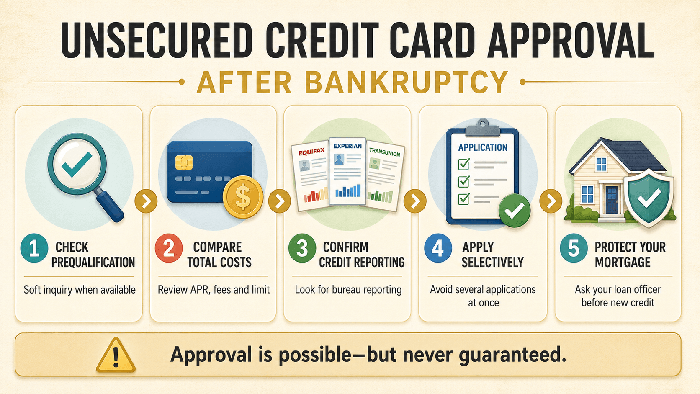
Improving your chances of approval for unsecured credit cards does not require submitting numerous applications or paying excessive fees. A safer approach is to identify cards that may fit your credit profile, compare the complete terms, and apply selectively. No strategy, credit score, or prequalified offer guarantees final approval.
Check for Prequalification Before Applying
Some issuers allow consumers to check for prequalified or preapproved offers before completing a formal application. This process may use a soft credit inquiry, which generally does not affect credit scores. However, consumers should confirm the type of inquiry before providing their information. Prequalification means the applicant may satisfy the issuer’s initial screening criteria. It is not a guaranteed offer. The issuer may still conduct a hard inquiry, verify application information, and approve or deny the account after receiving a full application.
Review All Fees, APRs, and Credit Limits
Read the card’s pricing and terms before applying. Review the purchase APR, cash-advance APR, penalty APR, annual fee, monthly maintenance fee, account-opening fee, balance-transfer fee, late-payment fee, and foreign-transaction fee when applicable. Also, check whether the card offers a grace period on purchases. Without a grace period, interest may begin accumulating from the transaction date, even when the statement balance is paid by its due date. Some cards for people rebuilding credit have low limits and several fees. If fees are charged to the account when it opens, they may reduce the credit available for purchases. For example, $75 in initial fees on a $300 credit limit would leave only $225 in available credit. Federal disclosure rules require issuers to provide important information about card rates and fees so consumers can compare offers.
Confirm Whether the Account Reports to the Credit Bureaus
Before applying, ask whether the issuer reports payment activity to Equifax, Experian, and TransUnion. Timely payments and responsible balance management, supported by regular reporting, can build a positive credit history. Reporting can also hurt a credit profile when payments are late or balances remain high compared with the credit limit. Opening an account alone does not guarantee an increase in credit score. The result depends on the consumer’s complete credit file, account activity, and the scoring model being used.
Avoid Applying for Several Cards at Once
A full credit card application commonly generates a hard inquiry. Applying for several cards within a short period may produce multiple inquiries and add several new accounts to the credit report. These changes can affect credit scores and may concern issuers reviewing the application. Consumers rebuilding after bankruptcy should research offers, use prequalification when available, and apply only for a card whose requirements and costs appear suitable. If an application is denied, read the adverse-action notice before applying elsewhere. The notice may identify the main reasons for the decision and help the consumer determine what to address first. Anyone planning to apply for a mortgage soon should speak with a loan officer before opening new credit. A new inquiry, account balance, or required monthly payment could affect mortgage underwriting or debt-to-income calculations.
Rebuild Credit After Bankruptcy With the Right Card Strategy
The right unsecured credit card can help rebuild payment history, improve your credit mix, and prepare you for future mortgage approval when used correctly.Secured Versus Unsecured Cards After Bankruptcy
Secured and unsecured credit cards can help rebuild credit after bankruptcy if the issuer reports to the credit bureaus and the cardholder manages the account responsibly. However, the costs, approval requirements, credit limits, and upgrade options can differ.
Security Deposit
A secured credit card requires a cash deposit to protect the issuer if the balance remains unpaid. The deposit commonly determines the initial credit limit. It is generally refundable when the account is closed in good standing or upgraded, but consumers should verify the issuer’s refund policy. An unsecured card does not need a security deposit. However, unsecured credit card approval may be more difficult shortly after bankruptcy because the issuer assumes greater risk without collateral in the form of deposited funds.
Fees and Interest Rates
Secured cards may offer lower fees than some unsecured cards marketed to consumers with damaged credit, but this is not always true. Applicants should review the annual fee, monthly maintenance charges, APR, late fees, and other costs. Some unsecured rebuilding cards charge several fees that reduce the available credit at account opening. A card without a deposit is not necessarily the more affordable choice.
Approval Likelihood
A secured card may be easier to qualify for because the deposit reduces the issuer’s risk. Nevertheless, approval is not guaranteed. Issuers may still evaluate income, bankruptcy history, recent credit activity, unpaid obligations, and previous accounts with the company. Unsecured-card requirements generally may be stricter. Applicants could receive better approval odds or terms after establishing recent on-time payments and demonstrating an ability to manage existing obligations.
Credit Limits
A secured card’s limit is often tied to the deposit. Some issuers allow cardholders to increase the limit by adding to the deposit, subject to the issuer’s rules. The issuer determines an unsecured card’s limit using its underwriting criteria. Someone rebuilding after bankruptcy may initially receive a low limit. Keeping the reported balance manageable can help prevent a low-limit card from showing high credit utilization.
Upgrade Possibilities
Some secured cards offer a path to an unsecured account after a period of responsible use. The issuer may periodically review the account, refund the deposit, and convert the card without requiring the consumer to close it. Other secured cards do not offer upgrades. Consumers should ask about graduation policies before applying, including whether an upgrade requires a new application or hard inquiry. They should also confirm whether the original account history will remain on their credit reports. There is no single correct number or type of credit card for everyone rebuilding after bankruptcy. The appropriate choice depends on the consumer’s budget, credit profile, upcoming borrowing plans, and ability to manage the account. Compare the total costs and terms carefully, rather than opening several accounts simply to rebuild credit faster.
How a New Credit Card Can Affect a Future Mortgage
Opening a credit card can affect mortgage qualification even when the applicant uses the account responsibly. If you’re planning to buy or refinance a home, think about the timing of your unsecured credit card application.
Hard Inquiry and New Account
A credit card application usually creates a hard inquiry on the applicant’s credit report. If approved, the new account can also reduce the average age of the applicant’s credit history. Either change may affect credit scores, although the effect varies by credit profile and scoring model.
Credit Utilization
A new credit limit could lower overall credit utilization if balances remain low. However, making purchases on the card or carrying a balance can raise utilization and potentially reduce credit scores. This risk can be greater with a low-limit card because even a modest balance may represent a large percentage of the available credit.
Required Monthly Payment
Any reported balance and minimum payment may be included in the borrower’s debt-to-income ratio. A new monthly obligation could reduce the mortgage amount the borrower qualifies for or affect approval when the debt-to-income ratio is already near the program or lender limit.
Opening Credit After Mortgage Preapproval
Mortgage lenders may review a borrower’s credit again before closing and verify whether new inquiries resulted in additional debt. A preapproval is based on the borrower’s financial profile at the time it is issued. Opening a credit card, financing furniture, buying a vehicle, or increasing existing balances can change that profile. A borrower who has already been preapproved should consult the loan officer before applying for or opening new credit. The loan officer can evaluate whether the inquiry, account, balance, or monthly payment could affect underwriting. Waiting until after the mortgage closes is often safer, but borrowers should follow their loan officer’s guidance for their individual situation.
What to Do When a Credit Card Application Is Denied
A denial does not necessarily mean you cannot qualify for a credit card later. Before submitting another application for unsecured credit card approval, review the issuer’s adverse-action notice and address the reasons given.
Read the Adverse-Action Notice
The card issuer must provide the main reasons for denying the application or explain how to obtain them. The notice may cite factors such as recent late payments, high balances, limited credit history, excessive inquiries, or insufficient income. If the decision was based on a credit report, the notice should also identify the credit-reporting company that supplied the report. It should explain your right to request a free copy of that report within 60 days. The credit bureau did not make the approval decision and cannot explain why the card issuer denied the application.
Review the Credit Report Used
Request the report from the credit-reporting company named in the notice. Review account balances, payment histories, collection accounts, personal information, and unfamiliar inquiries. Also, compare the report with the reasons provided by the card issuer. If the information is accurate, consider addressing the cited issue before applying again. This may mean paying down revolving balances, establishing more recent on-time payments, or allowing time to pass after several credit applications.
Correct Genuine Credit-Report Errors
If you find information that is incomplete or inaccurate, dispute it with the credit-reporting company. You may also dispute the information directly with the business that reported it. Attach copies of supporting documents and maintain records of all submissions. The credit-reporting company must investigate the dispute and correct or remove any information it determines to be inaccurate. Consumers should dispute only genuine errors. Accurate negative information generally cannot be removed simply because it contributed to a denial. The CFPB explains that applicants denied because of a credit report have the right to information about the decision, the credit score used when applicable, the key factors affecting that score, and access to the report used. Review the CFPB’s credit-denial guidance. After reviewing the notice and correcting any verified errors, reassess the card’s requirements before applying again. Prequalification with a soft inquiry may help identify possible offers, but it does not guarantee approval.
Unsecured Credit Card Approval Example
Hypothetical example: Maria received a Chapter 7 bankruptcy discharge eight months ago. Since then, she has made every payment on time, maintained steady employment, and kept a low balance on one secured credit card. Before applying for a new card, she reviewed her credit reports. She used an issuer’s prequalification tool, which stated that checking available offers would not affect her credit scores.
Maria selected one card with no security deposit, a $500 credit limit, a high APR, and no annual fee. She completed the formal application, which resulted in a hard credit inquiry. The issuer approved her application after reviewing her income, recent payment history, existing debt, and bankruptcy record.
This hypothetical unsecured credit card approval does not mean another applicant will receive the same result. Card issuers use different underwriting standards, and approval, credit limits, interest rates, and fees vary. A prequalified offer also does not guarantee final approval.
Final Thoughts on Unsecured Credit Card Approval After Bankruptcy
Unsecured credit card approval after bankruptcy is possible, but no credit score, waiting period, or prequalified offer guarantees approval. Each issuer evaluates factors such as income, recent payment history, existing debt, credit utilization, bankruptcy history, and prior relationships with the company. Before applying, compare the APR, fees, credit limit, grace period, and credit-bureau reporting. Use prequalification when available, apply selectively, and avoid opening several accounts within a short period. If an application is denied, review the adverse-action notice before trying another issuer. If you plan to apply for a mortgage soon, consult your loan officer before opening a credit card. A new inquiry, account, balance, or monthly payment could affect your credit scores, debt-to-income ratio, or mortgage approval.
Frequently Asked Questions About Unsecured Credit Card Approval:
Can Credit Card Companies See a Bankruptcy After It Is Discharged?
Yes. When a bankruptcy is discharged, it can still appear on your credit reports. It may be visible to card issuers when they review a new application. Chapter 7 bankruptcy typically stays on your record for up to 10 years from the filing date, while Chapter 13 usually remains for seven years. Receiving a new credit card does not remove the bankruptcy. Accurate bankruptcy information generally cannot be removed early simply because it affects approval.
Can You Keep an Existing Credit Card When You File Bankruptcy?
Possibly, but consumers should not expect an existing account to remain open. A card issuer may freeze or close an account after learning about the bankruptcy, even when the account has no balance. The result depends on the account agreement, the issuer, the bankruptcy chapter, and the individual case. Anyone preparing to file bankruptcy should disclose all required accounts to their bankruptcy attorney and avoid using credit cards without legal guidance.
Can You Become an Authorized User After Bankruptcy?
A primary cardholder may ask an issuer to add someone as an authorized user after bankruptcy. The authorized user is generally not responsible for repaying the account unless that person is also a joint account holder or otherwise contractually liable. Many issuers report authorized-user accounts to the credit bureaus. Positive account history could help, while high balances or late payments could hurt the authorized user’s credit profile. Becoming an authorized user does not guarantee higher credit scores or future approval.
Must You Disclose a Previous Bankruptcy on a Credit Card Application?
Applicants must answer every question on a credit card application completely and truthfully. If the application asks about a prior bankruptcy, provide accurate information. Do not omit or change details to improve the chance of approval. Even when the application does not directly ask about bankruptcy, the issuer may discover it while reviewing the applicant’s credit report. Providing false information could result in denial, account closure, or other consequences.
Can a Collector Demand Payment on Credit Card Debt Discharged in Bankruptcy?
A debt collector cannot collect a credit card debt that was discharged in bankruptcy. Consumers should keep their bankruptcy and discharge records in case a collector later contacts them about the account. If collection attempts continue, inform the collector that the debt was discharged and consider contacting a bankruptcy attorney. Do not assume that paying an old discharged balance will lead to unsecured credit card approval with the same issuer.
Can a Debit or Prepaid Card Rebuild Credit After Bankruptcy?
A standard debit or prepaid card typically doesn’t rebuild credit because it doesn’t have a line of credit. Usually, it doesn’t report payment history to credit bureaus. These cards can still help consumers make purchases without taking on new debt. Consumers who want an account that may contribute to their credit history should confirm that the provider reports activity to at least one credit bureau. Reporting alone does not guarantee that credit scores will increase.
This article about “How Unsecured Credit Card Approval Works After Bankruptcy” was updated on July 27th, 2026.