
A qualifying credit score is important when you apply for a mortgage, but it is not the only part of your credit that lenders review. Mortgage underwriters also look at your credit history to see how consistently you have paid your bills, how recent any late payments or collection accounts are, and whether your finances show you can take on a new housing payment. This is why two borrowers with similar credit scores can receive different mortgage decisions. One borrower may have a strong recent payment record and manageable debt, while another may have recent late payments, new collections, or unresolved credit issues. Your income, monthly debts, cash to close, and the type of loan you are applying for also matter. Understanding the difference between your credit score versus credit history can help you avoid surprises before applying. A mortgage lender should review the full file, not just the score, to explain what may affect your approval and what steps could strengthen your application.
Credit Score Versus Credit History: What Is the Difference?
Your credit score reflects your financial reliability to lenders and indicates how likely you are to repay a loan. It is calculated from information in your credit reports, including your payment history, account balances, length of credit history, recent credit applications, and the types of accounts you use.
Your credit history is the fuller record behind that number. It shows how you have managed credit over time, including your open and closed accounts, payment history, current balances, late payments, collection accounts, charge-offs, and other reported credit events.
For mortgage approval, the score may help determine whether you meet a loan program’s credit requirements and what pricing may be available. But the credit history helps the lender understand the story behind the score. A borrower may have a qualifying score but still need to explain recent late payments, unpaid collections, or other issues that appear on the credit report. This is why borrowers should not focus on the score alone. A stronger mortgage file usually shows a steady recent payment history, manageable balances, and no new credit problems before closing. Lenders also review income, monthly debts, assets, and the proposed housing payment to determine whether the loan is affordable.
Why Mortgage Lenders Review Both
Mortgage lenders evaluate your credit score and credit history. The credit score gives a quick view of your credit risk, while the credit history explains the details behind that score, including patterns of late payments and account management over time. Knowing the difference between your credit score versus credit history is essential for maintaining your financial health. A strong score can help you meet a loan program’s credit requirements and may affect the interest rate or pricing offered. But a qualifying score does not erase recent late payments, unpaid collections, high account balances, or other issues that appear on the credit report. Underwriters need to look beyond the number to understand whether there is a stable recent pattern of responsible credit use. Lenders also review credit alongside your income, employment, assets, monthly debts, and proposed housing payment. The goal is not simply to determine whether you have a certain score. The lender must determine whether the full mortgage payment is reasonable based on your overall financial situation. For example, when considering credit score versus credit history, a borrower with a lower credit score but a clean recent payment history, stable income, and manageable debt might have a more favorable application than someone with a higher score who has several recent late payments. Each mortgage program has specific requirements, so it’s important to review the entire credit report before concluding whether you qualify or not.
What Underwriters Look for in Your Credit History
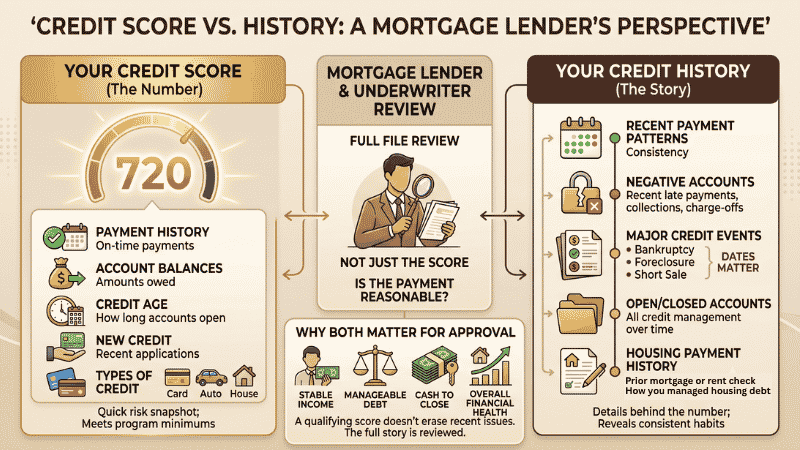 Mortgage underwriters review your full credit report, not just your score. They want to see whether your recent financial habits support a new mortgage payment. They commonly look at:
- Payment history: Late payments on mortgages, auto loans, credit cards, student loans, and other accounts. Recent or repeated late payments usually carry more weight than an older isolated issue.
- Negative accounts: Collections, charge-offs, judgments, repossessions, disputed accounts, and past housing-related credit problems may need additional review.
- Current balances: High credit card balances can raise your monthly debt obligations and affect your debt-to-income ratio.
- New debt or credit inquiries: Opening new accounts, financing a car, or applying for several credit lines before or during the mortgage process can change your approval profile.
- Housing payment history: When available, underwriters review prior mortgage or rent payments to see how you have managed a housing payment.
- Recent improvement: Past credit problems do not always prevent approval. Underwriters look at whether the issue was isolated, whether it has been resolved, and whether you have re-established an on-time payment pattern.
- Documented hardships: Job loss, illness, divorce, or a temporary business interruption may help explain a past credit issue. The lender may request supporting documents or a brief letter of explanation.
The goal is not to find a perfect credit report. It is to understand the full story behind your credit history and determine whether your current financial pattern supports the mortgage payment you want to take on. It’s important to understand the difference between credit score versus credit history when you evaluate your finances.
How Recent Late Payments Can Affect Mortgage Approval
Recent late payments can make mortgage approval more difficult, even when your credit score meets a program’s minimum requirement. Underwriters usually look at how late the payment was, how often it happened, which account was affected, and how recently it occurred.
A single late payment may have less impact when the rest of your credit history is strong. Several recent late payments, however, can raise concerns about your ability to manage a new mortgage payment. Late payments on a prior mortgage or rent are often reviewed especially closely because they involve housing obligations.
Underwriters may also look for a pattern. For example, one late payment during a documented hardship may be viewed differently from repeated late payments across credit cards, auto loans, and other accounts. The issue does not always result in a permanent denial, but it may affect the loan program, required documentation, interest rate, or the timing of your application. When recent late payments appear on your report, be prepared to explain what happened and show what has changed. Supporting documents may help when the problem was connected to job loss, illness, divorce, a temporary reduction in income, or another documented hardship. The most important step is usually re-establishing an on-time payment history and avoiding any new credit problems before applying for a mortgage.
Credit History After Bankruptcy, Foreclosure, or Short Sale
A bankruptcy, foreclosure, deed in lieu of foreclosure, or short sale can remain on your credit report for years. However, a past credit event does not automatically mean you cannot qualify for another mortgage. Eligibility depends on the loan program, the timing of the event, your recent credit history, and the lender’s requirements.
What Mortgage Underwriters Review After a Major Credit Event
Underwriters look closely at what happened after the bankruptcy, foreclosure, or short sale. They want to see whether you have re-established credit, paid accounts on time, kept new debt manageable, and avoided new housing-related late payments. An older bankruptcy with a clean recent payment history may be viewed very differently from a borrower who has recent late payments, new collections, or high credit card balances.
Why the Dates Matter
Lenders may review the date a bankruptcy was discharged or dismissed, the date a foreclosure was completed, or the date a short sale closed. Each mortgage program has its own waiting-period rules, so the correct date can affect whether you may be eligible now or need more time before applying. The lender may also need documents showing the event date, such as court records, a settlement statement, or credit-report information.
How Recent Late Payments Can Affect Your File
Late payments after bankruptcy, foreclosure, or a short sale can receive extra attention. They may raise concerns about whether the financial hardship has been resolved and whether you are ready to manage a new mortgage payment. One isolated late payment with a documented explanation may be viewed differently from a continuing pattern of missed payments. The underwriter will consider the full credit report, not just one account.
When a Letter of Explanation May Help
A lender may ask for a short letter of explanation when your report shows a major credit event or recent late payment. The letter should briefly explain what caused the problem, when it happened, and what has changed since then. Supporting documents may help when the issue was connected to job loss, illness, divorce, a business interruption, or another temporary hardship. The goal is to show that the situation was addressed and that your current finances are stable.
Review Your Credit Before Applying
Before applying for a mortgage, review all three credit reports for inaccurate dates, incorrect account statuses, or accounts that do not belong to you. Then have your file reviewed against the mortgage program you are considering. This helps you understand whether you qualify now, need more time to rebuild, or should correct errors before moving forward.
Why a Qualifying Score Does Not Always Mean Approval
Meeting a loan program’s credit-score requirement is an important first step, but it does not guarantee mortgage approval. A credit score is only one part of the lender’s review. The underwriter must also determine whether your overall financial file supports the new mortgage payment.
Your income, employment, monthly debts, assets, and housing payment all matter. A borrower may have a qualifying score but still have too much monthly debt, limited documented income, insufficient funds to close, or a proposed payment that does not fit the program’s requirements.
Recent credit activity can also affect the decision. For example, a borrower may meet the score requirement but have recent late payments, high credit card balances, new collection accounts, or several recent credit inquiries. These issues can raise questions about whether the borrower’s finances are stable enough for a new mortgage. The property and loan type matter, too. A condo, investment property, multi-unit home, cash-out refinance, or higher loan-to-value transaction may have different underwriting standards than a standard primary-home purchase. Lenders may also have requirements that are stricter than the minimum rules set by the loan program. This is why borrowers should avoid relying on a score alone. A full mortgage review should look at your credit, income, debts, assets, and purchase timeline together. That review can show whether you are ready to move forward now or what needs to improve before applying.
Final Thoughts About Credit Score Versus Credit History
A good credit score opens up mortgage options, but your credit history also matters. Factors such as recent payment behaviors, account balances, previous credit events, income, monthly obligations, and available funds play a crucial role in helping lenders assess whether the mortgage payment will be manageable. Understanding the difference between credit score versus credit history is essential in this process. Before you assume you need to wait or cannot qualify, have your full file reviewed. A mortgage professional can help identify what is working in your favor, what may need attention, and which loan options may fit your current situation.
Frequently Asked Questions About Credit Scores Versus Credit History
Does Checking My Own Credit Score Lower It?
No. Checking your own credit report or score is generally treated as a soft inquiry and does not lower your credit score. A lender’s credit pull when you apply for a mortgage is different and may have a small, temporary effect on your score.
What Credit Score Do Mortgage Lenders Use?
Mortgage lenders often order a three-bureau merged credit report, which may use a different scoring model than the score shown in a banking app or consumer credit-monitoring service. For many conventional loans, the lender may use the middle score when three scores are available for one borrower, then use the lower applicable score when more than one borrower applies.
Can You Get a Mortgage With No Credit History?
It may be possible, but the process may be more limited. Some loan programs allow manual underwriting or nontraditional credit when a borrower has no usable credit score. The lender may instead review documented rent, utility, insurance, or other recurring payment histories.
How Long Do Late Payments Stay on a Credit Report?
Most negative payment information, including late payments and collection accounts, can generally remain on a credit report for up to seven years. Bankruptcy information may remain longer, depending on the type of bankruptcy. Even when a negative item is still reported, recent issues usually have more effect than older ones.
Can an Authorized User Account Help With Mortgage Approval?
An authorized-user account may help establish credit history when the primary account holder has managed the account responsibly. However, the lender may still review the full file, including whether the borrower is responsible for any required payment and whether the credit profile supports the mortgage application.
Can Accurate Late Payments Be Removed From a Credit Report?
Accurate late payments generally cannot be removed simply because they are negative. You can dispute information that is incorrect, incomplete, duplicated, or reported under the wrong account. Credit reporting companies and the company that furnished the information must investigate valid disputes.
Will a Mortgage Lender Check Credit Again Before Closing?
A lender may review credit again shortly before closing. New debt, late payments, credit inquiries, employment changes, or major changes in account balances can affect the final approval. Avoid making purchases on credit, opening new accounts, or co-signing for another person until your mortgage has closed.
This article about “Credit Score Versus Credit History for Mortgage Approval” was updated on July 2nd, 2026.