Qualifying For A Mortgage With High Student Loan Debts And How It Affects DTI On Government and Conventional Loans
Buying a home when you’ve got a lot of student loans can seem super tough. A lot of people stress about their debt-to-income ratio (DTI) and worry that lenders won’t accept their repayment plans. But the good news? You can still get a mortgage even with high student loan debt — you just need to find the right loan program and a lender who gets it.
At Gustan Cho Associates, we specialize in helping borrowers turned down elsewhere. We have no lender overlays and work with over 300 wholesale lenders, giving you real options when others say no.
In this guide, you’ll learn:
- How each loan program (FHA, VA, USDA, Conventional, Non-QM) views student loans
- How student loan debt affects your mortgage approval
- Creative solutions to qualify even with six-figure student loan balances
- 2026 updates every borrower should know
- Why Gustan Cho Associates is the right partner if you need a mortgage with high student loan debts.
In the following paragraphs, we will cover qualifying for a mortgage with high student loan debts.
Qualifying For A Mortgage With High Student Loan Debts
It is possible to get approved for a mortgage with high student loans. But student debt does affect your debt-to-income ratio, the amount of loans you are eligible to take out, and how much of a home you can afford. Many homebuyers believe that having a large student loan balance means they will never qualify for a mortgage, but that is false. What is most important is not the total amount that you owe, but rather how your monthly student loan payment is accounted for by the lender when they calculate your debt-to-income ratio or DTI.
Home mortgages are difficult to secure due to student loans. First-time home buyers, doctors, lawyers, teachers, and younger people have good incomes but also considerable educational debt.
Government-backed and standard loans offer options for people with student debt. It is important to understand how it differs across loans to understand how lenders determine debt payments. When getting a mortgage, lenders examine a person’s income, credit, employment, assets, and liabilities. Student loans are in the liability class. Mortgages can be affected even if the loans are deferred, in forbearance, on an income-driven repayment plan, or not fully amortizing. This is why people looking for a mortgage with student loans may not know the DTI rules.
Impact of Student Loans on Mortgage Approval
There are three main ways student loans impact mortgage approval. One, they raise your monthly liabilities, which in turn increases your back-end DTI ratio. Two, they can negatively impact the mortgage amount you qualify for since more of your income is tied up in debt. Lastly, they can affect automated underwriting results, especially if your profile is borderline due to credit score, reserves, or down payment.
Once underwriting is complete, the monthly payment, rather than the total balance, is more critical. So, if a borrower has $150,000 in student loans, they can qualify easily if the monthly payment is low and in line with the program.
A borrower with a smaller balance might face greater challenges if the lender has to consider a higher presumptive payment based on a certain percentage of the loan balance. That is why it is not an adequate question to ask if student loans count as part of a mortgage application. Student loans do count. The important question is: to what extent do they count, and how are they evaluated under the loan program you are working with?
Mortgages When You Have Student Loans

Mortgage programs have specific guidelines for analyzing consumer credit reports. When they sell their loans to investors, they must comply with guidelines set by Fannie Mae and Freddie Mac; therefore, they tend to favor borrowers with strong credit, consistent income, and the ability to meet traditional underwriting criteria. When student loans come into play, things also tend to get more complicated and specific.
Mortgages with high student loans have the potential to be the easiest for the borrower while also providing the worst possible outcome for the lender.
If your student loans are on an income-driven repayment plan, under a conventional mortgage loan, the mortgage underwriter would likely be able to use the exact monthly dollar amount, as long as that monthly payment is a real number, documented, and approved by the automated underwriting system. This is beneficial for the borrower if the student loan statements show very low monthly payment obligations, as those obligations are unlikely to affect their ability to secure the loan.
How Do Mortgage Underwriters Determine DTI On Borrowers With Student Loans
When the borrower has a zero payment, or the payment is documented but not approved, the lender is forced to use an alternate payment that is much higher, which increases the debt-to-income (DTI) ratio and ultimately reduces their ability to secure a mortgage loan. This type of loan is most likely to be the most beneficial for the borrower when credit scores are good; therefore, student loan debt is less likely to be offset by low credit scores, low available reserves, or additional monthly obligations.
Even with student debt, the borrower can show that the student loan repayment plan is workable, that the revolving debt is low, and that the borrower has a good income, then the borrower can benefit from the student’s financing plan.
Student loans impact your mortgage in three big ways:
- Debt-to-Income Ratio (DTI): Lenders must count a monthly payment against your income, even if your loans are deferred.
- Credit Score: Large balances can weigh on your credit utilization and history, affecting automated underwriting approvals.
- Loan Program Rules: Each program — FHA, VA, USDA, and Conventional — has its own formula for counting student loan payments.
For many borrowers, student loan balances are higher than the original loan amount due to years of accrued interest. That’s why doctors, lawyers, teachers, and professionals with advanced degrees often carry six-figure student loans — and still want to buy a home.
The key is knowing which loan program gives you the most flexibility.
Why DTI Is So Important
Of the many elements that go into mortgage underwriting, DTI (debt-to-income) is one of the most important. DTI is a measure of the portion of a person’s gross monthly income that is dedicated to servicing debt. This is one of the more direct measures of a person’s ability to take on a new house payment.
In mortgage financing, DTI ratios come in twos. The front-end ratio considers only your proposed housing payment, while back-end ratios gauge the housing payment and all other debts listed on your credit report.
Student loans count on the back-end DTI. Even with a higher DTI, an applicant can still get approval. Although it complicates things, it will reduce your borrowing capacity. Moreover, qualifying for a mortgage with a high level of student loan debt also makes it more challenging. The effect of the student loan payment on the amount of house you qualify for can be affected by even the tiniest student loan payment. If the lender uses a student loan payment that is higher than what you pay, that difference will more likely than not lower your approval amount significantly.
Buy a Home Even With High Student Loans
Your student debt doesn’t have to stop you from qualifying.
Why Student Loans Complicate Qualifying for a Mortgage
Student loans complicate confusion because not all mortgage lenders view them the same way. For example, the number in the payment column on your credit report may be zero due to the loan being deferred, the loan being placed in forbearance, or in the case that the borrower enrolled in an income-driven repayment plan.
Mortgage guidelines may still warrant the lender to factor in a calculated payment regardless of the reported payment. Most borrowers have this assumption.
They have a deferred student loan or an income-based payment plan that is not high, and they think the student debt will not matter much. This is not the case in many instances. The lender may have to consider either a portion of the total student loan balance or a fully amortized payment, depending on the loan program. As a result, two borrowers with the same income and student loan balance may qualify for FHA, VA, USDA, or conventional financing differently. Knowing this is important when mortgage shopping with a large amount of student debt.
Mortgage Qualification and Deferred Student Loans
There is considerable misunderstanding surrounding deferred student loans. Some borrowers think that deferred student loans do not count toward qualifying for a mortgage. However, most of the time, deferred student loans still count for the purposes of determining Debt-to-Income (DTI). Most lenders will not overlook a liability that will inevitably become a liability again.
Borrowers with deferred loans may still have a monthly payment even if no payment is required at the moment. This is for underwriting purposes.
The amount that is used can differ by loan program. This is why most borrowers are caught off guard when lenders use a payment amount higher than their expectations. For anyone applying for a mortgage with a lot of student loan debt, it is important to review repayment documents early to avoid issues. This is even more important if your loans are currently deferred. Waiting until underwriting to resolve an issue is likely to result in a lower loan amount or even a loan denial.
Impact of Student Loans on Buying Power
Mortgage lenders use DTI to calculate how much house you can afford, and student loans may not stop the purchase, but will likely prevent you from buying a bigger house. Even if student loans do not prevent mortgage approval, they still reduce buying power. A large student loan payment, which takes up a larger share of your income, reduces your mortgage qualification.
Anyone with substantial student debt pursuing a mortgage needs to keep DTI issues in mind. Just getting the loan approved is only half the challenge. Not only do you need to be approved, but you also need to be able to repay the mortgage debt.
Some borrowers may qualify for a short-term mortgage, such as those with high incomes. However, if student loan payments take up most of the borrower’s DTI, the mortgage may be in jeopardy. Homeownership may still be achievable, but a few things may need to be changed. Such changes may include a different price target, a larger reduction in other debts, a larger down payment, or a more flexible loan.
Compare Government and Conventional Loans with Student Loan Debt
When you contrast government loans with conventional loans, the correct choice tends to depend on the profile of the borrower and how the student loan payment is treated. Government loans (FHA, VA, USDA, etc.) tend to be more lenient on credit and overall DTI, but they can be more conservative when the student loan payment is deferred, reduced, or ambiguous.
There is no one-size-fits-all solution for borrowers seeking a mortgage with high student loan debt. The nature of the loan program that is best for a client will depend on their credit score, income, employment type, down payment amount, reserves, and how student loan payments are documented.
Conventional loans tend to offer more leeway in using the actual payment, but they are typically more favorable to borrowers with stronger credit and lower risk. The FHA might be the most realistic starting point for applicants with excessive student loan debt and low credit scores. Because of the absence of a down payment and considerable flexibility in underwriting, VA might be the most advantageous overall structure for qualifying veterans. For prospective buyers in certain locations, USDA may also be appealing. When borrowers have good credit and the required income-driven repayment documentation is stable, conventional financing may be more cost-effective in the long run and offer more options.
HUD Guidelines on Mortgage With High Student Loan Debts on FHA Loans
In 2026, the Federal Housing Administration (FHA) introduced new rules to help people with large student loan debts get mortgage approvals. If a borrower does not have a regular payment reported for their student loans, the FHA will create a monthly payment based on 0.50% of the total loan balance. For example, if a borrower has $100,000 in student loans, the FHA will assume they have a monthly payment of $500, which will be included in their debt-to-income (DTI) ratio.
If a borrower’s student loan servicer offers a payment plan that fully pays off the loan over an extended period—like 25 years—and this plan results in a lower monthly payment than 0.50%, lenders like Gustan Cho Associates can use that lower amount.
To be eligible for an FHA mortgage loan, borrowers must maintain a front-end debt-to-income (DTI) ratio of no more than 46.9% and a back-end DTI ratio that does not exceed 56.9%, as assessed by automated underwriting systems (AUS). These new guidelines bring FHA rules closer to those of Fannie Mae, making it easier for borrowers with high student loan debt to get FHA financing. FHA can be an option for borrowers with high student debt who have good income, decent credit, and limited savings for a down payment. With high student loan debt, it is one of the most viable options for most people to get a qualified mortgage.
Mortgage With High Student Loans On FHA Loans
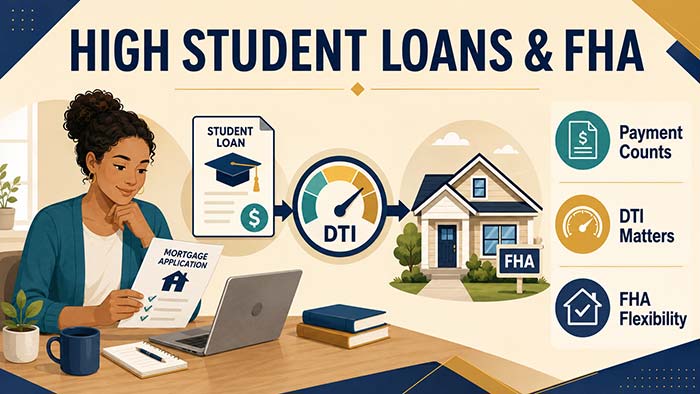
FHA loans are more flexible than most other loans when it comes to consumer debt, especially for those carrying student loan debt, lower credit scores, or higher overall DTI. For first-time home buyers, it is easier to qualify for FHA financing, as it allows lower down payments and is more forgiving than most conventional mortgage options. When qualifying for a mortgage with high student loan debt, it is important to understand that, with FHA financing, most lenders must consider student loan payments when determining DTI. If the credit report shows a payment and it is documented, that amount can be used as part of DTI.
If the payment is reported as zero or otherwise insufficient, the lender will need to use an amount calculated in accordance with FHA guidelines.
This is significant for borrowers in deferment, forbearance, or certain income-driven repayment plans. Even if your required payment is low for now, it still means that FHA underwriting wants to see some reasonable monthly obligation. This can increase your DTI more than you expected. Nonetheless, FHA is still a good option for many borrowers. The program tends to be more forgiving than other loan types on high total DTI ratios, provided the other parts of the file are strong.
USDA Guidelines on Mortgage With High Student Loan Debts
Like the FHA, the USDA now mandates that all student loans, including those in deferment, be accounted for in the loan application process. When calculating these loans, the USDA considers either 0.50% of the total loan balance or the fully amortized payment.
Using 0.50% of the outstanding balance hypothetical debt requirement can significantly impact borrowers’ debt-to-income (DTI) ratios, as the USDA imposes strict DTI caps set at 29% for the front-end ratio and 41% for the back-end ratio.
The USDA loan program can offer a viable financing option for borrowers residing in rural areas due to its favorable terms designed for those communities. However, the stricter DTI caps present a challenge, particularly for individuals carrying substantial student loans, as they may complicate their chances of approval. Additionally, the USDA does not allow non-occupant co-borrowers, further limiting options for borrowers seeking assistance.
Contacting USDA For A Mortgage With High Student Loans
The Federal Housing Administration (FHA) allows home buyers in rural and suburban areas to apply for a Mortgage with High Student Loan Debt. Applicants must meet certain income and property location limits. USDA loans also require lenders to include student loans as a liability when calculating the debt-to-income (DTI) ratio.
For moderate-income buyers with little to no money down and access to rural areas, USDA loans remain a solid option, but student debt has to be carefully evaluated.
Customers interested in a USDA mortgage with high student loan debt must know how the lender calculates the student loan payment. If the student loan payment shown on the credit report is accurate and is documented as such, then it can be used. If the payment is absent, or is zero, deferred, or is otherwise subject to stipulations, that lender is required to impute a hypothetical payment.
VA Mortgage With High Student Loan Debts
VA loans have super flexible mortgage options for veterans and active-duty service members, making them especially helpful for those dealing with a lot of student loan debt. A major benefit of VA loans is that if your student loans have been deferred for over 12 months, the VA won’t include them when checking your eligibility. Only married spouses are allowed to be co-borrowers with VA loans. For loans that aren’t deferred, the VA figures the monthly payment by taking 5% of the total balance and dividing it by 12. This approach can help reduce financial stress for borrowers.
A flexible structure and solid underwriting policies may make a VA mortgage more advantageous than other loan options for qualified veterans and service members, even with substantial student debt.
Additionally, the VA does not have a set debt-to-income (DTI) cap, as long as you can show a strong leftover income after expenses. This means veterans and service members with student loan debts can often qualify for larger loan amounts than they would with other options, like FHA or USDA loans. As a result, it can be easier for those who have served in the military to achieve homeownership, even with significant student loan debts.
Mortgage With High Student Loans On VA Loans
VA loans are one of the best mortgage options for eligible veterans, active-duty service members, and certain surviving spouses. With VA financing, there are significant benefits, including no down payment required in many cases and no monthly mortgage insurance. VA loans are also very competitive for borrowers with student debt. However, it is particularly important how residual income and debt obligations are assessed.
When student loans are involved, the lender needs to determine the monthly obligation to use in the DTI, which considers residual income, an analysis of how much money is left of your income after you have completed your major monthly obligations.
In some cases, this analysis of residual income may assist borrowers with more student loans, as long as there is sufficient money left after the housing payment calculation. Depending on the circumstances, some VA guidelines may allow the use of the documented payment if it is established and anticipated to continue. However, in some cases, particularly when the payment is deferred or ambiguous, there may be a placeholder payment. Also, in addition to DTI, VA underwriting, and other debts, the loan has been paid in full. This is part of the reason why, even if the file appears too tight, VA loans can be a good option for borrowers with student loan debt.
Don’t Let Student Debt Delay Your Dreams
We’ll show you flexible loan programs designed for borrowers with high balances.
Fannie Mae and Freddie Mac Guidelines on Mortgage With High Student Loan Debts on Conventional Loans
Conventional loans are often the most suitable choice for borrowers with substantial student loan debt. These loans support income-driven repayment (IDR) plans or income-based repayment (IBR) plans, as long as the monthly payment is reflected on your credit report.
This is particularly beneficial for those with large student loans, because lenders will only consider the actual payment amount when calculating debt-to-income (DTI) ratios. For instance,
if you owe $200,000 but are only required to pay $125 per month under an IBR plan, lenders will factor in only that $125 for your DTI assessment. Moreover, conventional loans provide advantageous terms for borrowers with significant student loan balances. While the maximum allowable back-end DTI for conventional loans is 50%, there are no specific requirements for front-end DTI. This flexibility enables borrowers with high student debt and low IBR payments to qualify more easily for conventional loans than those with Federal Housing Administration (FHA) loans. Consequently, conventional loans can be a more accessible option for those looking to navigate the challenges posed by heavy student loan debts.
Strategies To Increase Chances To Qualify
If you’re on an income-driven repayment plan, you need to have your statement/servicing document noted with the required monthly payment. The DTI is significantly affected by the payment documentation provided.
Step three entails improving the rest of your mortgage file. High credit scores and steady employment, along with existing cash reserves and a larger down payment, can greatly reduce the risk of a high student loan balance. Many borrowers do not default on their student loans, but rather on the overall file being sufficiently strong despite the debt.
Income Documentation And Loan Approval
Income-driven repayment plans are beneficial because they create a strategy to pay off large student loan balances by aligning loan repayments with one’s income. In terms of mortgage qualification, they can be useful, assuming the lender can use the payment amount and the documentation meets the requirements.
Large balances and lower monthly payments might qualify large loan borrowers extremely well if the loan program allows documented payments.
Others might see their lender performing a qualifying payment at a higher rate because other documentation is not considered fully documented, or because the program requires a different type of payment calculation.
Homebuyers with high student loan debt do not automatically qualify for an income-driven repayment plan. Although that may be the case, some documentation shows otherwise.
Non-QM and Alternative Mortgages With High Student Loan Debts
If government or Conventional loans don’t work, non-QM mortgages are another option.
- Bank statement loans (qualify using income deposits instead of tax returns).
- No-ratio loans (do not require DTI calculations).
- DSCR loans for investors (approval based on rental income, not personal debts).
These programs are especially useful for self-employed borrowers, professionals, or investors who want a mortgage with high student loan debts but don’t fit agency guidelines. Lastly, it is recommended that you look into as many loan programs as possible. Someone who gets denied under one structure can get approved under a completely different one. It is very important when it comes to your student loans. The differences in how student loans are treated are a reason to evaluate FHA, VA, USDA, and conventional loans.
Long-Term Updates for 2026 Borrowers
Here are the key 2026 changes every borrower should know:
- Credit Scoring Updates: New FICO 10T and VantageScore 4.0 models will be phased in by 2026–2027, and they will better reflect student loan repayment history.
- Student Loan Forgiveness Programs: Borrowers in Public Service Loan Forgiveness (PSLF) or similar programs may benefit from lenders’ increasingly accepting IDR documentation.
- FHA/Conventional Alignment: FHA’s move to 0.50% calculation makes it easier for borrowers with deferred loans than the older rules requiring 1%.
Final Thoughts
High student loan balances do not mean you can’t buy a home. With the right strategy, repayment plan, and loan program, you can qualify for a mortgage with high student loan debts and achieve homeownership.
At Gustan Cho Associates, we help borrowers every day who thought they couldn’t qualify. Whether you need FHA, VA, Conventional, or Non-QM, our team has no lender overlays and the experience to guide you to approval.
Borrowers who need a five-star national mortgage company licensed in 48 states with no overlays and who are experts on mortgage with high student loan debt, please contact us at 800-900-8569, text us for a faster response, or email us at alex@gustancho.com. The team at Gustan Cho Associates is available 7 days a week, on evenings, weekends, and holidays.
Mistakes Made By Borrowers
An example of a mistake a borrower makes is thinking the student loan balance is more important than the student loan payment. In mortgage underwriting, the payment is usually given greater weight. A second example is using online calculators that ignore the nuances of how different loan programs treat deferred or income-driven student loans. These calculators lead to guesswork.
Another mistake borrowers make is getting prequalified for a mortgage but failing to provide student loan documentation.
An informal estimate might look optimistic, but underwriting can adjust the approval amount based on real loan repayment scenarios. A common mistake is delaying the resolution of other, more manageable obligations. The most important factor is selecting the most appropriate mortgage program based on the student loan details, a realistic debt-to-income ratio, and your overall financial position.
Is It Possible To Purchase A Home And Have A Lot Of Student Loans
The answer is simple: yes. Every year, many people purchase homes despite having student loan debt. The issue is not the loans themselves but whether the monthly payment fits within the loan program’s parameters.
Most qualifying borrowers have high income, documented repayment terms, good credit, and manageable debt. Those with higher DTI may qualify for FHA or VA loans, depending on circumstances. If the first option fails, others may still be available.
Qualifying for a mortgage with high student loan debt requires strategy, documentation, and careful selection of the right loan program. It is not necessary to eliminate student debt first.
Frequently Asked Questions About Mortgage with High Student Loan Debts:
Can I Get a Mortgage with High Student Loan Debts?
- Yes, you can. Many people buy homes even with large student loans.
- The key is finding the right loan program and lender.
Do Lenders Count Deferred Student Loans When I Apply for a Mortgage with High Student Loan Debts?
- Yes. Even if your loans are in deferment, most lenders still count a payment. FHA and USDA use 0.50% of your balance, while VA may ignore loans deferred for 12 months or more.
Can I Use My Income-Driven Repayment (IDR) Plan to Qualify for a Mortgage with High Student Loan Debts?
- Yes.
- Conventional loans accept your IDR or IBR payment as long as it shows on your credit report.
- This helps many borrowers qualify with lower payments.
Will My Credit Score Stop Me from Getting a Mortgage with High Student Loan Debts?
- Not always. Large balances may affect your score, but on-time payments matter more. Many borrowers qualify for a mortgage even with fair or average credit.
What is the Maximum Debt-to-Income Ratio for a Mortgage with High Student Loan Debts?
- It depends on the program. FHA allows up to 56.9% DTI, Conventional up to 50%, USDA 41%, and VA has no official cap if residual income is strong.
Can I Add a Co-Borrower if I Need Help Qualifying for a Mortgage with High Student Loan Debts?
- Yes. FHA and Conventional loans allow non-occupant co-borrowers to help you qualify.
- VA only allows spouses.
Is a VA Loan the Best Choice for Mortgage with High Student Loan Debts?
- If you qualify, go for it. VA loans offer flexibility and may exclude student loans that have been in deferment for over 12 months.
Can I Still Buy a Home if My Student Loan Balance is Over $100,000?
- Yes. Many doctors, lawyers, and teachers buy homes with six-figure student loans.
- The payment amount, not the total balance, matters most when getting a mortgage with high student loan debts.
What Happens if I’m in Default on My Student Loans?
- You cannot qualify for most mortgages until your student loans are brought back into good standing.
- Setting up a repayment plan is usually the first step.
Who Can Help Me Get Approved for a Mortgage with High Student Loan Debts?
- Gustan Cho Associates specializes in helping borrowers with student loans and no lender overlays.
- We can guide you through FHA, VA, Conventional, or Non-QM options.
This article about “Qualifying for Mortgage With High Student Loan Debts” was updated on March 8th, 2026.
Who can help me qualify with student debt?
Gustan Cho Associates specializes in approvals other lenders can’t do.