
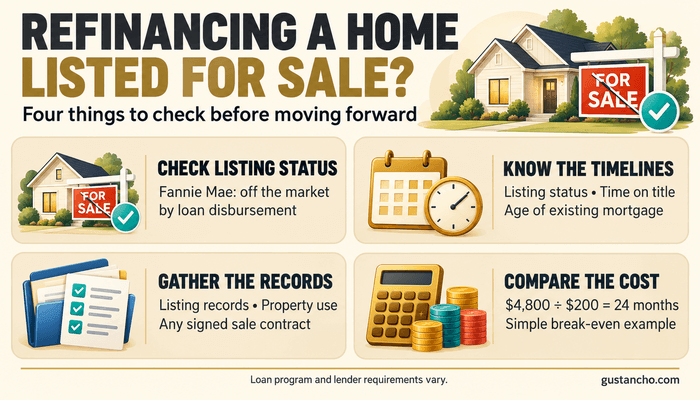
You may be able to apply for a refinance mortgage when house is still listed for sale, but the listing can affect approval and funding. For Fannie Mae limited cash-out and cash-out refinances, the property must be off the market by the disbursement date—the date the new loan funds are released. Other loan programs and individual lenders may have different requirements, so confirm the listing rules before moving forward.
What to Tell Your Loan Officer Before Applying
If your home is currently or recently listed for sale, give your loan officer these details before starting the refinance:
- Listing dates: When marketing began and when the listing expired, was withdrawn, or was canceled.
- Current status: Whether the home is still advertised through the MLS, real estate websites, social media, or for-sale-by-owner channels.
- Purchase contracts: Whether you accepted an offer or signed a contract. Include the expected closing date or termination documents if the sale fell through.
- Refinance purpose: Whether you want to lower the rate, change the loan term, or take cash out.
- Property use: Whether you currently occupy the home, use it as a second home, or rent it out—and whether that use will change.
- Selling plans: Whether you have decided to keep the property or still intend to sell it.
A brief explanation is enough to start. These details help the loan officer identify the appropriate program and any listing, occupancy, or timing conditions that need to be resolved.
Listing Status, Ownership Seasoning, and Mortgage Seasoning
Three separate factors can affect a refinance:
- Listing status: Whether the home is currently being marketed for sale. Removing a listing addresses marketing status.
- Ownership seasoning: How long the borrower has held title to the property.
- Mortgage seasoning: How long the existing mortgage has been in place before it can be refinanced under the selected program.
Canceling a listing does not change your ownership date or the age of your mortgage. A lender may also impose restrictions beyond a program’s published requirements, often referred to as overlays. If you receive a waiting-period condition or denial, ask which rule applies, whether it comes from the loan program or the lender, and which dates are used to measure it.
Fannie Mae Rules for a Home That Was Recently Listed
If the property was listed for sale, it needs to be off the market by the time the refinance loan is disbursed. That applies whether the transaction is a limited cash-out refinance or a cash-out refinance.
Limited Cash-Out Refinance
If you are doing a limited cash-out refinance, you do not have to leave the house off the market for six months simply because it was listed recently. The listing needs to be removed by disbursement, and the loan must still meet the normal limited cash-out requirements.
Cash-Out Refinance
Cash-out is where people often mix up several different rules. The house still needs to be off the market by the disbursement date. But cash-out loans can also have seasoning requirements. In many cases, the first mortgage being paid off needs to be at least 12 months old. At least one borrower also generally needs to have been on title for six months, although Fannie Mae provides exceptions in certain situations. Those time periods have nothing to do with how long the property was listed.
Why the Six-Month Rule Gets Misunderstood
Fannie Mae’s cash-out refinance requirements involve two separate timelines:
- Six months on title: At least one borrower generally must have owned the property for six months before the new loan’s disbursement date.
- Twelve months for the existing mortgage: When the refinance pays off an existing first mortgage, that loan generally must be at least 12 months old, measured from its note date to the new loan’s note date.
The existing mortgage does not need to be paid off beforehand—the refinance pays it off. Applicable exceptions can change these requirements, and neither timeline measures how long the home has been off the market.
Refinance Denied Because Your Home Was Listed? Get a Second Opinion
One lender’s overlay does not always mean every refinance option is closed. We’ll review the listing history, occupancy, equity, loan purpose, and available programs.What About a Freddie Mac Refinance?
Freddie Mac cash-out refinances have separate ownership and mortgage-seasoning requirements:
- Existing first mortgage: When the refinance pays off a first mortgage, at least 12 months generally must pass between the existing loan’s note date and the new loan’s note date.
- Ownership: At least one borrower generally must have been on title for six months before the new loan’s note date.
Applicable exceptions are addressed in Freddie Mac Guide Section 4301.5. These timelines concern ownership and loan age; they do not establish how long a home must remain off the market. For a currently or recently listed property, ask the lender to confirm the applicable listing policy and identify whether any restriction comes from Freddie Mac’s requirements or the lender’s own guidelines.
Can You Do an FHA Refinance if the Home Was Listed for Sale?
A recent listing requires a closer look at the refinance type and the property’s current use. A lender’s requirement to cancel a listing or wait before applying should be identified separately from FHA’s published eligibility rules.
FHA Cash-Out Refinance
FHA cash-out refinancing has these core requirements:
- Ownership and occupancy: To qualify, at least one borrower must have owned and lived in the home as their primary residence for the 12 months before the FHA case number assignment, with a limited exception for inheritances.
- Payment history: Mortgage payments must be up to date for the past 12 months, or since the mortgage was obtained if it’s been less than that. Additionally, payments on home-secured mortgages must be current through the month before disbursement.
- Existing loan history: A mortgaged property requires at least six payments on the current loan. Forbearance can add separate repayment requirements.
- Equity: Maximum LTV and combined LTV are 80% of HUD’s Adjusted Value, with financed upfront mortgage insurance handled separately.
FHA Rate-and-Term Refinance
Rate-and-term refinancing has different rules from cash-out refinancing. It is available for homes you live in as your main residence and for HUD-approved secondary homes. The lender needs to confirm that you currently live there and, if needed, how long you have lived there. If you moved out while trying to sell the home, the lender will need to review that change before moving forward.
FHA Streamline Refinance
A streamline refinance lets you replace your current FHA-insured mortgage. Your loan must be up to date, and the new refinance should give you a clear benefit. You cannot get more than $500 cash back. Some investment properties can be refinanced without an appraisal, so do not use cash-out occupancy rules to check if you qualify for a streamline refinance.
Listing Restrictions and Documentation
If your lender says the home must be taken off the market, ask if this rule is based on a HUD requirement or the lender’s own investor guidelines. Either a cancellation letter or an MLS status report can indicate whether your home is being marketed. Utility bills or other records can prove you live there. Giving one type of document does not automatically prove the other.
What About a Non-QM Refinance?
 Non-QM loans can be useful when a conventional or government refinance does not fit, but there is no single rule for a property that was recently listed for sale. Each Non-QM investor sets its own guidelines.
Some want the property completely off the market before the refinance application is submitted. Others may require it to be withdrawn for a specified period. A recently listed property may also affect the maximum loan-to-value ratio with some programs.
This is why I would never assume that a Non-QM loan automatically solves a listing problem. The lender needs to check the exact program before moving forward.
Recently Listed Does Not Mean Automatically Ineligible
A borrower may have listed the home, received no acceptable offers, and decided to keep it. That situation may still work with the right Non-QM program. Be prepared to explain when the property was listed, when it came off the market, why you decided not to sell, and what you plan to do with the home after refinancing.
Does a For-Sale-By-Owner Listing Count?
Yes, it can. A house does not have to appear in the MLS for a lender to consider it listed for sale. For-sale-by-owner advertising can still show that the homeowner has been trying to sell the property. That could include advertising on:
- Zillow
- Facebook Marketplace
- Realtor websites
- Social media
- Yard signs
- Local classified sites
- Other real estate websites
If you are trying to refinance a mortgage while the house is still listed for sale, removing the property from the MLS while continuing to advertise it elsewhere may not resolve the issue.
Tell the Lender About Any Recent Marketing
If you marketed the property yourself, mention it. The lender may ask when the advertising stopped and whether you still intend to sell. It is better to answer that question up front than to have an underwriter find an old online listing later.
Documents to Confirm Your Home’s Listing Status
The lender may request the following documents, depending on how the property was marketed and whether a sale was pending:
- Listing cancellation or termination confirmation: Documentation showing when the listing agreement ended.
- Dated MLS status report: A report showing the listing’s current status and the effective date of that status.
- Written agent confirmation: Confirmation that active marketing has stopped.
- FSBO advertising records: Evidence that applicable for-sale-by-owner advertisements have been removed.
- Contract termination or release documentation: Records showing that a purchase contract is no longer in effect if a pending sale fell through.
A withdrawn MLS status does not necessarily terminate the listing agreement. Confirm with your agent whether the agreement remains active, then ask your refinance lender which documents it will accept.
Can You Refinance if You Already Accepted an Offer on the House?
This is a different situation from simply having a property listed. Once you have accepted an offer and signed a purchase contract with a buyer, the sale is pending and needs to be addressed. Tell the refinance lender immediately. The refinance may no longer make sense if the property is scheduled for sale and the new mortgage would be paid off shortly after closing. There can also be issues involving title, occupancy, the pending sale, and the timing of both transactions. Do not refinance first and hope the purchase contract never comes up.
What if the Sale Falls Apart?
Deals fall through. If the buyer cancels and you decide to keep the property, refinancing may still be an option. Provide the lender with documentation showing that the purchase contract is no longer in effect, and explain that you are keeping the home. From there, the lender can determine whether the refinance meets the applicable program requirements.
Can You Put the House Back on the Market After Refinancing?
There is no single selling timeline that applies to every refinance. Review your loan documents for occupancy commitments, any required lender consent, and applicable prepayment penalties before deciding when to sell. Some loans charge a fee for an early payoff. Refinance seasoning and occupancy have different functions. Seasoning is to do with whether you’re eligible for the refinance. Occupancy concerns how you promise to use the property under the new loan. You have to be absolutely honest about your plans when you apply and when you close. If your circumstances do change later on, that is one thing, that is different from the scenario of you planning to sell straight away. You do need to be aware, though, that changing your mind doesn’t automatically terminate your contract, so check for any exceptions or whether you need to get approval.
Can a Recent Listing Affect the Refinance Appraisal?
For Fannie Mae loans, applicable appraisal reports must address whether the home is currently for sale or was offered for sale during the 12 months before the appraisal’s effective date. The appraiser must report the offering prices, dates, and data sources used.
Asking Price Versus Appraised Value
The seller’s desired amount for the property is referred to as the asking priceb, while the appraised value is what an appraiser determines the home is worth based on recent sales and market data. These figures can differ. For example, imagine a home listed at $550,000 that is later appraised at $625,000 during a refinance. The lender might ask about the difference and look closely at the reasons for the higher value. Even with this appraisal, the lender may not use $625,000 when figuring out your loan. A past asking price alone does not set the appraised value. Still, some loan programs or investors might have their own rules about property values. Check with your lender to find out what value they will use before you estimate your equity or cash-out amount.
Does Refinancing Make Sense if You Might Still Sell?
How long you expect to keep the new loan matters. If you sell before the savings recover the refinance costs, a lower payment may provide little financial benefit.
A Simple Break-Even Check
Hypothetical example: You pay $4,800 in net refinance costs and save $200 per month. $4,800 ÷ $200 = 24 months You would need approximately 2 years of savings to cover those costs. This is an initial screening calculation. A fuller comparison should account for the new loan term, financed closing costs, mortgage insurance, and the remaining balance on each loan at your expected sale date. Extending repayment can lower the monthly payment while increasing the total cost.
What “No Closing Costs” Really Means
A no-closing-cost refinance may involve a higher interest rate with lender credits or costs added to the loan balance. Those costs still affect what you pay or how much equity remains when you sell. Compare offers over the time you realistically expect to keep the loan, including a shorter timeline if your selling plans are uncertain.
FAQs About Refinancing a Recently Listed Home
Can I Refinance a Second Home or Investment Property That Was Recently Listed?
Possibly, through a program that permits the property’s actual use. Second-home and investment-property loans can have different equity requirements and pricing from primary-residence loans.
What if the MLS Shows Withdrawn, but My Listing Agreement Is Still Active?
Ask your agent to clarify the agreement’s status in writing. Your lender can then determine whether the withdrawal satisfies its condition or requires formal termination.
What if Zillow Still Shows My Home for Sale After Cancellation?
Obtain dated confirmation of the listing’s current status. Your agent should update the original listing source; if Zillow continues showing an active listing after cancellation, contact Zillow support.
Can I Refinance if I Moved Out Before Applying?
Moving out may change the property’s occupancy classification and available loan programs. Have the lender evaluate its current and intended use before selecting the refinance program.
Does a HELOC Have Different Listing Requirements?
It can. Ask the HELOC provider how it handles properties that are currently or recently listed, including whether cancellation or a waiting period is required.
Final Thoughts on Refinance Mortgage When House Is Still Listed For Sale
Before paying for an appraisal or other refinance services, request a clear explanation of any unresolved conditions and compare costs over the time you expect to keep the loan. Resolving those questions early helps you decide whether to proceed now, wait, or consider another financing option. Gustan Cho Associates can help you review available refinance options based on your property use and financial goals. Call 800-900-8569 or email gcho@gustancho.com to discuss your situation.
This article about “Refinance Mortgage When House Is Still Listed for Sale: What Lenders Require” was updated on October 12th, 2026.