
Are you trying to buy a house but find out you have unpaid court fees on your credit? It feels like a stop sign, but there’s a way to go ahead. You can actually get a mortgage with outstanding judgments. This guide makes it simple to understand. We will cover the must-haves for your application, what the bank wants to see, tips for making your application look better, how these judgments influence your loan’s terms, key points about your credit, and how to get the best advice. Dive in to learn how you can still land a mortgage with outstanding judgments despite those financial bumps.
Understanding Outstanding Judgments

Understanding judgments is pretty straightforward. Think of judgments as decisions made by the court, such as how much money you need to pay someone because you didn’t pay off your debts. They are big red flags on your credit report, showing that you’ve had significant issues paying back the money you owe.
Most of the time, these judgments can stick around for 10 to 20 years, changing based on where you live, and they can even get a time extension, continuing to affect you.
When it comes to getting a mortgage with outstanding judgments, it’s tricky because lenders see those judgments and worry about your ability to pay back the loan. A mortgage with outstanding judgments requires careful handling, as it directly influences lenders’ decision-making about your financial reliability.
Can You Get a Mortgage With Outstanding Judgments?
You can still secure a mortgage even if some debts are hanging over your head that you must pay off fully. However, there’s a bit of a process involved. When it comes to banks or companies that lend you money for a mortgage, they will need you to have a formal agreement. This agreement should be with the person or establishment you owe money to.
The crucial part of this agreement is that it clearly shows you’ve been consistently paying back the money for at least three months. To prove you’re sticking to this arrangement, you can use copies of checks that have been cashed or statements from your bank account.
Incorporating the concept of a mortgage with outstanding judgments, your ability to get a mortgage certainly remains. It does mean that you’ll need to be organized and have clear records of your repayment plan. Securing a mortgage with outstanding judgments revolves around demonstrating a reliable repayment pattern and having the paperwork to back it up.
Tips on Getting a Mortgage with Outstanding Judgments
When you’re looking into getting a mortgage, whether it’s government-backed or a conventional one, there might be some bumps along the way if you have outstanding judgments against you. However, it’s still possible to move forward if you know the rules of the road. Let’s break it down into simpler terms that are often used.
If you’re considering applying for an FHA Loan, you’re fortunate because the Federal Housing Administration backs it. They allow you to apply for a mortgage with outstanding judgments.
The key here is to have a plan for how you’re paying it off. This means you need a written agreement showing you’re committed to making payments and that you’ve kept your word by paying on time for at least three months. Being proactive in this manner can have a significant impact on obtaining your mortgage and progressing toward owning your home.
How To Get a Mortgage With Outstanding Judgments
If you’ve served in the military and are considering a VA Loan from Veterans Affairs, there’s good news for you, too. These loans are more flexible concerning outstanding judgments as well. Like with FHA loans, you need to show that there’s a payment agreement in place to tackle the judgment debt. Now, things get tighter when it comes to Conventional Loans.
Conventional loans follow guidelines set by Fannie Mae and Freddie Mac. To get a mortgage with outstanding judgments through these routes, you’ll need to either have the outstanding judgment resolved entirely or have an established payment agreement where you’ve consistently made payments.
They’re stricter, so having a clear plan and a payment history is very important. In all these scenarios, the emphasis is on showing responsibility towards the outstanding judgment. Whether it’s an FHA, VA, or conventional loan, having a strategy to resolve the judgment and showing a track record of payments can open the door to getting a mortgage with outstanding judgments.
Lender Policies on Mortgages With Outstanding Judgments
When you get a mortgage and have outstanding judgments, banks will look very carefully at your records, including checking public data, to find any judgments, even if they’re not on your credit history. It’s really important to tell your loan officer about any judgments you have right away. Different banks might have different rules, but usually, they want a few specific things:
Written Payment Agreement:
- If you have a mortgage with outstanding judgments, most banks want to see that you’ve agreed in writing on how to pay back the judgment creditor.
Payment History:
- Banks usually like to see that you’ve made your payments on time for at least three months on the judgment.
Debt-to-Income Ratio:
- When calculating how much debt you have compared to your income, your monthly payment towards the judgment will be counted.
Mortgage With Outstanding Judgments Lending Guidelines: How To Qualify For A Home Loan
Securing mortgage approval with an outstanding judgment can be challenging; however, it does not automatically result in denial. The primary consideration is whether the judgment poses a legal or financial risk to the borrower, lender, or property title. A judgment is a court-ordered debt. It can come from unpaid credit cards, personal loans, lawsuits, medical bills, business debts, landlord disputes, or other legal issues. Lenders pay close attention to judgments because they can lead to liens on property or indicate unresolved credit problems.
How To Address Judgments to Qualify and Get Approved for a Mortgage
Borrowers may still qualify for a mortgage with outstanding judgments if the judgment is paid, settled, released, or managed through a formal payment agreement. Requirements vary by loan program, underwriting findings, judgment type, state regulations, and lender criteria. Cho Associates supports borrowers with credit challenges, including judgments, collections, charge-offs, late payments, bankruptcy, and foreclosure. Reviewing mortgage guidelines before applying is essential for effective preparation.
What Is an Outstanding Judgment on a Mortgage Application?
An outstanding judgment indicates that a court has determined you owe a debt to a creditor, business, government agency, or individual. If the judgment has not been paid, settled, released, or addressed through a formal payment agreement, it remains outstanding. Judgments can appear in public records, title searches, creditor documents, legal filings, or other credit-related paperwork. Even if a judgment is not on your credit report, it might still be found during underwriting, title review, or closing.
Why Mortgage Lenders Care About Judgments
Lenders are concerned about judgments because they may impact a borrower’s ability to repay the mortgage. Judgments can also result in liens on property or affect future property rights. If a judgment is associated with the property being purchased, it may create title complications. Lenders must determine whether the judgment must be satisfied prior to closing, whether a payment plan is permissible, and if the monthly payment should be included in the debt-to-income ratio.
Can You Get a Mortgage With Outstanding Judgments?
Yes, you can get a mortgage with outstanding judgments, but you must deal with the judgment before closing. Often, you will need to pay it in full, settle for less, provide proof it has been released, or set up a written repayment agreement. Loan programs may allow a borrower to qualify with a payment agreement if the borrower has made required on-time payments and the payment is included in the debt-to-income ratio. Other situations may require the judgment to be paid off before or at closing.
Fannie Mae Guidelines on Mortgage Approval with Outstanding Judgments
Fannie Mae allows certain judgments and liens to be paid off at or before closing under specific circumstances, and lenders must follow DU findings and Selling Guide requirements. Freddie Mac requires borrower liabilities to be reflected and considered in underwriting. VA guidance states that judgments, federal debts, and liens must be paid in full, or a written repayment agreement must be included in the loan analysis.
Mortgage With Outstanding Judgments Lending Guidelines by Loan Type
Mortgage programs vary in how they treat judgments. A denial from one lender does not necessarily indicate ineligibility with all lenders. Frequently, denials result from additional lender-specific requirements rather than failure to meet core program guidelines.
FHA Mortgage With Outstanding Judgments Lending Guidelines
FHA loans are often suitable for individuals with prior credit challenges. While FHA does not automatically deny applicants with judgments, lenders must thoroughly review each judgment.
For FHA loans, underwriters assess whether the judgment indicates difficulty managing debt, failure to meet obligations, or a temporary, uncontrollable hardship.
FHA rules require lenders to document the reasons for approving applicants with judgments or collections, especially in manual reviews. Applicants may be required to pay the judgment in full, settle the debt, or provide a valid repayment agreement. The monthly payment may also need to be included in the debt-to-income ratio.
Conventional Mortgage With Outstanding Judgments
Conventional loans follow Fannie Mae or Freddie Mac guidelines. These loans may allow judgments, liens, collections, and charge-offs to be resolved at or before closing, depending on underwriting results and the type of debt.
Fannie Mae’s Selling Guide addresses collections, charge-offs, judgments, and liens under debts paid off at or before closing.
Freddie Mac requires liabilities to be properly reflected on the mortgage application and considered in underwriting. Approval for a conventional loan with a judgment typically depends on Desktop Underwriter (DU) or Loan Product Advisor (LPA) findings, title requirements, the judgment’s connection to the property, and any additional lender criteria.
VA Mortgage With Outstanding Judgments
VA loans offer flexible financing for eligible veterans, active-duty service members, and surviving spouses. However, outstanding judgments must still be addressed.
VA guidance states that judgments, federal debts, and liens must be paid in full or be subject to a written repayment agreement. The repayment agreement must be included in the loan analysis’s debt section.
For VA loans, underwriters evaluate residual income, debt-to-income ratio, payment history, and overall repayment capacity. A payment plan for a judgment may be permitted if sufficient residual income remains after all monthly obligations and the plan is properly documented.
USDA Guidelines on Outstanding Judgments
USDA loans are often stricter about judgments, especially federal or tax-related ones. Usually, USDA requires court-ordered judgments to be paid in full unless you have a valid payment plan and have made regular, on-time payments before applying. The payment plan must also be counted in your debt-to-income ratio. A 2026 USDA FAQ confirms that lenders should rely on the USDA Single Family Housing Guaranteed Loan Program Technical Handbook for policy decisions.
Do Judgments Have To Be Paid Before Closing?
Certain judgments must be satisfied prior to closing, while others may be managed through a payment agreement. The requirements depend on the loan program, title stipulations, state regulations, and lender policies.
If the judgment has become a lien on the property or could affect a clear title, the title company may require you to pay, settle, subordinate, or release it before closing.
Even if your loan program allows a payment plan, the title company may still require the judgment to be resolved if it affects the title. A judgment may need to be paid before closing if it is attached to the subject property, appears as a lien, affects title, is a federal judgment that does not allow a payment plan exception, or cannot be documented with a valid repayment agreement.
Do Lenders Require Judgments to Be Paid Off for Mortgage Approval?
The lender may also require you to pay off the judgment if you cannot demonstrate on-time payments under the agreement or if the payment would increase your debt-to-income ratio beyond acceptable limits. A payment plan may be accepted if you have a written agreement with the creditor, have made all required payments on time, the payment is included in your debt-to-income ratio, and the judgment does not cause a title problem. Avoid establishing informal payment plans without written documentation. Underwriters require clear evidence of the agreement, the payment amount, the creditor’s identity, the outstanding balance, and the payment history.
How Outstanding Judgments Affect Debt-To-Income Ratio
If you are on a payment plan, the monthly judgment payment may count as a debt. This can affect your debt-to-income ratio. For instance, a $250 monthly judgment payment may reduce the mortgage amount a borrower qualifies for. Therefore, it is important to review judgments early in the pre-approval process.
Why Paying Off a Judgment Can Sometimes Help Approval
Paying off a judgment may facilitate approval if a payment plan would result in an excessive debt-to-income ratio. Consult a mortgage professional before making payments, as allocating funds to a judgment may reduce resources available for the down payment, closing costs, or reserves.
Judgments, Title Issues, and Closing Problems
A significant challenge associated with outstanding judgments is not solely credit approval, but also the ability to clear the property title. You might get approved through automated underwriting, but your loan could still run into problems if a judgment shows up in the title search. The title company may require you to pay off, release, or provide legal proof about the judgment before closing.
Why Judgments Should Be Reviewed Before the Loan Is Underwritten
Borrowers are advised to disclose any judgments to their lender early in the process. Delaying disclosure until title work is completed may postpone closing or result in a last-minute denial. All parties should be informed if the judgment requires payment, settlement, release, or management through a payment plan.
Don’t Let an Outstanding Judgment Stop You!
Apply Online And Get recommendations From Loan ExpertsLender Overlays on Mortgage With Outstanding Judgments
Lender overlays are supplementary requirements imposed by lenders beyond standard mortgage guidelines. These overlays are a primary reason applicants with judgments may be denied. For instance, while standard guidelines may permit qualification with a written payment agreement, a lender’s overlay could mandate that all judgments be paid in full before closing. Alternatively, some lenders may accept a payment plan if the application meets the requirements of FHA, VA, USDA, Fannie Mae, or Freddie Mac. Consequently, it is advisable to select a lender experienced in handling credit-challenged mortgage applications.
Agency Guidelines Versus Lender Overlays
Agency guidelines are the basic rules set by FHA, VA, USDA, Fannie Mae, or Freddie Mac. Lender overlays are stricter rules that individual lenders add on top of those. Meeting agency guidelines does not guarantee approval if a lender imposes overlays. Denial under these circumstances does not necessarily indicate ineligibility; it may simply require seeking a lender who adheres more closely to standard guidelines.
What Documents Are Needed For a Mortgage With Outstanding Judgments?
If you have outstanding judgments, be ready to provide documents. The underwriter may request a copy of the judgment, creditor contact details, a payoff statement, a settlement or payment agreement, proof of payments, satisfaction of judgment, a release of lien, or anything the title company needs. Comprehensive documentation facilitates the lender’s decision on whether the judgment can be resolved before closing or managed through a payment plan.
Borrowers should collect court documents, proof of the outstanding balance, a written repayment agreement, canceled checks, bank statements showing payments, settlement letters, payoff statements, and documentation confirming the judgment has been released or satisfied, if applicable.
Some mortgage programs allow you to use gift funds, but you must document them properly. You may need a gift letter, proof that the donor can give the money, and evidence of the funds transfer. Funds should not be transferred without lender guidance. Large deposits, undocumented gifts, and last-minute transfers may create complications during underwriting.
Should You Pay, Settle, or Make Payments on a Judgment?
The best choice depends on your loan program, how much cash you have, your debt-to-income ratio, title requirements, and the timing of your closing. Paying the judgment in full may be the simplest option, but it is not always required. Settling can work if the creditor agrees in writing and provides the necessary documents. A payment plan may also work if your loan program allows it and you have made all required payments on time.
Why Borrowers Should Not Guess
Paying off a judgment is not always the optimal strategy. Allocating all available funds to satisfy a judgment may result in insufficient resources for closing costs or reserves. Applicants should evaluate their options before applying for a mortgage or making significant payments.
Live Borrower Scenario: Mortgage Approval With an Outstanding Judgment
A borrower applies for an FHA loan and has an old court judgment from a past credit card lawsuit. The judgment is for $4,800. The borrower has steady employment, sufficient income, and decent credit scores, but the judgment appears during the title review.
Instead of denying the application right away, the lender checks the loan program rules. The borrower contacts the creditor and sets up a written repayment agreement.
The borrower gives the lender the agreement, proof of payments, and documents showing the monthly payment. The lender includes the payment in the debt-to-income ratio and ensures the judgment does not block a clear title. The loan can still proceed if the borrower meets FHA guidelines, the payment plan is accepted, the underwriter approves the documents, and there are no title issues that require the judgment to be paid in full.
Steps to Qualify for a Mortgage With Outstanding Judgments
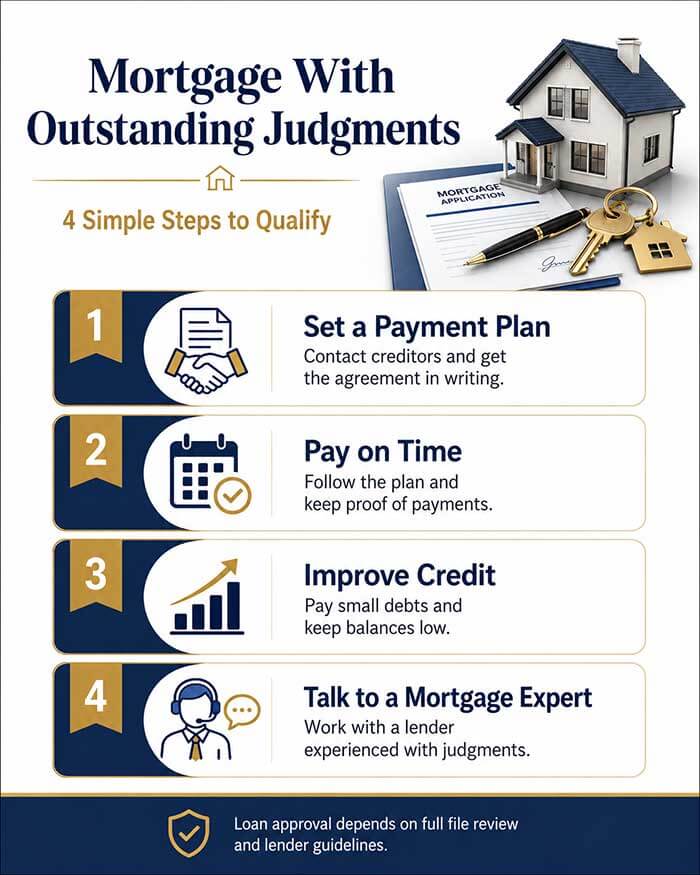
If You Need a Mortgage but Have Court Judgments Against You, Follow These Simple Steps:
Talk to the People You Owe Money:
- Reach out to the folks you owe money because of a court judgment and arrange how you’ll pay them back.
- It’s crucial to write down this plan.
Pay on Time:
- Once you’ve agreed on a payment schedule, pay as promised and keep track of all your payments.
Make Your Credit Better:
- Boost your credit report by clearing smaller debts, making all payments, and not using too much of your available credit.
Get Advice from a Mortgage Expert:
- Find a mortgage broker or officer who can handle cases with outstanding judgments.
- They can show you the right steps to take and help you find banks willing to work with you despite having a mortgage with outstanding judgments.
Following these steps can increase your chances of getting approved for a mortgage with outstanding judgments.
Impact of Judgments on Mortgage Terms
If unpaid court decisions are piling up, it can change the deal you get on your mortgage. Here’s how it shakes out:
- Interest Rates: Your bank might bump your rate because they consider you a bit riskier.
- Loan Amount: You might get less money because now more debt is hanging over you.
- Down Payment: You could have to put more cash down upfront to balance that risk.
So, if you’re looking into getting a mortgage with outstanding judgments, these are some things you might face.
Credit Score Considerations
Your credit score can take a hit if you have judgments against you, making it harder to get approved for a mortgage. Here’s some everyday advice on how to keep your credit in good shape:
- Keep an Eye on Your Credit: Always check your credit report for any mistakes and fix them.
- Lower Your Debt: Pay off what you owe to boost your credit score.
- Avoid Taking on More Debt: Avoid getting new loans or credit cards while you’re trying to get a mortgage with outstanding judgments.
How Can I Get Rid Of Judgment?
Consumers can settle on judgment with the judgment creditor. The older the judgment is, the more likely the judgment creditor will settle. Before consumers give the settlement amount to the judgment creditor, make sure to get a written agreement that states it is a zero balance. Consumers can also try to get the judgment vacated by claiming they were not served correctly. This task is often tough but consumers can give it a try.
Expert Legal and Financial Guidance
If you need more clarification about dealing with a court decision on the money you owe, it’s a good idea to talk to a lawyer who knows a lot about sorting out debts or handling bankruptcy. They can give you advice on what steps to take. Sometimes, declaring bankruptcy might be the best path to clear off judgments and other debts. If you’re thinking about this, speaking with a bankruptcy lawyer can help you determine if it’s the right move for you, especially if you’re dealing with a mortgage with outstanding judgments.
Bankruptcy Will Get Rid Of Most Judgments
Bankruptcy is a debt collector’s worst nightmare. Bankruptcy will wipe out judgments unless the judgment creditor claims a fraud claim. If consumers have multiple judgments, maybe bankruptcy might be the best option. Need to consult a bankruptcy attorney to see if Chapter 7 Bankruptcy is their best option or whether a settlement is.
Enforcing Judgments By Creditors
The creditor has many options on how to go about enforcing the judgment. However, the judgment debtor needs to have assets for the judgment creditor to be able to enforce the judgment. For example, if the judgment creditor finds out the debtor has assets in his or her bank accounts, the creditor can try to go after the assets in the bank account by getting a court order. Consumers with outstanding judgments with no assets or means to pay the judgment are considered judgment-proof. Most judgment creditors will not go after people with little to no assets.
If the judgment creditor finds out the judgment consumer has assets, they can enforce the judgment and go after the assets.
If the judgment creditor has no liquid cash but assets such as cars, jewelry, precious metals, and collectibles, the judgment creditor can try to place the lien on the asset. Borrowers can qualify for a mortgage loan with a judgment on their credit report. If the judgment debtor has no assets, there is nothing a judgment creditor can do to collect. If the judgment debtor has no assets, the debtor is considered judgment-proof, which means uncollectible. In this article, we will discuss and cover mortgage loans with outstanding judgments on credit reports.
Statute of Limitations on Judgments
The statute of limitations is the period where a judgment creditor has to try to collect and enforce the judgment. Judgment is in a consumer’s credit report for seven years from the judgment issue date. The judgment is deleted from the credit report seven years after the judgment issue date.
Just because the judgment is off one’s credit report does not mean the judgment is invalid. Each state has a different statute of limitations on judgments.
Most states have a statute of limitations ten years from the judgment issue date. However, a judgment creditor can renew the judgment for another ten years if the judgment creditor files the right extension paperwork. Most creditors do not renew old judgments—the judgment creditor’s right to renew an old judgment when it nears the statute of limitations period. The only way to get rid of a judgment is by settling with the judgment creditor or filing for bankruptcy.
Yes! You Can Still Buy a Home Even with an Outstanding Judgment
Apply Online And See If You QualifyMortgage With Judgment on Credit Report and Collection Accounts
All collection accounts can turn into potential judgments. If a collection agency gets wind that a person has assets or a good stable income, they may try to pursue suing you and try to get a judgment against them. If borrowers have a collection agency aggressively pursuing them, it may be best for consumers to try to settle with them instead of getting a judgment entered.
Fannie Mae and Freddie Mac, the two mortgage giants in charge of conventional mortgage lending guidelines, have strict lending guidelines regarding judgments.
Borrowers cannot qualify for conventional mortgage with outstanding judgments. All judgments against borrowers need to be paid off or borrowers need to enter into a written payment agreement and make 3 months of payments.
HUD Guidelines on FHA Loan Approval with Outstanding Judgments
The United States Department of Housing and Urban Development, HUD, the parent of the Federal Housing Administration, FHA, will permit home buyers with outstanding judgment on credit to qualify for a mortgage with judgment on credit report. This holds as long as a written payment agreement has been established. Three months of payments have been made to the judgment creditor. Three months of canceled checks need to be provided. Those having an outstanding judgment on credit reports which do not intend to file bankruptcy should set up a written payment agreement with their judgment creditors. They should start making payments if they want to qualify for mortgages.
Final Thoughts on Mortgage with Outstanding Judgments Lending Guidelines
Home Buyers can qualify for a mortgage with outstanding judgments without having to pay it off. However, if one decides to negotiate with the judgment creditor and negotiate the dollar amount owed for clearing the judgment, they need to get a payoff letter of the judgment. The judgment can be paid at the closing of the mortgage. Securing a mortgage with outstanding judgments is often feasible if judgments are managed appropriately. A frequent error is delaying action until underwriting or closing.
How Gustan Cho Associates Helps Borrowers with Judgments
Gustan Cho Associates assists individuals who have been declined by other lenders due to judgments, collections, charge-offs, late payments, bankruptcy, foreclosure, high debt-to-income ratios, or lender overlays. not qualify, even though the real problem is the lender’s stricter overlays.
Gustan Cho Associates reviews your whole file, including the judgment, credit history, income, assets, AUS results, title issues, and loan program options.
The goal is to determine whether the judgment needs to be paid, settled, released, or handled through a valid payment agreement. Early evaluation of the judgment, verification of its effect on the title, assessment of loan program provisions for payment plans, and comprehensive documentation are essential. If one lender denies your application, you may still have options. Denial may result from lender overlays, missing documents, or an unsuitable loan program. Gustan Cho Associates specializes in assisting borrowers with credit challenges and complex mortgage applications.
Get Qualified and Approved for a Home Loan with Mortgage Lenders with No Overlays
Homebuyers who need to qualify for a mortgage with outstanding judgments with a national lender licensed in multiple states with no mortgage overlays can contact us at Gustan Cho Associates at 800-900-8569 or text us for a faster response. Or email us at gcho@gustancho.com. Gustan Cho Associates have helped countless borrowers with outstanding judgments and tax liens. The team at Gustan Cho Associates is available 7 days a week, evenings, weekends, and holidays.
FAQs: Mortgage With Outstanding Judgments Lending Guidelines
Can I get a mortgage if I have outstanding judgments on my credit report?
Yes, getting a mortgage with outstanding judgments on your credit report is possible. However, you’ll need a written payment agreement with the judgment creditor to show that you’ve made consistent payments for at least three months.
What is an outstanding judgment?
An outstanding judgment is a legal decision specifying the sum of money you must pay to a creditor due to unpaid debts. It shows up as a significant negative mark on your credit record and may impact your capability to obtain a mortgage.
How long do judgments stay on my credit report?
Judgments usually stay on your credit report for seven years from the recording date. However, lenders can still uncover them through public record searches even after they have been removed from your credit report.
What do I need to qualify for a mortgage with outstanding judgments?
To qualify for a mortgage with outstanding judgments, you need a written payment agreement with the judgment creditor, proof of consistent payments for at least three months, such as canceled checks or bank statements, and a clear plan to improve your credit score and manage your debt.
What types of loans can I apply for with outstanding judgments?
With outstanding judgments, you can still apply for FHA, VA, or conventional loans under certain conditions. FHA and VA Loans require a payment agreement and consistent payments, while conventional loans have stricter guidelines, requiring resolution of the judgment or a documented payment agreement and history.
How do judgments affect my mortgage terms?
Outstanding judgments can impact your mortgage terms in several ways. They can lead to higher interest rates, as lenders may charge more to offset the risk. Additionally, your borrowing capacity may be reduced, resulting in lower loan amounts being offered. Furthermore, you might need to make a larger down payment.
What steps should I take to improve my chances of getting approved for a mortgage with outstanding judgments?
To improve your chances of getting approved, negotiate a payment plan with your creditors and document it. Make timely payments, improve your credit score, and consult a mortgage professional experienced in handling judgments.
What legal and financial advice should I consider?
t’s crucial to seek guidance from a lawyer specializing in debt settlement or bankruptcy for legal and financial advice. In certain situations, filing for bankruptcy may be the best option to eliminate judgments and other debts. Consulting a bankruptcy attorney is recommended to determine if this approach suits you.
How can I get rid of a judgment?
One approach is to negotiate a settlement with the judgment creditor to get rid of a judgment. Ensure you get a written agreement stating a zero balance. Alternatively, you can attempt to have the judgment vacated by proving improper service. If these options do not apply, filing for bankruptcy can discharge most judgments unless there’s a fraud claim by the creditor.
What is the statute of limitations on judgments?
The statute of limitations varies by state but generally lasts ten years from the judgment’s recorded date. Judgments can be renewed for another ten years if the creditor files the appropriate paperwork.
What happens if I can’t pay a judgment?
If you can’t pay a judgment and have no assets, you might be considered judgment-proof, meaning creditors can’t collect from you. However, judgments can still affect your ability to secure credit and may resurface if your financial situation improves.
How do lenders discover judgments that aren’t on my credit report?
Lenders conduct national public records searches through third-party services like Lexis Nexis or Data Verify, which can reveal judgments not listed on your credit report.
Can I still qualify for a mortgage if I negotiate a judgment settlement?
Yes, you can qualify for a mortgage while negotiating a judgment settlement. Ensure you have a written agreement with the creditor and can show that you’ve made consistent payments.
What should I do if a judgment is about to fall off my credit report?
If a judgment is about to fall off your credit report, disclose it to your loan officer. Lenders will still find it through public records searches, and being upfront can ensure your mortgage application process is completed on time.
Can outstanding judgments affect my chances of getting a loan from all lenders?
Policies vary by lender, but most will consider mortgage with outstanding judgments a significant risk. Government-backed loans like FHA and VA are generally more flexible, while conventional loans have stricter requirements.