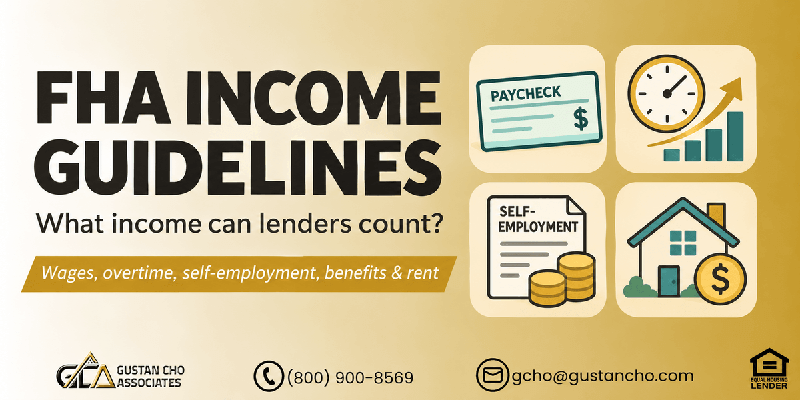
Quick answer: FHA income mortgage guidelines will allow more than just your regular salary to be used in the calculation to determine if you qualify for a mortgage. Salary, hourly wages, overtime, commissions, self-employment, Social Security, child support, and certain types of rental income can all be considered. The issue is how much of each of those streams the lender can verify and use. Fixed pay may be based on your current rate. Variable income will usually require an earnings history and an average. If your income has gone down, the lender will have to take that into account. Your qualifying income may therefore be different to the amount you are currently being paid. An FHA loan doesn’t have one income calculation that applies to every borrower. The lender will identify all of your income, review the documentation, and determine the amount allowable under FHA rules. They’ll then compare that figure to the proposed housing payment and your other monthly debt obligations.
What Does FHA Count as Qualifying Income?
FHA refers to the income that can be used to qualify for a mortgage as “effective income.” The lender must verify the income and apply the rule for that particular source. Receiving money regularly does not, by itself, establish that the full amount can be counted. For example, if your salary is $4,500 a month and your overtime averaged $600 a month over two years but only $350 a month over the past year, the lender generally cannot use the higher overtime average. If the overtime meets FHA’s history and continuation requirements and recent earnings support it, $350 a month may be the usable overtime amount. That would make the combined qualifying income $4,850 a month, subject to the rest of the loan review. This is why a pre-approval should be based on documented income rather than an estimate from a recent strong month.
Salary, Hourly Pay, and Income That Changes Each Pay Period
For a salaried employee whose earnings are consistent and likely to continue, the lender generally uses the current salary. For an hourly employee whose hours do not vary, the current hourly rate and regular hours can generally be used.
When the hours change, FHA generally calls for an average over the previous two years. A documented pay-rate increase may allow the lender to use the most recent 12-month average of hours at the current rate. Multiplying the highest number of hours on a recent pay stub by the new rate would overstate income if that schedule is not typical.
The lender compares current earnings with earlier pay records and looks into any significant difference. A raise can help, but it does not erase the need to document variable hours.
Overtime, Bonuses, Tips, and Commissions
FHA generally allows overtime, bonus, or tip income after two years of receipt when the earnings are reasonably likely to continue. Income received for a shorter period may qualify if it has been earned consistently for at least one year and the lender can support continued receipt. The lender generally uses the lower of the average over the past two years and the actual period received, if shorter, and the average over the past year. A recent decline warrants closer scrutiny, even when the historical average is higher. Commission income has a separate eligibility rule: the borrower generally needs at least one year of commissions in the same or a similar line of work, with earnings reasonably likely to continue. FHA generally calculates qualifying commissions using the lower of the applicable two-year or actual-period average and the previous year’s average. A large commission check does not automatically become a new monthly qualifying amount.
Self-Employment Income
FHA generally considers income from a business in which the borrower owns at least 25% to be self-employment income. Two years of self-employment is the usual benchmark. Income from one to two years of self-employment may be considered if the borrower previously worked for at least two years in the same or a related occupation.
The lender analyzes personal and, when applicable, business tax returns, as well as other required records. It does not simply treat deposits or gross business revenue as the borrower’s monthly income. Allowable adjustments can change the figure shown on a tax return.
If effective business income fell by more than 20% over the analysis period, the lender must document that it has stabilized before using it. The reason for the decline and the more recent earnings matter. A borrower should have current business records ready when the tax returns do not tell the whole story.
Part-Time and Seasonal Work
FHA generally treats a second, part-time job differently from a primary job with a consistent schedule. To use part-time employment income, the borrower generally must have worked the part-time job uninterrupted for the past two years, and the position must be reasonably likely to continue. The lender normally averages the income over two years; a documented increase in pay rate may permit a 12-month average of hours at the current rate. Seasonal work may count when the borrower has worked in the same line of seasonal employment for the previous two years and is reasonably likely to be rehired. The lender looks for a recurring seasonal pattern. Eligible unemployment income associated with that pattern may also be considered when FHA’s separate requirements are met.
Social Security, Pension, and Disability Benefits
Wages are not required if other eligible income is sufficient to cover the mortgage payments. Social Security, certain pensions and retirement distributions, and disability benefits may qualify when the lender verifies the amount and applies the continuation rule for that benefit.
Documentation might include an award or benefit letter, an account statement, and evidence of receipt. An award without a defined expiration date can often establish that benefits are likely to continue.
For disability income, the lender may verify the benefit and any expiration date but must not request information about the nature of the borrower’s disability or medical condition. Retirement distributions require a different review from fixed pension payments. The lender may need to establish that enough funds remain to support the distributions for the required period.
Wondering if Your Income Is Enough to Qualify for an FHA Loan?
Gustan Cho Associates helps borrowers understand FHA income mortgage guidelines, calculate qualifying income, and determine their homebuying potential.Child Support, Alimony, and Maintenance
Child support, alimony, or maintenance may count if the payment terms, receipt, and expected continuation meet FHA requirements. A borrower does not have to disclose these payments as qualifying income if they do not want the lender to use them. With a final divorce decree, separation agreement, or court order, the lender obtains evidence of the most recent three months of payments. If those payments have been consistent, it may use the current amount. For voluntary payments, the lender documents the agreement and 12 months of payment evidence; consistent receipt for the most recent six months can support using the current payment. When payments have been inconsistent, the lender may have to use an average instead. The income claimed must be expected to continue for at least three years.
Rental Income and Rent From a Boarder
Rental income is not always the lease amount. The calculation depends on whether the rent is from the home being financed or another property, and whether the borrower has an established rental history. For eligible rent from the subject property with limited or no rental history since the previous tax filing, FHA generally uses 75% of the lesser of the appraiser-supported market rent and the lease rent. When the borrower has reported the property’s rental income on the tax return, the lender generally reviews Schedule E and applies any permitted adjustments. For another rental property without a recent reported history, the lender generally deducts that property’s principal, interest, taxes, and insurance from 75% of the lesser market or lease rent. Other eligibility and documentation rules also apply, particularly when renting out a home the borrower is leaving. A boarder is someone renting space in the borrower’s home. FHA may consider existing boarder income when the borrower has a 12-month history, received payments in at least nine of those months, is receiving the income now, and has a written agreement showing the boarder’s intent to continue. The usable amount is generally the lower of the 12-month average and the current agreement amount. It cannot exceed 30% of total monthly effective income. Boarder income is distinct from rental income on a separate property.
Other Recurring Income and Nontaxable Income
Interest, dividends, capital gains, trusts, annuities, and note payments can all qualify under their own documentation and continuation rules. A one-off gain or a large account balance in itself is not the equivalent of regular monthly income. Some qualifying income (e.g., child support, part of a Social Security benefit) is exempt from federal income tax. FHA may allow the lender to ‘gross up’ the documented nontaxable portion to reflect the tax savings. The gross-up is not automatically 25%. FHA will generally limit the gross-up to the greater of 15% or the appropriate tax rate (based on the borrower’s prior-year tax rate). If the borrower did not have to file a federal return in the prior year, FHA will generally allow a 15% gross-up. Only income that has been established as nontaxable will be subject to the gross-up.
Job Changes, Gaps, and Falling Income
FHA usually does not require you to have worked for the same employer for two years. Instead, the lender looks at your overall work history and whether your current income is stable. If you have changed jobs more than three times in the past year, or switched to a different type of work, you may need to provide extra proof of stability. However, this does not apply if frequent job changes are common in your field.
For a gap in employment of six months or more, FHA may allow current employment income if the borrower has worked in the current line of work for at least six months, as determined by case number assignment, and has a documented two-year work history before the gap.
Falling income can affect the usable amount even when the borrower has earned that income for years. The lender reviews why it fell, whether the lower level has stabilized, and whether current documents support the amount proposed for qualification.
What Documents Will the Lender Ask For?
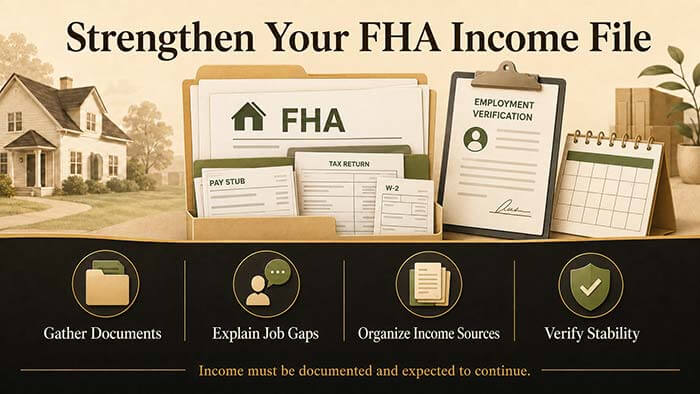
For employment income, you’ll need to provide recent pay stubs showing year-to-date earnings and the records necessary to verify your employment history. The type of records required will vary from file to file, with the lender potentially using W-2s, written or electronic employment verification, or other acceptable forms. The FHA August 2026 Handbook update has clarified the definitions of written, electronic, and reverification of employment. For other income, the lender may require tax returns, business records, benefit letters, bank statements showing receipt of the income, a court order, a boarding agreement, a lease, or an appraisal of market rent. Tax returns will be required in some cases for other income; they are not automatically required from every W-2 borrower just because the loan is FHA. Send the records for each source you’d like counted. If your income has recently changed, an explanation along with the most recent supporting documentation will help the lender determine which figure is usable before you go into the shop for pre-approval.
How FHA Income Affects Your Debt-to-Income Ratio
After calculating effective income, the lender compares it with your proposed housing payment and monthly debt obligations. FHA does not impose one universal 43% total debt-to-income limit on every application. For manual underwriting with a minimum decision credit score of at least 580, FHA’s usual starting ratios are 31% for housing and 43% for total debt. Certain documented compensating factors can permit 37%/47%, or 40%/50% when two eligible factors are present. A 40%/40% option has a separate no-discretionary-debt requirement. With a decision score below 580, or no score, the general manual limit is 31%/43%, subject to the specific exception for eligible energy-efficient homes. An application evaluated through FHA TOTAL follows the applicable automated underwriting process. None of these percentages guarantee approval; the lender must still verify income, debts, and other loan requirements.
FAQs about FHA Income Mortgage Guidelines
Is There a Minimum Salary I have to Earn to be Eligible for an FHA Loan?
There’s no single salary figure that will work for every borrower. The lender decides what amount of documented income it will use and whether that will support the proposed housing payment and your other debts. The amount of the loan, the amount of taxes, the amount of insurance, and your other obligations all factor in.
Can I Combine My Job Income with My Social Security or My Pension?
Yes, if each income stream satisfies its own documentation and continuation requirements. The lender works out each one separately and then adds up the available amounts.
Can I Use My Spouse’s Income if My Spouse is Not Applying?
Generally, the lender will use the borrower(s) ‘ income to service the mortgage. A spouse’s income is not automatically included in your qualifying income just because you live in the same house. You need to ask how adding a co-borrower would affect the full application.
Can Savings Make up for Income that FHA Cannot Use?
Savings may help with the down payment, closing costs, reserves, or an eligible manual-underwriting compensating factor. A bank balance does not automatically become recurring monthly income. The lender still has to calculate usable income under the applicable rules.
Does Being Paid Weekly or Every Two Weeks Change the Rules?
No. The lender converts your verified earnings into a monthly amount for qualification. How often you receive a paycheck does not remove the history or averaging requirements that apply to variable income.
Will a Larger Down Payment Increase My Qualifying Income?
No. A larger down payment might lower the loan amount and monthly payment, but it does not change the way FHA calculates your earnings or benefits.
This article about “FHA Income Mortgage Guidelines: What Counts and How Lenders Calculate It” was updated on November 23rd, 2026.