Many first-time home buyers with student loan debt worry that their student loan debt will prevent them from being approved for a mortgage. Fortunately, having student loan debt does not automatically disqualify you from purchasing a home. What is crucial is how the lender considers your monthly student loan payment when determining your debt-to-income ratio.
A borrower can still qualify for a mortgage with a large student loan balance, as long as their monthly payment meets the loan program’s rules. Different programs, such as FHA, VA, USDA, Fannie Mae, and Freddie Mac, handle student loans differently.
This totally applies if the loan is on hold, in forbearance, on an income-based repayment plan, or if you’re not making any payments at all. Before concluding that you can’t buy a home, it’s wise to review your student loan payment in conjunction with your income, credit score, down payment, and available loan program options. The right mortgage program can greatly benefit first-time home buyers with student loan debt.
Can You Buy a House With Student Loan Debt?
Yes, you can buy a house with student loan debt. Having student loans does not automatically mean a lender will deny your mortgage. Many first-time home buyers with student loans and still get approved for FHA, VA, USDA, conventional, or other home loan programs. What matters most is not always how much you owe in student loans. The bigger issue is the monthly payment the lender must consider when reviewing your debt-to-income ratio. Your debt-to-income ratio compares your monthly debts to your gross monthly income. If the student loan payment fits within the mortgage program rules, you may still qualify. For example, someone may owe $70,000 in student loan debt but only have a $125 monthly payment under an income-driven repayment plan. Another buyer may owe less, but the lender may have to count a higher payment because the loan is deferred or not clearly documented. That is why the monthly payment matters so much. Before you assume you cannot buy a home, first-time home buyers with student loans should have their student loans reviewed by a mortgage lender. The right loan program, the right paperwork, and the right lender can make a big difference.
Why the Monthly Student Loan Payment Matters More Than the Balance
When you apply for a mortgage, the lender is usually more concerned with your monthly student loan payment than the total amount you owe. A large student loan balance can look scary, but the lender wants to know how much that loan costs you each month.
For example, a buyer may owe $90,000 in student loans but only have a $150 monthly payment on an income-driven repayment plan. Another buyer may owe $25,000, but if the payment is not listed clearly or the loan is deferred, the lender may have to count a higher payment. That higher payment can hurt the buyer’s debt-to-income ratio.
Your debt-to-income ratio is one of the key numbers lenders consider. It’s a comparison of your monthly debts to your gross earnings. High monthly debts can make it harder to get approved for the mortgage you want. That is why your student loan paperwork matters. If your payment is low, make sure the lender has proof of that payment. A recent student loan statement or an income-driven repayment document can help the lender calculate the correct amount rather than using a higher estimated payment.
How Mortgage Lenders Count Student Loans
Mortgage lenders count student loans by looking at the monthly payment that must be included in your debt-to-income ratio. If your student loan payment is clearly listed on your credit report, the lender may be able to use that payment. If the payment is not listed, shows $0, is deferred, or is in forbearance, the lender may need extra paperwork from your student loan servicer. This is where loan program rules matter. FHA, VA, USDA, Fannie Mae, and Freddie Mac do not always count student loans the same way. One program may allow the lender to use your actual income-driven payment. Another program may require the lender to calculate a payment based on your student loan balance. That is why two buyers with the same student loan balance can get different results. One buyer may qualify because the lender can document a low monthly payment. Another buyer may have trouble qualifying because the lender has to count a higher payment. Before applying, first-time home buyers with student loans should gather their latest loan statement, repayment plan details, and proof of their required monthly payment. This information helps the lender calculate the correct payment and prevents surprises during underwriting.
FHA Student Loan Guidelines
FHA loans can be a good option for first-time home buyers with student loan debt, especially if they have lower credit scores or a smaller down payment. Student loans do not automatically stop you from getting approved for an FHA loan. The main question is how much of a monthly student loan payment the lender must count toward the loan.
FHA lenders include student loans when they calculate your debt-to-income ratio. If your credit report or student loan statement clearly shows a required monthly payment, the lender may be able to apply it. This can help if you are on an income-driven repayment plan and your payment is lower than a standard student loan payment.
If your student loan payment shows $0, is deferred, is in forbearance, or is not clearly documented, the lender may need to use an FHA-calculated payment instead. That can make your monthly debt look higher on paper, even if you are not making that payment right now. Before applying for an FHA loan, get your most recent student loan statement and proof of your current repayment plan. If you are on an income-driven plan, make sure the lender has documents showing the required monthly payment. The right documentation can help the lender count the correct payment and avoid problems during underwriting.
Fannie Mae Student Loan Guidelines
Fannie Mae can be a good option for first-time home buyers with student loan debt, especially if your student loan payment is low and properly documented. The lender is not only looking at how much you owe. They want to know what monthly payment must be counted in your debt-to-income ratio. If your credit report or student loan paperwork shows a real monthly payment, the lender may be able to use that amount. This can help borrowers on an income-driven repayment plan, as the payment may be much lower than a standard student loan payment. For example, you may owe a large student loan balance, but your income-driven payment may only be $80 or $100 per month. If that payment is documented correctly, it may be easier to qualify than if the lender had to count a higher estimated payment. If your payment shows $0, is deferred, or is unclear, the lender may need additional paperwork before deciding which payment to count. This is why your student loan documents matter. Before applying, get your latest student loan statement and proof of your repayment plan so the lender can review the file correctly. Fannie Mae may not be the best fit for every borrower, but it can help first-time home buyers with student loans when the payment is low, documented, and acceptable under the loan approval system.
Freddie Mac Student Loan Guidelines
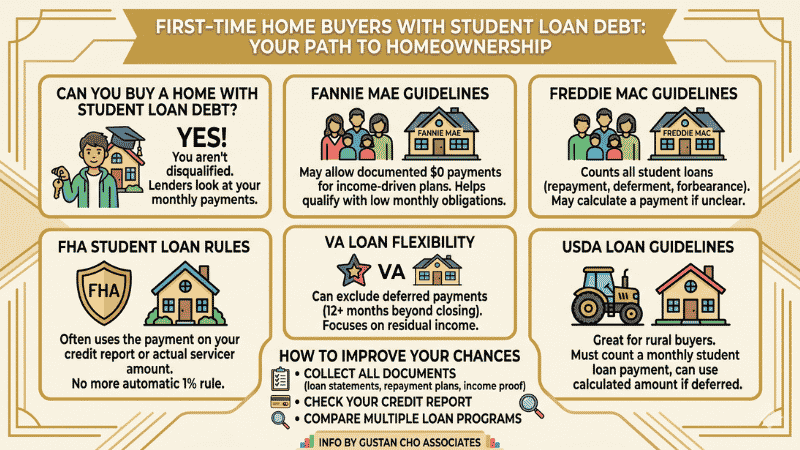
Freddie Mac loans can also work for first-time home buyers with student loan debt, but the lender still has to count the student loan correctly. The lender will review your credit report, student loan statement, and repayment plan to determine the monthly payment for your debt-to-income ratio.
If your student loan has a monthly payment greater than zero, the lender may be able to use that payment if it is properly documented. This can help if you are on an income-driven repayment plan and your required payment is lower than a regular student loan payment.
Freddie Mac is stricter when the student loan payment shows $0, is deferred, is in forbearance, or is not clearly listed. In most cases, the lender still has to rely on a monthly student loan payment. That payment can affect how much mortgage you qualify for. For example, a buyer may owe a large student loan balance but have a low documented payment. That may help the debt-to-income ratio. But if the lender cannot document the payment, the lender may have to use a higher calculated payment instead. First-time home buyers with student loans should gather their most recent student loan statement, repayment plan details, and proof of their required monthly payment before applying for a Freddie Mac loan. Good paperwork can help the lender use the right number and avoid delays during underwriting.
Get Mortgage Ready With Student Loans
A mortgage expert can review your student loan payment, income, credit score, down payment, and loan program options before you start shopping.VA Student Loan Guidelines
VA loans can be a strong option for eligible veterans, active-duty service members, and surviving spouses who have student loan debt. Being first-time home buyers with student loans does not automatically stop you from getting approved for a VA mortgage. The lender still needs to review how the student loan payment affects your monthly debts. VA lenders look at your student loan payment, debt-to-income ratio, and residual income. Residual income is the money left over after your major monthly bills are counted. This is one reason VA loans can be more flexible than other loan programs. A borrower may have a higher debt-to-income ratio and still qualify if there is enough money left over each month. If your student loan is deferred long enough, the lender may not have to count a payment. If the deferment does not last long enough or the payment is not clearly documented, the lender may need to count a monthly payment under VA rules. This is why paperwork is important. Before applying for a VA loan, gather your latest student loan statement, proof of deferment if the loan is deferred, and documents showing your required monthly payment. The lender needs this information to decide whether the student loan must be counted and how it affects your approval. For VA borrowers, student loans are only one part of the approval picture. The lender will also review your income, credit, employment, residual income, and overall ability to handle the new mortgage payment.
USDA Student Loan Guidelines
USDA loans can help first-time home buyers with student loans who want to buy a home in an eligible rural or suburban area. They can be a good option for buyers with limited savings, as USDA loans may allow for no down payment. But if you have student loans, the lender still has to count them when reviewing your mortgage application.
USDA lenders look at the student loan payment that must be included in your debt-to-income ratio. If your credit report or student loan statement clearly shows a monthly payment, the lender may be able to apply it. This can help if you are on an income-driven repayment plan and your required payment is low.
If your student loan is deferred, in forbearance, shows a $0 payment, or does not show a clear payment history, the lender may need to calculate a payment under USDA rules. That calculated payment can make your monthly debts look higher and may affect how much home you can qualify for. This is why it is important to get your student loan paperwork ready before applying. Bring your latest student loan statement, proof of your repayment plan, and any documents that show your required monthly payment. The more clearly the lender can document your student loan payment, the easier it is to review your file correctly. USDA approval also depends on other factors, such as household income limits, property location, credit history, and debt-to-income ratio. Student loans are only one part of the approval process, but they can make a big difference if the payment is not documented properly.
What If Your Student Loan Payment Shows $0?
A $0 student loan payment can help in some cases, but it does not always mean the lender will ignore the student loan. Mortgage lenders still need to know why the payment shows $0 and whether that payment is allowed under the loan program rules. Your student loan may show $0 because it is deferred, in forbearance, paused, or on an income-driven repayment plan. These situations are not always treated the same. Some loan programs may let the lender use the $0 payment if it is properly documented. Other programs may require the lender to count a monthly payment based on the student loan balance. This can make a big difference in your approval. For example, if your student loan shows $0 because you are on an approved income-driven repayment plan, the lender may be able to use that payment if the program allows it. But if the loan shows $0 because it is deferred or not clearly reported, the lender may need to calculate a payment instead. Do not assume a $0 payment means there is nothing to worry about. Before applying for a mortgage, get a current student loan statement and proof of your repayment plan. The lender needs clear documentation to determine whether the $0 payment can be applied or whether another payment must be counted.
Documents You Need Before Applying
If you are first-time home buyers with student loans, get your paperwork ready before you apply for a mortgage. This helps the lender count the right student loan payment and avoid delays during underwriting. Have these documents ready:
- Most recent student loan statement: This should show your loan balance, monthly payment, loan status, and student loan servicer.
- Proof of an income-driven repayment plan: If your payment is based on your income, provide documents showing the required monthly payment amount.
- Deferment or forbearance paperwork: If your student loan is paused, give the lender documents showing when the deferment or forbearance ends.
- Pay stubs and W-2s: These help the lender verify your income and job history.
- Tax returns, if needed: Self-employed borrowers or borrowers with certain income types may need to provide tax returns.
- Bank statements: Lenders use these to confirm your savings, down payment, and closing costs.
- Photo ID: A valid driver’s license, state ID, or passport is usually needed.
- Down payment documents: If your down payment is coming from savings, a gift, a retirement account, or the sale of another property, the lender may need a paper trail.
The more complete your paperwork is upfront, the easier it is for the lender to tell you which loan program may work best. Clear documents can also help prevent last-minute surprises before closing.
Why One Lender May Deny You and Another May Approve You
Not every lender looks at student loans the same way. Two lenders can review the same borrower and arrive at different conclusions. One lender may deny first-time home buyers with student loans, while another may approve them under the right program.
This often happens because of lender overlays. Overlays are additional rules a lender adds to the basic FHA, VA, USDA, Fannie Mae, or Freddie Mac guidelines. The loan program may allow something, but the lender may still say no because their company has stricter rules.
Student loans can also be counted differently depending on the loan program. One lender may use a higher calculated payment. Another lender may be able to use your actual income-driven payment if it is properly documented. That difference can change your debt-to-income ratio and affect your approval. Automated underwriting also matters. FHA, VA, USDA, Fannie Mae, and Freddie Mac each use their own approval systems. A borrower may not get approved through one system but may have a better chance through another program. If one lender denies you, do not assume you cannot buy a home. Ask why you were denied, get a copy of the findings, and have another lender review your student loan payment, credit, income, and loan options. Sometimes the issue is not the borrower. Sometimes it is the lender’s rules.
How To Improve Your Approval Chances With Student Loans
Organize your student loan paperwork before applying to boost your chances of mortgage approval. Do not wait until underwriting asks for it. Have your most recent student loan statement, repayment plan details, and proof of your required monthly payment ready from the start. If you are on an income-driven repayment plan, make sure the payment is clearly documented. A low student loan payment may help your debt-to-income ratio, but the lender needs proof. If the lender cannot document the payment, they may have to count a higher amount. Check your credit report before applying. Make sure your student loan information is reported correctly. If a student loan shows the wrong payment, wrong balance, or wrong status, ask your loan servicer for updated documents. Do not assume the lender can fix the issue without proof. First-time home buyers with student loans should avoid taking on new debt before or during the mortgage process. A new car loan, credit card balance, furniture account, or personal loan can raise your monthly debt and hurt your approval chances. Even a small new payment can matter if your debt-to-income ratio is already tight. It also helps to compare loan programs. FHA, VA, USDA, Fannie Mae, and Freddie Mac may count student loans differently. One program may not work, but another program may give you a better chance. The right lender should review your full file rather than focusing on just one number.
Final Thoughts on First-Time Home Buyers with Student Loans
Student loan debt does not automatically stop you from buying a home. What matters most is how the lender counts your monthly student loan payment, how that payment affects your debt-to-income ratio, and which loan program fits your situation best.
FHA, VA, USDA, Fannie Mae, and Freddie Mac may treat student loans differently. A $0 payment, deferment, forbearance, or income-driven repayment plan can change how the lender reviews your file. That is why the right paperwork matters.
First-time home buyers with student loans should have their student loans, income, credit, and loan options reviewed before getting a mortgage. One lender may deny your file, but another may approve it with the correct guidelines and documentation.
FAQs About First-Time Home Buyers With Student Loan Debt
Should I Switch to an Income-Driven Repayment Plan Before Applying for a Mortgage?
An income-driven repayment plan may help if it lowers the monthly student loan payment the lender must count toward the loan balance. A lower documented payment can improve your debt-to-income ratio. However, you should not change repayment plans without talking to your loan officer first. The lender needs to know whether the new payment can be documented and accepted under the loan program you are using.
Do Student Loans Hurt Your Credit Score When Buying a House?
Student loans do not automatically hurt your credit score. They can even help if they are paid on time because payment history is a major part of credit scoring. Problems can occur if loans are late, in default, or report incorrect information. Before applying for a mortgage, review your credit report and ensure your student loan balances, payments, and statuses are accurate.
Can Late Student Loan Payments Stop Me from Getting a Mortgage?
Late student loan payments can make mortgage approval harder, especially if they are recent. Lenders look closely at your payment history because they want to see that you can handle monthly debt payments. One late payment may not always stop approval, but repeated late payments or defaulted student loans can create bigger problems. The loan program, credit score, time since the late payment, and overall file strength all matter.
Should I Pay Off My Student Loans Before Buying a House?
You do not always need to pay off student loans before buying a house. In some cases, paying them off may help lower your monthly debt. In other cases, using all your savings to pay off student loans can leave you short on down payment, closing costs, or reserves. A lender should compare both options before deciding.
Can Co-Signed Student Loans Affect My Mortgage Approval?
Yes, co-signed student loans can affect mortgage approval if they appear on your credit report. Even if someone else makes the payment, the lender may still count the debt unless the loan program allows it to be excluded with proper proof. If another person has been making the payments, ask your lender what documents are needed before you apply.
Should I Consider Refinancing My Student Loans Before Applying for a Mortgage?
Refinancing student loans before getting a mortgage can either help or hurt you, depending on your situation. It may help if the refinance lowers your monthly payment. It may hurt if it creates a new credit inquiry, changes the loan terms, removes federal student loan protections, or delays your mortgage approval. Talk to a loan officer before refinancing student loans during the home buying process.
Does Student Loan Forgiveness Help with Mortgage Approval?
Student loan forgiveness may help if the balance is officially forgiven and no longer needs to be counted as debt. However, lenders usually need clear documents showing the loan was forgiven, discharged, or paid in full. If forgiveness is only expected in the future, the lender may still have to count the student loan under the mortgage program rules.
Can I Qualify for Down Payment Assistance if I have Student Loans?
Yes, having student loans does not automatically stop you from qualifying for down payment assistance. Each program has its own rules for income limits, credit, property location, loan type, and borrower eligibility. Student loans may still affect your debt-to-income ratio, so the lender must review both the mortgage and assistance programs together.
This article about “First-Time Home Buyers With Student Loan Debts” was updated on June 15th, 2026.