
Buying a home or refinancing should feel exciting—not stressful. Yet for many borrowers, the biggest worry is how long it takes to close a mortgage. At most lenders, the average time is still 30–45 days, which feels like forever when trying to move into your new home or lock in a lower rate.
At Gustan Cho Associates, we’ve built a proven system for closing a home loan in 21 days or less. This means you can go from application to keys in your hand much faster—without mistakes, stress, or unnecessary delays.
In this guide, you’ll learn why fast closings matter, exactly how our 21-day process works, and the steps you can take to speed things up.
Why Closing a Home Loan Quickly Matters in 2026

The 2026 housing market is still competitive. Sellers don’t just care about price—they also care about certainty. When you show you’re capable of closing a home loan in 21 days, your offer instantly stands out because it reduces the risk of the deal falling apart.
For refinances, speed is just as important. Mortgage rates fluctuate daily, and a faster closing ensures you lock in a favorable rate before the market shifts.
Industry Average vs. Gustan Cho Associates
- Traditional banks: 30–45 days to close
- Gustan Cho Associates: 21 days or less for most borrowers
That two-to-three week difference can determine whether you get the home you love—or lose it to a faster buyer.
The Step-by-Step Process for Closing a Home Loan in 21 Days
At GCA, we’ve streamlined the process while keeping it transparent and borrower-friendly. Here’s exactly how we achieve closing a home loan in 21 days:
1. Pre-Approval That Actually Means Approval
We don’t issue flimsy “pre-quals.” Instead, our loan officers complete your full loan application (1003), pull a tri-merge credit report, and review your income, assets, and debts.
Our pre-approvals are signed by an underwriter, which means they carry real weight when making an offer. You’re not just “pre-qualified”—you’re fully credit-approved and ready to move forward.
Note: Final approval always depends on the property (appraisal/title) and standard closing verifications, but an underwriter-reviewed file reduces last-minute surprises.
2. Submitting Documents for Processing
Right away, we collect and review all required paperwork:
- Pay stubs, W-2s, tax returns
- Bank statements (all pages, not just the summary)
- Valid government ID
- Proof of assets, insurance, and any other requested docs
The faster you send documents, the faster we move. Our processors “scrub” the file immediately to make sure nothing is missing, which is critical for closing a home loan in 21 days.
3. Automated Underwriting System (AUS) Findings
AUS results vary by loan type (FHA/VA/Conventional) and your full profile. If AUS returns an approval (like “Approve/Eligible” for many programs), your file typically moves faster. Overlays are extra rules some lenders add on top of FHA/VA/Fannie/Freddie guidelines. We aim to follow agency guidelines where possible.
4. Conditional Approval from Underwriting
An underwriter reviews your file and issues a conditional approval. This means you’re almost done—just a few final items are needed, such as:
- Updated pay stubs
- Verification of insurance
- Explanations for large deposits
We work closely with you to clear these conditions quickly, keeping you on track for closing a home loan in 21 days.
5. Clear to Close (CTC)
Once your loan is “Clear to Close,” we’ll send your Closing Disclosure (CD). After the CD is issued, federal rules require a 3-business-day review period before you can sign your final closing documents.
This doesn’t mean every loan closes in 3 days—it means the CD must be delivered early enough so you have time to review it before signing.
6. Signing & Funding
For purchases, you’ll sign at a title company. For refinances, a notary may come to your home. Your loan is funded and complete after the rescission period (for refis).
Purchases: sign → fund/record → keys.
Refinances: sign → 3-business-day rescission period → fund.
That rescission period is a federal consumer protection rule on most primary-residence refinances, so we build it into the timeline from day one.
Congratulations—you’ve just achieved what most lenders can’t: closing a home loan in 21 days.
Borrower Checklist for Closing a Home Loan in 21 Days
Here’s your borrower-friendly checklist to avoid delays:
- Apply early and get fully pre-approved
- Send requested documents within 24 hours
- Keep your job and income steady
- Avoid opening new credit lines
- Don’t make big purchases before closing
- Respond quickly to the loan officer and processor requests
If you follow these steps, you’ll be all set to close your home loan in just 21 days.
Ready to Close Your Home Loan? We Make It Simple
Let us simplify the closing process and help you move into your new home quickly.
Mistakes That Can Delay Closing a Home Loan
Even with the fastest process, some borrower actions can derail timelines. To keep your closing smooth, avoid these common mistakes:
- Opening new credit cards or loans: Applying for a credit card or loan while seeking a home loan can damage your credit score and raise your debt-to-income ratio. This can raise eyebrows with lenders, slowing your mortgage approval process.
- Depositing cash without documentation: Large cash deposits can be a red flag for lenders, as they need to verify the source of those funds to comply with anti-money laundering regulations. Depositing cash without the right paperwork could cause extra headaches and slow down the closing process.
- Changing jobs or reducing hours: Altering your employment status can create uncertainty for lenders regarding your income stability and future earning potential. A significant job change or a reduction in hours may require further verification, prolonging the closing timeline.
- Co-signing for another person’s loan: If you co-sign a loan while securing your own mortgage, it can increase your debt-to-income ratio. This could negatively affect your loan application and lead to further evaluation, causing delays in your closing.
- Forgetting to disclose debts or obligations: Transparency is crucial in the mortgage process; failing to disclose existing debts or financial obligations can be seen as a red flag. Lenders discovering undisclosed liabilities can lead to additional questions and possibly a reevaluation of your loan, resulting in extended closing times.
One misstep can turn a 21-day closing into a 45-day one.
Why Borrowers Choose Gustan Cho Associates
When you work with GCA, you get speed and a process built to reduce surprises:
- Nationwide lending coverage (ask us to confirm availability in your state)
- Access to a large wholesale network to match more borrower scenarios
- Extended availability (evenings, weekends, and many holidays)
- Same-day file review in many cases, once we have a complete application and documents
- Guideline-focused approach (we aim to follow agency guidelines where possible, without adding unnecessary lender overlays)
Tip: Ask your loan officer for their NMLS ID and licensing details for your state—happy to provide it.
Benefits of Closing a Home Loan with Gustan Cho Associates
When you work with GCA, you get more than just speed:
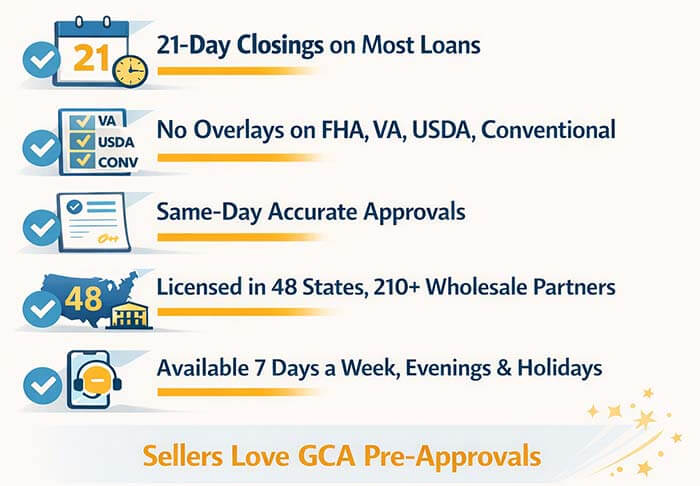
- 21-Day closings on most loan types
- No overlays on FHA, VA, USDA, and conventional
- Same-day a,ccurate approvals signed by underwriters
- Licensed in 48 states with 300 wholesale partners
- Available 7 days a week, evenings & holidays
This combination of speed and flexibility is why sellers love seeing GCA pre-approvals.
2026 Industry Updates That Help Speed Up Closings
Several new developments in 2026 make closing a home loan in 21 days even more realistic:
- Digital income and asset verification tools reduce paperwork delays
- More states now allow remote online notarization (RON)
- Wider acceptance of e-signatures on loan documents
- New FHA & VA rules simplify approvals for borrowers with past financial issues
By leveraging these tools, GCA ensures you close faster and with less stress.
Why Sellers Love Buyers Who Can Close Fast
In a multiple-offer situation, sellers often pick the buyer who can close sooner—even if another offer is slightly higher. Showing that you’re capable of closing a home loan in 21 days makes your offer far more attractive.
For you, that means winning the home you want without overpaying.
Final Word: Closing a Home Loan in 21 Days Is Possible
Closing a mortgage doesn’t have to drag on for months. With the right lender, clear communication, and borrower preparation, you can achieve closing a home loan in 21 days or less.
At Gustan Cho Associates, we make it happen every day—no overlays, delays, or unnecessary stress.
Borrowers who need a five-star national mortgage company licensed in 48 states with no overlays and who are experts on closing a home loan in 21 days, please contact us at 800-900-8569, text us for a faster response, or email us at alex@gustancho.com. The team at Gustan Cho Associates is available 7 days a week, on evenings, weekends, and holidays.
Related> Role of mortgage processor
Related> FHA Loan Requirements
Related> VA Home Loan Benefits
Related> USDA Mortgage Guidelines
Related> How to Rebuild Credit for Mortgage Approval
Related> Mortgage After Bankruptcy
Frequently Asked Questions About Closing a Home Loan in 21 Days:
How Long Does it Take to Close on a House?
Most mortgage-financed purchases typically close in about 30–45 days, but timelines vary based on underwriting, appraisal, title, and how quickly documents are provided.
Can You Close on a House in 21 Days?
Yes—closing a home loan in 21 days is possible when the buyer is fully pre-approved early, documents are submitted fast, the appraisal is scheduled quickly, and title/HOA (if any) are clean. Delays usually come from appraisal, title, or missing paperwork.
What is the Fastest Time to Close on a Mortgage?
Cash deals can sometimes close in 1–2 weeks, while financed deals can be faster than average when the file is fully documented and there are no property/title issues.
What Does “Closing” on a Home Mean?
Closing is the last step where you sign all the papers, the money gets handed over, the ownership changes (if you’re buying), and the loan kicks in.
What Happens on Closing Day?
You’ll review and sign key documents (such as the Closing Disclosure, promissory note, and deed paperwork), provide closing funds (by wire/cashier’s check), and receive keys, based on your contract terms and funding/recording timelines.
How Much are Typical Closing Costs?
Closing costs often run about 2%–5% of the purchase price, depending on loan fees, title, appraisal, escrow items, and local taxes/insurance.
How Far in Advance Will I Know My Closing Date?
The closing date is usually set in the purchase agreement, but it can be delayed if financing, repairs, appraisal, or title clearance take longer than expected.
What are the Most Common Reasons a Closing Gets Delayed?
Big culprits include low appraisals, title problems (liens/ownership issues), financing or underwriting delays, missing documents, and unmet contingencies (repairs, inspections).
What Documents Do I Need to Close Faster?
Standard items include pay stubs, W-2s/1099s, tax returns (if required), bank statements (all pages), ID, proof of insurance, and source documentation for large deposits. The faster you upload them, the faster underwriting can clear conditions.
What Can I Do to Help Ensure a Fast Closing?
To keep closing a home loan in 21 days on track: respond to document requests within 24 hours, avoid new credit/debt, don’t change jobs, keep funds sourced/seasoned when possible, and schedule appraisal/inspection quickly once under contract.
This article about “Closing a Home Loan in 21 Days: Guide to Fast Closings” was updated on February 5th, 2026.
Closing Your Home Loan Just Got Easier
No surprises—just clear steps and fast closing. Let’s make homeownership a reality for you.