This blog post focuses on Fannie Mae 5-10 Financed Properties, which is particularly beneficial for real estate investors. The 2008 Real Estate and Mortgage meltdown led to significant changes within the mortgage industry. One positive development is the return of non-QM loans. These allow homebuyers to secure financing through non-QM stated income and no-doc mortgage loans.
Find out about Fannie Mae 5-10 financed properties mortgage guidelines concerning the number of properties, reserve requirements, underwriting criteria, and how to qualify.
Fannie Mae has introduced updated lending guidelines for 5-10 Financed Properties. While the conventional lending guidelines still apply to investors with up to four financed properties, those holding more than four must adhere to the specific guidelines for 5-10 financed properties. In the following paragraphs, we will cover Fannie Mae 5-10 Financed Properties.
Mortgage Instructions for Financed Properties 5-10 Fannie Mae
Most borrowers who own multiple properties assume they are limited to conventional financing for four financed properties. Fannie Mae guidelines allow qualified borrowers to finance up to 10 residential one- to four-unit properties, but as the number of properties financed increases, the rules become more restrictive. The most common issues are related to how financed properties are counted, how much reserve money is required, if the property is a second home or investment property, and if the loan receives an eligible Desktop Underwriter decision.
Currently, Fannie Mae allows second homes and investment properties, up to 10 financed properties in DU, while there is no limit on financed properties for principal residence transactions that are not HomeReady and are not subject to DU.
Because of one reporting mistake, it is relatively easy to change the financed property count, increase reserve requirements, or make a loan ineligible, which is a material issue for borrowers and real estate investors. The borrower would perceive that they own four financed properties, whereas Desktop Underwriter would treat the borrower as having five or more financed properties based on the loan application, REO section, HELOC disclosures, or credit report.
What is the Maximum Number of Financed Properties for Fannie Mae?
Following the collapse of the real estate and credit markets, Fannie Mae initially capped financed properties at four, which included the homeowner’s principal residence. Subsequently, Fannie Mae revised this policy, allowing homeowners to finance up to 10 properties. Dale Elenteny, a senior mortgage loan originator at Gustan Cho Associates says the following:
The time a borrower takes to learn the Fannie Mae 5-10 financed properties mortgage guidelines is well invested. This avoids wasted time and unexpected outcomes and enhances the chances of getting a loan approved.
However, not all lenders offer Fannie Mae 5-10 Financed Properties loans. This mortgage market segment is considered a niche, with only a select group of lenders actively promoting these specialized loan programs.
Financing 5 or More Properties at The Same Time

Fannie Mae 5-10 Financed Properties Explained
Most people searching for Fannie Mae 5-10 financed properties are trying to learn about the possibilities of accessing a conventional loan after creating a significant real estate portfolio. In simpler terms, the query describes an individual who has numerous financed residential properties and is looking to either buy or refinance another one, in accordance with Fannie Mae guidelines. As outlined in the Fannie Mae Selling Guide, an underwriter using DU has a limit of 10 financed properties, including investment and second-home properties.
Importance Of The Guidelines For Real Estate Investors
The significance of this guideline is that many real estate owners transition from basic single- or dual-home ownership to a more complex financing setup after acquiring additional rental properties, a second home, or both. With an accumulation of financed properties, the reserve requirements become increasingly stringent. For 7 to 10 financed properties, Fannie Mae’s guidelines stipulate a higher reserve requirement for the remaining financed properties, contingent upon DU.
Own 5 to 10 Properties? You Can Still Get Financing
Fannie Mae allows qualified investors to finance up to 10 properties—don’t let outdated limits hold you back. Check Your Eligibility for the 5-10 Property Loan Program Today!Underwriting Fannie Mae 5-10 Financed Properties Mortgages
Numerous banks and credit unions tend to refrain from engaging with Fannie Mae 5-10 Financed Properties because the processing and underwriting of these mortgage loans are notably intricate and time-intensive.
Even though the borrower is personally liable for them, Fannie Mae states that certain types of properties are not subject to these financing restrictions.
In contrast, standard loans such as those for owner-occupied homes, second homes, and investment properties, typically known as simpler mortgage types, are processed more swiftly and straightforwardly, including handling personal and business tax returns.
Regarding 5 to 6 financed properties
If the borrower has 5 to 6 financed properties, Fannie Mae requires that an additional reserve equal to 4% of the total unpaid principal balance on the other financed properties be set aside. This reserve requirement can be substantial for borrowers with many leveraged properties.
Regarding 7 to 10 financed properties
Where a borrower has 7 to 10 financed properties, Fannie Mae requires setting aside 6% of the total unpaid principal balance on other financed properties, and this category is specifically DU. Essentially, this means that borrowers with more properties are generally required to have better liquidity and a more organized documentation process than those with fewer financed properties.
Importance of Personal Liability
Personal liability is a key stress point for most of these guidelines. If, for example, a borrower holds an investment property through an LLC and is not personally liable for the mortgage, then that investment property will not count in the financed property count. An example is given in the Fannie Mae Selling Guide where a borrower had investment properties that were financed and held in an LLC, and those properties were not considered because the borrower was not liable for the underlying debt.
Properties That Count Toward The Financed Property Limit
Fannie Mae considers financed one- to four-unit residential properties for which the borrower is personally liable, even if the monthly housing expense is excluded from the debt-to-income ratio.
It also relies on the cumulative count of all co-borrowers on the loan, though co-financed properties are counted only once. This means the count of financed properties could increase faster than borrowers anticipate.
Properties that generally do not count. These include timeshares, commercial real estate, vacant lots, and Leasehold estates of manufactured homes not titled as real estate. These distinctions are important, as many investors hold mixed holdings, and not every financed real estate holding is counted.
Counting Financed Properties: Fannie Mae Guidelines
The most common area of confusion in this subject is the counting method. Fannie Mae looks at the total number of financed one to four-unit residential properties that a borrower is personally liable for, including the subject property, and it is not a simple numerical count of how many addresses a borrower owns. It looks to see if the borrower has a financed principal residence, as that is also counted. A multi-unit residential property, for example, a two-unit property, is regarded as one financed property, not two.
Number of Properties Financed
Depending on the loan program and type of occupancy, Fannie Mae would also have an upper limit on the number of financed properties. For example, for a primary residence that is not HomeReady, there is no limit on the number of financed properties. For a HomeReady primary residence loan, the borrower can only have up to two financed properties.
For investment properties and second homes, the limit is 10 financed properties, provided they are processed through automated underwriting (DU).
High LTV refinance loans are unique in that they are not subject to the multiple-financed-property policy. This explains why many customers seeking Fannie Mae 5-10 financed property mortgage guidelines are interested in financing investment properties and secondary homes rather than traditional owner-occupied primary residences. The number of financed properties directly impacts eligibility when the property in question is an investment property or a second home.
Verification of Mortgage During Mortgage Process
For Fannie Mae 5-10 Financed Properties, it’s essential to conduct thorough mortgage verification for each property the real estate investor owns. This includes validating all property tax information and ensuring payment compliance for each property. Additionally, all lease agreements across the properties must be verified. Moreover, the credit and financial profiles of the mortgage loan applicant, including those of any partners and the properties themselves, must also be comprehensively assessed to ensure eligibility and financial stability under the Fannie Mae 5-10 Financed Properties program.
Financing an Investment Home Versus an Owner-Occupant House
Securing approval for a mortgage can be time-consuming and costly. Banks, credit unions, and most other lenders consider financing investment properties through programs like Fannie Mae 5-10 Financed Properties to be high-risk. The mortgage application, particularly for Fannie Mae 5-10 Financed Properties, undergoes rigorous and meticulous scrutiny during underwriting. Consequently, they take extra precautions to ensure that the application is error-free.
Income Docs Required To Start Mortgage Process
Traditional mortgage loans require two years of W-2s, two years of tax returns, and recent paycheck stubs. Real estate investors with four or more financed properties, lenders require and underwrite every property schedule on the following: Real Estate Owned Schedules.
Reserve Requirements for 5-10 Financed Properties
Reserve requirements are among the biggest concerns, as they affect many borrowers, even those who appear to qualify on paper. Fannie Mae requires borrowers who already own multiple financed properties to provide additional reserves, regardless of whether the current loan is for a second home or an investment property. The reserves are based on properties financed other than the subject property and the borrower’s primary residence.
Reserve Calculation
Fannie Mae employs a unique formula to determine additional reserves, which is a percentage of the aggregate unpaid principal balance on mortgages and HELOCs associated with the other financed properties. The total UPB excludes the subject property, the borrower’s primary dwelling, properties that are already sold, in the process of being sold, or accounts that will be paid off at closing or are excluded in DUP under the online loan application.
What Are Fannie Mae Guidelines For Financed Properties?
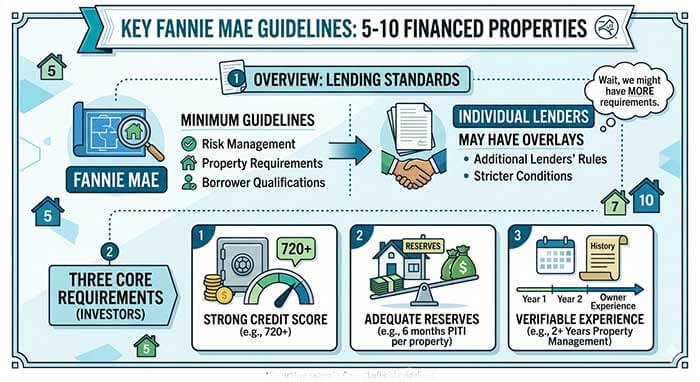 There are two mortgage lending guidelines for 5-10 Financed Properties. Have Fannie Mae’s minimum guidelines, and you have the individual mortgage lenders’ overlays. We will discuss Fannie Mae’s minimum lending guidelines on 5-10 Financed Properties. Fannie Mae’s guidelines for financed properties, especially for borrowers who own multiple properties, include a variety of requirements and stipulations designed to manage risk. Here are some of the key guidelines for investors looking to finance multiple properties through Fannie Mae:
Credit Score and Underwriting Considerations
Fannie Mae does not have 5-10 financed properties. If such a situation arises, what is the minimum credit score threshold? What’s the bottom line? Less than that. Manually underwritten fixed-rate loan guidelines suggest 620 for Fannie Mae and 640 for ARMs, with no singular minimum for DU case files, as DU considers risk assessment. The Selling Guide, on the other hand, directs lenders to the Eligibility Matrix for credit score requirements on manually underwritten loans on a case-by-case basis.
Importance of Desktop Underwriter
DU plays a crucial role in defining policy for multiple-financed properties, including second homes and investment properties. Specifically, Fannie Mae points out that for second-home or investment property deals, DU allows up to 10 financed properties, and the second-home property must be underwritten in DU and receive an Approve/Eligible recommendation, with a few exceptions for specific high-LTV refinance loans. This indicates that for higher property counts, borrowers shouldn’t assume that a great credit score will address everything. DU findings, accurate REO data, appropriate reserves, and proper occupancy classification are all crucial.
Number of Properties:
- Fannie Mae allows a borrower to have up to 10 financed properties, including the borrower’s primary residence and any refinanced mortgages.
Credit Score Requirements:
- Borrowers generally need a higher credit score to finance more than four properties. The minimum credit score requirement is often 720 or higher.
Reserve Requirements:
- For properties numbered 5 through 10, borrowers must typically have reserves equal to 6 months of the new mortgage payment (including principal, interest, taxes, insurance, and any association dues) for each property financed. This is in addition to reserve requirements for the borrower’s primary residence and other properties.
Down Payment:
- The down payment requirements are usually higher when financing multiple properties. For single-family investment properties, a down payment of at least 20% is generally required, and this percentage can increase depending on the number of properties owned and the borrower’s specific circumstances.
Loan-to-Value (LTV) Ratios:
- More conservative LTV ratios are applied for borrowers with multiple financed properties. Lower LTV limits help mitigate the additional risk of lending to investors with several mortgages.
Underwriting:
- The underwriting process for borrowers with multiple financed properties is more stringent. Lenders might ask for more paperwork to confirm that the borrower can handle extra debt. This documentation could include evidence of rental income from other properties.
Documentation:
- Borrowers must provide extensive documentation when financing multiple properties. This includes tax returns, lease agreements for rental properties, and a detailed list of all owned properties and their associated mortgages and expenses.
These guidelines are in place to ensure that investors are financially stable and capable of managing the debt associated with multiple financed properties. Borrowers should consult with lenders or financial advisors to understand fully how these requirements might apply to their situation.
Investor with 5+ Homes? Fannie Mae Has You Covered
Don’t get turned away just because you own multiple properties. Apply Now and Grow Your Real Estate Portfolio!Fannie Mae 5-10 Financed Properties Down Payment Requirements
The minimum down payment is 25% on any properties between 5 to 10 financed properties that are one unit. The minimum down payment required for 2 to 4-unit properties is a 30% down payment. The borrower applying for Fannie Mae 5-10 Financed Properties must have a minimum credit score of 720. Borrowers cannot have any mortgage late payment history in the past 12 months. Many lenders may extend this requirement as part of their overlays. Some lenders do not want to see any late mortgage payments, period.
Fannie Mae 5-10 Financed Properties Credit Guidelines of Borrowers
5-10 properties borrowers cannot have had any foreclosures, deeds in lieu of foreclosures, short sales, or bankruptcies in the past seven years. Two years of tax returns and rental income are listed on all schedules for the past two years. Six months of reserves which consist of principal, interest, taxes, and insurance for every property, including the primary home, is required for all financed properties.
What is the Minimum Loan Amount for Fannie Mae?
Fannie Mae does not set a specific minimum loan amount for most conventional mortgages it purchases. However, lenders may set their minimums based on their policies or the practicality of servicing smaller loan amounts. These minimums vary by lender and may depend on property type, location, and the borrower’s creditworthiness.
For smaller loans, Fannie Mae has a specific program called the “Small Loan Program,” which is designed for multifamily mortgage loans.
This program specifically targets loans under $6 million (or under $3 million in some markets), catering to smaller multifamily properties. If you’re considering a loan that might be lower than what typical mortgage lenders prefer, it’s a good idea to discuss the possibilities with potential lenders to determine their specific minimums and requirements.
Fannie Mae Multiple Property Guidelines for Second Homes
Misclassification of occupancy as an investment property rather than a second home can lead to serious complications. Per Fannie Mae, for a home to be classified as a second home, the home must be occupied by the borrower for part of the calendar year, must be a single-unit dwelling, must be suitable for year-round occupancy, must be of exclusive use to the borrower, and must not be a rental or a timeshare. Additionally, the home must not be bound by contracts that permit a management company to control occupancy.
Standards For Occupancy Of Second Homes
This is particularly important, as it is not uncommon for a borrower to take a property as a second home when, in fact, it resembles an investment property. Fannie Mae confirms that a second home can still be classified as a second home even when the lender has reported rental income associated with the property. However, that income cannot be included for qualifying purposes, and the second-home stipulations must still be adhered to.
Rules for Investment Properties for Borrowers with 5-10 Financed Properties
In most cases, properties that fall in this category of financed properties, such as investment properties, are where the count of properties financed becomes crucial.
Fannie Mae will use the number of financed properties to determine eligibility, assess reserve requirements, and assess policy fit for the transaction.
This could entail the borrower having a financed primary home, a financed second home, and a bunch of financed rental properties. After this new property becomes an investment property, the reserve and underwriting requirements can be very stringent.
Cash Flow And Qualification Challenges For Investment Properties
Borrowers with multiple properties should expect scrutiny of the REO schedule, mortgage liabilities, HELOC balances, rental income documentation, and any other relevant information. Fannie Mae instructs lenders to utilize other real estate owned and rental income policies when assessing the overall loan file. While the exact impact on qualification is file-dependent, the general principle here is clear: ownership of multiple properties typically results in additional documentation, increased scrutiny, and diminished tolerance for mistakes.
Common Errors That Could Result in Decline
The most frequent errors on Fannie Mae 5-10 financed properties loans are, in fact, not related to credit. They are typically related to data entry or misclassification issues, leading DU to determine an incorrect count of financed properties.
REO Section Of The Loan Application Issues
According to Fannie Mae, DU may identify the number of financed properties from the Number of Financed Properties field, the REO section, the application, or the credit report. If the data is erroneous, the lender must correct it and resubmit the case file.
Properties Owned by LLCs
Many borrowers assume that all properties owned by an LLC count against them. It depends on whether the borrower is personally liable on the loan. If the borrower is not liable, the property is not counted the same way under Fannie Mae’s financed property count. Confusion Between a Vacant Lot or Commercial Property and a Financed Counted Property It is a common misconception that all financed real estate assets and properties are counted. Fannie Mae explicitly states that vacant lots and commercial real estate are excluded.
Fannie Mae Financing with Multiple Properties
For borrowers with 5 to 10 financed properties, a more organized, cleaner file is expected. The most justified way is to clarify the count of financed one to four-unit residential properties where the borrower is personally liable, validate how the subject property will be categorized, ensure accuracy in all REO details, and document sufficient post-closing assets to meet reserve requirements. Approval hinges on these factors.
Strengthening The Mortgage File
Optimizing the mortgage file for this type of transaction requires accurate REO reporting, a clear explanation for the entity-owned properties, confirmed liquid reserves, and a genuine assessment of whether the property is, in fact, a second home or an investment property. The assessment is further complicated by the fact that DU, in its calculation of financed properties, relies on application data, REO data, mortgage disclosures, and, in some instances, the credit report.
Situations When a Borrower Should Explore Alternate Loan Opportunities
Not all borrowers with a sizeable portfolio can be easily accommodated by Fannie Mae guidelines. There are borrowers with considerable rental cash flow, but who lack personal liquidity. There are also those who hold properties through multiple entity layers, or who don’t meet the conventional documentation requirements.
In such circumstances, an alternative conventional approach or a non-agency option may be more suitable. This shouldn’t be interpreted as removing Fannie Mae’s options for borrowers with multiple properties.
Rather, the borrower needs to analyze the guideline’s compatibility before automatically assuming that a standard-conforming loan will be applicable. This has to do with how stringent Fannie Mae becomes with financed property count, reserve, and DU eligibility requirements as the portfolio increases.
Final Thoughts on Fannie Mae 5-10 Financed Properties Mortgage Guidelines
Fannie Mae does allow financing for borrowers with five to 10 financed properties, but these are not simple cookie-cutter loans. The subject property type matters. The financed property count method matters.
Reserve requirements matter. DU findings matter. And the difference between personal liability and business ownership can matter more than many borrowers realize.
Under the current Selling Guide, second homes and investment properties can go to 10 financed properties in DU, while reserve requirements rise to 4% for five to six financed properties and 6% for seven to 10 financed properties on the counted financed-property balances.
FAQ About Fannie Mae 5-10 Financed Properties Mortgage Guidelines
How Many Financed Properties Does Fannie Mae Allow?
Fannie Mae allows up to 10 financed properties for second home and investment property transactions underwritten through DU. For a principal residence that is not HomeReady, there is no financed property limit. HomeReady principal residence loans are limited to two financed properties.
Does Fannie Mae Count My Primary Residence In The Financed Property Total?
Yes. If your principal residence is financed, Fannie Mae includes it in the financed property count.
Do LLC-Owned Rental Properties Count Toward The 5-10 Financed Properties Limit?
They can, but not always. Fannie Mae focuses on whether the borrower is personally obligated on the mortgage. If the property is owned by an LLC and the borrower is not personally obligated on the mortgage debt, it may not be included in the financed property count.
How Much Reserves Do I Need With 5 To 10 Financed Properties?
For second home or investment property transactions, Fannie Mae requires additional reserves based on the aggregate unpaid principal balance of other financed properties. The reserve requirement is 4% for five to six financed properties and 6% for seven to 10 financed properties.
Can I Buy A Second Home With Multiple Financed Properties?
Yes, if the loan meets Fannie Mae’s second home rules and is underwritten through DU. The property must generally be a one-unit home, suitable for year-round occupancy, under the borrower’s exclusive control, and not a timeshare or rental property for qualification purposes.
What Properties Do Not Count Toward Fannie Mae’s Multiple Financed Property Limit?
Commercial real estate, multifamily properties with more than four units, timeshares, vacant lots, and certain manufactured homes not titled as real property are not subject to these financed property limitations.
What Is The Maximum Number Of Financed Properties Fannie Mae Allows?
Fannie Mae permits real estate investors to finance up to 10 properties, including their primary residence and refinanced properties.
What Are The Key Lending Guidelines For Properties Financed Through Fannie Mae?
Standard investment lending guidelines apply to up to 4 financed properties. For properties 5 through 10, borrowers must meet more stringent requirements, including higher credit scores, larger down payments, and sufficient reserve funds.
What Are The Reserve Requirements For Financing Multiple Properties?
Borrowers need reserves equal to 6 months of the mortgage payment (including taxes, insurance, and dues) for each financed property numbered 5 through 10.
How Much Is The Down Payment For Fannie Mae’s 5-10 Financed Properties?
The minimum down payment for single-family investment properties is 25% for properties 5 through 10 if they are one-unit. For two- to four-unit properties, a 30% down payment is required.
Can I Qualify For A Fannie Mae 5-10 Financed Property With A Previous Foreclosure Or Bankruptcy?
Borrowers seeking financing on 5-10 properties must have a clean record with no foreclosures, short sales, bankruptcies, or deeds instead of foreclosures in the past seven years.
What Is The Minimum Loan Amount For Fannie Mae?
Fannie Mae does not have a specified minimum loan amount for most conventional mortgages, but this can vary by lender. The “Small Loan Program” targets multifamily loans under $6 million.
How Can I Apply For A Fannie Mae 5-10 Financed Property Loan?
Prospective borrowers should contact participating lenders who offer the Fannie Mae 5-10 financed property loans, as not all lenders participate in this niche market.
These FAQs provide a brief overview of the requirements and procedures for real estate investors looking to finance multiple properties through Fannie Mae. For detailed advice and application processes, consulting directly with qualified lenders or financial advisors is recommended.
This Guide About Fannie Mae 5-10 Financed Properties Mortgage Guidelines Was Updated On April 9, 2026.