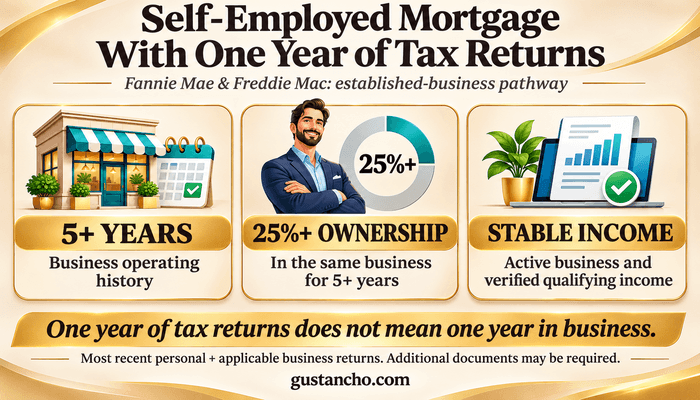
Quick answer: A self-employed mortgage with one-year tax returns may be available via Fannie Mae or Freddie Mac for an established business. Under their 5-year documentation route, the borrower would need to have the requisite ownership history in the same business. The lender will still review qualifying income, business stability, and supporting documentation. A borrower with a shorter self-employment history may be eligible under different rules, so one year of tax return documentation should not be equated with one year in business.
One Year of Tax Returns vs. One Year of Self-Employment
A business owner may have worked for themselves for many years while providing only the most recent required year of tax returns for a mortgage. The established-business rules below address that situation. A borrower who recently became self-employed presents a different question: whether the lender can use income from a business with less than a two-year history. That requires a separate review of tax-return income and prior employment. The age of the business, the borrower’s ownership history, and the period covered by the returns are related requirements but not interchangeable.
Fannie Mae One-Year Tax Return Requirements
Fannie Mae’s self-employed borrower guidelines permit one year of personal and applicable business federal tax returns when the business has existed for at least five years. The borrower has owned 25% or more for the previous five consecutive years. The lender must support that history with the application, tax returns, and other reliable records when needed. Each business is evaluated separately. A written cash-flow analysis is still required to establish usable income.
Freddie Mac One-Year Tax Return Requirements
Freddie Mac Guide Section 5304.1 also provides a one-year tax-return documentation pathway when the business has existed for at least five years. The borrower has been self-employed in that same business with at least 25% ownership for at least five years. The required returns depend on how the business reports its income. Supporting records and an income calculation remain part of the underwriting process. Files outside the five-year pathway generally require two years of returns, subject to the separate rules for shorter self-employment histories. A strong credit profile or favorable automated underwriting findings do not replace these requirements.
How to Prove Business Age and Ownership History
Business formation and personal ownership can begin on different dates. A company may have operated for ten years even though the borrower bought into it only two years ago.
For example, if a borrower bought a 30% share in an established company two years ago, the company’s long history does not count as five years of qualifying ownership for that borrower. In this case, the lender should look for another way to document ownership.
Depending on the agency and the business, supporting records can include business licenses, formation documents, partnership agreements, ownership transfer records, and tax records. A formation document shows when the company was formed, but it does not prove when the borrower received their share. The records should match the business listed on the mortgage application and show the required ownership period.
Which Tax Returns and Supporting Documents Are Needed?
 One year of tax returns still means a complete mortgage file. When preparing for a review with Gustan Cho Associates, a mortgage broker, gather the records that establish both income and ownership. The lender may request:
- The most recent required personal federal tax return, with all applicable schedules and forms.
- Applicable business returns, K-1s, and related income documents.
- Evidence of ownership percentage and the required business and ownership history.
- Verification that the business remains active.
- Current financial statements or other supporting records when needed to evaluate income stability.
Partnerships and corporations may require separate business returns. An LLC’s name alone does not establish which return applies; its tax treatment matters. The underwriter determines the documents required for the particular income source.
Which Tax Year Can You Use?
Borrowers cannot choose an older return simply because it shows more income. The file must meet the agency’s requirements for the most recent returns and their age. Filing extensions and the application or closing date can affect the documentation required. Freddie Mac’s tax-return documentation rules explain these timing requirements. Also distinguish the number of returns collected from the income period used in the calculation. A lender may request additional records to resolve questions even when a one-year documentation pathway applies.
Self-Employed With One Year of Tax Returns?
Some mortgage programs may allow one year of tax returns when specific eligibility and documentation requirements are met. Review your income history and potential options with Gustan Cho Associates.What If You Own More Than One Business?
Eligibility for one-year documentation must be evaluated for each business whose self-employment income is being used. One established business may qualify, while another may require a longer documentation period. For example, a borrower who’s had Business A for eight years and started Business B two years ago should not assume that the same documentation applies to both businesses. Disclosed business losses can also impact qualifying income (depending on the agency’s rules and whether that income is being used). You should let the loan officer know about all your ownership interests from the outset so the file can be properly evaluated.
How One Year of Returns Becomes Mortgage Qualifying Income
After looking over your tax returns and making allowed adjustments, the lender figures out how much income you can use to qualify for the mortgage. Gross sales, bank deposits, and money you move to your personal account do not automatically count as qualifying income. Some deductions might be added back, but not all of them qualify. If you have a partnership or S corporation, the income shown on a K-1 is not the same as cash distributions. The lender may also look at whether you can actually access the income and if the business can keep making those payments.
Hypothetical Monthly Income Example
Assume a sole proprietor meets the one-year documentation requirements. After reviewing the return and making the permitted adjustments, the underwriter determines that supported annual qualifying income is $96,000. Dividing that amount by 12 produces $8,000 in monthly income for the mortgage calculation. The $96,000 figure in this illustration is the result of underwriting analysis. It is not gross revenue or a number the borrower can select from the return. The lender must also confirm that current business performance supports the income being used. See our business cash-flow analysis guide for additional background.
What Happens if Current Income Is Declining?
Meeting the ownership history requirement in no way resolves an income decline. The lender may require current P&L statements, business bank statements, explanations, and so on to determine whether the business has stabilized in terms of earnings. A decline can result in reduced usable income or make it unsuitable for qualification. A further return won’t necessarily fix that. You need to tell the loan officer about any significant changes to your revenue, your expenses, or your business as a whole before relying on an income estimate.
Can You Qualify With Less Than Two Years of Self-Employment?
Some borrowers can qualify with a shorter self-employment history, but the agency requirements differ from the five-year documentation pathways above. For Fannie Mae, the most recent signed personal and applicable business returns must reflect a full 12 months of income from the current business. The lender must document prior income at the same level or at a higher level in a qualifying related field or occupation with similar responsibilities. Experience and business debt also require consideration. Freddie Mac requires supporting documentation of income stability and a combined two-year income history from the current self-employment and prior employment in the same or a similar occupation or industry. Qualifying income uses the lesser of stable monthly income from the new business or the prior occupation, with a written analysis supporting the determination. The returns must reflect at least one year of self-employment income. An electrician transitioning from an employee role to their own contracting business may have relevant continuity. That experience alone does not establish eligibility; the returns, income levels, and other requirements still need to be reviewed.
Alternatives When the Conventional One-Year Option Does Not Fit
If the five-year option does not fit your situation, the lender might look at two years of tax returns or use rules for a shorter history. FHA, VA, and USDA loans each have their own self-employment requirements. You can find more details about these programs in our self-employed mortgage overview. Some non-QM programs for self-employed borrowers use different tax-return or alternative documentation options. If your tax-return income is too low, you might want to look at a bank statement mortgage as well. Each lender and investor has their own requirements, ways of calculating income, pricing, and terms, so you should not assume the conventional five-year rules apply to these products.
FAQs About Self-Employed Mortgage With One-Year Tax Returns
Do I Need a Separate Business Tax Return if I File Schedule C?
A sole proprietor’s Schedule C is part of the individual federal return, so there generally is no separate business return for that sole proprietorship. The lender still needs the complete required individual return and applicable supporting records. Other entities may have separate business filing requirements.
Can I Use Only W-2s if My Own Company Pays Me a Salary?
Receiving W-2 wages from a company you own does not automatically make you an ordinary wage-earner for underwriting. A borrower with at least 25% ownership is generally treated as self-employed, and the lender must evaluate the applicable business-income documentation requirements.
Does Changing from a Sole Proprietorship to an S Corporation Restart My Business History?
It doesn’t automatically restart the history under Freddie Mac’s rules. You’d have to combine the prior and current structures. To do that, the ownership % would have to be the same, and there would be no other known changes (in product, service, or location). There would have to be no indication that the change negatively affected revenue or expenses. The lender would have to document their assessment. A new entity name or tax form alone is not sufficient to resolve the issue.
Why Might a Lender Ask for Two Years Even if I Appear Eligible for One?
The lender must confirm that the file satisfies the agency requirements and that there is stable qualifying income. Unclear ownership, another business, income issues, or lender-specific policy can all result in further requests. You need to determine which requirement the additional documentation is intended to satisfy so you can supply the correct records.
Can IRS Transcripts Replace Copies of My Tax Returns?
Transcripts can, in certain circumstances, meet the documentation requirements (i.e., they contain the required information). They may, however, lack the detail required to assess the business income. The lender may still require the returns, schedules and/or other records to complete the review.
Final Thoughts on Self-Employed Mortgage With One-Year Tax Returns
If you’re self-employed and have an established business, using just one year of tax returns can make the mortgage process easier. However, you’ll still need to show enough income, prove your ownership history, and demonstrate that your business is stable, along with meeting other mortgage requirements. Collecting your ownership records and discussing all your businesses early on helps your lender determine what paperwork you’ll need. If your business is new, your lender will look at your previous jobs and tax returns using different, shorter-history guidelines.
This article about “Self-Employed Mortgage With One-Year Tax Returns: Fannie Mae and Freddie Mac Guidelines” was updated on November 5th, 2026.