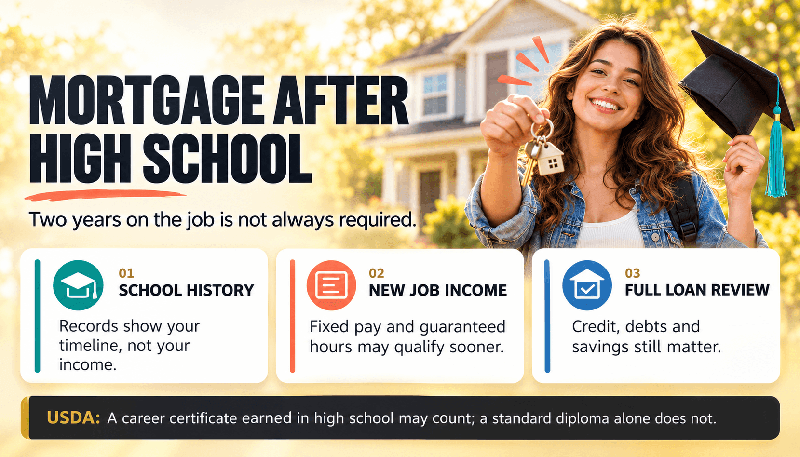
Mortgage guidelines after high school vary by loan program. You may qualify soon after graduation without two years on the job if the lender can verify your qualifying income and you meet the loan’s credit, debt, and funds-to-close requirements. School records may help document your recent history, but each program has different rules for how education is considered.
Do You Need Two Years of Employment to Get a Mortgage?
Two years of employment helps with mortgage underwriting, but it is not an absolute requirement for every borrower. This applies to individuals who may have just left high school or college, vocational training, or completed military service and have just entered the workforce.
When lending, the main concern is stable, consistent, and ongoing income. The specific criteria depend on the program, the type of income, and the strength of the application.
For a conventional loan, Fannie Mae states that lenders evaluate a borrower’s most recent employment. Although a shorter employment history may be acceptable, consider positive employment factors. Prospective homeowners should understand they do not have to wait 2 full years from their first full-time employer to get a mortgage.
Does Your New Paycheck Count Toward Mortgage Qualification?
Your pay type matters as much as your start date. A fixed salary or an hourly wage with guaranteed minimum hours may be easier to use when you have just started working. For a Fannie Mae conventional loan, fixed base pay has no minimum history of receipt, although the lender must still verify your earnings and assess your overall work history. If your hours change from week to week, the lender may treat your pay as variable income. Fannie Mae generally requires at least 12 months of that income. Overtime, bonuses, and income from a second job have separate history requirements, so a lender may be able to count your regular pay without counting those newer earnings. For example, a guaranteed 40-hour schedule is evaluated differently from a job offering 15 to 35 hours each week. Ask the lender which parts of your paycheck can be used before deciding how much to spend on a home.
Example: A 19-Year-Old Applies After High School
This is a hypothetical example, not a Gustan Cho Associates loan.
Maria graduated from high school in June and started a full-time job in September at $21 an hour, with 40 hours guaranteed per week. She has her school transcript, signed employment offer, first pay stub, and $12,000 saved from part-time work while she was in school. She has one recently opened credit card and has never paid rent.
The lender can use her transcript to document when she was in school. The offer and employer verification can establish her pay rate and guaranteed hours, while her pay stub shows that earnings have begun. At $21 an hour for 40 hours a week, her gross base pay would be about $3,640 a month if the lender can use the full amount. That calculation is only a starting point. The lender still needs to review her credit history, debts, bank statements, funds needed to close, and the home she wants to buy. It must also determine whether her income meets the chosen loan program’s rules. Her school record explains her short work history; it does not, by itself, qualify her for the mortgage.
How School Enrollment Can Help Document Your History
Recent graduates may not have two years of traditional employment records. In this case, education may be the most important factor in documenting a borrower’s history before entering the workforce.
Does the New Position Have to Be in the Field You Studied in?
Not necessarily. The borrower remains eligible if the new position is outside the field of study. The lender has to evaluate whether the new position provides stable income and meets the loan program’s criteria.
FHA Loan After High School
You may qualify for an FHA loan soon after high school, even if you have not worked for two years. The lender still needs to document your recent history and determine whether your current income can be used to qualify. If you were in school during the preceding two years, FHA permits the lender to use evidence of enrollment to document that period. A transcript or school record can show when you attended school. It does not establish that you earned income. The lender must separately verify your current job, earnings, and whether the income is stable enough to use for the mortgage.
FHA Credit Score and Down Payment
For a typical FHA purchase, a qualifying borrower with a credit score of at least 580 may be eligible for a down payment as low as 3.5%. A score from 500 through 579 generally limits financing to 90% of the applicable value, or at least 10% down. The lender will also review your debts, funds for closing, and the property. Meeting an FHA credit score threshold does not guarantee approval, and individual lenders may apply stricter requirements.
Conventional Loan After High School
A borrower, for example, may be eligible for a conventional mortgage even if they have not worked for two years after completing high school. Fannie Mae instructs lenders to evaluate whether the employment income shows a pattern of continuity. However, Fannie Mae allows a short work history if there are reasonable supporting factors. It may be possible for the recent school graduate to obtain conventional financing, even if their first post-school job is salaried or hourly.
Qualifying With a New Job Offer
A recent graduate may be able to use income from a new job to qualify for a Fannie Mae conventional loan, even if the job has not started when the loan is reviewed. An offer letter by itself is not enough. Fannie Mae has one set of requirements when the lender obtains a pay stub before the loan is delivered, and a stricter set when no pay stub will be available by then. The latter option is generally limited to a one-unit primary residence purchase using fixed base pay. A fully executed, noncontingent offer or contract is needed, along with an eligible start date and proof of sufficient funds to cover expenses before work starts. Ask the lender to review the complete offer, start date, and available funds before relying on future income to make a home purchase. Freddie Mac and other loan programs have their own requirements.
VA Loan After High School
 Graduates who are eligible for VA home loan benefits may use them. VA eligibility is not a result of a parent’s service. A parent’s service is merely related to the borrower. Veterans, service members (active-duty), certain members of the National Guard and Reserve, and some surviving spouses can obtain a Certificate of Eligibility.
Does VA Require Two Years on the Same Job?
No. VA underwriting will consider employment history, but two years in the borrower’s current position is not required. VA guidance states that the lender may evaluate the borrower’s previous employment, education, and training, as well as the type of employment, when assessing income stability. Borrowers who have entered the workforce recently may qualify as long as the lender can document stable, reliable income and the borrower has met all other VA credit, income, occupancy, and underwriting requirements. VA-sponsored loans let eligible borrowers buy a home with no down payment if they meet the program requirements.
USDA Loan After High School
A recent high school graduate may qualify for a USDA guaranteed loan, but the lender must establish that the income used to repay the mortgage is stable and dependable. USDA does not require a borrower to spend a set amount of time with the current employer. For base salary or hourly wages, the income guidelines generally call for one year of history, which may come from a combination of employment, eligible education, or military service.
Does High School Count Toward USDA Employment History?
USDA may count time spent in college, technical school, or a career-based certificate program completed in high school. A standard high school diploma without an accompanying career-based certificate does not satisfy this education provision. If you started your first job after graduating from a traditional high school program, the lender will review your documented work history and current earnings. Attending high school alone does not establish the qualifying employment history or income needed for approval. Work you held while attending school may also be relevant to that review.
What If There Were a Gap Between School and Work?
Be ready to give the lender the dates you attended school and started working. The lender may ask you to explain a gap after graduation and will assess whether your current income is dependable. The home must also be in a USDA-eligible area, and your household must meet the program’s income limit and other loan requirements. A USDA loan can offer eligible buyers financing without a down payment, but a short work history does not guarantee approval.
New Job After High School? You May Still Qualify for a Mortgage
A long employment history is not always required. Recent graduates may be able to qualify when their new job, income, education, and overall loan file meet program guidelines.What If You Have Little or No Credit History?
A recent high school graduate may have a limited credit history or no traditional credit score. That does not always mean the borrower must establish several new credit accounts and wait years before applying. Some mortgage programs offer ways to evaluate borrowers who lack sufficient traditional credit to generate a score.
Nontraditional Credit
Depending on the loan program and the type of underwriting, lenders may review documented payment history beyond the standard credit report. Some examples include eligible housing payments and other recurring financial obligations, as long as the mortgage guidelines permit. FHA guidelines outline the process for evaluating credit-challenged borrowers. USDA also provides a process for some loan programs for borrowers with either limited or nontraditional credit. Before requesting mortgage credit, potential borrowers should contact a lender. New credit, credit inquiries, or high account balances may all affect the underwriting decision.
Can a Parent Help You Qualify for a Mortgage?
A parent or another eligible person may be able to help a recent graduate qualify as a non-occupant borrower, depending on the loan program. The non-occupant borrower applies for the mortgage and shares responsibility for the debt even though they will not live in the home. This is different from simply giving the buyer money for the down payment.
FHA Non-Occupying Co-Borrowers
FHA permits certain transactions with non-occupying borrowers. FHA financing can generally reach the normal maximum loan-to-value when the occupying and non-occupying borrowers are qualifying family members and the transaction meets FHA requirements. Other non-occupying borrower transactions may have lower maximum financing limits.
Conventional Non-Occupant Borrowers
Fannie Mae also permits non-occupant borrowers on eligible principal-residence transactions. Desktop Underwriter considers the income, assets, liabilities, and credit of all borrowers when evaluating the loan. Specific LTV and underwriting requirements apply. Freddie Mac similarly permits non-occupying borrowers on qualifying purchase and no-cash-out refinance transactions, subject to its underwriting requirements. A parent helping with the mortgage does not automatically mean the recent graduate can qualify. The lender must evaluate everyone obligated on the loan under the applicable program.
Documents Recent Graduates May Need
Documentation will depend on the loan program and the borrower’s situation, but a recent graduate should be prepared to provide records covering both school and current employment. The lender may request:
- High school, college, or vocational school transcripts
- Diploma or other proof of graduation
- School enrollment records
- Recent pay stubs
- W-2s, if available
- Written or electronic verification of employment
- Employment offer or contract, when applicable
- Bank and asset statements
- Identification and Social Security information
- Credit documentation
- Written explanations for significant gaps when required
Not every borrower will need every document. The purpose is to establish a clear timeline outlining the transition from school to employment and to document the income, assets, and credit used for mortgage qualification.
How Lender Overlays Can Affect Recent Graduates
Meeting the minimum mortgage guidelines after high school does not guarantee that every lender will approve the same borrower.
Mortgage lenders may have requirements more restrictive than the minimum standards established by FHA, VA, USDA, Fannie Mae, or Freddie Mac. These additional requirements are commonly referred to as lender overlays.
For example, an agency guideline may permit a shorter employment history or a loan for a borrower without a traditional credit score, while an individual lender may require additional documentation or decline that type of loan. This is why a denial from one lender does not necessarily mean the borrower is ineligible under the actual loan program. Before giving up, borrowers should determine whether the problem comes from the agency guideline itself or from the lender’s additional underwriting requirements.
Steps to Get Pre-Approved After Graduation
Graduates should apply for pre-approval before making an offer on a home. A lender reviews your income, credit, debts, and available funds before issuing a pre-approval. You will need to present your last few payslips, recent bank statements, your ID, and any available W-2s. If a borrower recently completed school, a lender may request school transcripts, a diploma, or school records to show the lender the employment preparation period. If your current employment offer is new, the lender will need to review your complete employment offer letter or contract to determine if your employment income meets the program requirements. It is also advised that you refrain from taking on debt, applying for credit, and making large, unaccounted-for deposits while waiting to obtain a mortgage. These factors can influence your eligibility for a mortgage. A pre-approval will answer your questions about which program (s) may work best for you and whether there are any program overlays.
Final Thoughts on Mortgage Guidelines After High School
Many first-time homebuyers believe they have to wait at least 2 years before they qualify to buy a home. The mortgage guidelines after high school for home purchase tend to be flexible. The FHA, conventional, VA, and USDA programs all have employment and income guidelines that may work for buyers with short employment and income histories if the lender can document the borrower’s transition from school to work.
Having provable income, a good or acceptable credit score, or a supported nontraditional credit history, and having cash when it is required, along with the necessary supporting documentation to back up your application, is of the utmost importance.
Recent graduates also need to understand that one lender saying no to a mortgage application does not mean they are permanently unable to obtain a mortgage. Lender overlays can and do, at times, exceed the guidelines established by the primary agencies. Getting a pre-approval with a lender that understands borrowers with an unconventionally short employment history can help you see which loan program fits your situation best, so that you can house hunt in confidence.
Frequently Asked Questions About Mortgage Guidelines After High School
Can an 18-Year-Old Get a Mortgage Without a Parent on the Loan?
Potentially. You must be old enough to sign an enforceable mortgage note in the state where the home is located, which is typically 18. You do not need a parent on the loan solely because of your age. The lender still has to approve your income, credit, debts, and funds for closing.
Can I Qualify for a Mortgage Before My First Job has Issued a W-2?
Possibly. For a Fannie Mae conventional loan using fixed salary or hourly pay with guaranteed minimum hours, a completed employer verification is one documentation option instead of a pay stub and W-2. The lender must still confirm your current employment and determine whether the income qualifies. Ask what additional records it needs if you have only recently received your first paycheck.
Will Living with My Parents Rent-Free Keep Me from Getting a Mortgage?
Living rent-free does not automatically disqualify you. Tell the lender that you have no rental payment history. This matters especially if you also have no credit score: some conventional loan paths that use nontraditional credit require a documented housing payment, while a manually underwritten Fannie Mae loan with no housing payment history can require substantial reserves.
Can My Parents Help Pay Closing Costs Without Co-Signing?
Yes, if the loan program permits a gift from them. For example, Fannie Mae allows an eligible parent’s gift to cover closing costs on a qualifying primary-residence purchase. The lender will need a gift letter stating that repayment is not expected and documentation showing the funds are available or have been transferred. A gift does not make your parent responsible for the mortgage.
What if I Change Jobs After Pre-Approval but Before Closing?
Tell your loan officer before making the change. Lenders verify employment late in the loan process, and a change in employer, start date, pay, or hours may require them to review your income again. You may still qualify, but the lender might need new documents or more time before closing.
How Much of a Mortgage Can I Afford if I Make $70,000 a Year?
A $70,000 salary is about $5,833 a month before taxes, but a salary alone cannot establish an affordable loan amount. Ask the lender to calculate the payment using your qualifying income, existing debts, proposed interest rate, property taxes, insurance, and any mortgage insurance or HOA dues. Then compare the total monthly payment with your own budget and the cash you will have left after closing.
This article about “Mortgage Guidelines After High School: Can You Buy With a New Job?” was updated on September 24th, 2026.