Conditional mortgage approval means an underwriter has reviewed your loan file but still needs specific documents, explanations, or third-party items before granting final approval. Conditional mortgage approval delays often result from incomplete bank statements, unclear income, employment verification, large deposits, new credit, appraisal issues, title work, or homeowners’ insurance. To avoid delays, submit all requested pages, respond promptly, and do not open new accounts, change jobs, make large purchases, or move closing funds without first speaking with your loan officer. Your mortgage is not final until all conditions are cleared and the lender issues a clear-to-close.
What Is Conditional Mortgage Approval?
A green light isn’t full yet – just a maybe with loose ends left to tie. The person checking your paperwork says things look okay so far, though a few pieces still need sorting. Clearing those hurdles comes first. Only then does it become official. These items are called conditions. Conditions may include updated pay stubs, bank statements, letters of explanation, proof of earnest money, employment verification, or clarification on something in your credit or income documents. Conditional approval is a good sign, but it does not mean your loan is fully approved yet. The loan can move closer to clear to close once all conditions are reviewed and accepted by the underwriter.
How Long Does Conditional Approval Take?
One thing – conditional approval might last several business days once the underwriter gets everything needed. Often, waiting stretches out if paperwork is incomplete, confusing, or lacking details. Right away matters; borrowers who reply fast and include every required item tend to keep things moving. A full set at first try makes a difference.
What Types of Mortgage Conditions Can an Underwriter Issue?
Underwriting conditions are requirements that must be satisfied before a mortgage can advance to final approval, closing, or funding. Conditions vary based on the borrower’s finances, property, loan program, and lender guidelines. Understanding each category can help borrowers address conditional mortgage approval delays before the scheduled closing date is affected.
Borrower and Financial Conditions
Borrower conditions involve the information used to evaluate income, credit, assets, debts, and eligibility. Common requests include:
- Updated pay stubs, W-2s, tax returns, or bank statements
- Verification of employment or additional income
- Letters explaining credit inquiries, late payments, employment gaps, or address differences
- Documentation for large deposits, gift funds, or earnest money
- Proof that a debt has been paid or an account has been closed
- Updated profit-and-loss statements for self-employed borrowers
- Divorce decrees, bankruptcy documents, or child-support orders when relevant
Documents must be complete, legible, and consistent with the application. If new information changes the borrower’s income, assets, debts, or credit profile, the underwriter may issue revised or additional conditions.
Property and Appraisal Conditions
The property must meet the lender’s collateral requirements and any applicable loan-program standards. Property-related conditions may include:
- A completed appraisal supporting the purchase price or loan amount
- Corrections to the appraisal report
- Evidence that required repairs have been completed
- A final inspection or repair certification
- Comparable-sale clarification from the appraiser
- Condo or homeowners association documents
- Flood-zone certification
- Well, septic, pest, or structural inspections when required
An appraisal delay does not always indicate a problem with the borrower. The lender may be waiting for the report, a correction, an inspection, or documents from an outside party.
Title, Insurance, and Closing Conditions
These conditions help confirm that the lender’s lien can be recorded properly and that the property will have the required insurance coverage. Examples include:
- A clear title commitment
- Resolution of judgments, tax liens, ownership disputes, or unreleased liens
- Proof of homeowners insurance
- Flood insurance when the property is in a designated flood zone
- Verification of property taxes and homeowners’ association dues
- Final figures from the title or settlement company
- Correct legal descriptions, vesting information, or closing documents
- Confirmation that required funds are available for closing
Title and insurance conditions often depend on third parties. Borrowers should still respond quickly if the lender requests additional information or signatures.
Prior-to-Document and Prior-to-Funding Conditions
Lenders may classify conditions according to when they must be cleared. The exact terminology varies, but two common classifications are: Prior-to-document conditions must generally be satisfied before the lender prepares or releases final loan documents. These may include an approved appraisal, verified funds to close, acceptable title work, homeowners’ insurance, and final income documentation. Prior-to-funding conditions may be cleared after documents are prepared or signed, but before the lender releases the loan funds. Examples can include confirmation that required documents were signed correctly, last-minute employment verification, proof that closing funds were received, or correction of a missing signature. A borrower should not assume that signing the closing documents means all conditions have been satisfied. The transaction is not complete until all required conditions are accepted and the loan is funded or otherwise completed under the applicable state closing process.
Common Causes of Conditional Mortgage Approval Delays
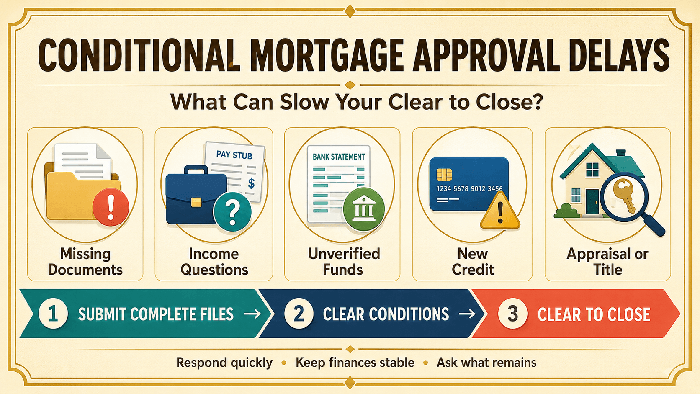 Conditional mortgage approval delays can happen when the underwriter needs clearer information, updated documents, or items from outside parties. Some delays are within the borrower’s control, while others involve an employer, an appraiser, a title company, an insurance agent, or a homeowners association.
Missing, Expired, or Illegible Documents
Mortgage documents must be complete, current, and easy to read. A missing bank statement page, a cropped pay stub, an expired statement, or a blurry photo may prevent the underwriter from clearing a condition. Submit every page, including blank or disclosure pages. Original PDF files are usually better than screenshots. Review each document before sending it, and respond to the entire condition request, not just one part.
Income and Employment Verification Problems
The lender must confirm that the income used to qualify is accurate, stable, and likely to continue. Delays may occur when:
- An employer is slow to respond
- Pay stubs do not match the application
- Overtime, bonuses, or commissions vary
- The borrower recently changed jobs
- Employment gaps require an explanation
- Tax transcripts or other income records are unavailable
Borrowers should tell their loan officer about any changes to their job, schedule, or pay immediately. The lender may also verify employment again shortly before closing.
Bank Statements, Large Deposits, and Gift Funds
Underwriters review bank statements to confirm that the borrower has enough eligible funds for the down payment, closing costs, and required reserves. Missing pages, overdrafts, unexplained transfers, or deposits that cannot be traced may create additional conditions. Certain large deposits may need to be sourced, depending on the loan program and whether those funds are needed for closing. Gift funds can require a gift letter, evidence of the donor’s transfer, and proof that the money reached the borrower or settlement agent. Do not move money between accounts without first asking your loan officer what documentation will be needed.
New Credit, Higher Balances, or Undisclosed Debt
Opening a credit card, financing furniture, buying a vehicle, or increasing existing balances can change the borrower’s credit score and debt-to-income ratio. Undisclosed debts discovered during underwriting may also require the loan to be recalculated. Lenders may monitor credit activity or obtain updated information before closing. Avoid new credit inquiries, large purchases, co-signing, and changes to existing accounts until the loan has closed. Contact the loan officer before making any financial decision that could affect qualification.
Appraisal, Title, Insurance, or HOA Delays
Not every delay is caused by the borrower. A file can also be held up while the lender waits for:
- The appraisal or a corrected appraisal report
- Evidence that required repairs were completed
- A clear title commitment
- Resolution of a judgment, lien, or ownership issue
- Acceptable homeowners or flood insurance
- Condominium or HOA documents
- Updated property-tax or association information
These items often depend on third parties. Borrowers can help by choosing an insurance provider early, paying for the appraisal promptly, and completing HOA or title requests without delay.
Self-Employment and Complex Income
Self-employed borrowers often need more documentation because their qualifying income may differ from gross business revenue. The underwriter may request personal and business tax returns, year-to-date profit-and-loss statements, balance sheets, business bank statements, or confirmation of the business’s continued activity. Rental income, commission income, overtime, bonuses, multiple jobs, and irregular earnings can also require additional calculations. If documents contain conflicting figures or show declining income, the underwriter may need an explanation and further review.
Last-Minute Financial or Employment Changes
A borrower’s qualification can change between conditional approval and closing. Changing jobs, reducing work hours, taking unpaid leave, making a large purchase, moving closing funds, or spending part of the required cash can create new conditions or place the approval at risk. Continue paying every bill on time and keep your finances as stable as possible. Before changing employment, transferring funds, opening a line of credit, or making a major purchase, speak with your loan officer. Conditional approval is an important milestone, but the mortgage is not final until all required conditions have been met and the lender has authorized the loan to close.
Ready to Move From Conditional Approval to Clear to Close?
Send your scenario or complete a quick application. We’ll help you clear conditions, avoid delays, and guide your file toward final approval.What Happens After Conditional Approval?
After conditional approval, the borrower must provide the remaining items requested by the underwriter. These may include updated bank statements, pay stubs, letters of explanation, or proof of funds for closing. Once the conditions are submitted, the underwriter reviews them again. If everything is accepted, the loan can move to final approval and clear to close. If something is still missing or unclear, the underwriter may ask for more information before the file can move forward.
How to Submit Mortgage Conditions Correctly
Submitting complete and clear documents can help prevent conditional mortgage approval delays. Follow this checklist when responding to an underwriter’s request:
- Read the entire condition request. Make sure you understand every document and explanation the underwriter needs.
- Submit every requested page. Include all pages of bank statements, tax returns, pay stubs, and other records—even blank pages.
- Use original PDF statements when available. Download documents directly from your bank, employer, or account portal instead of sending screenshots.
- Do not alter, crop, or combine documents unless instructed. Edited documents may be rejected or require further review.
- Label each document clearly. Use simple names such as “July Bank Statement” or “2025 W-2” so the processor can identify each item.
- Include supporting evidence with explanations. A letter of explanation may also require receipts, account records, or other proof.
- Submit conditions together when possible. Sending a single complete package may reduce the need for repeated reviews and extra emails.
- Confirm that the processor received everything. Ask whether any pages are missing and whether the file is ready to be resubmitted to underwriting.
Never create, change, or hide information on a mortgage document. If you do not understand a condition or cannot obtain an item, contact your loan officer or processor before submitting a substitute.
How to Avoid Delays Before and During Underwriting
Some conditional mortgage approval delays are within the borrower’s control, while others depend on employers, appraisers, title companies, insurance providers, or the lender’s workload. Preparing early and knowing who is responsible for each outstanding item can help keep the loan moving.
Delays Borrowers Can Help Prevent
Before and during underwriting:
- Submit complete, current, and readable documents.
- Respond promptly to requests from the loan officer or processor.
- Keep paying all bills on time.
- Avoid applying for new credit or increasing card balances.
- Do not change jobs, reduce work hours, or take unpaid leave without first contacting the loan officer.
- Avoid large purchases, unexplained deposits, overdrafts, and undocumented transfers.
- Keep enough verified money available for the down payment, closing costs, and required reserves.
- Choose a homeowners’ insurance provider early.
- Tell the lender immediately about changes to income, employment, debts, assets, or marital status.
Even a small change can require the underwriter to recalculate the loan or request updated documents.
Delays Caused by Third Parties
Some conditions depend on people or companies outside the borrower’s direct control. An employer may take several days to verify employment. An appraiser may need additional time to complete the report, correct an error, or confirm that repairs have been completed. Title companies may need to resolve liens, ownership questions, or recording issues. Insurance agents and HOAs may also be slow to provide required documents. Borrowers cannot complete these tasks themselves, but they can provide accurate contact information, promptly sign requested forms, and follow up with the appropriate party when asked.
Delays Caused by Lender Workload
Underwriting turnaround times may increase when lenders receive a high volume of applications or when a loan requires manual underwriting, compliance review, quality-control review, or approval from more than one department. Submitting documents quickly does not always mean they will be reviewed the same day. Ask your loan officer or processor:
- Which conditions are still outstanding?
- Is the lender waiting on a third party or me?
- Has my file been resubmitted to underwriting?
- What is the estimated review time?
- Is my closing date or rate-lock expiration at risk?
Clear communication cannot prevent every delay, but it helps identify problems early and gives the mortgage team more time to protect the scheduled closing.
Can a Loan Be Denied After Conditional Approval?
Yes. A mortgage can still be denied after conditional approval if the borrower, property, or loan no longer meets the lender’s requirements. Conditional approval means the file appears eligible based on the information reviewed so far, but final approval depends on meeting all required conditions. Understanding the possible outcomes can help borrowers respond to conditional mortgage approval delays.
- Denial: The lender determines that the loan does not meet approval requirements. This may happen if income cannot be verified, the appraisal is too low, debt increases, credit worsens, funds cannot be documented, or another serious issue is discovered. The lender should provide a notice explaining the main reason for its decision.
- Suspension: The underwriter temporarily pauses the decision while an important issue is resolved. The file may return to active review once the lender receives acceptable documents or clarification.
- Incomplete file: The lender cannot complete the application review because required information is missing. The borrower may receive a deadline for submitting the outstanding documents. Failure to respond may result in the application being closed or denied.
- Revised conditions: New information does not always result in denial. The underwriter may instead request updated statements, another explanation, proof of additional funds, a corrected appraisal, or other documents. Revised conditions mean more work is required before final approval, not necessarily that the loan has failed.
Borrowers should ask which condition caused the problem, what documentation may resolve it, and when the response is due. A conditional approval is encouraging, but the loan is not final until all conditions are cleared and the lender issues authorization to close.
Conditional Approval vs. Final Approval vs. Clear to Close
These terms describe different stages of underwriting. Understanding them can reduce confusion during conditional mortgage approval delays.
Conditional Approval
The underwriter has reviewed the loan file and believes it may qualify, but certain requirements remain. The borrower or a third party may need to provide updated documents, explanations, appraisal items, title work, insurance, or other information.
Final Approval
Final approval generally means the underwriter has accepted the major conditions and approved the loan. However, the lender may still need to complete final compliance checks, verify employment, confirm closing funds, or prepare loan documents.
Clear to Close
Clear to close means the lender has authorized the loan to proceed to closing. The Closing Disclosure and signing must still be completed, and the loan is not funded merely because it is clear to close. Borrowers should continue paying bills on time and avoid new credit, job changes, large purchases, or moving money until the transaction is complete. Terminology and timing can vary by lender and state, so borrowers should ask which conditions—if any—remain before signing and funding.
Conditional Mortgage Approval Delay Example
A borrower received conditional approval, but the underwriter requested complete bank statements and proof of a $7,500 deposit. The documents were needed to confirm that the borrower had enough verified funds for closing and that the deposit did not come from an undisclosed loan.
The borrower initially submitted screenshots showing only the account balance. The images did not include every statement page, the account number, or proof showing where the deposit came from.
The processor reviewed the condition, downloaded complete PDF statements with the borrower, and documented that the $7,500 was transferred from the borrower’s savings account. The processor included statements from both accounts so the underwriter could trace the money from its original source to the receiving account. The corrected documents were resubmitted as one complete package. The lender’s second underwriting review added three business days to the process. This example shows how incomplete records can create conditional mortgage approval delays, even when the money itself is acceptable. Review times vary by lender, file complexity, and workload.
What to Do When Conditional Approval Is Taking Too Long
If your file has stalled, contact your loan officer or processor and ask for a clear written update. Do not assume every delay is caused by underwriting. The lender may be waiting for documents from you, your employer, the appraiser, the title company, the insurance agent, or another third party. Ask these questions:
- Which conditions remain outstanding?
- Is the lender waiting on me or a third party?
- Has my file been resubmitted to underwriting?
- Are my appraisal, title work, and homeowners’ insurance cleared?
- What is the expected underwriting review time?
- When does my rate lock expire?
- Could an extension add cost?
- Is the scheduled closing date still realistic?
If you need to provide something, ask exactly what is required and submit the complete documents promptly. If the delay involves a third party, ask who is following up and when another status check will occur. When the closing date or rate lock is at risk, request a revised timeline and discuss available options. Regular follow-up can uncover conditional mortgage approval delays before they threaten the transaction. However, repeated calls cannot shorten the lender’s review queue. Focus on confirming what remains, who is responsible, and the next expected action.
Final Thoughts About Conditional Mortgage Approval Delays
Waiting too long for a mortgage decision might feel heavy, particularly if moving day looms. Files often stall since documents aren’t complete, details raise questions, or paperwork demands context an underwriter must have before proceeding. One solid move keeps things moving – send every paper needed right away. Money staying the same helps, so let nothing shift there. When they ask, reply fast; that matters more than most think. Taking on fresh loans? Not now. Wait till it’s done. Getting conditionally approved feels good, sure. Still, only counts when clear to close lands in your inbox.
Frequently Asked Questions About Conditional Mortgage Approval Delays
Does a Conditional Mortgage Approval Expire?
It may. The approval letter could include an expiration date, and paperwork like pay stubs, bank statements, credit reports, and appraisals may become outdated. The lender may request updated information if the mortgage does not close within the expected period.
Is Conditional Approval Stronger Than Mortgage Preapproval?
Generally, yes. Preapproval is an early assessment and does not guarantee financing. Conditional approval usually follows a more detailed underwriting review, although specific requirements still need to be cleared.
Can Conditional Approval Strengthen a Purchase Offer?
It may show the seller that the buyer has completed more financial review than someone with only a basic prequalification. However, sellers decide which offers to accept, and conditional approval does not guarantee that the mortgage will close.
Does Conditional Approval Lock the Mortgage Rate?
No. Conditional approval and a mortgage rate lock are separate. A rate is locked only when the lender confirms the interest rate, lock period, and expiration date. Ask whether the rate is locked and what happens if the closing occurs after the lock expires.
Are Conditional Approval Requirements Different for FHA and Conventional Loans?
Yes. Both require acceptable documentation of income, assets, credit, and property, but their program rules can differ. FHA loans may have HUD-specific appraisal and property requirements, while conventional loans follow Fannie Mae or Freddie Mac guidelines plus any lender overlays.
Can an Underwriter Waive a Mortgage Condition?
Sometimes, an underwriter can revise or remove a lender-specific condition when other acceptable documentation resolves the concern. Conditions required by law, the loan program, the investor, or the property appraisal generally cannot simply be ignored.
How Many Times can an Underwriter Request Additional Documents?
There is no fixed limit. An underwriter may request more information whenever submitted documents are incomplete, outdated, inconsistent, or reveal a new issue. A file can be closed as incomplete if the required information is not provided by the stated deadline.
This article about “Conditional Mortgage Approval Delays: Causes and How to Avoid Them” was updated on July 31st, 2026.