Mortgage Rates on Non-QM Loans and No-Doc Mortgages
This guide covers mortgage rates on non-QM loans and no-doc mortgages. Current Home Mortgage Rates after the election of President Donald Trump have increased to an all-time high since 2008. Rates on conventional loans are in the 5.0% range for prime borrowers. Tanhia Romero, NMLS 489790, a senior mortgage loan originator at Gustan Cho Associates, says the following about mortgage rates on non-QM loans and no-doc mortgages:
Jumbo mortgage rates for prime borrowers are nearing 6% and many times higher due to LLPA. Many home buyers cannot qualify for government and conforming loans due to higher housing prices.
FHFA has increased conforming limits on conventional and high-balance loans throughout the United States. Non-QM loans are becoming the home loan of choice for many home buyers. Non-QM loans are not Hard Money Loans. Non-QM loans are not for borrowers with bad credit. In the following paragraphs, we will cover mortgage rates on non-QM loans and no-doc mortgages.
What Determines Mortgage Rates on Non-QM Loans
Mortgage rates on Non-QM loans rely on the borrower profile, loan type, property, and the financial markets. Credit score, the size of the down payment, loan-to-value ratio, the income documentation type, the property’s use, reserves, and recent credit conditions can all impact the final rate.
Non-QM mortgages typically have higher rates compared to rate standard conventional loans, as lenders rely on flexible underwriting and alternative methods of documenting the borrower’s capability to repay.
On the other hand, a borrower with a strong credit profile, large down payment, and reserves may receive more competitive pricing. As rates and program requirements frequently change, it is best to contact the lender to receive a more competitive quote rather than relying on an advertised rate, which can apply to a narrowly defined borrower.
Credit Scores versus Non-QM Mortgage Rates

Introduction of Non-QM Loans and Alternative Lending
NON-QM Loans and subprime lending is back. Bank statement mortgage loans and no doc mortgage loans for self-employed borrowers are back. They are more popular than ever before. Mortgage rates on non-QM loans are generally higher than traditional financing. However, most non-QM loan programs do not require income verification or tax returns. There is no mortgage insurance required on non-QM loans. 10% down payment NON-QM Jumbo Mortgage with no private mortgage insurance is now available.
Factors That Influence Non-QM Mortgage Rates
Non-QM lenders typically will not set one universal interest rate.
Risk Factors
Credit scores reduce risk to lenders. Higher credit scores can mean lower interest rates. Conversely, higher interest rates, increased down payment, and greater reserve requirements may be assessed for recent bankruptcies, foreclosures, short sales, and late mortgage payments. Some Non-QM programs accept lower credit scores. While a borrower with a lower credit score may be approved for a program, pricing may differ from a borrower with a higher credit score.
Down Payments
The greater the down payment, the lower the risk to lenders. As a result, higher interest rate mortgages may be assessed to borrowers who finance a greater percentage of the total value of the property. In addition, a greater down payment may be required if the Non-QM lender believes the subject property is a second home or an investment property.
Income Documentation Programs
The program from which a Non-QM loan is originated may be impacted by the documentation of income.
Alternative Forms of Income Documentation Include:
- bank or business statements
- 1099 forms
- profit and loss statements
- calculations of asset depletion
- a debt service coverage ratio
- rental income
- documentation programs with no ratios or limited documentation
Less traditional documentation may result in alternate pricing, greater credit, reserve and down payment requirements.
Variable Rates
Rates may also be assessed for the type of property and how it will be used. For example, a primary or second home, a short-term rental, a condominium or an investment property may each be assessed different interest rates. The different types of loans, the different ways in which a borrower proves their ability to repay, along with the type of property and the type of occupancy may result in different rates even for borrowers with the same credit scores.
Fixed, Adjustable, and Interest-Only Terms
These loans may have fixed terms, may have adjustable rates, or may have periods in which the borrower will make interest-only payments. Be aware that a lower initial monthly payment may result in a higher total cost for the loan. When evaluating these loans, you should examine rates and costs (including any points and lender fees), prepayment terms, and the total monthly payment for any loans you are considering.
How Are Mortgage Rates on Non-QM Loans Priced
Mortgage rates on Non-QM loans and No Doc (No Documentation) mortgages can vary significantly depending on various factors, including the lender, the borrower’s creditworthiness, the loan-to-value ratio, and current market conditions. Non-QM loans for homebuyers who don’t meet the typical criteria for traditional conventional mortgages. Non-QM loans have higher interest rates than traditional mortgages because they are considered riskier for lenders.
Non-QM mortgage rates may be based more on the borrower’s down payment, credit score, and financial history rather than conforming to standard lending guidelines.
No Doc mortgages, known as stated income or low documentation loans, were popular before the 2008 financial crisis. These loans allowed borrowers to state their income without providing extensive documentation. Due to their association with the financial crisis, No Doc mortgages are less common today and come with higher interest rates to compensate for the higher risk to lenders.
Self-Employed or Hard-to-Document Income?
If tax returns do not show enough income, Non-QM programs such as bank statement, 1099, P&L, DSCR, or asset-based loans may help you qualify.Getting the Best Mortgage Rates on Non-QM Loans
The specific interest rates for these types of mortgages can only be determined by contacting lenders directly or working with a mortgage broker. Rates can fluctuate based on the current economic climate, the lender’s policies, and the borrower’s unique financial situation.
It’s important to note that regulations and lending practices have become more stringent since the financial crisis, making it more challenging to obtain no-doc and Non-QM loans may be subject to certain eligibility criteria.
Suppose you are interested in Non-QM loans or No Doc mortgages. In that case, I recommend contacting several lenders or mortgage brokers to get personalized rate quotes and discuss the terms and conditions that apply to your situation. Additionally, it’s crucial to carefully consider the risks and benefits of these types of mortgages before proceeding, as they may only be suitable for some.
Are Non-QM Mortgage Rates Higher Than Conventional Rates?
As a general rule, Non-QM interest rates will be higher than conventional loans. Rates may be higher because lenders are considering alternative means of income verification, are accepting a recent adverse credit event, are considering a greater debt-to-income ratio, or are accepting a property in a higher risk loan. There are many factors (for example, good credit and a low loan to value) that may lessen the rate. It’s important to keep in mind that Non-QM loans should not be viewed as “bad credit” or “hard-money” loans. Non-QM loans may be advantageous to the self-employed borrower and real estate investors and may provide a better option than a conventional loan.
What Does a No-Doc Mortgage Mean Today?
The term “no-doc mortgage” means that the borrower will not provide income to the lender in the form of W-2s, pay stubs, or tax returns. Rather, the lender will perform their own underwriting and will assess the risk of the loan based on other financial documents provided to the lender.
For mortgages meant for owner-occupants, lenders must make a reasonable determination and act in good faith to ensure that borrowers have the ability to repay the loan.
Depending on the program, the lender may consider the borrower’s assets, bank deposits, credit history, reserves, the borrower’s housing expenses, and other financial information In the case of loans for investment properties, some lenders allow the property’s rental income to be considered in lieu of the borrower’s employment income. The available programs and required documentation differ from one lender to another.
How to Obtain a Greater Non-QM Mortgage Rate
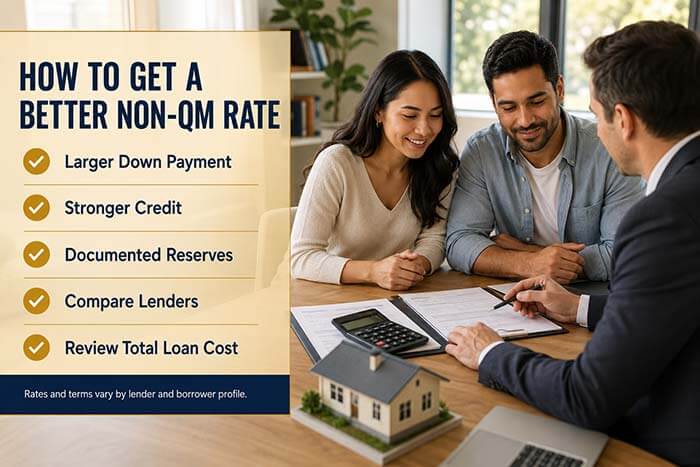
Non-QM borrowers can enhance their pricing by addressing any portion of their application that presents a higher risk for the lender.
Increase Down Payment
A borrower able to reduce the loan to value ratio may be able to improve pricing and find a greater number of lending programs.
Improve Credit Profile
A borrower may find pricing improves by ensuring credit card balances are kept low and all bills are paid in full and on time and that any errors on their credit report are resolved.
Keep Cash Reserves
A borrower able to document several months of mortgage payments may find more favorable mortgage options from more lenders.
More than One Non-QM Lender
There is a significant variation in pricing and lender risk among Non-QM lenders. A borrower may find more favorable mortgage terms from a lender with a program that fits the borrower’s circumstances, even if another lender offered that borrower terms with a significantly higher risk.
Examine the Entire Loan Offer
The lowest marketed interest rate for a mortgage does not indicate the lowest cost mortgage. The rate, required points, any loan origination fees, the underwriting covenant, the required down payment and reserves, and the total amount of cash to be disbursed at closing should all be considered.
Increase of Mortgage Rates and Housing Prices
Mortgage rates have been steadily going up since the new year: Many borrowers are waiting for that big correction. Current mortgage rates for FHA loans have gone up three-quarter of a percentage point since last October. Conventional mortgage rates are currently hovering around the 6.50% mark.
This year has been the year where Non-QM loans and no doc mortgage loan programs have hit the market. Bank Statement Mortgage Loan programs for self-employed borrowers are now very popular.
Many home buyers with prior bankruptcies and foreclosures no longer have to wait the minimum waiting period after bankruptcy and/or foreclosure. This is due to the many options they now have with the introduction of Non-QM loans and alternative financing loan programs.
Mortgage Rates on Non-QM Loans on Second Home Financing
Current home mortgage rates for second homes are the same as owner-occupied rates depending on borrowers’ credit profile and income as well as the borrower’s debt-to-income ratio. Condo hotel and non-warrantable mortgage loans are now very popular and are back. No Doc Fix and Flip Rehab Loans for real estate investors are a very popular loan program with very low rates and 9-month interest-only financing. There are no doc investment property loans where borrowers’ income and tax returns are not required.
Where Are Mortgage Rates on Non-QM Loans Headed?

Home mortgage rates on non-QM loans started to creep up starting last November and starting the new year, mortgage rates have consistently have been going up week after week. When the stock market goes up, mortgage interest rates go up. The Dow Jones has been in positive territory week after week.
Historically, the stock market has always done very well in January. Many analysts predict a major correction and so do investors. Those borrowers who have not locked their mortgage rates are now paying the price.
Many of my clients who have a clear to close are delaying their closing hoping that there will be a market correction. Borrowers who are refinancing can afford to speculate in waiting for mortgage rates to drop. But homebuyers do not have their luxury unless they want to delay their purchase closing.
How to Get a Better Non-QM Mortgage Rate
- Increase the Down Payment
- Improve the Credit Profile
- Maintain Strong Cash Reserves
- Compare More Than One Non-QM Lender
- Compare the Entire Loan Offer
Mortgage Rates on Non-QM Loans and Economic News
Nobody has a crystal ball and can predict what the credit markets will do. Interest rates have gone up so rapidly this year. Many, including myself, feel that there will be a major market correction. However, interest rates have been spiking up week after week. For borrowers who barely qualified for a mortgage because of tight debt to income ratio, I strongly recommend that they lock their rates. There is a strong possibility that mortgage rates can drop. There is also the probability that mortgage rates will continue to climb.
Qualifying and Getting Approved for Non-QM Loans
Borrowers can qualify for non-QM loans with credit scores down to 500 credit scores. There are no maximum loan limits on non-QM mortgages like conforming and government loans. 5% to 20% down payment. Dale Elenteny, NMLS 904444, a mortgage loan originator at Gustan Cho Associates says the following:
Mortgage rates on non-QM loans depend on borrowers’ credit scores and down payment. Higher credit score borrowers can get better rates on non-QM loans than conforming loans due to no private mortgage insurance.
Non-QM mortgage rates range between 6% to 9% with no mortgage insurance. For more information on non-QM financing, please contact Gustan Cho, NMLS 873293 of Gustan Cho Associates at 800-900-8569 or text us for a faster response. Or email us at gcho@gustancho.com. The team at Gustan Cho Associates is available seven days a week, evenings, weekends, and holidays. Gustan Cho Associates is a DBA of Coast2Coast Mortgage, LLC NMLS 376205.
Frequently Asked Questions About Mortgage Rates on Non-QM Loans
What is the interest rate on a Non-QM loan?
The Non-QM interest rate is not a set number. The price is dependent on the borrower’s credit, the size of the down payment, the type of loan documentation, the size of the loan, the type of occupancy and property, the level of reserves, and the current Non-QM loan rate sheet of the lender. Non-QM loan pricing is impacted by the conditions of the financial markets.
What Credit Score Do You Need for a Non-QM Loan?
Since Non-QM loans are not standardized, minimum credit scores are flexible. Lower scores may be eligible, but are likely to come with a higher cost of credit, a higher interest rate, and/or a larger down payment.
What is the Down Payment of a Non-QM Loan?
The amount of the down payment is dependent on the loan program, along with the borrower’s credit score, the type of occupancy, the type of property, the type of recent credit events, and the method of income documentation.
Is a Non-QM Loan a Subprime Mortgage?
No. A Non-QM loan is a mortgage that does not fulfill the definition of Qualified Mortgage. A Non-QM loan may be used by a borrower that is creditworthy and has a Non-QM loan that has a significant amount of assets, a Non-QM loan that has an Non-QM loan that has an income that does not meet the agency underwriting standards, or a borrower that has an Non-QM loan that has a Non-QM loan that has a significant amount of assets.
Can I Refinance a Non-QM Loan to a Conventional Loan in the Future?
Yes, a borrower has the realistic opportunity to refinance if they have additional access to credit, have enough qualifying income, have sufficient time since a bankruptcy or foreclosure, have decreased the loan amount, or have met the conventional loan requirements. It will be up to the guidelines and the market when the borrower is looking to refinance.
Does a Non-QM Loan Have a Prepayment Penalty?
Prepayment penalties may be an option on some of the investments-property and business-purpose Non-QM Loans. The restrictions for owner-occupied loans may differ. The borrower should read the loan documents and ask how the penalty is calculated prior to signing.
Does a Non-QM Loan Have Private Mortgage Insurance?
Many of the Non-QM Programs do not offer traditional private mortgage insurance. The lender may adjust the interest rate, fees, and other costs to account for a higher loan-to-value. Borrowers may want to think of the costs as a whole rather than focus on the mortgage insurance.
Do Non-QM Loans Cater to First-Time Home Buyers?
Yes. First-time home buyers may qualify if they can provide the down payment, reserves, credit history, and proof of the ability to repay. Non-QM loans are available to all borrowers, not just investors or seasoned home buyers.