Jumbo Loans With Low Down Payment And Bad Credit: What Borrowers Need To Know
In this guide, we will discuss and cover jumbo loans with low down payment and bad credit on home purchases. Jumbo loans with low down payment and bad credit are starting to make a comeback across the United States. Since these are not agency loans, requirements and guidelines vary from lender to lender. Lenders of Jumbo Loans with low down payment and bad credit want to review the overall profile of the borrower. They will particularly want to thoroughly review the borrower’s assets and liabilities.
In addition to funding the down payment, assets signal financial security to lenders. Lenders assess retirement accounts, savings, and other liquid assets to ensure applicants will not be financially overextended after closing.
Applicants with poor credit and payment history should dedicate time to improving their overall financial profile, as even incremental improvements can expand available financing options. Reducing credit card balances and other revolving debt can improve credit scores and decrease monthly obligations. Applicants should avoid incurring new debt or initiating additional credit inquiries.
Why Jumbo Loan Guidelines Are Stricter Than Conforming Loans
Jumbo loans are portfolio loans and not agency loans. Each lender of jumbo loans with low down payment and bad credit has their own lending guidelines and do not have to follow minimum agency guidelines like conventional loans. A large down payment shows the borrower has skin in the game.
A lender of jumbo loans is open to take into account other assets besides the down payment such as liquid investments, reserves, additional income that is not used for the new jumbo loan.
Jumbo loans with low down payment and bad credit, lenders want to see the borrower has proven their income is sufficient where the borrower has the ability to repay their jumbo loans as well as other monthly bills. Lenders want to be convinced borrowers are able to afford the loan payment and meet all other monthly obligations. Inconsistencies in employment, income payment history, and the duration of income are also taken into consideration when making jumbo loans with low down payment and bad credit.
How To Improve Your Chances Before Applying
Obtaining a jumbo loan with a low down payment is possible, but it is significantly more challenging for applicants with poor credit. Lenders favor borrowers with strong financial profiles because of the larger size and greater risk associated with these loans. Credit score, payment history, income, debt-to-income ratio, savings, and down payment are all critical factors.
Applicants pursuing jumbo loans with low down payments and poor credit should focus on presenting a robust application. Efforts to improve credit, increase savings, reduce debt, and demonstrate consistent income are essential.
Lenders frequently prioritize overall financial recovery and stability over isolated credit issues. A comprehensive assessment of credit, assets, income, and down payment strategy should inform the decision to apply immediately or to delay for further preparation.
Borrowers must follow the respective agency guidelines. All agency mortgage loans have maximum mortgage loan amounts associated with them. So what happens if home buyers want to buy a home for an amount over their maximum loan amount?
There Are Two Options
- Pay the amount over the max loan amount in cash
- Or obtain a traditional or non-QM JUMBO mortgage
In this article, we will discuss and cover Jumbo Loans With Low Down Payment And Bad Credit On Purchases.
Jumbo Loans With Low Down Payment And Bad Credit: What Borrowers Need to Know
Individuals with limited savings for a down payment and lower credit scores often encounter significant challenges when attempting to purchase high-value properties. First-time home buyers frequently inquire about the availability of jumbo loans with low down payments for individuals with poor credit. While such options exist, obtaining jumbo financing is generally more challenging than securing conventional mortgage financing.
Due to the larger loan amounts and nonconformity with standard guidelines, lenders scrutinize credit history, cash reserves, debt-to-income ratios, and income stability more closely.
Applicants seeking jumbo loans with low down payments and poor credit should anticipate more stringent requirements. However, individuals with credit challenges may still qualify if other aspects of their financial profile are robust. Many clients of Gustan Cho Associates inquire about purchasing higher-priced homes with a down payment of less than 20 percent. This guide addresses frequently asked questions regarding jumbo loans with low down payments, examines the impact of poor credit on eligibility, outlines lender evaluation criteria, and provides strategies to enhance approval prospects.
With Low Down Payment Options Explained
A jumbo loan is a mortgage that exceeds the loan limit established for a specific county. When the loan amount surpasses this threshold, it is classified as a jumbo loan. Because these loans cannot be sold under standard guidelines, lenders typically impose more rigorous requirements.
Understand jumbo loans with low down payment in relation to bad credit and the credit, income, reserve, and qualification requirements.
In certain cases, borrowers may qualify with as little as 10 percent down, or even less if they demonstrate exceptional financial strength. However, jumbo loans with lower down payments generally entail stricter credit and reserve requirements.
What Characterizes A Loan As A Jumbo Loan
A loan is considered a jumbo loan when it surpasses the conforming loan limit for a given county. Because house prices vary by location, the jumbo loan limit also varies by market. As a result, mortgages that are considered conforming in one county could be considered jumbo in another.
Assessing Self-Employed Borrowers
Self-employed applicants encounter more rigorous qualification standards for jumbo loans. Lenders typically examine tax returns, business records, profit-and-loss statements, and bank statements. Income volatility may present additional challenges. Applicants with poor credit must prepare their documentation with particular care.
Jumbo Loans With Low Down Payment and Bad Credit—Check Your Options
Jumbo guidelines vary by lender. Get a quick review of your credit, income, assets, and down payment to see what’s possible—and what steps can improve approval odds fastCash Reserves For Jumbo Loans With Low Down Payment
Increasing savings and resolving outstanding credit disputes prior to application will further strengthen the financial profile. Ensuring that income, asset, and employment documentation is complete will facilitate a smoother application process.
Cash reserves refer to funds remaining after closing that are available for future use. Jumbo lenders typically require applicants to maintain several months’ worth of housing payments in reserve.
Depending on loan size and credit profile, some lenders may require additional reserves. For jumbo loans with low down payments, maintaining sufficient reserves is critical. Applicants with lower credit scores can improve their approval prospects by demonstrating substantial assets remaining after the down payment and closing costs. Lenders interpret reserve funds as indicators of financial stability.
Why Low Down Payment Jumbo Financing Is More Difficult To Obtain
Beginning with minimal equity in the property significantly increases lender risk, particularly when combined with a lower credit score. Consequently, most jumbo loans are extended to borrowers with strong credit profiles and substantial down payments. It is uncommon to find jumbo loans that allow both a low down payment and poor credit, leaving limited options.
For applicants with poor credit, lenders may offset risk by requiring a larger down payment, greater cash reserves, a lower debt-to-income ratio, or a consistent and substantial income history.
Most jumbo lenders require higher credit scores than conforming lenders. For individuals with poor credit, it is important to recognize that lenders assess the underlying causes of low credit scores differently. Recent late payments, collections, or significant credit issues typically carry more weight than the numerical score alone. For instance, a low score resulting from high credit card utilization is viewed differently from one caused by a recent bankruptcy or multiple late payments.
Lenders’ Definitions Of Bad Credit
Lenders may define bad credit in various ways, including low credit scores, recent late payments, high credit card balances, collections, judgments, charge-offs, or other significant credit issues. Even if an applicant’s credit is sufficient for a conventional loan, it may not meet the stricter standards required for a jumbo loan.
Everyone’s definition of bad credit is different. Some folks consider having prior bankruptcy or foreclosure as having bad credit. Others consider being late on credit tradelines as bad credit. Lenders have their own definition.
Several credit issues can affect your chances of getting a jumbo loan. These include late mortgage payments, recent bankruptcies, foreclosures, short sales, many late payments on loans or credit cards, and large collections. Lenders look at whether these problems are isolated or part of a pattern of financial trouble.
Jumbo Loans and Credit Scoring
There is no universal minimum credit score for all jumbo lenders. Many institutions prefer scores significantly higher than those required for government-backed loans. In general, a higher credit score strengthens an applicant’s profile. Certain jumbo lenders may demonstrate greater flexibility for applicants with exceptionally strong credit scores. For low-down-payment jumbo loans, lenders typically expect higher credit scores, a positive payment history, and substantial savings. Applicants with lower credit scores will encounter fewer options, though qualification remains possible in select circumstances.
What To Do Before Applying
While these strategies are beneficial, the most critical step is to conduct a comprehensive review of your credit history. Examine your credit score, identify any late payments, high balances, or significant negative entries, and ensure consistent bank statements. Prior to applying, assess your total debt and credit utilization. Providing a down payment above the minimum requirement can improve approval prospects. Additionally, ensure that total monthly housing expenses remain within an affordable range and do not overextend your budget when considering a jumbo loan.
Mortgages After 2008 Real Estate Meltdown
In the year 2025, we are still seeing many side effects of the market crash of 2008. Jumbo mortgages with Low Down Payment And Bad Credit was non-existent until recently. Jumbo lenders want the cream of the crop borrowers. This crash affected many Americans. Over the past decade, some of those affected have done a great job recovering.
Jumbo Financing Comes With Very Strict Guidelines On Many Financial Events Such As The Following:
- credit score requirements
- debt to income ratio requirements
- down payment requirements
- bankruptcies
- foreclosures
- short sales
- deed in lieu
- even late payments on the credit report
Many Americans who were hurt in the real estate crash of 2008 are now once again in the jumbo market. But may find themselves unable to qualify for Jumbo mortgages with less than 20% down payment and prior bad credit. In this case, homebuyers who need to qualify for Jumbo loans with less than 20% down payment and Bad Credit may want to take a look at Non-QM jumbo loans. Please contact Michael Gracz of Gustan Cho Associates at (800) 900-8569 for more details and see if you fit into a Non-QM Loan.
What is the Minimum Down Payment for Jumbo Loans
Down payment requirements for jumbo loans differ by lender, loan amount, occupancy status, credit profile, and property type. Typically, jumbo loans require a larger down payment than conventional loans. Some lenders may permit down payments as low as 10 percent, contingent upon the applicant’s creditworthiness. Underwriters seek evidence of improved financial management.
For example, an applicant who experienced financial difficulties two years prior but now demonstrates steady income, timely payments, and accumulated savings will be viewed more favorably than one with ongoing unpaid debts.
Increasing the down payment can enhance approval prospects by reducing the loan-to-value ratio. A larger down payment may also compensate for weaknesses in credit history and demonstrate financial strength. Even a modest increase in the down payment can significantly improve the likelihood of approval for applicants with poor credit.
What Are Non-QM Loans And Who Are Eligible?
The term “Non-QM” stands for non-qualified mortgage. Please reference blog (https://gustancho.com/non-qm-mortgages-for-self-employed-borrowers). A Non-QM loan simply means it does NOT have to follow Freddie Mac and Fannie Mae FHA, USDA, or VA guidelines. Allowing many more borrowers to qualify. These loans require at least 10% to 20% down payment on a home purchase. Down Payment is based on borrowers’ credit scores. They may require a slightly higher down payment for lower credit score borrowers.
Why Are Jumbo Loans More Difficult To Obtain Than Conforming Loans?
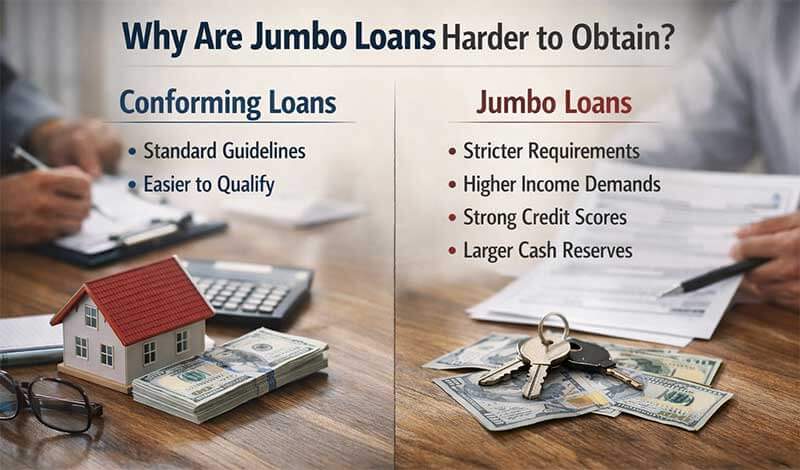
Jumbo mortgage loans involve stricter requirements due to the higher loan amounts, which elevate lender risk. Lenders conduct thorough evaluations of credit history, income stability, and savings. Additionally, they require evidence of sufficient funds remaining after closing. Conforming loans follow a more straightforward, standardized set of rules.
Conforming loans follow standard rules set by agencies, making them easier to qualify for. Jumbo loans have their own rules, which vary by lender and can be harder to meet.
So, you might qualify for a regular mortgage but not for a jumbo loan with the same financial profile. They tend to focus on the whole picture rather than the parts. A borrower with a low income and a long credit history, along with an explanation supporting the low credit score, can be an acceptable case even if the score is low. For past credit history issues, ongoing problems can be difficult to approve. If credit history problems are recent or ongoing, it becomes much more difficult to approve.
An Agency Loan Fits Into The Following Categories Below:
Jumbo loans are portfolio loans. Portfolio loans are loans the lender does not sell to agencies. FHA, VA, USDA, and Conventional loans are agency loans. Lenders of agency loans need to abide the minimum of the particular agency guidelines is they want to sell the loans they fund on the secondary market and/or want the agency to insure the loan. The following are the agency and the loans they insure and guarantee.
- Freddie Mae-Conventional Loans
- Fannie Mac-Conventional Loans
- VA-VA Loans
- USDA-USDA Loans
- HUD/FHA- FHA Loans
Key Features On Jumbo Loans With Low Down Payment
What are some key features of Non-QM Jumbo Loans With Low Down Payment? The main advantage is the ability to only need 10% down without any added mortgage insurance or secondary financing. The 10% down payment Jumbo Non-QM loan only requires a minimum credit score of 660. Reserve requirement of six months PITI. This is incredibly lax compared to most jumbo financing guidelines.
Denied for a Jumbo Loan? Get a Second Opinion
Different jumbo lenders have different rules. We’ll review your scenario and match you with options that may work now—even if one lender said “no.”Jumbo Loans With Low Down Payment Maximum Loan Limits
This is true for long amounts up to $2 million. Not too many folks believe that home buyers can qualify for Jumbo Loans With Low Down Payment and Bad Credit. However, it is true. Gustan Cho Associates are experts in NON-QM Jumbo Mortgages and alternative financing loan programs. We are direct lenders with no mortgage overlays on government and conventional loans.
Jumbo Loans With Low Down Payment With 600 Credit Scores

Let’s use another situation for a borrower and a credit score of 600. This loan program would only require a 15% down payment and six months of reserves. These also have a maximum debt to income of 40/45%. The majority of jumbo financing is capped at 36% back in the debt-to-income ratio. Please read that again, a JUMBO mortgage with 15% down and a score down to 500 FICO.
Co-Borrowers On Jumbo Loans
If borrowers have more than one applicant on the mortgage, the primary wage earners’ middle credit score is used to calculate the down payment needed and interest rate. That right there is a game-changer! They take a common-sense approach to underwriting. If you have a unique situation and would like to get your scenario reviewed by an underwriter, please contact Mike Gracz on (800) 900-8569.
The Role of Compensating Factors
In a jumbo mortgage, the underwriter may consider a larger down payment, more reserves, better-documented income, a low debt-to-income ratio, and length of employment. For jumbo mortgages, underwriters may approve you if you have strengths like a bigger down payment, more savings, steady income, a low debt-to-income ratio, and stable employment.
Positive factors favoring loan applicants are often referred as compensating factors. Compensating factors can help balance out weaknesses in your application, though they don’t guarantee approval.
If the DTI ratio is poor, it is not possible to mortgage the debt on the borrower. Jumbo loans have higher DTI ratios than most other loans. It is very important to know that if your debt-to-income (DTI) ratio is too high, you won’t qualify for a jumbo loan. Jumbo loans often allow higher DTI ratios than other loans, but if your credit is poor, having a lower DTI is especially important. is self-employed and show signs of bad credit, then their scenario is likely to be underwritten more strictly. While positive income strength may be in addition to self-employed underwriting stress.
Reserve Requirements On NON-QM Jumbo Mortgages
Very lax reserve requirements for Jumbo financing. 6-month reserves are needed. THERE ARE exceptions on a case by case basis. Let’s circle back to common sense underwriting. A few key characteristics that will allow the reserve waiver lowered or even eliminated:. 24 months of on-time Mortgage/ rental payments. High credit scores. Larger down payment. No Bankruptcy or foreclosure, short sales, deed in lieu for 60 plus months. In other words, if the only parameter you do not meet is the reserve requirement, borrowers more than likely will get a waiver. Michael Gracz of Gustan Cho Associates is the expert!
When A Borrower Should Wait Before Applying For A Jumbo Loan
In certain circumstances, postponing the application may be advisable. Recent late payments, unstable income, insufficient savings, or unresolved credit issues can result in denial or less favorable loan terms. Allocating time to improve credit, reduce debt, increase savings, and document income can yield more favorable outcomes.
A strategic approach to loan application timing is essential for success. Careful planning can improve approval prospects, as jumbo loans are more difficult to obtain.
Delaying the application to strengthen financial standing may simplify the process and yield better results. In some cases, increasing the down payment to reduce the loan amount below the jumbo threshold may make conforming loan options available. Waiting to improve credit can also expand access to more favorable financing alternatives. The optimal course of action depends on the applicant’s overall financial situation, the property’s value, and the intended timeline. If adequate preparation has not been achieved, it is prudent to avoid rushing into a jumbo mortgage.
Frequently Asked Questions Jumbo Loans With Low Down Payment and Bad Credit
Can I Get Jumbo Loans With Low Down Payment And Bad Credit?
It’s possible, though approval is generally more difficult than with ordinary mortgage programs. When a borrower wants a jumbo loan with a low down payment and bad credit, lenders tend to be more risk-averse. Because of this, they usually require higher income, higher remaining funds, a lower debt-to-income ratio, and a more positive recent payment record.
What Credit Score Do I Need For Jumbo Loans With Low Down Payment?
There is no minimum standard, as jumbo lenders create their own guidelines. Overall, a more positive credit profile is generally needed with a lower down payment.
How Much Down Payment Is Required For Jumbo Loan?
This is determined by the lender, the loan amount, the property, and the overall borrower strength. There are jumbo loans with low down payment options. However, weaker credit often results in a higher minimum down payment.
Are Jumbo Loans Harder To Qualify For Than Conforming Loans?
Certainly. Jumbo loans have more stringent guidelines due to the increased risk for lenders. Underwriting is more thorough than for conforming loans.
Do Jumbo Lenders Look At Reserves After Closing?
Certainly. Reserve requirements are often very important for jumbo financing. After a borrower pays the down payment and closing costs, lenders want to see that the borrower still has an accessible surplus.
Can Self-Employed Individuals With Poor Credit Qualify For Jumbo Loans?
It can happen, but usually, the file is reviewed more closely. Self-employed individuals usually need more robust income documentation, and poor credit is always difficult to approve without strong compensating factors.
Getting Pre-Approved on Jumbo Loans With Low Down Payment And Bad Credit Summary
Gustan Cho Associates has a network of over 300 wholesale mortgage lenders of which many are non-QM lenders. Non-QM loans use alternative income sources and not traditional income such as income taxes. Some non-QM jumbo loans include asset depletion, DSCR loans, P and L statement loans, and bank statement loans.
Using alternative income does have a slight change in the interest rate.If you’re apprehensive about the Non-QM jumbo mortgage, please understand the requirements for documentation are the same for all loan programs.
We will try to fit you in your everyday jumbo mortgage loan if you qualify. As talked about in this guide, many borrowers looking to enter non-QM jumbo mortgage have suffered financially over the past 10 years. Non-QM Jumbo loans can be used as a band-aid loan, meaning you can refinance out of them. When utilizing a Non-QM jumbo mortgage on an owner-occupied property, there will never be a prepayment penalty. This is a great option to get you into your dream home while you wait for foreclosure, short sale, or deed in lieu seasonings and in some cases bankruptcy seasonings to elapse. Please contact Mike Gracz at (800) 900-8569 or text, Michael, for a faster response to go over Non-QM Jumbo mortgage and long-term mortgage goals!