Homebuyers should ask for seller concessions from the home seller to pay closing costs. There are two types of costs for a home purchase. The down payment and closing costs. Most homebuyers do not have to come up with closing costs. Alex Carlucci, a senior mortgage loan officer at Gustan Cho Associates says the following:
Find out how seller concessions work and understand what overages of seller concessions. What occurs when seller credits are more than the closing costs. Know the general rules for FHA, VA, USDA, and Conventional loans before closing.
If structured the home purchase contract correctly, homebuyers do not have to worry about the closing costs. Homebuyers just need to come up with the down payment. Seller concessions are closing cost credits given by the home seller to buyers to cover part, most, or all of the home buyer’s closing costs. Proceeds from seller concessions can be used for any closing costs incurred by the home buyer.
How Do Seller Concessions Apply to a Home Purchase
Seller concessions, also called seller credits, are when the seller helps pay some of the buyer’s costs. If the credit is too high, the buyer and seller may need to adjust the contract, apply the credit to allowed costs, lower the sale price, or move the funds around before closing.
If buyers understand seller concessions, they can avoid surprises later in the mortgage process. For sellers, understanding the rules can help make their offer more attractive and avoid underwriting issues.
Real estate agents and loan officers also benefit from clear transactions. Seller credits usually cover allowed closing costs, prepaid items, and, depending on the loan, a temporary interest-rate buydown. These credits must follow the loan program’s rules and match the buyer’s actual closing costs.
What Are Seller Concessions for Closing Costs
Seller concessions are designed to help the buyer avoid paying a large out-of-pocket amount at closing. Seller concessions are not intended to provide cash to a buyer. If the final closing calculation shows that the buyer does not need the seller concession to cover their allowable closing costs and prepaid items, the buyer typically cannot receive cash back at the closing table. This is often where buyers get confused. You might agree to a large seller concession at first, but later discover your closing costs are lower than expected or the loan program doesn’t allow that much. In these situations, the deal will need to be changed before closing.
What Can Seller Concessions Be Used For?

Seller concessions may cover the costs of lender fees, title fees, recording fees, prepaid taxes, prepaid homeowner’s insurance, and initial escrow fees. Seller concessions may also be applied towards discount points or a temporary buy-down, if the loan program allows it and proper documentation has been submitted. VA also indicates that seller or builder credits may pay all or part of the buyer’s closing costs. Requesting a kickback of the unused portion of the seller concessions is not allowed under any circumstances and is considered mortgage fraud. Sellers concessions can be used to cover the following closing costs, but cannot be used for the down payment on the home purchase:
- title charges
- state and county transfer stamps and fees
- recording fees
- attorneys costs
- inspection fees
- upfront points
- appraisal fees
- homeowners insurance
- pre-paid
- escrows
- any other fees and costs associated with the purchase and closing of the mortgage loan
Homebuyers cannot use seller concessions cannot be used towards the down payment of the home purchase. Seller concessions can also be used to buy discount points. Discount Points are used to lower borrowers’ mortgage rates.
Seller Concessions for Closing Cost
Seller concessions are financial contributions made by a party of interest towards a buyer’s mortgage transaction. Depending on the type of loan, these amounts may include closing costs, prepaid items, temporary buy-downs, or other permitted charges.
Fannie Mae’s guidelines on seller concessions include borrower closing costs, prepaid items, and certain post-settlement HOA assessments. Different expenses do, in fact, differ in treatment.
Some items are deemed customary seller-paid costs in some markets and therefore do not count toward the same concession cap. Fannie Mae states that customary and common fees charged by a seller in a given locality are exempt from the maximum concession financing limit.
Seller Concession Limits by Loan Type
One reason buyers should not assume the same rule applies to every loan is that seller concession rules vary by mortgage program. Conventional financing arrangements with Fannie Mae stipulate that maximum financing concessions are based on occupancy type and the LTV or CLTV ratio. For primary and secondary residences, the limit is 3% for values greater than 90%, 6% for values between 75.01% and 90%, and 9% for values less than or equal to 75%. On the other hand, the limit for investment properties is set at 2% regardless of the CLTV ratio.
Freddie Mac also has stated limits for maximum financing concessions of 3%, 6%, 9%, and 2% based on occupancy type and transaction profile
Seller Concessions on Conventional Loans
Conventional loans can be confusing because buyers often hear one thing (the seller can pay closing costs, but they might not realize this depends on the type of property and the loan-to-value (LTV) ratio. For a second home with an LTV or CLTV > 90%, the maximum closing-cost concession is 3%. If the LTV is between 75.01 and 90%, the maximum concession is 6%. For an LTV of 75% or less, the maximum is 9%. For investment properties, the maximum is usually 2%.
Financing concessions that exceed program limits or the borrower’s actual financing closing costs are treated as sales concessions and may lower the effective sales price under effective sales price underwriting.
This means buyers with a small down payment on a conventional loan may not be able to use as much seller credit as those with larger down payments. If a contract is based on the wrong assumption, it can cause problems during underwriting. Fannie Mae differentiates between financing and sales concessions. That’s the sort of problem that can change a seemingly solid purchase offer into a file that requires last-minute adjustments.
FHA Seller Concessions and Closing Cost Limits
Because of the flexible credit standards and lower down payment options, FHA financing is a common choice for first-time homebuyers. However, the rules regarding seller concessions also apply. These limits are set by HUD, and FHA policy underwriting issues pertain only to amounts above the limit, which are of no underwriting benefit to the borrower.
FHA applies a typical seller concession limit of 6% of the sales price. That can help buyers who are struggling to manage their closing costs and prepaid expenses.
Like other loan types, however, the buyer is not allowed to receive cash back from concessions that exceed the permitted adjustments. The credit must be connected to the costs allowed in the transaction. For buyers with limited cash, FHA seller concessions can lower the amount needed at closing. But, as with other loan programs, giving too much credit can cause contract and underwriting issues.
Differences In VA Seller Concessions And Seller-Paid Closing Costs
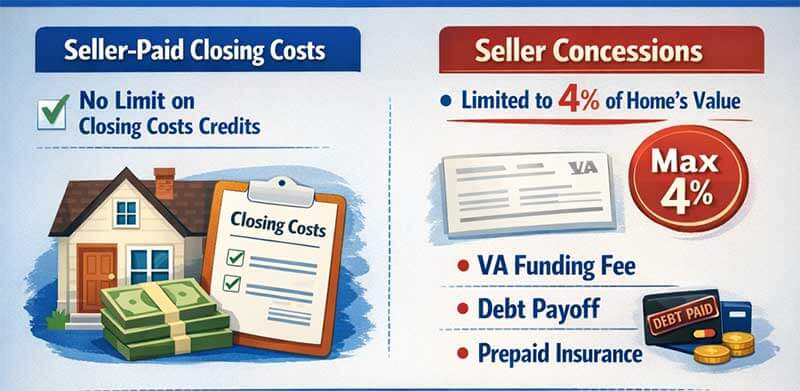
The regulations governing VA loans are often misunderstood because VA distinguishes between seller-paid closing costs and seller concessions. The VA explains that seller or builder concessions may cover all or part of the buyer’s closing costs, and that the VA does not limit the amount of closing-cost concessions.
In VA loans, the VA specifies that there is no ceiling on the amount of closing cost credits, but the seller concessions are limited to 4% of the reasonable value of the home.
The VA also states that concessions are items added to the transaction at no cost to the purchaser, such as paying the VA funding fee, paying off debt, or making an advance payment of hazard insurance. The VA limits seller concessions to no more than 4% of the home’s reasonable value. Furthermore, the VA lists the following concession examples: payment of the funding fee, debt payoff, and prepayment of hazard insurance. This difference matters. While VA loans can offer significant help with costs, it’s important to understand exactly how that help is structured. Not every dollar is counted the same way. That’s why lenders need to review VA transactions closely to make sure concessions are handled correctly.
USDA Seller Concessions Rules for Home Buyers
As of 2025, USDA guidance on guaranteed loans states that the seller concession limit is 6%. This includes a clarification that seller-paid buyer real estate commission fees do not count toward the 6% cap. Since the rules for each program are distinct, buyers should not focus solely on the term “seller concessions.”
Seller concessions cannot be used to cover the buyer’s real estate commission within that 6% limitation. That change is significant because it altered the structure and limits of some transactions under current USDA guidelines.
It can be confusing to offset closing costs if no one explains exactly what the credit covers, whether underwriting allows it, and if it fits the specific dollar and percentage rules for the loan. The best approach is not to push for the highest possible seller concession. Instead, set the credit at a realistic, allowed amount, and make sure, early on, how the lender will treat those costs.
How Buyers and Sellers Can Structure Credits the Right Way
You can usually avoid seller concession overages by basing the contract on realistic numbers rather than overly high estimates. Before asking for a seller concession, buyers should review their Loan Estimate and discuss expected closing costs with their lender.
If the seller wants to help a lot, it may be better to adjust the price, use a temporary rate buydown, or offer a targeted credit instead of a broad concession.
Real estate agents should work with loan officers to ensure the contract aligns with market conditions and lending rules. This is especially important when buyers want the most concessions to keep more cash. The goal is to reduce the cash needed at closing without creating an excess, or ‘overage,’ that must be removed.
Common Mistakes With Seller Concessions
A common mistake is thinking all loan types allow the same seller contribution. That’s not the case. Conventional, FHA, VA, and USDA loans each have their own rules. Another mistake is confusing a seller concession with a general cash benefit to the buyer. Another mistake is mixing up seller concessions with giving cash directly to the buyer.
Mortgage rules don’t allow unused seller credits to be treated as cash for the buyer. The money usually has to be allocated to allowable costs under the deal.
Disclosure is issued, there may be little room to fix a poorly structured concession without amending the contract or changing the deal’s economics. A fourth mistake is not knowing the difference between seller-paid closing costs, seller concessions, standard seller costs, lender credits, and real estate commission deals. These terms may sound alike, but agency rules treat them differently.
What Happens When Seller Concessions Exceed Closing Costs
This is the central issue for this topic. When seller concessions exceed the buyer’s actual closing costs, the overage does not normally benefit the buyer as a refund. Overage of seller concessions occurs when the seller credit exceeds the borrower’s loan program stipulation or exceeds the borrower’s allowable closing costs and prepaid items.
A sales concession can affect underwriting math. If the effective price is reduced for qualifying purposes, the loan-to-value ratio may need to be recalculated. In some cases, that can affect eligibility, pricing, or how the file is underwritten.
On conventional loans sold to Fannie Mae, financing concessions must be equal to or less than the borrower’s closing costs, and any amount above closing costs must be treated as a sales concession. Fannie Mae further states that financing concessions above its program limits are treated as sales concessions and must be deducted from the property’s sales price for LTV and CLTV calculations.
What Does Overages of Seller Concessions Mean
A few different things can happen with seller concessions overages. The first would be the buyer obtaining a seller concession exceeding the maximum percentage allowed by the loan program. The second is if the credit is within the percentage cap, but the actual closing costs drop below the expected amount. The third is too broad-scope contract language that presumes the credit will fund activities the program/lender will not allow.
If credit goes unused after all allowable costs are paid, that amount must be eliminated, reallocated to a different allowable cost, or addressed through a different contract structure.
The mortgage guidelines do not permit seller concessions to be used as cash for the buyer. For buyers, this means a seller credit that looks generous can lose part of its value if it is not matched to real, allowable charges. For sellers, it means offering too much credit can create unnecessary complications rather than helping the deal close. For everyone involved, it means the best contract is usually the one that is accurate, supportable, and aligned with the final loan structure from the start.
What Happens When Seller Concessions Are Greater Than Closing Costs
When you buy a home, seller concessions can help you reduce the amount of cash you need at closing. In many markets, these concessions let buyers cover some or even all of their closing costs, prepaid expenses, or temporary buydown fees. This makes the start of your mortgage more affordable and helps you keep more savings after closing.
A common misunderstanding in the home-buying process is how seller concessions are limited. Seller concessions are not meant to give buyers extra cash.
Fannie Mae also says that financing concessions cannot exceed the buyer’s closing costs. That’s why understanding seller concession overages is important. A deal might look good on paper, but these details can make the difference between a contract that closes smoothly and one that runs into problems.
Seller Concessions Over Closing Costs
Any amount over the closing costs must be classified as a sales concession. Fannie Mae also requires that financing concessions in excess of its program limits be classified as sales concessions and subtracted from the property’s sales price for LTV and CLTV calculations. When seller concessions exceed a buyer’s actual closing costs, the buyer typically will not receive the overage as a refund.
With conventional loans sold to Fannie Mae, the financing concessions must be equal to or less than the borrower’s closing costs. This is important because a sales concession will impact the underwriting math.
When the effective price is lowered for qualifying purposes, the loan-to-value ratio may need to be adjusted. This may, in some instances, impact the eligibility, pricing, or underwriting of the file. For buyers, a large seller credit might seem helpful, but it can lose value if it doesn’t match the allowed costs. For sellers, offering too much credit can cause problems that put the deal at risk. The best contracts are accurate, reasonable, and in line with the loan’s requirements from the start.
Ready to Save on Closing Costs with Seller Concessions?
Contact us today to learn how you can take advantage of seller concessions to save money on your home purchase.Are There Limits For Seller Concessions
Depending on which mortgage loan program an applicant chooses, each program has a maximum amount of seller concessions allowed.
- FHA Loans (Federal Housing Administration) – Maximum seller concessions: 6%
- VA Loans (Veteran Affairs) – Maximum seller concessions: 4%
- USDA Loans (United States Department of Agriculture) – Maximum seller concessions: 6%
- Conventional Loans
- For owner-occupant homes: Maximum seller concessions: 3%
- For second or vacation homes: Maximum seller concessions: 3%
How Agents And Lenders Mitigate Concessions Overages
When it comes to seller concessions, any excess amount must be returned to the seller and cannot be given to the buyer. If the concessions exceed the buyer’s allowed closing costs or the program’s limit, the excess does not go back to the buyer. For conventional loans, any extra is usually considered a sales concession, which means the sales price may need to be adjusted for underwriting.
For example, let’s say you’re buying a home for $200,000, and your lender allows for a seller concession of up to 6%. The seller can help cover up to $12,000 (6% of $200,000) of your closing costs.
If you request the full 6% ($12,000) but only need $8,000 for your closing costs, the remaining $4,000 cannot be given to you as cash or used for anything else. Instead, it must be returned to the seller. So, in this case, while seller concessions can help you cover costs, any unused portion goes back to the seller.
When a Price Reduction May Work Better Than Seller Concessions
Sometimes, lowering the sales price is a better solution than asking for a bigger seller concession. Reducing the price can help if closing costs are too low to use all the seller credit, or if the loan type limits concessions.
In some cases, using seller funds for a temporary rate buydown is a better option if the loan program allows it and the buyer wants lower payments initially.
While a lower price might not fix every affordability problem, it can be simpler than using credits that can’t be fully applied. Fannie Mae counts temporary buydown costs toward its concession limits, so they must still comply with agency rules. The best option depends on the loan program, the buyer’s finances, and the specific costs involved.
Down Payment and Closing Costs Requirements on Home Purchase
There are two types of costs that a home buyer is required to pay on any home purchase. The first is the down payment. The down payment required varies depending on the loan program the buyer chooses. Two loan programs, USDA and VA, do not require any down payments. FHA loans require a 3.5% down payment. Owner-occupied conventional loans require a 3% down payment for first-time home buyers and a 5% down payment for traditional conventional loan programs. Second-home conventional loans require a 10% down payment.
Using Lender Credit For Closing Costs
If the homebuyer is short in closing costs, the lender can offer lender credit instead of a higher mortgage rate. Investment homes require a 20% down payment. Jumbo mortgages require a 20% down payment. Condotel unit mortgage loans require a 25% down payment. Non-warrantable condominium purchases require a 20% down payment.
How Much Should Mortgage Closing Costs Be?
All home purchase transactions have closing costs. Closing costs are costs associated with the closing of a home purchase. Examples of closing costs include the following:
- title charges
- transfer stamps
- inspection costs
- appraisal fees
- upfront points
- homeowners insurance
- pre-paid items
- any other costs and fees associated with the closing of a home loan
What Are Lender Credit Toward Buyers Closing Costs
Many home sellers will help buyers with closing costs by offering seller concessions. Most buyers don’t need to worry about these costs. If a seller chooses not to provide a concession, lenders can give credits to help cover closing costs.
Seller concessions are exclusively applicable to closing costs and prepaid expenses and cannot be applied to the down payment. Lenders may offer credits where borrowers can use the credit to cover closing costs instead of opting for a higher mortgage rate. For more information, please call us at 800-900-8569, text us for a quicker response, or email us at gcho@gustancho.com.
Looking to Save on Closing Costs with Seller Concessions?
Contact us today to discuss how seller concessions can make your home purchase easier and more affordable.How Can I Waive Paying Closing Costs on My Home Purchase and Get It Paid?
Many home buyers have limited funds when buying a new home. There are ways of being creative on a home purchase and more often than not. Homebuyers do not have to worry about closing costs. This is because it can be covered in the following ways: Seller concessions from home buyers. Lender credit to cover closing costs by lenders. In the following paragraph, we will discuss using seller concessions to cover closing costs on a home purchase.
How Much Money Do I Need To Buy a House With a Mortgage
There are two types of costs involving home purchase: the down payment and the closing costs. Home buyers must show that they have a down payment on a home purchase. The down payments can be gifted. Most homebuyers do not have to worry about closing costs on a home purchase. This is because closing costs can be covered with either seller concessions or lender credit.
Down Payment Requirements on Home Purchase
Every loan program has its down payment requirements. The only two mortgage loan programs do not require any down payment on a home purchase. They are the following:
The minimum down payment needed on a home purchase is 3.5% on an FHA mortgage loan. The minimum down payment on a conventional loan is 3% for first-time homebuyers and 5% for home buyers. VA and USDA loans do not require a down payment and offer 100% financing.
HUD Guidelines on Seller Concessions
FHA Loans allow up to 6% seller concessions of the purchase price towards closing costs. What this means is that a home seller can give a homebuyer up to 6% of the home purchase price as a sellers concession. So the home buyer can use it towards any closing costs.
VA Guidelines on Seller Concessions
VA Loans allow up to 4% seller concessions. Conventional loans allow up to 3% seller concessions on owner-occupant properties. Second homes and 2% on investment homes. Seller concessions are very important in many home purchases. Seller concessions are often a necessity to make the deal happen. This is because many home buyers only have the down payment, not the closing costs on a home purchase.
What Can Seller Concessions Be Used For?
The seller concessions can be applied towards closing costs associated with the home purchase. Here are examples of closing costs:
- Discount points
- Title charge charges
- Transfer stamps
- Recording fees
- Home Inspections
- Appraisal costs
- Surveys
- Mortgage loan origination fees
- Mortgage processing and underwriting fees
- Attorneys fees
- Inspection fees
- Pre-Paid:
- Real estate and insurance escrows
- Other costs associated with closing
How Seller Concessions Help Homebuyers Not Come Out of Pocket For Closing Costs
Seller contributions towards closing costs are great for both the buyer and seller. For Buyers with limited funds, having the seller pay the closing costs will make the home purchase possible. Home sellers are worried about offering seller concessions because the house may not appraise.
If the house does not appraise with seller concessions, the home seller can lower the seller concession or get rid of it altogether.
The home seller offering the concession towards closing costs makes the home sale possible. Ultimately, the seller gets their net price from the house sale. The bottom line is that the seller does not lose anything. This is because the seller concessions are part of the home purchase price.
Get Seller Concessions to Reduce Your Closing Costs
Contact us today to learn how you can take advantage of this option in your home purchase process.Case Scenario On How a Home Purchase With Seller Concessions Work
Closing costs are high, sometimes more than the down payment. Here’s a simple example:
Imagine a seller who wants $100,000 for their home. To help the buyer cover closing costs, the seller agrees to give the buyer $6,000 in concessions. This means the home’s sale price goes up to $106,000, but the seller still makes the $100,000 they wanted.
This way, the seller still gets their desired amount, and the buyer doesn’t have to pay the extra closing costs because the seller’s concessions cover that expense. This arrangement works out for both parties.
How Paying Closing Costs With Seller Concessions Works
Before shopping for a home, make sure that the pre-approval is solid. Most loan officers will run credit and AUS FINDINGS before issuing a pre-approval letter. Loan officers should do a full credit analysis.
Loan officers can also estimate tentative closing costs and the down payment required.
Loan Officers will also get you an approximate monthly housing payment. Closing costs can be more than the down payment. This depends on what county and state the property is in. Some states cost more than others due to tax stamps and other state fees.
Lenders Can Offer Lender Credit For Closing Costs In Place of Higher Rate
Homebuyers who are limited on funding besides the down payment can get closing costs covered with seller concessions or lender credit. The majority of home sellers have no problem in offering seller concessions.
Every homebuyer should request a seller concession from home sellers through their real estate agent. Home buyers need to make sure their realtor requests the sellers concession.
The seller’s contribution must be written on the real estate sales contract. Make sure realtors and loan officers communicate before making an offer. Many home buyers often get confused about how seller concessions Work. However, if the buyer is purchasing an investment home, the maximum a home seller can offer in seller concessions is no more than 2% sellers concession to the investment home buyers.
Final Thoughts on Seller Concessions and Closing Costs
Buyers should understand that unused credits usually do not become cash back. Sellers should know that a higher concession is not always better if the deal cannot support it.
Frequently Asked Questions About Seller Concessions:
What Are Seller Concessions In a Mortgage?
Seller concessions are contributions from the seller that help cover certain buyer costs in the transaction, such as allowable closing costs, prepaid items, or other permitted charges under the loan program.
What Happens If Seller Concessions Exceed Closing Costs?
On conventional loans sold to Fannie Mae, any financing concession above the borrower’s closing costs must be treated as a sales concession. Amounts above agency caps may also require the sales price used for LTV calculations to be reduced.
Can a Buyer Get Leftover Seller Concession Money Back at Closing?
Usually no. Seller concessions are generally meant to cover allowable transaction costs, not create extra cash back to the buyer beyond permitted adjustments.
How Can a Seller Contribute to a Conventional loan?
For Fannie Mae conventional loans, principal residences and second homes are generally capped at 3% when LTV or CLTV is above 90%, 6% when it is 75.01% to 90%, and 9% when it is 75% or less. Investment properties are generally capped at 2%.
What is the FHA Seller Concession Limit?
FHA generally allows seller concessions up to 6% of the sales price, subject to current FHA policy and allowable transaction charges.
Are VA Seller Concessions The Same as Seller-Paid Closing Costs?
No. VA says it does not limit credits for a loan’s closing costs, but seller concessions are limited to 4% of the home’s reasonable value. VA treats those categories differently, which is why structure matters on VA loans.
Does USDA Allow Seller Concessions?
Yes. USDA guidance includes a 6% seller concession limitation, and USDA clarified in 2025 that seller funds used to pay the buyer’s real estate commission fees are not counted toward that 6% cap.
What Exactly are Seller Concessions?
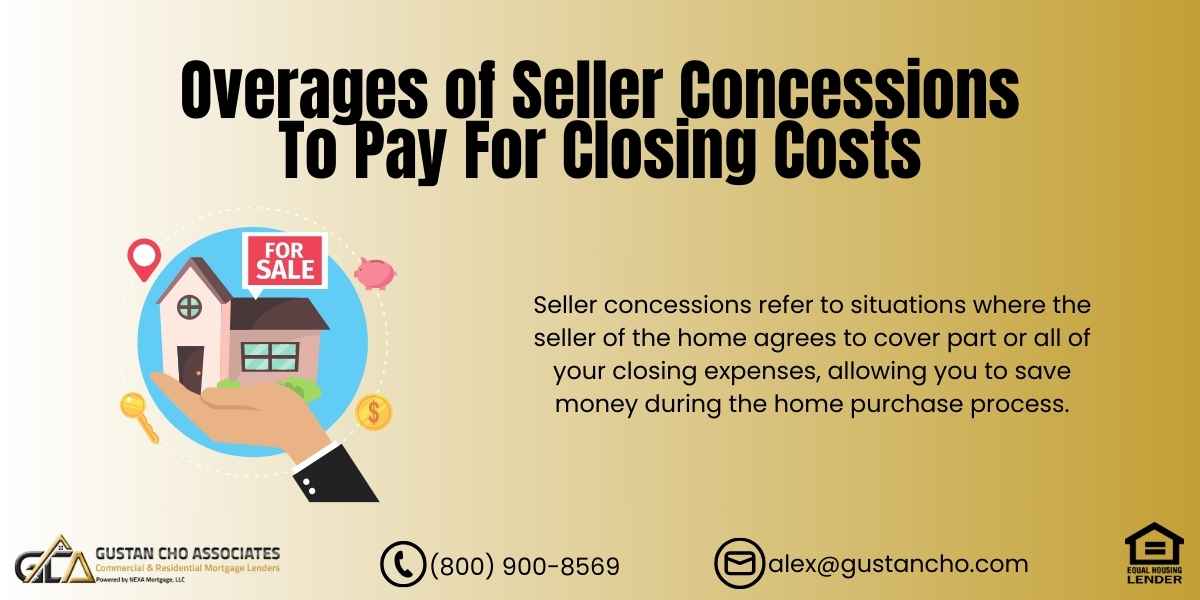
Seller concessions refer to situations where the seller of the home agrees to cover part or all of your closing expenses, allowing you to save money during the home purchase process.
Can Seller Concessions Cover My Down Payment?
No, seller concessions can only cover closing costs and prepaid fees, not your down payment.
How Much Seller Concessions Can I Get with an FHA Loan?
With an FHA loan, the seller can give you up to 6% of the home’s price to help cover closing costs.
Do Seller Concessions Mean I Get Money Back at Closing?
No, any leftover seller concessions you don’t use must be returned to the seller. You can’t get cashback.
Are Seller Concessions Allowed for VA Loans?
Yes, VA loans allow seller concessions of up to 4% of the home’s price to help pay your closing costs.
Can I Ask for Seller Concessions on a Second Home?
If you’re buying a second home, you can request up to 3% in seller concessions.
Why would a Seller Agree to Seller Concessions?
Sellers agree because it helps the buyer afford the purchase. The seller usually raises the home price slightly to cover this cost so they don’t lose money.
If the Home doesn’t Appraise, Can Seller Concessions be Changed?
If the home doesn’t appraise for the agreed amount, the seller concessions can be reduced or removed.
Can Seller Concessions Lower My Mortgage Interest Rate?
Yes, you can use seller concessions to buy discount points, which lower your mortgage interest rate.
What if the Seller Won’t Offer The Seller Concessions?
If the seller doesn’t give seller concessions, your lender might help with lender credit instead. However, that could mean a slightly higher interest rate.
This blog about “Overages of Seller Concessions To Pay For Closing Costs” was updated on April 1, 2026.