In this guide, we will cover HUD FHA 203k loans manual underwriting guidelines for renovation loans. An FHA 203k renovation mortgage can be manually underwritten when the loan receives a Refer recommendation from FHA TOTAL or when FHA rules require downgrading an automated approval to manual underwriting.
HUD FHA 203k loans manual underwriting guidelines vary by Bankruptcy Chapter, discharge date, circumstances, and other FHA requirements, including credit history.
The borrower must meet FHA manual underwriting requirements for credit, income, debt-to-income ratios, reserves, housing history, and compensating factors. The property and renovation project must also meet FHA 203k requirements. Before closing, lenders carefully review your qualifications alongside the specifics of your renovation project. In the following paragraphs, we will cover HUD FHA 203k loans manual underwriting guidelines for renovation loans.
What Is an FHA 203k Renovation Loan?
An FHA 203k Rehabilitation Mortgage enables qualified borrowers to combine financing for both the purchase or refinance of a property and eligible improvements, all in a single FHA-insured mortgage.
Borrowers can include approved renovation costs in their mortgage, eliminating the need for a separate home improvement loan.
Funds are placed in a rehab escrow account and disbursed as work is completed, in accordance with FHA and lender rules. FHA has two main types of programs, the Limited 203k and the Standard 203k. A 203k mortgage is especially useful when a property does not currently meet the FHA Minimum Property Requirements but will after the required repairs are completed.
FHA Limited 203k and Standard 203k
It’s important to know the key differences between Limited and Standard 203k loans. Each one covers different repairs, follows unique consulting and project rules, and sets its own limits on rehab costs.
What Is a Limited FHA 203k Loan?
Limited 203k loans, sometimes called 203k Streamline loans, are designed for smaller remodeling projects and repairs that don’t affect the home’s structure. Currently, the HUD allows a total rehabilitation cost limitation of $75,000 for a Limited 203k. There is no minimum cost requirement for repairs. An approved 203k consultant is not required.
An FHA loan that goes through an Automated Underwriting System relies on the FHA’s TOTAL Mortgage Scorecard for application assessment.
Permitted repairs include kitchen and bathroom remodeling, flooring replacement, painting, certain roofing and plumbing repairs, HVAC improvements, electrical work, non-structural replacements, accessibility and energy-efficiency upgrades, and replacement of appliances, gutters, and siding.
How Mortgage Underwriters Review FHA 203k Loans
The lender reviews and approves the final work plan to ensure it complies with FHA requirements, including all repairs. Standard 203k projects can include major structural work, big remodels, or home additions. These projects must cost at least $5,000. There is no $75,000 limit as with the Limited 203k, but your budget must still fit within FHA’s maximum loan limits, the property’s value, and estimated rehab costs.
A 203k loan requires an FHA-approved 203k. Consultant who prepares the work plan and cost estimate and makes sure the rehab meets FHA standards.
For FHA 203k loans, a ‘Refer’ rating must be approved by an FHA Direct Endorsement underwriter. Sometimes, an Accept rating also needs manual underwriting, which follows FHA rules but allows more flexibility with credit and other requirements. Instead of a computer, a person reviews your full file. The underwriter also checks your willingness and ability to repay the loan.
HUD TOTAL Mortgage Scorecard for FHA Loans
TOTAL Mortgage Scorecard provides an Accept recommendation, and there is no basis for file downgrading, the mortgage is processed subject to the requirements of FHA’s TOTAL underwriting. When FHA SCORECARD provides a Refer recommendation, the application is subject to manual underwriting.
In some cases, an Accept recommendation may also be downgraded if the loan is within certain HUD-identified circumstances.
These may include recent bankruptcies, issues meeting the mortgage payment requirement, certain unresolved derogatory credit, undisclosed mortgage obligations, significant reduction in business income, or other circumstances that limit the ability to fully provide information or answer questions in the TOTAL Scorecard system.
What Does a Refer/Eligible per Automated Underwriting System Findings Mean
Getting a Refer recommendation does not mean your mortgage application is denied. The loan still has to meet all the qualification criteria, but manual underwriting gives you another FHA-approved way to have your application reviewed.
Reasons Why an FHA Loan May Need Manual Underwriting
There are several reasons that may warrant shifting an FHA application from automated to manual underwriting. Receiving a Refer recommendation from the FHA TOTAL system is fairly common.
Another may be when the application received an Accept recommendation, but the lender finds information that FHA requires the underwriter to assess manually.
HUD requires certain downgrades when circumstances include bankruptcy, a recent foreclosure, a deed in lieu, a short sale, mortgage payment issues, a contested derogatory credit, or undisclosed mortgage debt within 2 years of assignment of the FHA case number. Each situation is analyzed on a case-by-case basis, and the relevant FHA guidelines are applied. If you aren’t approved through the automated system, you might still qualify for an FHA 203k loan.
HUD Manual Underwriting Credit Requirements on FHA Loans
When it comes to manual underwriting, the borrower’s payment history is the most important factor. Underwriters look at the entire credit profile.
FHA manual underwriting places the most emphasis on recent credit events because recent credit behavior is a better indicator of the borrower’s financial situation and management than older credit events.
Payment history of housing and installment accounts, revolving credit, major derogatory credit events, and unpaid obligations, late payments, and the borrower’s overall debt management are just some of the factors underwriters may consider.
Need Manual Underwriting for an FHA 203k Loan?
Lower credit scores, higher DTI, limited credit history, or recent credit events may require manual underwriting. We’ll review your compensating factors and approval path.FHA’s Assessment of Payment History on Manual Underwrites
FHA deems a borrower to have an acceptable payment history when there have been no more than two 30-day late payments for mortgage or installment obligations in the preceding 24 months, and all housing and installment obligations have been fulfilled in the last 12 months.
HUD, as well as other mortgage agencies normally want to see timely payments in the past 12 months. Major derogatory credit events on revolving accounts within the past 12 months may warrant further review.
If your payment history falls short of FHA’s credit standards, late payments will be noticed. Every case is reviewed individually. Ideally, all your monthly payments over the past two years should have been on time.
FHA 203k Minimum Credit Score and Down Payment
FHA’s general rules for credit score also apply in this instance with respect to maximum financing. A borrower may qualify for maximum FHA financing with an FHA Minimum Decision Credit Score of 580. In a typical FHA financing scenario, this means 96.5% of the value may be financed, and the borrower must make a minimum 3.5% investment.
For a borrower with a Minimum Decision Credit Score of 500 to 579, HUD has set a maximum loan-to-value ratio of 90%. A borrower with a credit score of under 500 is generally ineligible for FHA-insured financing.
These are FHA’s rules, but not every FHA 203k lender will approve loans at these credit scores. Some lenders set stricter requirements for credit, reserves, contractors, property, or manual underwriting. Always check for lender overlays before applying for an FHA 203k mortgage.
HUD FHA 203k Loans Manual Underwriting Guidelines on DTI
The primary difference between automated and manual FHA loans is how the Debt-to-Income (DTI) ratio is applied to manually underwritten FHA loans.
HUD FHA Loans Manual Underwriting Guidelines with a Credit Score of 500 to 579
Generally, for a borrower in the 500 to 579 credit score range, the limits for manual underwriting are 31% for the front end and 43% for the back end. Borrowers, if your credit score is in this range, you can’t use compensating factors to go above the usual manual DTI limits
Manual Underwriting at a Credit Score of 580 or Above
A borrower with a credit score of 580 or above may qualify for standard housing expense ratios. These ratios can be increased if FHA-approved compensating factors are present. With one acceptable compensating factor, qualifying ratios may be 37% front-end and 47% back-end. If you have no discretionary debt, you may qualify for 40% front-end and 40% back-end ratios. With two acceptable compensating factors, a borrower with a score of 580 or above may qualify for 40% front-end and 50% back-end ratios. These are the highest ratios FHA manual underwriting allows, but they do not guarantee approval. The underwriter still needs to see that your overall credit profile is strong.
Compensating Factors for HUD FHA 203k Loans Manual Underwriting Guidelines
Compensating factors are positive aspects of a mortgage application that the FHA allows underwriters to consider when qualifying ratios exceed the limits of standard manual underwriting. Depending on your DTI, FHA-recognized compensating factors might include verified cash reserves, a small increase in housing expense, leftover income, or extra income that doesn’t count as qualifying income. These factors can strengthen your application by showing you can handle new housing costs, but they won’t offset major credit issues.
What Are Reserves and Do Lenders Require Reserves on Manual Underwriting
For manual underwriting, discuss reserves with your loan officer early in the process. FHA typically requires borrowers to have verified reserves of one month’s PITI for one- or two-unit properties. For three- or four-unit properties, that requirement is usually three months of PITI.
Reserves cannot be gifted or borrowers and must be your own money left after closing. Gifts or borrowed funds don’t count as reserves for FHA manual underwriting.
For one-unit properties, if qualifying rental income from an accessory dwelling unit is considered, then there may be additional reserve requirements, including two months of PITI.
FHA 203k Loans and Chapter 13 Bankruptcy
One of the primary purposes of the FHA manual underwriting is to serve eligible borrowers who are still in Chapter 13 bankruptcy. Having a Chapter 13 bankruptcy is not an automatic disqualification from receiving an FHA-insured mortgage. Generally, the lender can assign the FHA case number only after 12 months have passed since the Chapter 13 payout.
The lender must ensure that the required Chapter 13 payments during that period were made, and made on time and without disruption.
The borrower must obtain approval from the bankruptcy court to proceed with the mortgage transaction. The borrower must still satisfy all other FHA criteria and conditions regarding income, assets, debts, housing history, duration, and amount of reserves and debts, and mortgage and property eligibility, including 203k requirements. Just because, even if you meet FHA requirements, not all lenders will process a manually underwritten FHA 203k loan during an active Chapter 13 bankruptcy.
FHA 203k Loans After Bankruptcy Mortgage Guidelines
FHA generally requires a two-year waiting period after a standard Chapter 7 discharge under the manual guidelines. Under exceptional documented circumstances, a borrower’s financial behavior after bankruptcy may permit a waiting period of less than 1 but more than 0 years. A bankruptcy discharge dated within two years of the assignment of the FHA case number is one of the situations that require an Accept classification. All bankruptcy documents should be reviewed before making an offer on a property that needs renovation.
What Properties Are Eligible for FHA 203k Financing?
FHA 203k financing is only applicable to certain eligible residential properties that meet FHA standards after rehabilitation. Eligible Properties include certain one and two-to-four-unit homes, townhouses, and certain qualifying condominium and manufactured homes, HUD-owned properties, and certain primarily residential mixed-use properties.
The property must generally have been completed for a minimum of one year prior to the assignment of an FHA case number.
A house that currently does not qualify for regular FHA 203(b) financing due to safety, security, or property-condition issues may be eligible for a 203k mortgage since the approved rehabilitation would remedy those deficiencies.
What the Limited 203k Does Not Cover
Limited 203k financing cannot be used when the project exceeds the FHA’s definition of major rehabilitation. A project will exceed the Limited program, among other things, if it exceeds nine months, requires plans or architectural drawings, requires the borrower to be unable to occupy the property for more than 30 total days, or meets FHA’s definition of major rehabilitation.
Effective June 23, 2026, FHA’s Limited 203k program allows up to four draws per contractor. A project that requires more drawings falls outside the Limited program.
When the Limited 203k program does not fit the scope of the rehabilitation project, the Standard 203k program may be the appropriate FHA rehabilitation program.
FHA 203k Loan HUD Consultants
For Standard 203k, the borrower is required to utilize an FHA-approved 203k Consultant. The Consultant examines the property and prepares the Work Write-Up and cost estimate, which define the required work and the specifications. FHA does not require a Consultant for Limited 203k projects. However, a Consultant may be utilized, and HUD permits financing of eligible Consultant fees in the Limited 203k program, as currently written. Borrowers should not confuse the FHA 203k Consultant with a contractor. They serve different functions in the rehabilitation transaction.
Contractor Selection for an FHA 203k Loan
Contractor selection is crucial to the success of an FHA 203k loan. The lowest bid is not always the best choice. Pick a contractor who knows renovation details, lender paperwork, permits, timelines, inspections, payment requests, lien rules, and the payment schedule. The lender must review and sign off on the rehabilitation documentation before closing. Before you sign a contract or make a large, non-refundable payment, check with your lender about any contractor requirements. Some lenders require contractor conditions that go beyond the HUD minimum.
Can you do a Manual Underwriting on an FHA 203k Loan?
Can a Borrower Do Their Own FHA 203k Repairs?
There are provisions within the FHA’s Rehabilitation Self-Help Agreement, which is used when borrowers do their own repairs. Any lender can review and approve a Self-Help project, but many lenders will not approve Self-Help Repairs. Even if FHA rules allow self-help repairs, you must get lender approval before relying on sweat equity or your own labor.
How the FHA 203k Appraisal Process Works
The appraisal for an FHA 203k loan is not the same as a standard appraisal because the appraiser evaluates the property after the authorized rehabilitation is complete.
The mortgage calculation considers the property’s value after improvements, subject to FHA valuation and maximum mortgage regulations.
This allows the loan to reflect planned improvements, not just the property’s current condition. The automated appraisal practice for every 203k transaction has proven to be misleading. Final completion is addressed through applicable inspections, draws, consultants, and closings. Certain situations may warrant additional value work, but borrowers should exercise caution and not expect to incur a second complete appraisal.
Denied for an FHA 203k Renovation Loan? Get a Second Opinion
Some lenders avoid FHA 203k loans or add overlays on manual underwriting. We’ll review your file and see whether another FHA 203k approval path may still work.How FHA 203k Renovation Funds Are Paid
Post-closing funds for renovations are not released to borrowers in cash form as unrestricted funds. Approved renovation funds are placed in an escrow account and released in accordance with FHA and lender provisions as renovations are completed.
The current standard FHA policy for 203k permits a maximum of five draws composed of four interim draws and one final draw. Each draw may include multiple disbursements.
The current FHA policy for Limited 203k permits a maximum of four draws per contractor or when the borrower acts as the contractor under an approved arrangement. These draws consist of an initial draw, no more than two interim draws, and a final draw. Both you and your contractor should understand the draw process before construction starts, since cash flow issues can slow down your project.
Does a 203k Renovation Have to Be Completed?
HUD permits completion within 12 months for a Standard 203k. The Limited 203k may permit a rehabilitation period of up to 9 months. The completion period is established with the rehabilitation documents and reflects the scope of the work. (HUD) These longer time frames have replaced the old FHA 203k rules that some websites still mention.
Can Mortgage Payments be Financed During FHA 203k Renovations?
A Standard 203k may permit financing a Mortgage Payment Reserve when the property cannot be occupied during the rehabilitation. Currently, HUD allows the mortgagee to establish a financing reserve of up to 12 months of mortgage payments, but only while the property is unoccupied and within the approved & completed rehabilitation time period. This can be very helpful if major construction means you can’t live in your home during renovations. A financeable Mortgage Payment Reserve is a separate and distinct concept from the personal reserves that are required for manual underwriting.
How the FHA 203k Loan Amount Is Calculated
The maximum FHA 203k mortgage is not the sales price plus the amount the borrower wants to spend on improvements. FHA uses a specific calculation that considers the property’s as-is value, eligible rehabilitation costs, the estimated value after improvements, the applicable loan-to-value ratio, and the FHA area mortgage limit.
For most non-condo units, FHA’s calculation can use an after-improvement value of up to 110% in the applicable formula. For condo units, FHA’s calculation is limited to 100% of the after-improvement value.
The final base mortgage is subject to the applicable FHA mortgage limit. While the Standard 203k doesn’t have a set renovation budget cap, the loan still has to fit within the FHA’s mortgage and value limits. Not having the $75,000 cap from the Limited program doesn’t mean loan-to-value rules don’t apply.
FHA Mortgage Insurance on 203k Loans
FHA mortgage insurance applies to FHA 203k loans because they are FHA-insured mortgages. When reviewing the total housing payment, borrowers should consider the full payment, including property taxes and insurance, as well as any mortgage and FHA insurance premiums, since these may affect the total payment and the borrower’s ability to qualify. This is especially applicable to a Manual Underwrite since the Underwriter must perform a Total DTI and Housing Ratio Analysis.
HUD FHA 203k Loans Manual Underwriting Documents
A manual underwrite for an FHA 203k loan requires much more paperwork than an automated FHA purchase. Borrowers should be prepared to provide employment verification, qualifying income, documents verifying sufficient funds to close, assets, and any required post-closing reserves.
They should expect to provide supporting documentation for employment, housing history, and debts. Applicants should be prepared to address any bankruptcy and major credit events that may have occurred.
The construction side of the 203k may require copies of all contracts, bids, permits, architectural drawings, appraisals, and any other project-related documents. Gathering these documents ahead of time is a smart move, especially if you have a signed contract and tight deadlines.
HUD FHA 203k Loans Manual Underwriting Guidelines with Lender
One of the biggest challenges for FHA 203k applicants is finding a lender who offers both FHA 203k loans and manual underwriting. HUD sets requirements for FHA insurance. However, it can be difficult to find a lender who offers both FHA 203k loans and manual underwriting.
If a lender denies a loan application, it may reflect that lender’s specific requirements rather than noncompliance with HUD Agency Guidelines and FHA rules. Even if HUD permits manual underwriting, a lender may still choose not to approve the loan.
Lenders may impose additional requirements such as higher credit score minimums, restrictions on manual underwriting for renovation loans, limits on Chapter 13 loans, extra reserve requirements, bans on self-help work, contractor standards, or restrictions on certain property types.
Step by Step HUD FHA 203k Loans Manual Underwriting Guidelines
After you qualify, your application enters the underwriting process. The review covers your income, assets, debts, credit, housing history, bankruptcy, DTI, and reserves. If you’re planning a major renovation, prepare for a long-term commitment. After a property is identified, the repairs to be done will determine if it is a Limited or Standard renovation loan. The scope of work and the contractor documentation are done after a decision is made on the type of loan.
A Standard renovation loan requires the use of an FHA-approved 203k Consultant. The Limited renovation loan may use a Consultant, but is not required.
The appraiser conducts an evaluation, and the lender performs a mortgage calculation to determine whether the property, loan amount, renovation budget, and borrower meet FHA guidelines. When loan manual underwriting is required, a Direct Endorsement underwriter reviews the borrower’s credit, income, assets, liabilities, reserves, and compensating factors.
Common Reasons the FHA 203k Manual Underwrites Get Delayed
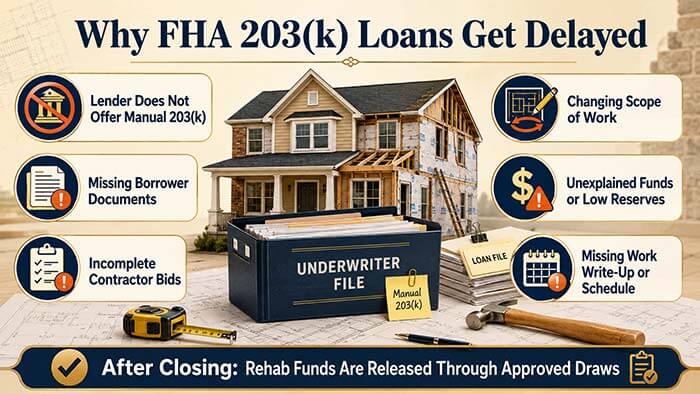
With the right preparation, you can avoid most delays in the process. One common cause is starting the loan process before confirming the lender will approve a manual underwrite on a 203k loan. Another issue is using a contractor that has no experience with renovation financing and draws.
After all borrower and renovation requirements are satisfied, the mortgage can proceed to closing. Rehabilitation funds are placed in a closing escrow and disbursed through the approved draw process subsequent to closing.
Loan file review can be delayed by incomplete bankruptcy filings, unexplained deposits, missing credit reports, changing contractor bids, last-minute rehab schedules, insufficient savings, and changes to the planned work. Try to complete as much of the underwriting process as possible before selecting a property that needs major renovations.
Example of an FHA 203k Manual Underwrite
This example illustrates a borrower who wishes to purchase a home with a new roof, HVAC, electrical, flooring, and kitchen renovations. This borrower has a job and the required income, but receives a Refer recommendation through the FHA TOTAL program, which requires manual review. An FHA lender that supports 203k manual underwriting will evaluate the borrower’s file and determine whether the borrower is eligible under the FHA manual underwriting guidelines. The underwriter will analyze the borrower’s employment, income, credit, monthly obligations, reserves, and the proposed mortgage and reconstruction of the home. While the renovation team reviews the property, they determine whether a Limited or Standard 203k applies, verify the contractor’s scope and costs, collect the required appraisal and consultant documents, and set up the rehabilitation escrow. The mortgage will not close unless both the borrower and rehabilitation project fulfill specific FHA and lender criteria. These are key considerations for the FHA 203k manual underwriting process.
Tips for Increasing the Probability of FHA 203k Manual Underwriting Approval
Manual underwriting cases need thorough pre-approval. Keep a strong record of recent housing payments, avoid late payments, and hold off on opening new credit accounts during the mortgage process. Make sure you have sufficient funds for your investment, closing costs, and reserves. Provide detailed explanations and supporting documents for every major credit event when your lender requests them. If your transaction involves a Chapter 13 bankruptcy, request court authorization as early as possible rather than waiting until just before closing. Ensure the contractor is experienced and that the proposed work fits the right FHA 203k program. Check with your lender to confirm they’re ready to move forward before making any major financial commitments.
HUD FHA 203k Loans Manual Underwriting: Final Thoughts
FHA 203k loans provide an opportunity to purchase homes that require repairs and offer financing when other options are unavailable. Manual underwriting is beneficial when automated FHA approval is not obtained or when HUD rules require a more detailed review. Neither option eliminates underwriting requirements.
The borrower must meet financial requirements. The property must meet our criteria. The renovation must meet the appropriate 203k program requirements.
We must review and approve the contractor and supporting documentation. The mortgage must conform to FHA guidelines. The main challenge is finding a lender who offers both FHA 203k loans and manual underwriting.
Need Assistance with FHA 203k Manual Underwrite Renovation Loans?
Gustan Cho Assoc. may be able to assist you if you are purchasing a fixer-upper, refinancing a house that needs work, experiencing a Refer/Eligible underwriting find, rebuilding your credit, or having an FHA 203k request processed during or after a Chapter 13 bankruptcy. Gustan Cho Associates may also offer assistance in other scenarios.
Before Moving Forward, Make Sure You Know the Answers to These Three Basic Questions:
- Does the borrower meet FHA Manual Underwriting requirements?
- Does the proposed property meet the FHA 203k financing guidelines?
- Will the proposed renovation meet the guidelines of the Limited or Standard 203k Program?
These guidelines may also apply to other work under the FHA 203k Program. The team at Gustan Cho Associates are experts with HUD FHA 203K loans manual underwriting guidelines and is available 7 days a week, evenings, weekends, and holidays. The team at Gustan Cho Associates are experts in all government and conventional loan programs. Please reach out to Gustan Cho Associates at (800) 900-8569 or text 262-627-1965 for a faster response. You can also email us at gcho@gustancho.com. The Team at Gustan Cho Associates is available 7 days a week, evenings, weekends, and holidays.
FAQs: HUD FHA 203k Loans Manual Underwriting Guidelines
What are HUD FHA 203k Loans Manual Underwriting Guidelines?
HUD FHA 203k loan manual underwriting guidelines allow for the manual underwriting of renovation loans. This means that even if a loan doesn’t get automated approval, the lender can still approve it through manual review.
Why Do Some Lenders Not Offer FHA 203k Loans with Manual Underwriting?
Many lenders choose not to offer FHA 203k loans with manual underwriting because they have stricter internal guidelines or overlays, even though HUD FHA 203k loans’ manual underwriting guidelines permit it.
What Types of Renovations Can I Do with an FHA 203k Loan?
With an FHA 203k loan, you can renovate kitchens and bathrooms, add rooms, repair roofing, upgrade plumbing, and more. The HUD FHA 203k loans manual underwriting guidelines cover minor and major renovations.
Can I Get an FHA 203k Loan if I’m in a Chapter 13 Bankruptcy?
If you are in an active Chapter 13 Bankruptcy repayment plan or recently discharged, HUD FHA 203k loans manual underwriting guidelines allow for manual underwriting of your loan.
What’s The Difference Between FHA 203k Streamline and Standard Loans?
The FHA 203k streamline loan is for renovations up to $35,000, while the standard loan has no renovation budget limit. According to HUD FHA 203k loans manual underwriting guidelines, both can be manually underwritten.
What Happens if My FHA 203k Loan Doesn’t Get Automated Approval?
Suppose your loan doesn’t get automated approval. It can still be processed through manual underwriting if it meets HUD FHA 203k loans manual underwriting guidelines.
How Can I Ensure My FHA 203k Loan is Approved Through Manual Underwriting?
Make sure your credit history, income, and debts are well-documented. HUD FHA 203k loans manual underwriting guidelines will review your financial situation more thoroughly than automated systems.
Is There a Waiting Period After Chapter 13 Bankruptcy for FHA 203k Loans?
There’s no waiting period after Chapter 13 Bankruptcy discharge for FHA 203k loans if you go through manual underwriting. This is allowed under HUD FHA 203k loans manual underwriting guidelines.
Can I Choose My Contractor for an FHA 203k Renovation?
Certainly, you have the freedom to select your contractor; however, they must receive approval from your lender and satisfy the criteria outlined in the HUD FHA 203k loans manual underwriting guidelines.
What are the Benefits of Working with a Lender That Follows HUD FHA 203k Loan Manual Underwriting Guidelines?
Working with such a lender gives you a better chance of loan approval if your financial situation doesn’t fit automated criteria. This flexibility is key to accessing renovation financing through HUD FHA 203k loans manual underwriting guidelines.