What is a Conforming Versus Non-Conforming Mortgage? A Complete Homebuyer Guide
This guide covers conforming versus non-conforming mortgage loans. Homebuyers and homeowners have a variety of mortgage loan programs to choose. There are conforming versus non-conforming mortgage loan programs. Conforming Loans needs to conform to government and/or conventional mortgage guidelines. John Strange, a senior mortgage loan originator at Gustan Cho Associates says the following about conforming versus non-conforming mortgage loans.
Learn what conforming versus non-conforming mortgage loans mean, how loan limits work, and which loan option may fit your home purchase.
Depending on the borrowers credit profile and the type of property they want to purchase and/or refinance dictates whether they qualify for conforming versus non-conforming mortgage loans. Lenders can offer government and conventional loan programs. Government and Conventional Loans are called conforming loans because they need to conform to FHA, VA, USDA, FANNIE MAE, FREDDIE MAC mortgage guidelines.
Conforming Versus Non-Conforming Mortgage: Main Difference
Many homebuyers encounter the terms conforming and non-conforming mortgage loans during the loan process, but may not know what they mean. Understanding the difference is important because it can affect your loan choices, down payment requirements, credit score needs, mortgage rate, approval process, and how quickly you can close.
Common Features of Conforming Mortgage Loans
A conforming mortgage loan is a conventional loan that complies with the rules set by Fannie Mae and Freddie Mac, including annual loan limits.
A non-conforming mortgage loan does not meet these rules. Examples of non-conforming loans are jumbo loans, non-QM loans, bank statement loans, DSCR loans, foreign national loans, and other special mortgage programs.
For 2026, the baseline conforming loan limit for a one-unit property in most of the United States is $832,750, according to the Federal Housing Finance Agency. Higher limits apply in certain high-cost areas, and Fannie Mae lists higher baseline limits for two-unit, three-unit, and four-unit properties. At Gustan Cho Associates, we help borrowers compare conforming and non-conforming mortgage loans so they can see which option matches their credit, income, debt-to-income ratio, property type, and long-term homeownership plans.
Why Conforming Loans Matter to Homebuyers
A conforming mortgage loan is a conventional mortgage that meets the requirements of Fannie Mae and Freddie Mac. These loans are called “conforming” because they follow the rules needed for Fannie Mae or Freddie Mac to buy the loan from the lender after closing.
Conforming loans are often a strong choice for borrowers with good credit, stable employment, verifiable income, and a property that meets conventional lending standards.
Conforming loans are not government loans. They are not FHA, VA, or USDA loans. A conforming mortgage is a type of conventional loan that meets agency standards for loan size, credit profile, income documentation, debt-to-income ratio, property type, and overall risk.
Conforming Versus Non-Conforming Mortgage Rates
Conforming loans are popular because they usually have good mortgage rates, flexible down payment options, and are widely available. Many people with good credit, steady income, and reasonable monthly debts can qualify for a conforming loan.
Because conforming loans follow Fannie Mae and Freddie Mac rules, many lenders use automated systems like Desktop Underwriter (DU) or Loan Product Advisor (LPA) to review applications.
These systems help determine whether a borrower is automatically approved. Conforming mortgage loans usually require full income verification, a credit check, asset verification, and an appraisal. Some programs let you qualify with as little as 3% down, but if your down payment is under 20%, you may need private mortgage insurance.
What Is a Non-Conforming Mortgage Loan?
A non-conforming mortgage loan does not meet Fannie Mae or Freddie Mac rules. This does not mean the loan is bad or risky. It just means the loan does not fit conforming mortgage guidelines. A mortgage may be non-conforming because the loan amount is too high, the borrower uses alternative income documentation, the property type is unusual, or the credit profile does not fit standard conventional guidelines.
Non-Conforming Does Not Always Mean Bad Credit
Many people assume that non-conforming mortgage loans are only for those with bad credit, but that is not true. Someone with excellent credit may need a non-conforming loan if they are buying a home that exceeds the conforming loan limit. This type of loan is called a jumbo loan. may have high income but may be self-employed and unable to qualify using traditional tax returns. That borrower may need a bank statement mortgage loan, which is also considered non-conforming.
Common Types of Non-Conforming Mortgage Loans
Non-conforming mortgage loans may include jumbo loans, non-QM loans, bank statement loans, DSCR investment property loans, asset-based loans, ITIN mortgage loans, foreign national loans, recent bankruptcy mortgage loans, and loans for unique property types. These programs can help when a borrower does not meet the usual requirements for a conforming loan.
Non-Conforming Mortgage: Main Difference
The main difference between conforming versus non-conforming mortgage loans is whether the loan meets Fannie Mae and Freddie Mac requirements. A conforming mortgage fits agency rules. A non-conforming mortgage falls outside those rules.
For 2026, the FHFA announced that the baseline conforming loan limit for a one-unit property in most U.S. counties is $832,750. High-cost areas may allow higher conforming loan limits, up to 150% of the baseline limit in eligible areas.
This difference can affect approval guidelines, the flexibility of the process, interest rates, down payment requirements, mortgage insurance, paperwork, reserve requirements, and how the loan is handled after closing. One of the biggest differences is the conforming loan limit. If the loan amount exceeds the conforming loan limit for that county and property type, the mortgage becomes non-conforming.
Guidelines Are Another Major Difference
Conforming loans must follow Fannie Mae or Freddie Mac rules. Non-conforming loans are usually based on investor guidelines, portfolio lender rules, or non-QM lender requirements. This is why choosing the right mortgage company is important. Sometimes, borrowers are turned down by one lender because of extra rules, not because they do not qualify.
Conforming Loan Limits?
Conforming loan limits are the maximum loan amounts Fannie Mae and Freddie Mac can generally purchase. These limits are updated annually by the Federal Housing Finance Agency. The limit depends on the year, county, property type, and whether the home is in a standard-cost or high-cost area. Higher limits may apply for two-unit, three-unit, and four-unit properties, as well as certain high-cost locations.
Why Conforming Loan Limits Change
Conforming loan limits change because home prices change. The FHFA adjusts loan limits using a formula tied to home price movement. Freddie Mac reported that the 2026 loan limits increased by 3.26% based on FHFA house price data between the third quarter of 2024 and the third quarter of 2025. This matters because higher loan limits can help more borrowers stay within conforming mortgage limits rather than needing a jumbo loan.
Why County Matters
A borrower buying a home in one county may have a different conforming loan limit than a borrower buying in another county. High-cost housing markets may have higher conforming loan limits. This is why borrowers should not rely on a general national number. The right conforming loan limit depends on where the property is and how many units it has.ng mortgage loan that exceeds the conforming loan limit for the property’s county and unit count. For example, if the conforming loan limit for a one-unit property in a standard-cost area is $832,750 and the borrower needs a loan amount above that limit, the loan may be considered a jumbo loan.
Jumbo Loans Are Common in High-Price Housing Markets
Jumbo loans are common in expensive housing markets where home prices exceed the conforming loan limit. Buyers in areas with higher home values may need jumbo financing even with high income and excellent credit.
Jumbo Loans Usually Have Stricter Requirements
Jumbo lenders may require stronger qualifications, including higher credit scores, larger down payments, more savings, lower debt-to-income ratios, and additional paperwork. Because jumbo loans do not meet Fannie Mae or Freddie Mac guidelines, lenders and investors assess risk more closely.
A non-QM mortgage loan is a non-qualified mortgage that does not fit the standard qualified mortgage rules used by many traditional lenders. Non-QM loans are a major category of non-conforming mortgage loans.
Non-QM does mean no rules. It means the loan complies with alternative investor guidelines rather than standard agency guidelines.
Who May Need a Non-QM Mortgage?
Self-employed borrowers, real estate investors, borrowers with recent credit events, borrowers with high debt-to-income ratios, and borrowers with alternative income documentation may benefit from a non-QM mortgage. A borrower may be able to repay the loan but may not meet traditional conforming mortgage documentation requirements.
Examples of Non-QM Loan Programs
Common non-QM programs include bank statement loans, DSCR loans for real estate investors, 1099 income loans, asset depletion loans, profit-and-loss statement loans, and loans for borrowers with recent bankruptcy, foreclosure, short sale, or deed-in-lieu. These programs can help financially strong borrowers who do not meet standard conforming mortgage requirements.
Bank Statement Loans Versus Conforming Loans
A bank statement loan is usually a non-conforming mortgage option for self-employed borrowers. Instead of using traditional tax returns, the lender may review personal or business bank statements to calculate income. This can help business owners whose tax returns show less income due to business deductions.
FANNIE MAE and Freddie Mac Conforming Loan Guidelines
Conforming loans generally require income to be documented in accordance with Fannie Mae or Freddie Mac standards. Self-employed borrowers may qualify, but their income must be calculated from tax returns, business history, and supporting documentation. If the tax return income is too low, the borrower may not qualify for a conforming mortgage, even if the business is doing well. An ent mortgage may help when a self-employed borrower has strong deposits, steady business revenue, good cash flow, and an adequate down payment but does not show sufficient income on tax returns for a conforming loan.
DSCR Loans Versus Conforming Loans
A DSCR loan, or debt service coverage ratio loan, is a non-conforming mortgage option often used by real estate investors. Instead of qualifying primarily on the borrower’s personal income, the lender assesses whether the property’s rental income supports the mortgage payment.
Conforming vs. Non-Conforming Loans: Which Is Best for You?
Compare benefits, guidelines, and rates to find the ideal mortgage loan for your home purchase.Why Investors Use DSCR Loans
Real estate investors often use DSCR loans because they may own multiple properties, have complex tax returns, or prefer qualifying based on property cash flow. A DSCR loan can help when rental income is strong, but the borrower does not want to use regular or tax return income to qualify.
What is a Conforming Versus Non-Conforming Mortgage?
When looking for a mortgage, you’ll often come across the terms “conforming” and “non-conforming.” These labels help describe how a loan stacks up against the rules set by Fannie Mae and Freddie Mac, the two government-supported companies that buy and insure most mortgages in the U.S. John Strange, a senior mortgage loan originator explains the difference between conforming versus non-conforming mortgage loans:
A conforming loan satisfies their benchmark rules, which cover loan size, credit score, debt-to-income ratio, and the paperwork lenders must collect. In contrast, a non-conforming loan fails to meet one or more standards.
Common examples include jumbo loans, which exceed the maximum size the GSEs will buy, loans for borrowers with special income situations, or loans with other higher-risk features. Which mortgage is right for you hinges on your finances, credit score, your income structure, and the type of home you’re buying. Let’s dig into the main differences to find the best option for your needs.
What You Should Know About Conforming Mortgages
Conforming mortgages are loans that conform to the rules set by Fannie Mae and Freddie Mac. The rules cover the loan amount, and these limits change each year. In 2025, the standard limit will be $806,500 for most places, with higher amounts allowed in expensive areas.
Here Are The Other Main Rules for Conforming Mortgage Loans:
- You’ll usually need a credit score of 620 or higher.
- Your debt-to-income ratio can’t go over 45% to 50%.
- You must prove your income and assets with full documents.
- The property must be appraised and meet agency standards.
Because lenders consider these loans safer, they tend to have lower interest rates than loans that don’t follow these guidelines.
What Makes a Mortgage Non-Conforming?
Non-conforming mortgages are loans that don’t fit the mold that the government-sponsored entities Fannie Mae and Freddie Mac have laid out. They might go over the maximum amount allowed (often called jumbo loans), or they can involve borrower situations that are a bit out of the ordinary, such as:
- Credit scores that dip below the usual acceptable level.
- Debt-to-income ratios that are higher than the norm.
- A recent bankruptcy or foreclosure on the record.
- Self-employed income or paychecks that don’t follow a clear pattern.
- Borrowers who are foreign nationals or who don’t live in the U.S. full-time.
Lenders who make these loans can set guidelines or pass them to private investors. Because the risk sits a bit higher, these loans often have steeper interest rates or requests for bigger down payments.
Conforming Versus Non-Conforming Mortgage: Key Differences
The biggest divide between conforming and non-conforming mortgages is whether the loan can be sold to Fannie Mae or Freddie Mac.
Check Out These Main Points of Separation:
- Loan Amount: Conforming loans stay under the maximum caps.
- Non-conforming loans—especially jumbo loans—go past those caps.
- Backer: Conforming loans have the government’s safety net.
- Non-conforming loans don’t share that safety net.
- Rates: Conforming loans generally give you friendlier interest rates and better lending terms.
- Credit Stance: Non-conforming loans let you use alternative credit files or accept lower credit scores.
- Documentation: If you take out a non-conforming loan, you can use profit and loss statements, or skip income proof altogether.
Who Should Think About a Non-Conforming Mortgage?
These mortgages work best for people who don’t fit the mold for regular loans. You might want one if:
- You want to borrow more than the regular limit.
- You run a business and can’t give the usual pay stubs or W-2s.
- Your credit report has a few recent issues, but you can explain them.
- You want to buy a one-of-a-kind property that regular loans won’t cover.
- You don’t have permanent residency status, like foreign nationals or visa holder s.
- A non-conforming mortgage could be the key to your new home even if a standard loan won’t work.
What to Know About Conforming Mortgage Loans
Pros of Conforming Loans:
- Typically lower interest rates.
- Straightforward approval for qualified borrowers.
- Backed by Fannie Mae and Freddie Mac.
- Rules are the same no matter where you go.
Cons of Conforming Loans:
- Rules can be too strict.
- Income and credit score limits can leave some people out.
- There’s a cap on how much you can borrow each year.
- Conforming mortgage gives good rates and a smooth process if you follow the agency guidelines.
Non-Conforming Mortgage Loans: Pros & Cons
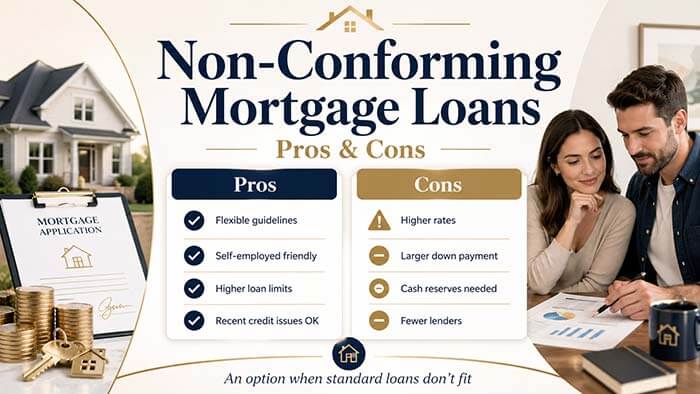
Pros of Non-Conforming Mortgage Loans:
- Flexible Qualifications: Non-conforming loans have looser eligibility rules, making them easier for some borrowers to obtain.
- Great for Freelancers: If you’re self-employed, have gig income, or get paid in stock, lenders are more likely to accept your income.
- Higher Limits: Non-conforming loans can go beyond the usual property price ceiling so that so you can borrow more for bigger homes.
- For Recent Credit Issues: Even if you had a bankruptcy or a low score a couple of years ago, you can still get approved.
Cons of Non-Conforming Mortgage Loans
- Higher Rates: Expect to pay more in interest than you would with conforming loans.
- Bigger Down Payment: You might need to put down 10%-20% or more right away.
- Extra Reserves: Many lenders want you to show 6-12 months of mortgage payments in cash reserves.
- Fewer Lenders: Only a limited number of banks and credit unions offer these loans, so your options are narrower.
If the standard loan programs don’t fit, these loans can help you borrow what you need, even if your file is rough.
Refinancing Non-Conforming Into Conforming Mortgage Loans
Absolutely! You cay refinance a non-conforming mortgage into a conforming loan if your mortgage balance drops below the conforming limit or your credit score improves.
Perks of Refinancing
- Lower Rates: Conforming loans often come with better interest rates.
- Smaller Monthly Payment: A lower rate usually translates into a lower monthly bill.
- More Loan Options: You can access a wider array of conventional loan programs.
- Remember, when you refinance, you must meet all the current conforming rules, so be sure you qualify!
Picking the Perfect Mortgage for You
The best mortgage for you isn’t just about whether the loan is conforming or non-conforming. It’s about what fits your situation. A conforming loan might be straightforward and cost-effective if you’re a W-2 employee with solid credentials. However, a non-conforming loan could get you into a home more easily if you’re self-employed, bouncing back from credit troubles, or buying a higher-priced home. It’s smart to work with a lender who offers both loan types and specializes in finding the loan program that fits your life, not just your credit score.
What Are Conforming Loan Limits?
Jumbo Loans, Non-QM Loans, Bank Statement Loans, and Portfolio mortgage loan programs are called non-conforming loans because they do not conform to agency guidelines.
We are also non-conforming lenders and experts on non-QM loans, bank statement loans, jumbo mortgages, and alternative financing. Loan Officers with The Gustan Cho Team issues pre-qualification letters 7 days a week, including evenings and holidays
Borrowers can either apply online or contact the mortgage loan originator. One of our licensed loan officers can take mortgage loan application over the phone. Most automated approvals via the Automated Underwriting System unless it requires manual underwriting is required prior to issuance of pre-qualifications. There are lenders that have no mortgage lender overlays on all government and conventional loan programs such as FHA, USDA, VA, and conventional loans.
The Importance of Mortgage Lenders with No Overlays
With lenders with no lender overlays, automated approval is final mortgage approval if borrowers can clear conditions stated on AUS. Unique or difficult mortgage files are first reviewed by a mortgage underwriter before issuance of pre-approval. Reputable and experienced loan officers will qualify a borrower very thoroughly. Dale Elenteny, a senior mortgage loan originator at Gustan Cho Associates says the following about the importance of a pre-approval letter.
Loan officer will review borrowers credit and financial profile so there are no issues during the mortgage process leading to last minute mortgage loan denial.
A loan officer who properly pre-approves a borrower should have no issues in closing in time. They should have no issues during the mortgage approval process.
Income Is Most Important Factor To Qualify For Conforming versus Non-Conforming Mortgage
As long as borrowers have documented income, a loan officer who works for a mortgage company who have little to no lender overlays can not just close the loan but close it on time. Borrowers with credit issues such as a bankruptcy, foreclosure, deed in lieu of foreclosure, short sale, late payments, unsatisfied collection accounts, or other forms of bad credit can still qualify for a mortgage loan. Christy Hembree, a senior mortgage loan originator at Supreme Lending says the following about the mandatory waiting period after a bankruptcy or a housing event:
Borrowers need to meet the proper mandatory waiting period after bankruptcy and/or housing event. Need timely on all of their payments for the past 12 month.
Re-established credit after bankruptcy and/or housing event is a must. We help borrowers with prior bad credit and recent late payments by helping them improve their credit scores so they can qualify for a loan. Once borrowers contact us, they are our client and a lifelong relationship starts.
Fixed Rate FHA Mortgage Loans
The team at Gustan Cho Associates offers 30 year and 15 year fixed rate FHA mortgage loans. Require a 580 credit score for a 3.5% down payment FHA loan. Borrowers with credit scores between 500 to 579 are eligible for an FHA loan with a 10% down payment. Below are the agency HUD guidelines on FHA loans:
- 500 to 579 scores require 10% down payment
- 3.5% down payment on FHA loans over 580 credit scores with no lender overlays
- Maximum back end debt to income ratios for borrowers with credit scores between 580 and 620 is 43% to get AUS Approval
- Debt to income ratios 46.9% front end and 56.9% back end for FHA borrowers with credit scores higher than 620 to get AUS Approval
- Multiple non occupied co-borrowers are allowed on FHA loans
- Up to 6% sellers concession allowed with FHA loans
- Open collections, late payments, bank overdrafts, judgments, tax liens, and other prior bad credit allowed.
- Collection and charged off accounts do not have to be repaid or settled to qualify for FHA loans.
- Bankruptcy, Foreclosure, Deed in Lieu of Foreclosure, Short Sales are allowed.
- However, need to adhere to HUD guidelines concerning mandatory waiting period requirements.
- Manual underwrites available on FHA Loans on borrowers who cannot get an automated approval via the Automated Underwriting System.
- 100% gifts allowed on a home purchase by a family member.
- 24-hour mortgage loan underwrites and mortgage approvals. 14-day closings if requested.
- Closings in 14 days if it is a rush file.
- Most closings are in 30 days or less.
- No waiting period for borrowers with a short sale as long as they were current on their loan until the day of the sale.
Mortgage Decisions Made Easy: Conforming vs. Non-Conforming
Quickly learn how to select between loan limits, flexible underwriting, and interest rates.Conventional Mortgage Loan Programs
Fannie Mae and Freddie Mac Mortgage Lending Guidelines on Conventional Loans
- Minimum 620 credit scores on conventional mortgage loans with no lender overlays.
- Maximum 50% debt to income ratio.
- No overlays. As long as borrowers get an approve/eligible per DU or LP FINDINGS.
- 5% down payment conventional loan with credit scores of 620 with no mortgage insurance required.
- 3% sellers concession allowed on a home purchase.
- Lenders credit towards closing costs in lieu of higher mortgage rates.
- Second home conventional loans require 10% down payment.
- Investment home conventional loans require 20% down payment.
- Conventional loan after 4 years after deed in lieu and/or short sale with 5% down payment and no lender overlays.
- Prior bad credit okay.
- As long as borrowers get an automated approval via AUS, The team at Gustan Cho Associates has no mortgage overlays.
UPDATE on HomePath Mortgage Loans
Fannie Mae no longer offers HomePath mortgage loans. However, home buyers can still purchase Fannie Mae HomePath properties. However, need to seek other sources of financing whether they are FHA loans, FHA 203k loans, Conventional Financing or Non-QM Mortgages.
VA Loans With No Lender Overlays
Most lenders have mortgage overlays on VA loans. Why is it that most lenders require 620 credit scores and 45% debt to income ratios by VA borrowers when the VA does not have a credit score and/or debt to income ratio requirements? The reason is due to VA lender overlays. The team at Gustan Cho Associates has no lender overlays on VA loans:
- 100% financing.
- No minimum credit score requirements.
- No debt to income ratio caps on VA loans.
- The funding fee can be rolled into the loan.
- Open collections, charge offs, late payments, and other prior bad credit allowed.
- 2 year waiting period after bankruptcy and housing event.
- 4% sellers concessions allowed.
- Veteran home buyers can qualify for VA loans during Chapter 13 Bankruptcy repayment period.
- There is no waiting period after Chapter 13 Bankruptcy discharged date to qualify for VA home loans.
Alternative and NON-QM Jumbo Loans
There are Jumbo conforming versus non-conforming mortgage loans. Traditional jumbo lenders require 700 credit scores, 41% DTI, and full documentation. Conforming versus Non-conforming mortgage loans on jumbo mortgages is that Jumbo non-conforming Loans do not require higher credit scores and income tax returns.
Conforming versus Non-Conforming Mortgage Loans: Jumbo Mortgages
Gustan Cho Associates offers non-QM jumbo mortgages with 10% to 20% down payment and 620 credit scores. We also offer non-QM jumbo mortgages for self-employed borrowers where income tax returns are not required.
Income tax returns are not required on non-QM bank statement mortgage loan programs for self-employed borrowers. 24 months bank statements are averaged to get qualified monthly income.
Down payment requirements on non-QM jumbo mortgages depend on borrowers credit scores. Alex Carlucci, a senior mortgage loan originator at Gustan Cho Associates explains about conforming versus non-conforming mortgage loans:
Why Self-Employed Borrowers May Not Fit Conforming Guidelines
Debt-to-income ratio caps at 50% with compensating factors. There is no waiting period after housing event and/or bankruptcy with non-QM loans. All non-QM loans do not require private mortgage insurance. verification of rent and/or verification of mortgage is required on all bank statement mortgage loan programs.
- 90% loan-to-value Jumbo Loans now available with no mortgage insurance premium
- Super Jumbo Loans for loan sizes over $3 million
- Specialty homes with no comparable sales
- The appraisal will go by the cost approach
Condotel And Non-Warrantable Condo Loans
Condotel and Non-Warrantable Condo Financing are non-conforming loans.
- Condotel Financing with 25% down payment
- Non-warrantable condo loans with 20% down payment
- 500 minimum square feet
- Adjustable Rate Mortgages
- 680 credit scores
- 43% DTI
- Reserves required
- No studios
- One bedroom and full kitchen
- Minimum loan size $150,000
FHA 203K Mortgage Loans
HUD, the parent of FHA, has an acquisition and construction loan program for owner occupant home buyers. Home Buyers can now purchase fixer uppers with FHA 203k Loans. There are two types of FHA 203k Rehab Loans:
- FHA Streamline 203k Loans
- Standard FHA 203 Loans
203K Streamline Loans:
- Up to $35,000 in rehab funding
- One closing
- Cannot do structural changes
Full 203K Loans:
- No construction budget
- Can do structural changes
- Gut rehab projects allowed
Multi-Unit Financing
- Owner occupant FHA 2-4 unit mortgage loans require 3.5% down payment.
- 85% of potential rental income can be used for borrower’s extra income on rental units.
- No landlord experience required.
- Conventional 2-4 unit mortgage loans owner occupant properties require 5% down payment.
- 75% of potential rental income can be used as borrower’s extra income to qualify for debt-to-income ratios on conventional multi unit mortgage programs.
- No landlord experience required.
- Reserves required.
Debt-to-Income Ratio on Conforming Versus Non-Conforming Mortgage Loans
Understanding conforming versus non-conforming mortgage loans can help borrowers avoid confusion, compare better loan options, and choose the right approval path. A conforming loan may be the best fit for borrowers who meet Fannie Mae or Freddie Mac guidelines. A non-conforming loan may be the better solution when the borrower needs jumbo financing, alternative income documentation, investor financing, or more flexible credit guidelines.
Down Payment Requirements for Conforming Versus Non-Conforming Loans
The right mortgage is not always the one with the most familiar name. The best loan is the one that fits your credit, income, assets, property, and long-term goals. Gustan Cho Associates helps you review all your options so you can move forward with confidence.
Homebuyers who need to qualify for mortgage with direct lender with no overlays on government and conventional loans can contact us at Gustan Cho Associates at 800-900-8569 or text us for faster response. Or email us at gcho@gustancho.com.
There are major differences in conforming versus non-conforming mortgage loans. Viewers who need further clarification on the differences in conforming versus non-conforming mortgage loans can contact us at Gustan Cho Associates at gcho@gustancho.com.
Final Thoughts on Conforming versus Non-Conforming Mortgage Loans
Knowing how conforming and non-conforming loans differ helps you feel more in control as you navigate your mortgage journey. At Gustan Cho Associates, we’re experts in both kinds of loans and welcome borrowers that other lenders say no to. Whether you’re buying a starter home or refinancing a jumbo mortgage, we’ll be with you from pre-approval to closing.
Frequently Asked Questions (FAQs) on Conforming versus Non-Conforming Mortgage Loans
What Is The Difference Between A Conforming And Non-Conforming Mortgage?
A conforming mortgage meets Fannie Mae and Freddie Mac guidelines, including loan limit rules. A non-conforming mortgage does not meet those rules. Non-conforming loans may include jumbo loans, bank statement loans, DSCR loans, non-QM loans, and other specialty mortgage programs.
Is A Non-Conforming Loan Bad?
No. A non-conforming loan is not automatically bad. It simply means the loan does not meet Fannie Mae or Freddie Mac’s standard guidelines. Many strong borrowers use non-conforming loans because of loan size, self-employment income, investment property financing, or unique property types.
Is A Jumbo Loan The Same As A Non-Conforming Loan?
A jumbo loan is one type of non-conforming loan. It is considered non-conforming because the loan amount exceeds the conforming loan limit for the county and property type.
Are FHA Loans Conforming Loans?
No. FHA loans are not conforming conventional loans. FHA loans are government-insured mortgages with their own guidelines. Conforming loans are conventional loans that meet Fannie Mae or Freddie Mac standards.
Are VA loans conforming loans?
No. VA loans are not conforming conventional loans. VA loans are government-backed mortgages for eligible veterans, active-duty service members, and certain surviving spouses.
Do Conforming Loans Have Better Rates Than Non-Conforming Loans?
Conforming loans often have competitive rates because they follow Fannie Mae and Freddie Mac standards. However, rates depend on credit score, down payment, loan size, property type, occupancy, reserves, and the full borrower profile.
Can I Qualify For A Non-Conforming Mortgage After Bankruptcy?
Yes, some borrowers may qualify for a non-conforming or non-QM mortgage after bankruptcy, foreclosure, short sale, or deed-in-lieu. The required waiting period, down payment, credit score, and reserves depend on the lender and loan program.
Do Self-Employed Borrowers Need Non-Conforming Loans?
Not always. Many self-employed borrowers qualify for conforming loans based on their tax returns. However, if tax return income is too low due to business deductions, a bank statement loan or another non-conforming mortgage may be a better option.
What Loan Is Better, Conforming Or Non-Conforming?
The better loan depends on the borrower. A conforming loan may be better for borrowers with standard income, good credit, and a loan amount within the conforming limit. A non-conforming loan may be better for borrowers who need jumbo financing, alternative income documentation, investor loans, or more flexible credit guidelines.
How Do I Know If My Loan Is Conforming Or Non-Conforming?
Your loan officer can review your loan amount, county, property type, credit, income, assets, and underwriting findings. If your loan meets Fannie Mae or Freddie Mac rules and is within the conforming loan limit, it may be conforming. If it falls outside those rules, it may be non-conforming.
What’s The Difference Between a Conforming and a Non-Conforming Mortgage?
A conforming mortgage sticks to the guidelines set by Fannie Mae and Freddie Mac. A non-conforming mortgage falls outside those rules, either because the loan amount is too high or because the borrower’s situation is too different.
Why Would Someone Pick a Non-Conforming Mortgage Loan?
People choose non-conforming loans when major life events or the housing market don’t fit standard rules, like low credit scores, special income situations, or buying a high-priced home.
Is A Jumbo Loan A Type Of Non-Conforming Mortgage?
Yes, jumbo loans are a specific type of non-conforming mortgage because they exceed the limits set by Fannie Mae and Freddie Mac.
Can I Get a Non-Conforming Loan With Low Credit?
Some non-conforming loans are open to borrowers with low credit scores, recent bankruptcies, or other credit challenges.
Terms will be different, however.
Are Interest Rates Higher on Non-Conforming Loans?
Mostly, yes. Non-conforming loans involve more risk for lenders,, so they usually come with higher interest rates.
Can I Refinance a Non-Conforming Loan Into a Conforming Mortgage?
Absolutely. If your loan amount and credit picture meet conforming standards, you can refinance into a conforming loan.
Do Non-Conforming Loans Require Bigger Down Payments?
Often. Jumbo loans and other non-conforming mortgages may ask for 10% to 20% or more down payments.
Are Non-Conforming Loans Harder to Get Approved For?
They can be, depending on the lender. Still many lenders, especially non-QM and portfolio lenders, focus on more flexible loan choices.
Who Offers Both Conforming and Non-Conforming Mortgages?
Mortgage brokers like Gustan Cho Associates connect you to more than 280 wholesale lender with conforming and non-conforming loan programs.
This Guide On Conforming Versus Non-Conforming Mortgage Loans Was UPDATED On April 28, 2026.