

Opening a new credit card before applying for a mortgage can sometimes raise your credit score, and understanding why opening new credit cards raises scores is important for potential borrowers. A new card may reduce your credit utilization, enhance your credit mix, and improve your payment history. These changes, when managed carefully, can strengthen your mortgage application.
However, this strategy isn’t suitable for everyone; if you open new credit too close to your closing date, it can trigger concerns with underwriters and potentially hurt your chances of approval.
Key Takeaway
A new credit card can help you prepare for a mortgage if you open it early, keep the balance low, and make every payment on time. But if you are already close to closing, it is usually better not to open any new accounts.
Why Opening New Credit Cards Raises Scores
Opening a new credit card can help your credit score in two different ways.
First, it can lower your credit utilization, which is the percentage of available credit you are using. For example, if you have a $3,000 balance and only $5,000 in total credit limits, you are using 60% of your available credit. If you open a new card with a $5,000 limit, your total available credit rises to $10,000. That same $3,000 balance now uses only 30% of your credit, which may help your score.
Second, a new credit card can improve your credit mix. Credit scoring models look at the types of accounts on your credit report.
A healthy mix may include both revolving accounts, such as credit cards, and installment loans, such as auto or student loans. If most of your accounts are installment loans, adding a revolving account can make your credit profile look more balanced.
These two factors are related, but they are not the same. Lower utilization indicates you are not overusing your available credit, which is one of the reasons why opening new credit cards raises scores. Additionally, a better credit mix demonstrates your ability to manage different types of debt responsibly. When both aspects improve, your credit profile may appear stronger to mortgage lenders.
Boost Your Credit, Boost Your Approval Odds
Learn why opening new credit cards can actually raise your score for a mortgage.
Temporary Hard Inquiry Considerations
One of the few downsides to opening a new credit card is the hard inquiry on your report. Each new card application generates this inquiry, which can lower your score by a few points. However, this effect is temporary.
Most models add the inquiry to your score within a few months. You’ll lose those points if you keep your utilization low and maintain on-time payments.
Given that the inquiry is a small risk compared to the longer-term gain to your score, the trade-off is worth it for most future homeowners.
Strategic Timing for Mortgage Approval
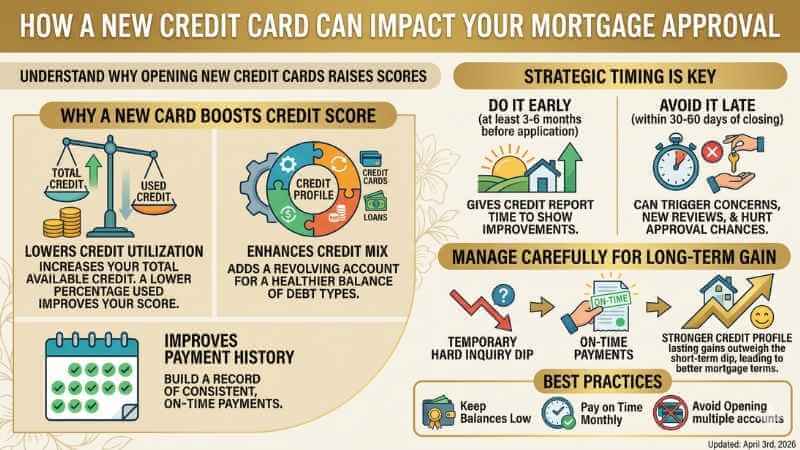
Opening a new credit card may help your credit profile, but only if you do it far enough in advance. In most cases, this strategy works best when you are at least three to six months away from applying for a mortgage. That gives your credit report time to show the new account, lower utilization, and a record of on-time payments.
If you are already in the mortgage process, timing becomes much more sensitive. Once you are within 30 to 60 days of closing, it is usually best to avoid opening new credit accounts. A new account can slightly lower your score, change your debt profile, and trigger an extra review by the lender.
The safest approach to improving your credit score is straightforward: consider why opening new credit cards can raise your score as an early preparation step, rather than a last-minute fix. If you are close to submitting a mortgage application or finalizing a closing, prioritize keeping your existing balances low, making timely payments, and avoiding new debt.
How On-Time Payments Can Help Your Credit Score
Getting a new credit card can actually boost your credit score, but only if you handle it wisely. Your credit score depends primarily on your payment history, so paying your bills on time is more important than opening new accounts.
If you open a card early enough and use it for small, manageable purchases, a record of on-time payments may strengthen your credit profile over time. But this strategy is not a good fit for everyone. If you are close to mortgage underwriting, already preparing to close, or worried you may carry high balances, opening a new card may create more risk than benefit.
The goal is not to open multiple accounts just to raise your score quickly. The goal is to build a steady record of responsible credit use. For many borrowers, that means using one new account carefully, keeping the balance low, and paying it on time every month.
Short Dip for Long Climb
Getting a new card can drop your score a few points for a month or so because of the hard inquiry. But the lasting gains from added credit, a balanced utilization rate, and a richer credit mix usually beat that tiny setback. Those few extra points can mean better mortgage terms, lower interest rates, and big savings over the years for many buyers.
Smart Timing for Signing Up
Knowing you should open new cards and fist bumps, your score is only half the picture. Timing matters. If you’re 30 to 60 days from closing, skip the new applications; underwriters dislike sudden shifts and may call the deal a risk.
The sweet spot for opening new credit cards is at least six months before you plan to apply for a mortgage. This window gives you time for the positive effects of lower utilization and a clean payment record to show up on your credit report.
Surprising Credit Hack for Homebuyers
Opening the right credit cards may improve your mortgage approval chances.
How Credit Scores Can Affect Mortgage Rates
Credit scores influence how much you pay for a mortgage. In general, borrowers with stronger credit scores may qualify for better interest rates and more loan options. In comparison, borrowers with lower scores may face higher rates or tighter lending standards. But a credit score is only one part of the full picture. Lenders also review income, debts, down payment, loan type, and overall risk.
That’s why improving your credit before seeking a mortgage is important, even if it doesn’t guarantee a specific rate or approval. A higher score can simplify the qualification process for you, potentially lowering your long-term borrowing costs. Understanding why opening new credit cards raises scores can also play a role in your overall credit improvement strategy.
If you are rebuilding credit after a financial setback, progress is possible, but results vary from borrower to borrower. The timeline depends on factors like recent payment history, current balances, new credit activity, and the type of derogatory event on your report. Instead of expecting a fast jump to a specific score, it is better to focus on steady improvement over time.
Why New Credit Tradelines Can Matter for Mortgage Approval
Mortgage lenders look at your overall credit profile, not just one score. A new credit tradeline, such as a credit card, may help if it adds available credit, improves your mix of accounts, and shows a pattern of on-time payments.
Simply opening a new credit card isn’t enough; the real advantage lies in how you manage it. Maintaining low balances and making timely payments are essential for improving your credit profile before applying for a mortgage. This is why opening new credit cards can raise scores when done thoughtfully and in advance, rather than as a last-minute effort to boost your score.
Why New Credit Cards Can Help Rebuild Credit Before a Mortgage
Opening a new credit card can help rebuild credit when used correctly. For borrowers preparing for a mortgage, a new account may improve credit in three main areas: available credit, account mix, and payment history.
But this strategy works best as part of a larger credit plan. Simply opening new accounts will not raise a score on its own. The real benefit comes from keeping balances low, paying on time every month, and giving the account time to strengthen your credit profile.
For individuals who have faced past credit issues, such as bankruptcy, obtaining a new credit card can be a useful way to rebuild their credit. However, the main focus of this article is not to advocate for opening numerous accounts. Instead, it’s important to understand why opening new credit cards raises scores; when managed responsibly, new credit can help improve mortgage readiness over time.
FAQs About Why Opening Credit Cards Raises Scores:
Can Opening a New Credit Card Help Before Applying for a Mortgage?
Yes, sometimes. A new credit card may help if it lowers your overall credit utilization, adds a revolving account to your credit profile, and gives you more chances to build an on-time payment history. But the benefit usually takes time and depends on how responsibly you use the account.
Why Opening New Credit Cards Raises Scores for Some Borrowers?
The main reason why opening new credit cards raises scores is that a new account can increase your total available credit. If your balances stay low, your credit utilization ratio may drop, which can help your score. In some cases, a new card can also improve your credit mix if you do not already have much revolving credit.
Will a Hard Inquiry Hurt My Credit Score Before a Mortgage?
It can, but the effect is often small. A hard inquiry and a brand-new account may cause a short-term score dip. That is why opening a card can be risky if you are close to applying for a mortgage or already in underwriting.
How Long Should I Wait After Opening a New Credit Card Before Applying for a Mortgage?
There is no one rule for every borrower, but waiting several months is usually safer than applying right away. Consumer credit guidance commonly recommends waiting as long as possible between new card applications and mortgage shopping, and mortgage-focused guidance often warns against opening new accounts in the 6 to 12 months before applying.
Should I Open a New Credit Card While I Am in Underwriting or Close to Closing?
Usually no. Opening a new account during the mortgage process can change your credit profile, trigger an extra lender review, and, in some cases, affect approval or pricing. Large new credit card balances can also create problems even if you do not open a new account.
How Many New Credit Cards Should I Open Before Trying to Qualify for a Mortgage?
Less is usually better. Opening several accounts at once can make lenders cautious, as it may lower the average age of your accounts and generate multiple inquiries. If this strategy is used at all, it should be part of a careful credit-building plan, not a last-minute push before mortgage approval.
This article about “Why Opening New Credit Cards Raises Scores for Mortgage” was updated on April 3rd, 2026.
Ready to Buy a Home? Fix Your Credit First
See why lenders view new credit cards as a positive when managed correctly.