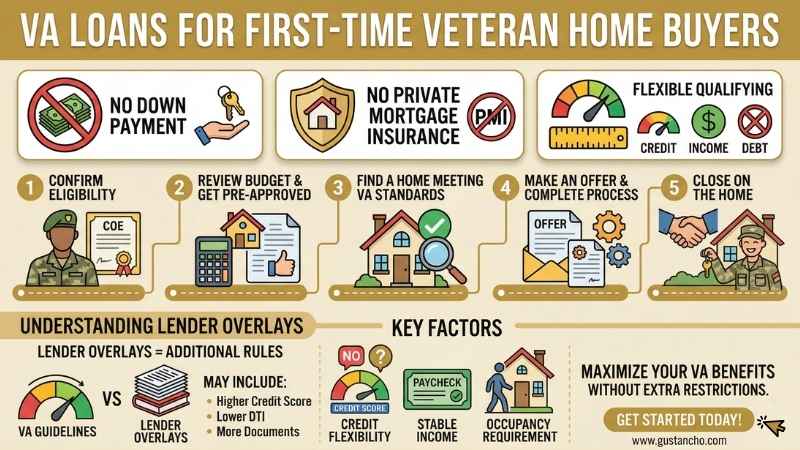
VA loans for first-time veteran home buyers can make buying a home more affordable because they offer no down payment, no private mortgage insurance, and flexible qualifying guidelines. For eligible veterans, active-duty service members, and some surviving spouses, a VA loan is often one of the most accessible ways to buy a first home.
If you are new to the homebuying process, the most important things to understand are who qualifies, how VA loans work, what credit and income factors matter, and what lenders mean by “no overlays.”
A lender overlay is an extra rule added by a lender on top of standard VA guidelines. Understanding that difference can help first-time buyers avoid unnecessary denials and shop more confidently. In this guide, you will learn how VA loans for first-time veteran home buyers work, what the basic eligibility rules are, what no-overlays means, and what steps to take before getting pre-approved.
What Are VA Loans?
VA loans are government-backed mortgages that help eligible veterans, active-duty service members, and surviving spouses buy homes. Because the VA guarantees these loans, lenders can offer better terms—like no down payment, no private mortgage insurance (PMI), and lenient credit requirements. These benefits make a VA loan a stronger choice for first-time buyers than conventional or FHA loans.
Benefits of VA Loans for First-Time Veteran Home Buyers
VA loans for first-time veteran home buyers can be especially beneficial, as they help eliminate several common barriers to home ownership. Compared to many other loan options, these VA loans can lower upfront costs, reduce monthly expenses, and provide greater flexibility in the qualification process.
- No Down Payment: Eligible borrowers may be able to buy a home without making a down payment, thereby making homeownership more accessible to first-time buyers.
- No Private Mortgage Insurance: VA loans do not require monthly private mortgage insurance, which can help reduce the overall monthly payment compared with many low-down-payment conventional loans.
- Competitive Interest Rates: Because VA loans are backed by the government, they often come with lower interest rates than many other mortgage options, which can improve affordability.
- Flexible Qualification Standards: VA loans can be more flexible on credit and debt-to-income than many conventional loans, although lender-specific requirements may still vary.
- No Prepayment Penalty: If you’ve got a VA loan, you can pay it off early or throw in some extra cash whenever you want, and there’s no penalty for doing that.
Who Can Qualify For VA Loans?
Only veterans with a valid Certificate of Eligibility (COE) are eligible to qualify for VA loans. VA home loans is hands down the best residential mortgage loan program in the United States. A young soldier who has served this Great Country called America can get the most on VA loans for first time home buyers after proudly serving our country.
Why VA Loans Are A Strong Option For First-Time Veteran Home Buyers
VA loans are often a strong fit for first-time veteran home buyers because they remove some of the biggest barriers to homeownership. Eligible borrowers may be able to buy a home with no down payment, no private mortgage insurance, and more flexible qualifying guidelines than many conventional loan programs. VA loans for first-time veteran home buyers are easy to manage. Instead of focusing solely on saving a large down payment, buyers can dedicate more time to preparing their credit, reviewing their budget, and understanding how much home they can comfortably afford. Working with a lender that adheres to standard VA guidelines without extra overlays can also minimize unnecessary obstacles during pre-approval and underwriting.
Qualifying For VA Loans As A First-Time Veteran Home Buyer
To qualify for VA loans for first-time veteran home buyers, the first step is confirming that you meet the VA’s basic eligibility standards. In most cases, this means having sufficient qualifying military service, obtaining a valid Certificate of Eligibility, demonstrating stable income, and planning to live in the home as your primary residence. Additionally, the property must meet VA appraisal and minimum property standards.
Certificate of Eligibility (COE)
The Certificate of Eligibility, or COE, confirms that you qualify for the VA home loan benefit based on your military service. Many lenders can help obtain your COE, and some borrowers can request it directly through the VA.
Income And Ability To Repay
VA lenders check out your income to ensure you can pay the monthly mortgage payment along with any other bills and living costs. The VA does not use the qualification in the same way as a conventional loan in every case. However, stable, documentable income remains important.
Occupancy Requirement
VA loans are intended for primary residences. That means you must plan to live in the home you are buying. They are not designed for vacation homes or pure investment properties.
Credit Flexibility
The VA does not set one universal minimum credit score in its handbook, but lenders often set their own score requirements. Some lenders are more flexible than others, which is why borrowers may get different answers depending on where they apply.
Debt-To-Income Flexibility
VA loans can also be flexible with the debt-to-income ratio, especially when the overall file is strong. In some cases, borrowers may still qualify with a higher DTI if they have compensating factors and receive a favorable automated underwriting decision.
Property Standards
The home must meet VA minimum property requirements. The VA appraisal looks at both value and basic safety, soundness, and livability standards. This helps protect the buyer and the lender. After reviewing the standard VA qualification factors, it is important to note that some lenders apply additional rules, called overlays. These lender overlays can make approval harder, even when a borrower appears to meet the core VA guidelines.
VA Guidelines vs. Lender Overlays
The Department of Veterans Affairs sets the core rules for the VA loan program, but individual lenders may add stricter requirements of their own. These extra rules are called lender overlays.
A lender overlay is not the same as a VA rule. It is an internal lending standard that can make approval harder for some borrowers. Different lenders might have their own requirements, such as one that asks for a higher credit score or a lower debt-to-income ratio than another, even if both are issuing VA loans.
This is one reason first-time veteran home buyers can receive different answers from different lenders. A borrower who does not qualify under one lender’s overlays may still qualify with another lender that follows the standard VA guidelines more closely. Understanding this difference can help buyers shop more effectively and avoid assuming they are automatically ineligible after one denial.
What Lender Overlays Mean on a VA Loan
VA lender overlays are additional rules that some mortgage lenders apply to the standard VA loan guidelines. These are not rules created by the Department of Veterans Affairs. They are internal requirements set by the lender. Different lenders can have varying requirements even if they’re offering the same VA loan program. Some lenders might want you to have a better credit score, a smaller debt-to-income ratio, or even more documents than other lenders. This is why a borrower may be told no by one lender and still qualify with another. Understanding lender overlays is important when exploring VA loans for first-time veteran home buyers. These overlays can impact approval even if the borrower seems to meet the basic VA guidelines. By distinguishing between VA rules and additional lender requirements, buyers can shop more effectively and reduce confusion early in the process.
VA Loans Made Easy for First-Time Veteran Buyers
No overlays, no hassles—just simple VA loan approval for your first home.How Much House Can You Comfortably Afford?
Qualifying for a VA loan and comfortably affording a home are not always the same thing. A lender may approve you for a certain loan amount based on your income, debts, and VA loan guidelines, but you should also look at your full monthly budget before deciding how much home to buy.
For first-time veteran home buyers, that means thinking beyond the mortgage payment alone. Property taxes, homeowners’ insurance, utilities, maintenance, childcare, commuting, and other regular expenses can all affect what feels affordable month to month.
A smart homebuying decision is based not only on what you qualify for, but also on what fits your lifestyle and long-term budget. Even if you qualify for a certain loan amount with VA loans for first-time veteran home buyers, it’s important to review your entire monthly budget before determining how much home to purchase. Mortgage approval doesn’t always account for real-life expenses, such as utilities, childcare, school costs, medical expenses, transportation, maintenance, and other personal spending. For first-time veteran home buyers, the key question isn’t just how much you can qualify for, but how much you can comfortably afford each month.
Credit Score and DTI Flexibility
VA loans can be more flexible than many other mortgage programs when it comes to credit history and debt-to-income ratio. That can be especially helpful for first-time veteran home buyers who may not have perfect credit or who are carrying other monthly obligations.
However, it is important to understand that the Department of Veterans Affairs does not approve loans directly, as a lender does. Individual lenders still review the full file and may apply their own requirements. That means one lender may be more flexible than another on credit scores, debt-to-income ratios, or documentation requirements.
In general, strong compensating factors such as stable income, cash reserves, or a solid overall credit profile can help support approval for VA loans for first-time veteran home buyers, even when a borrower does not fit a narrower conventional lending box.
Step-by-Step Process for First-Time Veteran Home Buyers
Step 1: Confirm Your VA Loan Eligibility
Before shopping for a home, verify that you meet the basic VA service requirements and obtain your Certificate of Eligibility.
Step 2: Review Your Budget and Get Pre-Approved
Talk with a lender, review your income and debts, and determine a realistic price range before starting your home search.
Step 3: Find a Home That Meets VA Standards
Choose a home you plan to occupy as your primary residence and make sure it is likely to meet VA appraisal and property requirements.
Step 4: Make an Offer and Complete the Loan Process
Once your offer gets the green light, your lender will dive into the next steps, including processing, underwriting, appraisal, and final approval.
Step 5: Close on the Home
Once all the final details are sorted out, you’ll sign the closing papers and grab the keys to your first place.
Maximize Your VA Benefits Without Extra Restrictions
Discover how first-time veteran buyers can secure a VA loan easily.Common VA Loan Myths First-Time Buyers Should Ignore
- Myth: You can only use a VA loan once.
- VA loan benefits can often be used more than once, depending on your entitlement and eligibility.
- Myth: VA loans always take longer to close.
- VA loans can close on a standard mortgage timeline, though timing depends on appraisal, documentation, and lender processes.
- Myth: You need perfect credit to qualify.
- VA loans are often more flexible than many other mortgage options, but lender requirements can still vary.
Why VA Loans With No Overlays Are the Best Choice
If you’re a veteran buying your first home, VA loans for first-time veteran home buyers are the easiest and most budget-friendly option. Picking a lender with no overlays means you won’t face extra rules that slow things down. With no down payment, PMI, and low interest rates, a VA loan is still the top pick for anyone who has served.
VA Guidelines vs. Lender Overlays
The VA establishes the fundamental guidelines for VA loans for first-time veteran home buyers, but individual lenders might implement stricter internal standards called overlays. These overlays can influence various aspects of qualification and loan structure, which is why two lenders may provide the same borrower with different answers.
Credit and Debt-to-Income Requirements
The VA program is often more flexible than many other mortgage options. However, lenders may still apply their own credit score or debt-to-income standards. Some lenders are comfortable with broader credit profiles, while others require stronger scores or lower monthly debt obligations.
Collections and Charge-Offs
Not all lenders treat unpaid collections or charged-off accounts the same way. In some cases, a borrower may still qualify under standard VA guidance. At the same time, another lender may require additional documentation or payoff as part of its own internal overlay policy.
Bankruptcy and Housing Event Waiting Periods
The waiting period for getting loans after going through Chapter 7 or Chapter 13 bankruptcy, foreclosure, or other big credit issues can change based on your situation and what extra rules the lender has. That is why borrowers should not assume one lender’s answer applies everywhere.
Closing Costs, Seller Concessions, and Lender Credits
VA loans have flexible options when it comes to seller concessions and lender credits, which can help reduce a buyer’s out-of-pocket costs. Even so, the exact structure of closing costs depends on the transaction, the rate chosen, and the lender’s approach. Under standard VA guidelines, VA loans for first-time veteran home buyers may offer more flexibility regarding credit, debt-to-income ratio, prior credit issues, and closing costs than many people realize. It’s essential to understand the distinction between VA rules and any lender-added restrictions, as lender overlays can vary. By reviewing your eligibility, budget, and homebuying goals early on, you can make smarter decisions and navigate the process with greater confidence. If you’re exploring your options, speaking with a lender who understands VA loans can help you determine the best path forward.
Frequently Asked Questions About VA Loans for First-Time Veteran Home Buyers:
Do I Need a Certificate of Eligibility to Start the VA Loan Process?
Not necessarily. You do need a Certificate of Eligibility, or COE, to confirm that you qualify for the VA home loan benefit, but many lenders can help obtain it for you during the loan process. The VA says the COE proves your eligibility based on your service history and current duty status.
Can I Use a VA Loan if I am a First-Time Home Buyer?
Yes. You do not have to be a repeat buyer to use a VA loan. In fact, VA loans are often a strong option for first-time veteran home buyers because they may allow no down payment, no monthly mortgage insurance, and flexible qualifying standards.
Can I Use My VA Loan Benefit More Than Once?
Yes. The VA home loan benefit is reusable in many cases. If you have remaining entitlement or restore your entitlement after paying off and disposing of a prior VA-financed property, you can use the benefit again.
Do I have to Live in the Home I Buy with a VA Loan?
Yes, in most cases, the home must be for your own personal occupancy as a primary residence. The VA says that VA-backed home loans are meant to help eligible folks buy, build, fix up, keep, or adjust a home for themselves to live in, not to collect a bunch of investment properties.
What is the VA Funding Fee, and do All First-Time Buyers have to Pay it?
The VA funding fee is a one-time fee that helps keep the VA loan program running for future borrowers. For first-use VA purchase loans in 2026, the fee is 2.15% with less than 5% down, 1.5% with 5% or more down, and 1.25% with 10% or more down. Some borrowers are exempt, including many veterans receiving compensation for a service-connected disability.
How Long Does it Take to Close on a VA Loan?
There is no single required closing timeline, and the exact timing depends on the lender, appraisal, documentation, title work, and transaction conditions. A safer way to phrase it in the article is that VA loans can often close within a typical mortgage timeframe, but timing varies from file to file.
This article about “VA Loans For First-Time Veteran Home Buyers With No Overlays” was updated on April 6th, 2026.