
Updated FHA Loan Requirements for 2026: What You Need to Know
Big changes are coming to FHA loan requirements in 2026, including updates to credit scores, down payments, loan limits, mortgage insurance, occupancy, and eligibility. FHA loans are still a good option for buyers who need lower down payments. Be sure to check both HUD guidelines and your lender’s rules, which are updated annually in HUD Handbook 4000.1.
In 2026, FHA loans will continue helping first-time and repeat buyers, especially those who can’t qualify for conventional loans.
We’ll walk you through each step, from credit scores and down payments to student loan guidelines and income requirements. With these updates, FHA loans can still make homeownership a reality for many people.
Higher loan limits in many places will make it easier to buy with a smaller down payment, use gift funds, and purchase homes with up to four units. For single-family homes, loan limits now range from $541,287 to $1,249,125.87. Are you considering an FHA loan to buy a home? FHA loans are popular because they’re one of the easiest types of mortgages to qualify for, especially if you’re a first-time buyer or have had credit issues. In this guide, we’ll review everything you need to know about updated FHA loan requirements 2026.
Why FHA Loans Are So Popular
FHA loans are backed by the Federal Housing Administration, which helps lenders feel confident lending to buyers with low credit or high debt. Here are a few reasons why FHA loans are a top choice for many homebuyers: FHA loans help buyers who have limited savings, lower credit scores, or can’t get a conventional loan. FHA has clear rules for who can qualify and offers fixed-rate loans. With the new residency rules, lawful permanent residents can apply under the same conditions as U.S. citizens, but non-permanent residents face new restrictions for case numbers assigned on or after May 25, 2025. Even though FHA guidelines are flexible, you’ll need to provide a lot of paperwork. Just meeting the minimum credit score might not be enough if you have late payments, collections, or tax problems.
- Lower Credit Requirements: FHA loans can be obtained by borrowers with credit scores starting at 500.
- Low Down Payments: Eligible buyers can make a down payment as low as 3.5%.
- Flexible Income Requirements: You can even have a non-occupant co-borrower, like a family member, help you qualify.
These factors make FHA loans a great choice, especially for first-time buyers or those with credit challenges. Now, let’s get into the updated FHA loan requirements for 2026. Because FHA and lender rules can be complicated, it’s a good idea to talk to an experienced mortgage professional. FHA loans make homeownership possible with low down payments, flexible credit standards, options for one- to four-unit properties, and the ability to use gift funds. If you can’t get a conventional mortgage, FHA loans are a strong option, and you might be able to refinance later as your finances improve. FHA rules cover credit scores, down payments, loan limits by county, mortgage insurance, and occupancy. The 2026 changes show how important it is to plan your finances carefully. Qualified buyers can buy with as little as 3.5 percent down, finance up to four-unit properties, and take advantage of higher loan limits, up to $1,249,125 for single-unit homes in high-cost areas. Be sure to consider mortgage insurance costs and the new 2026 residency rules, since both can affect your approval.
What Are The 2026 Updated FHA Loan Requirements?
In 2026, FHA loans will have new rules for minimum down payments, credit scores, loan limits by area, mortgage insurance, and occupancy. Buyers can still get FHA loans for homes with up to four units if they live in one, and those who qualify can still put down as little as 3.5 percent.
The changes to FHA loans in 2026 will include minimum credit score requirements, minimum down payment requirements, county-based FHA loan limits, mortgage insurance requirements, and primary-residence eligibility.
FHA’s one-unit loan limits for 2026 will be between $541,287 and $1,249,125 based on the location of the loan. A new FHA residency rule starts in 2025 and could change who is eligible for a loan. Per the regulations of Mortgagee Letter 2025-09, with an assigned FHA case number dated May 25, 2025, applicants who are non-permanent resident borrowers will no longer be eligible; however, permanent residents will be eligible but under the same conditions as U.S. citizens.
Buying your first home? FHA loans make it easier!
Apply now and take the first step toward homeownership.
What Are the Types of FHA Loans?
FHA loans come in different forms to fit various buyer needs. Here are the types of FHA loans available in 2026:
- Fixed-Rate FHA Loan: A traditional loan with a stable, fixed interest rate over 15 or 30 years.
- Adjustable-Rate FHA Loan (ARM): A loan with a lower initial interest rate that adjusts over time.
- FHA 203(b) Loan: The most common FHA loan used to buy or refinance a primary home.
- FHA 203(k) Loan: Designed for buyers who want to finance home purchases and repairs in one loan.
- FHA Streamline Refinance: A simpler way for FHA borrowers to refinance and lower their rate.
- Energy Efficient Mortgage (EEM): Allows borrowers to finance energy-saving home improvements.
- Graduated Payment Mortgage (GPM): Starts with lower payments that increase over time.
- Home Equity Conversion Mortgage (HECM): It is also a reverse mortgage for individuals aged 62 and above.
Each type of FHA loan offers different benefits, so knowing which one best fits your needs is good.
Key Updates to FHA Loan Requirements in 2026
Even though FHA rules are flexible, your approval also depends on your income, job history, savings, debts, and credit. Lenders check HUD rules, use computer systems, and may have extra requirements. Having a steady income and managing your debts well helps.
Changing jobs often, having little savings, making late payments, or having disputed accounts can make approval harder. Remember to budget for all costs, like deposits, prepaid expenses, escrow, and closing fees.
It’s important to meet the minimum credit score. In 2026, loan limits for single-family homes range from $541,287 to $1,249,125, with even higher limits for multi-unit properties and places like Alaska, Hawaii, Guam, and the Virgin Islands. Loan limits depend on your county and city, so check your local limits. You may use an FHA loan for various property types, provided they are occupied by one unit. This option benefits buyers who wish to reside in one unit and rent the others.
HUD Mortgage Insurance Premiums Requirements on FHA Loans
The standard upfront mortgage insurance premium is 1.75 percent of the loan amount, as determined by HUD. upfront mortgage insurance premium, and what is the monthly MIP? HUD explanation. FHA loans must include both an initial mortgage insurance premium and a monthly mortgage insurance premium. The HUD appendix on premiums states that the standard initial MIP is 1.75 percent of the loan amount.
Most of the time, the upfront mortgage insurance premium is added to your loan balance, so you don’t have to pay it all at closing unless you want to.
Monthly mortgage insurance is part of your regular payment and depends on your loan details. HUD updates this information often. Mortgage insurance ends when you pay off the loan. Older loans may have different rules for canceling insurance, but new FHA loans follow the latest guidelines. Many people refinance to a conventional loan as their credit or equity improves.
Updated FHA Loan Requirements: Minimum Credit Score Guidelines
HUD requires a minimum credit score of 580 to finance up to 96.5 percent of a home’s value. Applicants with scores between 500 and 579 may qualify for up to 90 percent financing. Scores below 500 are not eligible for standard FHA loans. A score of 580 or higher, along with meeting all other criteria, allows for the minimum 3.5 percent down payment.
FHA Credit Score Requirements for 3.5% Down
According to HUD documents, borrowers with a score of 580 or higher are eligible for the maximum FHA financing, while those with a score between 500 and 579 are eligible only for 90 percent LTV financing. Those with a score below 500 will almost never qualify for FHA-insured standard financing.
The updated FHA loan requirements make it clear what credit scores are needed to qualify:
- 500–579 Credit Score: You’ll need a 10% down payment.
- 580 or Higher Credit Score: You can qualify with a 3.5% down payment.
If your credit score is lower, don’t worry—FHA loans can still be an option. FHA loans are designed to work with borrowers with past credit challenges, including bankruptcy or foreclosure.
When a 10% Down Payment is Required
If your credit score is between 500 and 579, you might still qualify, but you’ll need to make a bigger down payment.
HUD materials state that scores of 500-579 are associated with a maximum LTV of 90 percent, which means 10 percent down on a purchase transaction.
Some lenders may require higher credit scores or additional savings beyond the FHA minimums. The 3.5 percent down payment is still a favorite among first-time buyers, people with moderate incomes, and those who want to keep more of their savings, especially when using gift funds.
How Deferred Student Loans Affect FHA Loan Approval in 2026
If you have student loans, the updated FHA loan requirements now include all student loans in your debt-to-income (DTI) ratio, whether they’re deferred or not.
- Income-Based Repayment (IBR): If you’re on an IBR plan, the FHA will use that lower monthly payment in your DTI, making qualifying easier.
- If No Monthly Payment Shows Up: When no payment amount is listed, lenders will calculate 0.5% of your loan balance to estimate your monthly payment.
This change helps buyers with student loans know what to expect when calculating DTI ratios.
Updated FHA Loan Requirements on Multi-Family 1, 2, 3, and 4 Unit Home
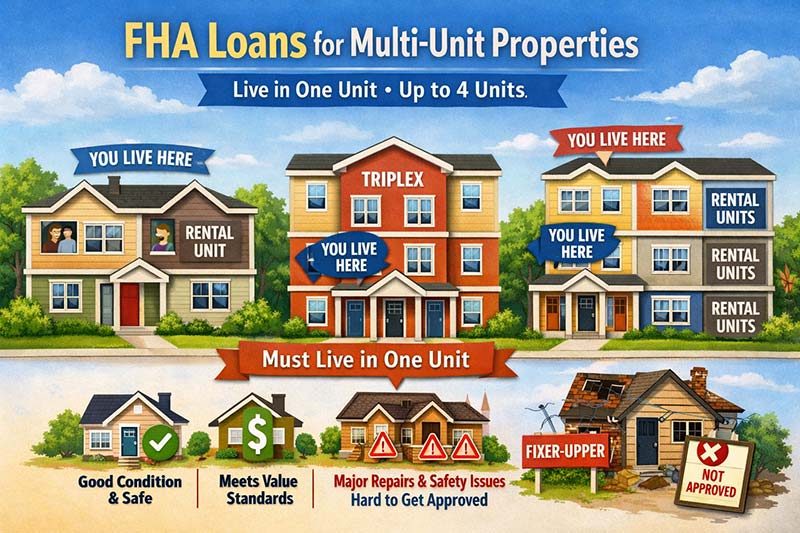
FHA loans are for primary homes and can be used for properties with up to four units if you live in one. If you want to buy a duplex, triplex, or four-unit building, you can use an FHA loan as long as you live in one unit and follow the rules. FHA has clear standards for a home’s condition, value, and safety, so homes that need major repairs or pose safety issues can be hard to get approved.
HUD’s Updated Appraisal Requirements
The FHA’s new requirements for home appraisals aim to ensure properties meet standards for safety and functionality.
- Three-Year Chain of Title: Appraisers must look at the past three years of property ownership history to prevent issues with property flipping.
- Appliance Checks: Appraisers check that appliances like dishwashers, stoves, and refrigerators are working, which means utilities must be turned on.
- Ownership Review: Appraisers will check records to avoid issues with undisclosed transactions.
These guidelines protect buyers by making sure the home is in good shape.
Is your home FHA-ready? Don’t let appraisal issues delay your loan approval!
Apply now for a free consultation and ensure your home meets FHA appraisal standards before you buy.
Employment Requirements for FHA Loans: What’s New in 2026
FHA loans come with new employment guidelines to ensure borrowers’ steady income.
- Frequent Job Changes: If you’ve changed jobs three times in the past year, lenders will verify your current income and make sure it’s stable for the next three years.
- Part-Time Income: You need two years of continuous part-time work to use this income for your loan.
- Employment Gaps: To qualify for job gaps over six months, you’ll need to have been with your current employer for six months.
These updates give lenders confidence in approving FHA borrowers who show job stability.
FHA Debt-to-Income Ratio Guidelines
To get an approve/eligible per automated underwriting system, the borrower needs a maximum of 46,9% front-end and 56.9% back-end debt-to-income (DTI) ratio that guarantees FHA loan approval. FHA manual underwriting has a 31 front-end and 43% back-end debt-to-income ratio with zero compensating factors, 37% front-end and 47% back-end with one compensating factors, and 40% front-end and 50% back-end with two compensating factors. Lenders look at your whole financial picture. Some applications are approved quickly, while others need more paperwork. Every part of your loan file matters, not just your DTI. FHA loans are popular because they’re flexible and have lower upfront costs. Approved lenders offer these loans, and you can use home equity or gift funds if you document them properly.
Updated FHA Loan Requirements For Installment Debts Less Than 10 Months
In the past, installment debts (e.g., car payments) with fewer than 10 months left could be left out of your DTI calculations. In 2026:
- Debts With 10 Months or Less Can Be Excluded: Only if your remaining payments total 5% or less of your gross monthly income.
This flexibility helps borrowers maintain a healthy DTI ratio near the end of their installment loans.
Guidelines for Non-Taxable Income
FHA allows non-taxable income (like Social Security) to be “grossed up,” which means increasing the income amount for loan calculations.
- New Gross-Up Rate: Non-taxable income can be increased by 15% or your actual tax rate (if known).
- Documentation Needed: Lenders need documentation confirming that the income is non-taxable.
This lets FHA borrowers with fixed incomes show more qualifying income.
Using Gift Funds as a Down Payment
You can still use gift funds for your down payment, but the updated FHA loan requirements require proof that the funds have been in the donor’s account for at least 30 days.
- Documentation: If the gift is from a real estate commission (like a family member’s agent), lenders need proof of the agent’s real estate license.
- Family gifts are an approved source, so you should have no problem using gifts for an FHA loan.
This ensures transparency when family members help with down payments.
FHA Loan Requirements for Rental Income on Retained Homes
The FHA has updated requirements if you’re keeping your current home as a rental while moving into a new one.
- New Home Distance: To count rental income, the new home must be at least 100 miles away from your current property.
- Equity Requirement: If your tax returns don’t show a rental history, your retained home must have at least 25% equity.
These guidelines help buyers who need to relocate without negatively impacting their DTI ratio.
Using Authorized Credit User Accounts for FHA Loans
If you are an authorized user on someone else’s card, it may lead the FHA to consider that debt in your debt-to-income ratio (DTI).
- 12-Month Payment History: If the primary user has paid on time for a year, you may be able to exclude the debt.
- Proof Needed: You’ll need bank statements or canceled checks from the last 12 months to show consistent payments.
This update allows borrowers who use authorized credit accounts responsibly to improve their DTI calculations.
Ready to Apply for an FHA Loan?
With these updated FHA loan requirements in 2026, FHA loans remain an accessible and flexible option for many homebuyers. Whether you’re a first-time buyer or coming back to the market, FHA loans could help you get into a new home sooner. Closing costs can be funded by interested party contributions and seller concessions. They must also comply with HUD’s guidelines and be documented in the loan file and contract stipulations. Specifically, HUD’s FHA FAQ states that interested party contributions must be documented in the sales contract or other binding legal documents.
Ready to take the next step? Apply for an FHA loan now and begin your path to owning a home! Call or text us at 800-900-8569 or email us at alex@gustancho.com.
Frequently Asked Questions About Updated FHA Loan Requirements:
What Are The Updated FHA Loan Requirements For Credit Scores in 2026?
- The updated FHA loan criteria for 2026 allow individuals to qualify with a credit score of just 500 if they can provide a 10% down payment.
- Alternatively, those with a credit score 580 can secure a loan with a much more accessible down payment of 3.5%.
- This change signifies an opportunity for many potential homeowners to enter the housing market.
Can I Get An FHA Loan If I Have Student Loans?
- Yes! With the updated FHA loan requirements, all student loans now count in your debt-to-income ratio (DTI), but income-based repayment amounts can be used, which may lower your DTI.
Do I Need a High Income to Qualify for an FHA Loan?
- Not necessarily. FHA loans are designed to work with various income levels.
- Plus, with the updated FHA loan requirements, you can even use a non-occupant co-borrower, like a family member, to help you qualify.
What Is The Minimum Down Payment Required Under The Updated FHA Loan Requirements?
- If your credit score is 580 or above, the lowest down payment you can make is 3.5%.
- For 500 to 579 credit scores, a down payment of 10% is necessary.
What Happens If I Have Deferred Student Loans?
- Under the updated FHA loan requirements, deferred student loans are now counted in your DTI.
- If no payment is listed, FHA will consider income-based repayment amounts or 0.5% of your loan balance.
Can I Use Gift Funds For My Down Payment?
- Yes, FHA allows gift funds for down payments, but the updated FHA loan requirements require you to document these funds.
- Proof that the funds have been in the donor’s account for at least 30 days is necessary.
Do The Updated FHA Loan Requirements Affect Home Appraisals?
- Yes, FHA appraisals now have stricter rules.
- Appraisers must review a property’s ownership history for the past three years and check that all appliances are operational.
Can I Still Qualify For An FHA Loan If I Change Jobs Often?
- It depends. If you’ve changed jobs three times in the past year,
- FHA lenders must verify that your current income is stable per the updated FHA loan requirements.
How Does Rental Income From My Current Home Factor Into My FHA Loan?
- If you plan to rent out your current home while buying a new one, the updated FHA loan requirements allow rental income to count if the new home is over 100 miles away and you have at least 25% equity in your current property.
Can I Use Income That Isn’t Taxed, Like Social Security, To Qualify for an FHA Loan?
- Yes, FHA allows non-taxable income to be “grossed up” by 15% or your actual tax rate, which can help with qualification.
- This is part of the updated FHA loan requirements for 2026..
Are FHA Loans Only For First-Time Home Buyers?
- No.
- Aside from first-time buyers, those who have purchased homes before can also use FHA loans, provided they meet the FHA requirements, the lender’s requirements, and that they are buying a home that will be their primary residence.
- FHA consumer guidance states that the program applies to one- to four-unit properties for qualified owner-occupants.
Can Non-Permanent Residents Still Qualify For FHA Loans?
- For FHA case numbers assigned on or after May 25, 2025, Mortgagee Letter 2025-09 removed eligibility for non-permanent resident borrowers.
- Lawful permanent residents still qualify and will do so under the same conditions and requirements as US citizens.
Do FHA Loan Limits Change Every Year?
- Yes.
- FHA mortgage limits are reviewed and updated yearly by HUD.
- For 2026, the one-unit floor is $541,287, and the one-unit high-cost ceiling is $1,249,125.
Are Student Loans Counted As Liabilities When Applying For An FHA Loan?
- Yes,
- FHA loans must list all student loans as part of a borrower’s liabilities, regardless of payment status, payment type, or whether the loan is in deferment or forbearance.
- FHA loans typically treat 0 payments as payments and use 0.5% of the outstanding balance.
- This is the case unless the loan has been forgiven, canceled, discharged, or paid in full.
Do Income-Driven Repayment Plans Count As A Payment For FHA?
- Not unless the credit report indicates a payment was made.
- FHA policy states that if the credit report shows a payment, the FHA will use that amount.
- If the payment is zero, FHA uses 0.5% of the outstanding balance.
What Loan Is Best For High Student Loan Debt?
- It will depend on the borrower’s full profile, but Fannie Mae may be more flexible in some situations, as it may accept a documented $0 payment due under an income-driven repayment plan.
- FHA, USDA, and Freddie Mac are stricter when the reported payment is $0.
Do Student Loans That Are Deferred Affect Mortgage Approval Status?
- Yes, in most cases they do.
- Deferring A Student Loan Payment Is Not A Valid Rationale For Excluding Student Loan Debt From FHA, USDA, Freddie Mac, and VA.
What Is A Student Loan Payment Consideration By The VA For Debt-To-Income Ratio?
- VA employs a calculation method justification based on 5% of the total debt divided by 12.
- If the payment listed on the credit report is less than that figure, the lender must prove that the lower payment will be sustained for 12 months post-closing; otherwise, they must use the threshold figure.
Can USDA Permit A Mortgage Qualifier To Have A Student Loan Payment Of Zero?
- With USDA, the lender is required to use the payment on the credit report if it is greater than zero, a documented payment if it is greater than zero, or 0.5% of the total debt if it is zero.
This blog about “Updated FHA Loan Requirements on Home Loans” was updated on March 19, 2026.