Getting a mortgage after retirement involves qualifying based on income, assets, and credit, even if those come from retirement. Many lenders consider social security, pensions, retirement account distributions, and rental income. Some potential borrowers can qualify for the mortgage by using assets in either conventional or Non-QM mortgage loan programs. Many factors can affect a loan approval. These can range from the loan program, overall credit health, debt-to-income ratio, and the lender’s final assessment of the borrower’s financial information.
Can You Get a Mortgage After Retirement?
Yes. Retirement or age alone does not disqualify a borrower from obtaining a mortgage. A borrower does not need employment income when sufficient Social Security, pension, annuity, retirement-distribution, rental, investment, or other eligible income is available. Under the Equal Credit Opportunity Act and Regulation B, lenders cannot consider an applicant’s age when assessing creditworthiness, provided the applicant can legally enter into a contract. A lender also cannot discount qualifying income simply because it comes from Social Security or another public-assistance program. However, these protections do not prevent a lender from evaluating the borrower’s ability to repay the mortgage. The lender may review:
- The amount of qualifying income
- Whether the income is stable and properly documented
- Whether income with a defined expiration date is expected to continue
- Monthly debts and debt-to-income ratio
- Credit history and applicable credit scores
- Funds available for the down payment and closing costs
- Required cash reserves
- Property type and occupancy
- Other loan-program requirements
Regulation B allows age to be considered in specific situations that affect creditworthiness. For example, a lender may evaluate how long a particular income source is expected to continue. A credit program may also use age to favor applicants aged 62 or older, such as through an age-based lending program. The central question is not how old the borrower is. The lender must determine whether the borrower has sufficient qualifying income, assets, credit, and financial capacity to repay the mortgage. Additional information is available in 12 CFR § 1002.6, Rules Concerning Evaluation of Applications.
How Mortgage Lenders Qualify Retired Borrowers
Like all other mortgage applicants, retired borrowers go through the same general underwriting process, but their income may be documented differently. Lenders will evaluate:
- Qualifying monthly income
- Debt-to-income ratio
- Credit history
- Funds available for closing
- Assessed assets and required reserves
- Property type and occupancy
- Required income stability and continuance
For conventional loans sold to Fannie Mae, qualifying income must be stable, documented, and expected to continue. Income that will end or is tied to an account that will eventually be depleted may require evidence that it will continue for at least 3 years after the loan is sold. A retiree does not necessarily require employment income if sufficient retirement or other qualifying income is available.
Using Social Security Income in Qualifying for a Mortgage
Social Security income may help a borrower qualify for a mortgage after retirement when the benefits are properly documented. The exact requirements depend on the type of Social Security benefit, whose work record the benefit is based on, and the applicable loan program.
Social Security Retirement Benefits
For a Fannie Mae conventional loan, Social Security retirement benefits based on the borrower’s own work record generally do not require proof that the income will continue for three years unless the lender has a reason to believe the benefits may end. Benefits based on another person’s work record or received on behalf of another person may require additional documentation and evidence that the income is expected to continue for at least three years from the mortgage note date. The lender may verify eligible Social Security income using an SSA award letter, SSA-1099, signed federal tax returns or tax transcripts, proof of current receipt, or other documentation permitted by the loan program.
How Social Security Gross-Up Works
A lender may increase qualifying income when some or all of the Social Security benefit is nontaxable. This adjustment is commonly called a gross-up. For a Fannie Mae loan, the lender may treat 15% of the Social Security benefit as nontaxable without obtaining additional documentation. The lender may then gross up that 15% portion by 25%. For example, consider a borrower receiving $1,500 per month in Social Security income:
- Monthly Social Security benefit: $1,500
- Portion treated as nontaxable: $1,500 × 15% = $225
- Gross-up amount: $225 × 25% = $56.25
- Total qualifying income: approximately $1,556 per month
The lender is not automatically increasing the entire $1,500 benefit by 15% or 25%. Only the portion treated as nontaxable receives the 25% adjustment. If the lender wants to treat more than 15% of the benefit as nontaxable, additional documentation must support the larger nontaxable amount. The borrower’s tax returns, tax transcripts, benefit documentation, or other acceptable records may be used for this purpose.
Documents Needed for Social Security Income
Depending on the benefit type, borrower, loan program, and automated underwriting findings, the lender may request:
- Social Security award or benefit letter
- SSA-1099
- Bank statements or other proof of current receipt
- Signed federal tax returns or tax transcripts when required
- Documentation supporting the nontaxable portion of the income
- Evidence of three-year continuance when required
Not every borrower must provide every document on this list. The lender will determine which documents are necessary based on the benefit type and mortgage program. These requirements are explained in the Fannie Mae Social Security income guidelines.
Ready to Qualify for a Mortgage After Retirement?
Complete a quick application or send your scenario. We’ll review your retirement income, assets, credit, DTI, and best mortgage path toward approval.Using Pension, Annuity, and Retirement Distributions to Qualify
Pensions, annuities, and distributions from retirement accounts may be used to qualify for a mortgage after retirement. However, Fannie Mae applies different history, calculation, and continuance requirements depending on whether the payment is fixed or variable and where the income originates. These income sources are not the same as Fannie Mae’s employment-related asset calculation. Retirement-distribution income is based on payments the borrower receives or is scheduled to receive. Employment-related assets, as qualifying income, use eligible assets to calculate a monthly income amount based on the mortgage term.
Fixed Retirement Distributions
A fixed retirement distribution is a payment made in a consistent amount according to an established schedule. For example, a borrower might receive $3,000 from an IRA every month. Fannie Mae does not require a minimum history of receipt to document a fixed retirement distribution. The lender may use the monthly payment amount as qualifying income when the distribution is properly documented and meets the applicable continuance requirements. If payments will begin on or before the first payment date of the new mortgage, the lender may document the income with a benefit statement from the organization that provides it. The statement must identify:
- The type of income
- The payment amount
- The frequency of payments
- The scheduled starting date
Variable Retirement Distributions
A variable retirement distribution changes in amount or frequency. A borrower might withdraw different amounts from an IRA throughout the year rather than receive the same payment each month. Fannie Mae generally requires at least 12 months of documented receipt before variable retirement distributions can be used as qualifying income. The lender calculates the monthly qualifying amount by averaging the income received during the most recent 12 months. The most recent or largest withdrawal should not automatically be treated as the borrower’s monthly qualifying income.
Pension Income
A pension may provide a fixed monthly payment for the borrower’s lifetime or for another defined period. The lender must verify the amount using acceptable documentation, such as:
- Pension award letter
- Benefit statement
- Bank or financial account statement
- Signed federal tax return
- IRS Form W-2
- IRS Form 1099
Pension documentation may not always state that the payment will continue for at least three years. In that situation, the lender may determine continuance based on the pension agreement, information about the government- or employer-sponsored program, or applicable laws and regulations governing the pension. A lifetime pension generally differs from an IRA distribution because the pension may not depend on the gradual depletion of a borrower-controlled account.
Personal Annuity Income
Income from a personal or insurance annuity may be used when the payment amount and required continuance can be documented. If the annuity has a defined expiration date or depends on the remaining account balance, the lender must establish that the income is expected to continue for at least three years from the mortgage note date. The lender may review the annuity contract, benefit statement, account balance, payment schedule, and evidence of current receipt.
Three-Year Continuance Requirement
Retirement-account distributions and personal or insurance annuity income generally must be expected to continue for at least three years from the mortgage note date. When determining whether retirement-account income can continue for three years, eligible balances from a borrower’s 401(k), IRA, or Keogh accounts may be combined. The borrower must have unrestricted access to the accounts, without penalty, for the combined balances to support continuance under this provision. The lender must also consider funds being used for the down payment, closing costs, and required reserves. The same funds cannot be counted as available to support future distributions after they have been allocated to closing.
Using IRA, 401(k), and Retirement Accounts Distributions
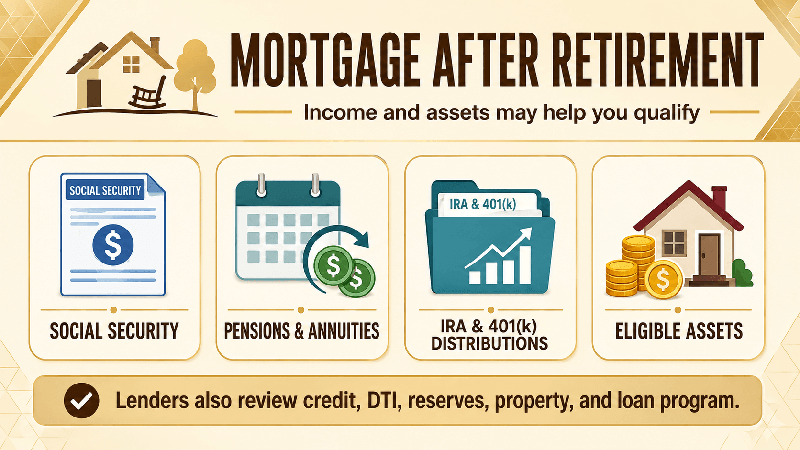 For Fannie Mae conventional loans, documented fixed retirement distributions are generally accepted, as are variable distributions (i.e., average over the most recent 12 months). Verification from the lender is also required for continued income and sufficient remaining assets. Retirement accounts may also be used for other types of distributions. IRA, SEP, Keogh, and 401(k) funds, once vested, are considered eligible for use toward closing costs, the down payment, and reserves when the lender verifies ownership and access to the funds.
Fixed Retirement Distributions
A borrower receiving a set monthly distribution may be able to use the documented payment as qualifying income. The lender will review account statements, 1099-R forms, benefit statements, or other documents to verify the amount and payment schedule.
Variable Retirement Distributions
For variable retirement distributions, a lender may not be able to use the most recent distribution. Instead, the average of the last 12 months may be used. For Fannie Mae loans, variable retirement distributions are typically used if a 12-month receipt history is documented.
Qualifying With Assets Instead of Traditional Retirement Income
Some retirees have substantial retirement savings but do not receive enough monthly income to qualify for the mortgage they want. Depending on the loan program, eligible assets may be converted into a monthly qualifying income amount. The rules differ significantly between Fannie Mae conventional loans and Non-QM asset-depletion programs.
Fannie Mae Employment-Related Assets as Qualifying Income
Fannie Mae permits certain employment-related assets to be used as qualifying income when the loan and borrower meet specific requirements. Eligible assets may include vested funds held in an IRA, SEP, Keogh, or 401(k), as well as certain eligible lump-sum retirement or severance distributions. The following restrictions generally apply:
- The maximum LTV, CLTV, and HCLTV is 70%.
- The maximum may increase to 80% when the owner of the assets used to qualify is at least 62 years old at closing.
- The transaction must be a home purchase or a limited cash-out refinance.
- The property must be the borrower’s principal residence or second home.
- Cash-out refinances and investment properties are not eligible for this specific calculation.
- The borrower must have unrestricted access to the retirement assets.
- Assets must be owned individually by the borrower. If the assets are jointly owned, the co-owner generally must also be a borrower on the loan.
- A retirement account is generally used when distributions have not been established or when the existing distribution is insufficient to qualify the borrower.
Checking and savings accounts are generally not eligible as employment-related assets unless the funds can be documented as originating from an eligible source, such as a lump-sum retirement distribution or a qualifying severance package. Ineligible assets include inheritances, proceeds from the sale of real estate, lawsuit settlements, lottery winnings, stock options, nonvested restricted stock, divorce proceeds, and virtual currency.
How Fannie Mae Calculates Asset-Based Income
The lender begins with the borrower’s eligible documented assets. The lender then subtracts:
- Any penalty that would apply if the account were fully distributed
- Funds needed for the down payment
- Closing costs
- Required mortgage reserves
The remaining amount is called the borrower’s net documented assets. The lender divides that amount by the mortgage’s amortization term in months. For example, consider a 65-year-old borrower with $750,000 in an eligible IRA. Assume no early-withdrawal penalty applies and the borrower will use $50,000 for the down payment, closing costs, and required reserves. The calculation would be:
- Eligible retirement assets: $750,000
- Funds needed for closing and reserves: $50,000
- Net documented assets: $700,000
- Mortgage term: 360 months
$700,000 ÷ 360 = approximately $1,944 in monthly qualifying income This calculation does not automatically qualify the borrower for a mortgage after retirement. The borrower must still satisfy the applicable credit, DTI, property, occupancy, LTV, and underwriting requirements. The complete requirements are available in the Fannie Mae employment-related asset guidelines.
Non-QM Asset-Depletion Programs
Some Non-QM lenders offer asset-depletion or asset-utilization programs for retirees with substantial liquid or retirement assets who cannot qualify under conventional income requirements. Non-QM calculations are not standardized. Requirements may vary based on:
- The types of assets accepted
- The percentage of each account that can be used
- The number of months used to calculate income
- Required reserves
- Credit scores
- Down payment or equity
- Property occupancy
- Loan purpose
- Investor or lender guidelines
A borrower should not assume that the Fannie Mae calculation applies to a Non-QM mortgage. Each lender’s asset-depletion program must be reviewed separately. Non-QM lenders must still evaluate the borrower’s ability to repay in accordance with applicable federal requirements.
Mortgage Loan Options for Retired Borrowers
There are no special forward-mortgage programs available only to retired borrowers. Retirees generally use the same conventional, FHA, VA, USDA, jumbo, and Non-QM programs available to other eligible borrowers. The main difference is how the lender documents and calculates the borrower’s income and assets. A mortgage after retirement may be approved using Social Security, pensions, annuities, retirement-account distributions, rental income, investment income, eligible assets, or a combination of acceptable sources.
Conventional Loans
Conventional loans may work for retirees with qualifying Social Security, pension, annuity, retirement-distribution, rental, dividend, interest, or other eligible income. Certain Fannie Mae and Freddie Mac programs may also allow eligible retirement- or employment-related assets to be converted into qualifying monthly income. Each agency has separate documentation, asset, occupancy, transaction, and continuance requirements. Conventional financing may be used for an eligible:
- Principal residence
- Second home
- Investment property
However, specific asset-based qualification methods may have more restrictive property, occupancy, and LTV requirements.
FHA Loans
FHA loans may be available to retired borrowers who meet HUD’s credit, income, debt, occupancy, and property requirements. FHA financing is generally limited to a principal residence. Social Security, pensions, annuities, retirement distributions, and other eligible income sources may be considered when properly documented. FHA loans require an initial mortgage insurance premium and yearly mortgage insurance. The amount and duration of the annual premium depend on the loan’s terms, LTV, and other applicable HUD requirements.
VA Loans
VA loans may be available to eligible Veterans, active-duty service members, and certain surviving spouses. Retirement does not prevent an otherwise eligible borrower from using VA financing. Qualified borrowers may be able to purchase a principal residence without a down payment when sufficient entitlement is available, and all other VA and lender requirements are met. VA loans do not require monthly private mortgage insurance, although a VA funding fee may apply unless the borrower is exempt. The lender will evaluate qualifying income, credit, debts, residual income, occupancy, and the borrower’s overall ability to repay.
USDA Loans
A retired borrower may qualify for a USDA-guaranteed loan when purchasing an eligible principal residence in an approved rural area. USDA loans may provide 100% financing for qualified borrowers, but applicants must meet credit, repayment-income, property, and occupancy requirements. The household must also remain within the program’s applicable income limits. USDA household income used to determine program eligibility is not always calculated the same way as repayment income used to qualify for the mortgage.
Jumbo Loans
Jumbo loans are mortgages that exceed the applicable conforming loan limit. Retirees may qualify using eligible retirement income, investment income, assets, or other income accepted by the lender. Because jumbo loans are not governed by one universal set of underwriting requirements, income calculations, asset requirements, reserves, credit standards, and maximum DTI ratios vary among lenders and investors.
Non-QM Loans
Non-QM financing may help retirees with substantial assets or alternative income who cannot meet conventional or government income requirements. Depending on the lender, available programs may include asset depletion, asset utilization, bank-statement loans for self-employed borrowers, and other alternative-income options. Non-QM requirements vary significantly. These loans may require a larger down payment, additional reserves, stronger credit, or higher rates and fees than comparable agency financing. Approval remains subject to the lender’s underwriting and applicable ability-to-repay requirements.
Reverse Mortgages Are Different From Forward Mortgages
A reverse mortgage is a separate age-based home-equity product rather than a standard forward mortgage for retirees. The most common reverse mortgage is the FHA-insured Home Equity Conversion Mortgage, or HECM. A HECM is generally available to eligible homeowners age 62 or older who occupy the property as their principal residence. Unlike a traditional mortgage, a HECM generally does not require monthly principal-and-interest payments as long as the borrower continues to meet the loan requirements. The borrower must still:
- Pay property taxes
- Maintain homeowners insurance
- Pay applicable HOA charges
- Keep the property in acceptable condition
- Continue occupying the home as a principal residence
Interest and applicable fees are added to the loan balance, causing the balance to increase over time. Borrowers should compare a HECM with available forward-mortgage and home-equity options before deciding which structure fits their financial and estate-planning goals.
Debt-to-Income Ratio for Borrowers After Retirement
The calculation of a debt-to-income ratio (DTI) remains the same upon retirement. DTI represents the proportion of a borrower’s monthly debt responsibilities compared to their gross monthly income. Potential lenders will account for:
- New mortgage payment
- Property taxes
- Mortgage-related insurance
- Homeowners association fees (HOA)
- Auto loans
- Student loans
- Credit card debt
- Other obligations are typical of the loan program.
For most Fannie Mae loan casefiles underwritten through Desktop Underwriter, 50% is the maximum allowable DTI. A DTI below 50% does not guarantee approval because DU evaluates the complete credit, income, asset, property, and loan profile.
Estimate Your Retiree Mortgage Payment Before You Apply
Your approval depends on income, debts, credit, assets, taxes, insurance, HOA dues, and proposed housing payment. Get a realistic payment and DTI review upfront.Credit Score Requirements After Retirement
Credit scores are not assessed differently based on retirement status. Credit scoring and mortgage program underwriting guidelines determine the credit scores. Fannie Mae conventional loans have different credit-scoring thresholds for loans that are manually underwritten and those underwritten using Desktop Underwriter (DU). DU underwriting considers the overall credit report, whereas most underwriting models hinge on a single credit score. Lenders also evaluate payment history, credit amounts owed, credit report activity, and other report information. Improving the overall credit score may make lenders more willing to offer better financing options.
How Assets and Cash Reserves Can Help Retired Borrowers Qualify
After retirement, many borrowers may have cash or retirement assets but still have less monthly income than when they were working. Assets can help pay for:
- Down payment
- Closing costs
- Required reserves
- Approved asset-based income calculations
Cash reserves are the funds left over after the mortgage closes. These cash reserves differ from assets that are converted to qualifying income. The reserve requirements depend on the transaction, occupancy, property type, number of units, and other properties owned by the borrower that are also financed. For loans processed through the Fannie Mae Desktop Underwriter (DU), the reserves needed will be determined by DU as part of its overall risk assessment. Additional reserves may improve the outcome of the mortgage application process, but do not guarantee approval.
Buying a Primary Home, Second Home, or Investment Home After Retirement
While mortgages after retirement can be used to purchase other than primary residences, the type of occupancy will affect the programs available to retirees.
Primary Residence
A primary residence is a property a borrower occupies as their principal residence. Of the various mortgage programs, primary residences, whether conventional or government-backed, are typically more flexible.
Second Home
A conventional 2nd home has occupancy requirements. Under Fannie Mae guidelines, this is usually a one-unit property that is designed to be, and is under the borrower’s control, suitable for year-round use, occupied by the borrower for part of the year, and under the borrower’s control.
Investment Properties
Many retired borrowers can finance an investment property. Rental income may be used in certain scenarios for qualifying purposes (with appropriate documentation and in accordance with the loan program’s guidelines). Investment and second-home financing may have different (higher or more extensive) down payment, reserve, pricing, and underwriting requirements than financing for a primary residence.
Documents Retirees May Need for Mortgage Approval
Documentation requirements vary by type of retiree income and program, but meeting all requirements as early as possible will help prevent delays caused by the uncertain underwriting process. Retiree borrowers may be requested to submit:
- Documentation for the Social Security award or benefit
- SSA-1099 forms
- Pension or annuity statements
- 1099-R forms
- Retirement account statements (Traditional IRAs, Roth IRAs, 401k, etc.)
- Documentation for retirement plan distributions
- Bank and brokerage statements
- Tax returns, if required
- Rental-income documentation, when applicable
- Standard mortgage application documentation
- ID
When funding a down payment, closing costs, or reserve, the lender must confirm that the requested amount of eligible funds is available. Not all retirees must provide all of these documents. The requested documents must be aligned with the loan program, underwriting, and the borrower’s cash and assets.
Common Retirement-Income Problems That Delay Mortgage Approval
Based on the mortgage files our team has reviewed, retirement itself is rarely the reason a borrower has trouble qualifying. The more common problem is that the income or assets do not meet the documentation and calculation rules of the selected loan program. The following issues can delay or change an approval for a mortgage after retirement.
Variable IRA Distributions Without Enough History
Some borrowers take money from an IRA only when they need it. The withdrawals may vary widely from one month to the next. For a Fannie Mae loan, variable retirement distributions generally require at least 12 months of documented receipt. The qualifying amount is normally based on the average received during that period. A recent large withdrawal cannot automatically be treated as monthly income. When reviewing this type of file, the loan officer should compare the account statements, distribution history, 1099-R, and remaining account balance. If the required history is unavailable, another documented source of income or an eligible asset-based calculation may be required.
Retirement Assets Become Insufficient After Closing Funds Are Deducted
A borrower may have enough retirement assets, but the lender may subtract the funds needed for the transaction. For an eligible Fannie Mae employment-related asset calculation, the lender must deduct:
- Down payment
- Closing costs
- Required reserves
- Applicable withdrawal penalties
Only the remaining net documented assets can be converted into monthly qualifying income. We have seen borrowers focus on the total account balance without considering these deductions. The solution is to calculate the available assets early, before the borrower signs a purchase contract or commits to a specific down payment.
A Pending Retirement Changes Qualifying Income
A borrower may apply while still employed, but plans to retire before or shortly after closing. If the lender learns that employment income will decrease, the existing salary may no longer be the correct income for qualification. The loan officer should review the expected retirement date, final employment date, pension start date, Social Security benefits, retirement distributions, and any other income that will remain after retirement. The file may need to be restructured using the lower retirement income. In some cases, reducing monthly debt, changing the purchase price, increasing the down payment, or using another eligible source of income can help the borrower qualify.
Social Security Documents Do Not Match Bank Deposits
Social Security award letters and bank deposits do not always show identical amounts. Medicare premiums, tax withholding, benefit adjustments, or other deductions may cause the deposited amount to be lower than the stated benefit. When the amounts do not match, the loan officer should identify whether the document shows the gross benefit, net deposit, or both. The lender may request an updated award letter, SSA-1099, bank statements, tax documents, or another acceptable record. The difference should be explained and documented before the file reaches final underwriting.
Annuity or Retirement Income Lacks Continuance Documentation
A borrower may receive regular income but still be unable to use it if the lender cannot establish that the payments will continue for the required period. The loan officer should review:
- The source of the income
- Whether the payment is fixed or variable
- The account’s remaining balance
- The annuity contract or retirement agreement
- The payment frequency
- Any stated termination date
- Funds are being removed for closing
Retirement-account distributions and personal-annuity income generally must be expected to continue for at least three years from the mortgage note date. If the documents are incomplete, the borrower may need an updated statement from the plan administrator or another acceptable source.
Jointly Owned Assets Create an Eligibility Problem
A borrower may want to use a jointly owned retirement or employment-related asset, even if the other owner is not included on the mortgage application. Under the applicable Fannie Mae employment-related asset rules, the assets must generally be owned individually by the borrower. If another person jointly owns the account, that person generally must also be a borrower on the loan. The loan officer should verify account ownership before relying on the assets. If the co-owner cannot or does not want to apply, the file may need to use a different eligible account, an alternative income source, or a different loan program.
Insurance or HOA Expenses Increase the DTI
Retired borrowers sometimes qualify based on an estimated housing payment, only to have the DTI increase after the homeowners’ insurance quote, property taxes, flood insurance, or HOA charges are confirmed. This problem is especially common with condominiums, properties in flood zones, and homes located in areas with rapidly increasing insurance costs. The loan officer should estimate the complete housing payment as early as possible. If the final expenses increase the DTI, possible solutions may include shopping for more affordable insurance coverage, reducing the loan amount, increasing the down payment, paying off eligible debts, or selecting another property.
The Selected Asset-Depletion Program Does Not Fit the Transaction
Not every asset-depletion program works for every property or loan purpose. For example, Fannie Mae’s employment-related asset calculation is limited to eligible purchase and limited cash-out refinance transactions involving a principal residence or second home. It cannot be used for an investment property or standard cash-out refinance. Non-QM asset-depletion programs may allow additional transaction types, but their eligible assets, calculations, down payments, reserves, and credit requirements vary by lender. Before using asset depletion to issue a preapproval, the loan officer should confirm:
- Property occupancy
- Loan purpose
- LTV
- Eligible asset types
- Account ownership
- Access to the funds
- Required divisor or calculation
- Required reserves
- Applicable lender overlays
Matching the borrower with the correct program at the beginning can prevent the income from being rejected later in underwriting. These examples show why retirement-income files should be reviewed in detail before a borrower makes an offer. A strong retirement balance does not automatically create qualifying income, but careful documentation and the correct loan program can prevent many avoidable delays.
Mortgage After Retirement Examples
These examples use hypothetical borrowers and figures for illustrative purposes only, and do not guarantee approval. Approval for a loan is contingent upon the lender’s review, the borrower’s underwriting, assets, liabilities, credit, the program, and the mortgage loan property.
Example 1: Social Security Plus Pension Income
Consider a retired borrower receiving $2,800 per month in Social Security income and $2,200 per month from a pension. The borrower has $5,000 in total monthly income before any permitted adjustments. If the proposed housing payment is $1,600 and other monthly debts total $400, the borrower has $2,000 in total monthly obligations. Dividing $2,000 by $5,000 produces a 40% debt-to-income ratio: $2,000 ÷ $5,000 = 40% DTI Whether a 40% DTI is acceptable for a mortgage after retirement depends on the loan program, underwriting method, credit profile, reserves, and other factors. This hypothetical example does not guarantee mortgage approval.
Example 2: Social Security Plus IRA Distribution
Another example involves a borrower with a Social Security payment of $2,400 per month and a monthly IRA distribution of $3,000. For qualifying retirement distributions under a Fannie Mae loan, retirement account distributions used as qualifying income must meet all applicable qualifying requirements. Retirement-account income (income expected to continue for at least 3 years after the loan date) can enable a retiree to qualify for the loan when employment income is no longer available.
Example 3: Qualifying With Retirement Assets
Let’s take a 65-year-old borrower with significant retirement assets but limited monthly income. Fannie Mae has a method that allows employment-related assets to qualify as income. This is done by subtracting any applicable penalties, closing costs, and reserve funds from the total amount of retirement assets, then dividing the result by the loan term. If a 30-year mortgage was taken out against $700,000 in net eligible assets, the monthly payment would be about $1,944. Here’s how we got that number: $700,000 ÷ 360 = $1,944 Please note that a borrower must also meet all other eligibility and underwriting criteria.
Getting a Mortgage Shortly Before Retirement
Applying for a mortgage in the years before retirement can get tricky if the borrower’s income will change in retirement.
For Fannie Mae loans, when a lender knows a borrower will move to a lower income due to retirement, the lender should evaluate the lower income as stable and predictable and qualify the borrower using that income.
A borrower who is approaching retirement should let the lender know as soon as possible. The lender can calculate if retirement income will be used, if income from the borrower’s current employment will be used, or if the retired borrower’s assets will be used, or if income from a combination of sources will be used. If the lender knows that the borrower will retire or move to a lower income before or shortly after closing, the lender must evaluate the lower income as stable and predictable and use that income for qualification. Current employment income should not be used when the lender has information showing that it will not continue.
Common Reasons Retired Borrowers Have Trouble Qualifying
Being retired is almost never the issue. Qualification challenges usually stem from a lack of income, excessive debt, incomplete or poorly documented credit risk files, or poor credit risk files overall. Common problems include:
- Retirement income that cannot be sufficiently documented
- IRA or annuity distributions that fail to satisfy the applicable continuance requirements
- Heightened debts relative to qualifying income
- Insufficient eligible assets for an asset-based calculation
- Limited funds available for closing and required reserves
- Recent significant credit problems
- Incorrectly calculated retirement income
- Property and occupancy problems that do not fulfill the selected loan program
Mortgage lenders must consider and document a borrower’s ability to repay, which involves evaluating income, assets, credit history, employment (when applicable), and other recurring obligations. Selecting an appropriate income calculation and loan program can provide a significant advantage to borrowers whose financial situation has changed following retirement.
Steps to Take Before Applying For A Mortgage After Retirement
Not having the proper documents is usually the lender’s biggest frustration.
- List all of your reliable income streams. Consider Social Security, pensions, annuities, retirement income distributions, rental income, etc.
- Retirement and Asset statements are needed. Ensure you have the current balances.
- Review your debts. Be sure to include auto loans, credit cards, and other finance agreements.
- Lenders pull your credit report to determine your eligibility. Avoid new debt and reporting inaccuracies.
- How much cash will you need? Down payment? Closing costs? Funds to maintain a closing reserve?
- Talk to your lender about your retirement, including the income you will no longer have from employment.
- Get preapproved before making an offer. A lender can review which income sources and which mortgage programs best match your situation.
The goal is not only to find a lender willing to extend the mortgage loan. Rather, the objective is to appear to the greatest extent possible in the application to have sufficient documented and supported income and assets appropriate to the selected mortgage program.
Final Thoughts on Getting a Mortgage After Retirement
It is possible to obtain a mortgage after retirement without traditional employment income. Social Security, pensions, annuities, retirement plan distributions, rental income, and other eligible assets can be used to satisfy the loan program’s requirements.
Ultimately, it is about determining which income and assets can actually be used when considering the various mortgage options. Financially strong retirees may have numerous financing choices, while borrowers with more intricate income may wish to research Conventional, Government, and Non-QM financing programs.
Retirement does affect income documentation, but it does not preclude the opportunity to obtain financing.
FAQs About Mortgages After Retirement
Can Investment Dividends and Interest be Used as Mortgage Income After Retirement?
Yes. Investment dividend income and interest may be used to satisfy the requirements of certain mortgage programs. For Fannie Mae loans, a two-year history of dividend payments, possibly verified by the lender, is typically required. The lender must also verify that the borrower owns the assets from which the dividends are derived.
Can Trust Income be Used to Qualify for a Mortgage in Retirement?
Trust income is an eligible source of income for retirement mortgages. For Fannie Mae loans, lenders may accept the trust agreement, trustee statement, trust tax returns, or a letter from the trust attorney or trust accountant as supporting documentation for fixed trust income payments, or, in some cases, for variable trust income payments.
Can Capital Gains be Counted as Mortgage Income for a Retiree?
Capital gains are generally considered one-time income. However, Fannie Mae may consider them an eligible source of income when the borrower has a history of earning income consistently. In this case, the minimum required history is two years.
Can a Retired Homeowner Refinance an Existing Mortgage?
Yes. Retirement itself does not prevent a borrower from refinancing a mortgage. The requirements for a refinance are the same as for a new mortgage. Cash-out refinances are more stringent.
Can a Retired Borrower Qualify with a Working Co-Borrower?
Yes, if the loan program permits it. An application may be strengthened by an eligible co-borrower or spouse’s qualifying income, if that spouse is a borrower on the mortgage, and meets the underwriting requirements. Some conventional mortgage programs allow non-occupant borrowers, with certain exceptions.
Is a Reverse Mortgage the Same as a Regular Mortgage for Retirees?
Not at all. Traditional mortgages require borrowers to meet the obligations to qualify and repay the loan. The reverse mortgage system is the opposite. A HECM generally does not require monthly principal-and-interest payments while an eligible borrower occupies the property as a principal residence. However, the borrower must continue paying property taxes, homeowners insurance, applicable HOA charges, and maintenance expenses. Interest and fees are added to the balance, so the balance generally grows over time.
Can a Retiree Take Cash Out of a Paid-Off Home with a Mortgage?
It is possible. Homeowners who have completely paid off their mortgage may also take out a new cash-out mortgage. Fannie Mae permits an eligible cash-out refinance, subject to its cash-out refinance requirements and with full underwriting approval.