Can I qualify for two FHA loans due to expanding family size? Yes, you may qualify for two FHA loans due to an expanding family size if your number of legal dependents has increased and your current home no longer meets your family’s needs. Simply wanting a larger home does not qualify. Your existing residence must also have a loan-to-value ratio of 75% or less, based on the outstanding mortgage balance and a current residential appraisal. If necessary, you may pay down the mortgage to meet that limit. The new home must become your principal residence. You must still meet FHA’s income, credit, asset, and debt-to-income requirements, including accounting for the applicable housing obligations on both properties.
FHA Requirements for a Second Loan Due to Family Growth
FHA generally limits a borrower to one FHA-insured mortgage on a principal residence at a time. The family-size exception may allow another FHA mortgage when a documented increase in legal dependents makes the existing home inadequate.
Your Number of Legal Dependents Has Increased
You must provide satisfactory evidence that your number of legal dependents has increased. Birth certificates, adoption papers, or the relevant custody or guardianship orders will all be acceptable to document the change. These are examples of possible supporting records. HUD doesn’t prescribe a single universal document checklist for every family situation, and the provision of a particular record will not in itself establish eligibility. The lender is responsible for determining whether the documentation supports an increase in legal dependents for qualification purposes. Marriage, a new relationship, or someone’s children moving into your home doesn’t, in itself, establish that increase. In the case of a blended family, the lender will have to look at the documented legal relationships and family circumstances to determine whether that particular exception is met.
Your Current Home No Longer Meets Your Family’s Needs
The borrower must also show how that increase has affected the suitability of the existing home. For example, limited sleeping space in a small home may no longer accommodate the family’s needs. HUD does not prescribe a universal bedroom-per-person formula for this exception. The lender evaluates the documented circumstances. Wanting a larger kitchen, more storage, a home office, or a newer property does not, by itself, establish eligibility.
The New Home Must Become Your Principal Residence
The property purchased with the additional FHA mortgage must become the borrower’s principal residence and meet FHA’s occupancy requirements. This exception does not permit the purchase of a vacation home or an investment property with FHA financing. The borrower must intend to live in the new home as the primary residence.
The 75% LTV Rule on Your Existing FHA Home
Under the HUD family size exception, your existing principal residence must have a loan-to-value of 75% or less. The calculation is based on the outstanding mortgage balance and a current residential appraisal. An online home value estimate or the original purchase price will not substitute for the required appraisal. If the mortgage balance exceeds the limit, HUD will allow a principal paydown to bring the LTV to 75% or less.
How to Calculate LTV and the Required Paydown
Calculate the percentage using this formula: LTV = (outstanding mortgage balance ÷ current appraised value) x 100 For a hypothetical home valued at $400k with a mortgage balance of $285k, you’d have an LTV of 71.25%, which would satisfy the equity requirement for this exception (the borrower would still need to meet the other eligibility and underwriting requirements, of course). If the same property has a $320k mortgage balance, then its LTV is 80%. At an appraised value of $400k, the maximum balance allowed under the 75% LTV limit is $300k. The borrower would therefore be required to make a $20k principal paydown (assuming all other things remain the same). The lender will have to confirm the balance following the paydown.
How This Differs From Your New Home’s Down Payment
The 75% LTV rule applies to the home you already own. It doesn’t require a 25% down payment on your next home. The new purchase is still subject to its own FHA down payment and other financing requirements.
Can You Keep Your First FHA Home as a Rental and Use the Rent to Qualify?
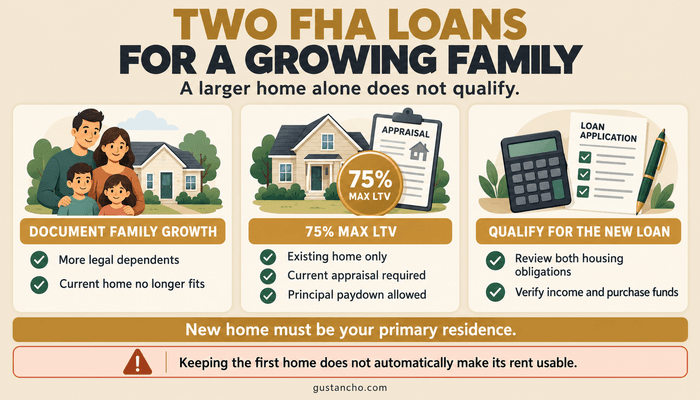
Keeping your existing FHA mortgage and using rental income from that property are separate underwriting decisions. Meeting the family-size exception does not automatically make the proposed rent eligible for mortgage qualification.
Keeping Your Existing FHA Mortgage
If you meet the family-size exception and qualify for the new mortgage, you may retain the existing FHA-financed home and potentially convert it to a rental. The new property must become your principal residence. The family-size exception itself does not require moving more than 100 miles away. A purchase nearby may qualify when the documented increase in legal dependents, housing needs, existing-home LTV, and other requirements are satisfied.
Using Rental Income From the Home You Are Leaving
Under HUD’s departing-residence rental-income policy, counting rent from the property you are vacating requires relocation to an area more than 100 miles from your current principal residence. The lender needs to secure a lease that lasts at least one year beyond closing, along with proof of the security deposit or first month’s rent payment. Where the limited-or-no-rental-history provisions apply, the lender must obtain an appraisal that supports the market rent and shows at least 25% equity in the property. Satisfying that equity requirement alone does not make proposed rent eligible for a nearby move. For a family purchasing a larger home locally, the practical result is important: you may qualify to keep the first FHA mortgage, but a newly signed lease generally will not allow you to count the proposed rent. If that income cannot be used, the lender must evaluate your qualification while accounting for the applicable housing obligations on both homes.
Qualifying for the New FHA Mortgage
Meeting the family-size exception allows consideration of another FHA-insured mortgage. Approval still depends on whether your income, monthly obligations, and available funds support the new purchase.
Income and Monthly Housing Obligations
The lender must evaluate your existing housing obligation, proposed housing payment, and other recurring debts. Housing expenses include principal, interest, property taxes, homeowners insurance, and applicable mortgage insurance and homeowners association fees. The lender must also determine whether rental income from the home you are leaving can be counted. If that income is ineligible, you generally need sufficient qualifying income to carry the housing obligations on both properties, along with your other debts. Your debt-to-income ratio is evaluated under the applicable FHA underwriting requirements. Meeting the family-size and equity requirements does not, by itself, establish financial qualification.
Funds Needed for the Purchase and Any Mortgage Paydown
This exception does not waive the down payment, closing costs, mortgage insurance, or any required reserves for the new purchase. Your financing plan will have to take all of those into account in addition to any principal reduction on the existing mortgage. In the earlier example, a $20k principal paydown would get the existing home into the 75% LTV bracket. The problem is that you’re now using that money to pay down the existing loan, so it’s no longer available for the next purchase or your remaining savings. Before you make any substantial principal payment, have the full financing package reviewed to ensure that the proposed paydown, the documented funds for closing, any required reserves, and your qualification on both properties all work in conjunction.
Growing Family? Explore Whether You May Qualify for Two FHA Loans
HUD may allow an exception when your current home no longer meets your family’s needs. Review the family-size requirements, documentation, and 75% LTV rule with Gustan Cho Associates.Documents to Review Before Buying Another Home
Review the supporting documentation early to assess whether the family-size exception and the proposed purchase are viable. The documentation should set out what has changed in the family, why the present home is not suitable, and whether you can meet the equity and financial requirements.
Evidence of the Family Change and Housing Needs
Gather the records to support the increase in legal dependents as previously discussed. The right records will, of course, vary according to the circumstances and are subject to underwriting review. A good factual explanation of the limitations of the current home will go a long way to establish why another property is required. The relevant facts (e.g. the amount of sleeping accommodation currently available) should be set out.
Appraised Value, Mortgage Balance, and Any Paydown
An approximate property value and a recent mortgage statement will help you determine whether the property is likely to be close to the 75% LTV. That’s a preliminary calculation to assess whether it’s feasible. Final underwriting requires a current residential appraisal and confirmation of the outstanding mortgage balance. An online valuation or an estimated sales price does not replace the requirement for an actual appraisal. If a principal paydown is required then the lender will require documentation of the funds used and confirmation of the resulting mortgage balance.
Income and Asset Documentation for the New Mortgage
Income and asset documentation for the new mortgage will assist the lender in assessing your qualification and your available purchase funds. This will vary according to your individual circumstances and may include pay stubs, W-2s, tax returns (where required), and bank statements. The review must take into account the applicable housing obligations of both properties, any other recurring debts, and any rental income that would be eligible for qualification. The asset documentation must also demonstrate adequate funds for the required down payment, closing costs, any mortgage paydown, and the required reserves.
Hypothetical Example: Meeting the Exception but Still Needing to Qualify
Imagine a homeowner who now has more legal dependents than when they bought a two-bedroom home with an FHA mortgage. In this case, the lender has confirmed that the current home no longer meets the family’s needs, and that a recent appraisal and the mortgage balance meet the 75% LTV rule.
The homeowner wants to buy a larger home nearby as their main residence and plans to rent out their current home. Their budget is based on the idea that rent will cover the existing mortgage payment.
But since the move is nearby, FHA rules usually do not allow the proposed rent to count as income from the old home. The lender has to check if the borrower’s income is enough to cover both housing payments and any other regular debts. If the review finds that the borrower’s income is insufficient to cover these costs, the borrower might meet the family-size exception but would still not be approved for the new purchase as things stand. The next step is to determine whether a lower payment, reduced recurring debt, or another documented source of income could help the borrower qualify. Meeting the exception answers the question about having more than one FHA mortgage, but financial qualification is a separate issue.
Next Steps if Your Second FHA Loan Plan Does Not Qualify
Identify the specific obstacle before changing your purchase plans. An equity shortfall, missing documentation, and insufficient qualifying income each require a different review. If the existing home has insufficient equity, have the lender determine the principal paydown needed using the current appraisal and mortgage balance. Then assess whether that payment is affordable while preserving sufficient funds for the new purchase and any required reserves. If evidence of the family change is missing, ask which facts remain unsupported. The file may need records establishing the increase in legal dependents or a clearer explanation of why the current home no longer meets the family’s needs. Additional documentation helps only when it supports the actual circumstances. If proposed rental income cannot be counted, have the lender evaluate qualification with the existing housing obligation included. Review whether a lower purchase price, smaller proposed payment, or reduced recurring debt could make the financing workable. Expected rental cash flow should not be treated as qualifying income until its eligibility is established. If there has been no qualifying increase in legal dependents, review whether the circumstances fit another FHA exception or a different financing approach. Depending on the facts, that review might include selling the existing home or considering another mortgage program. Each alternative has its own eligibility, occupancy, and financial requirements.
Other Exceptions for Having Two FHA Loans
HUD recognizes other exceptions that may permit another FHA-insured mortgage. These include qualifying employment-related relocation to a new principal residence more than 100 miles from the current home.
Another exception applies to a borrower who leaves a jointly owned principal residence that will remain occupied by an existing co-borrower. A non-occupying co-borrower on another FHA mortgage may also qualify for FHA financing on their own principal residence.
Each exception has separate requirements. Eligibility should be evaluated under the provision that fits the borrower’s circumstances.
Lender Overlays vs. HUD Guidelines
HUD establishes FHA eligibility and underwriting requirements. Individual lenders may apply additional standards, commonly called lender overlays. If an application is denied, ask which specific requirement was not met and whether it comes from HUD or the lender. Another lender may have different overlays, but changing lenders cannot remove a HUD eligibility requirement.
FAQs About Two FHA Loans Due to Expanding Family Size
Does My Next Home have to be More Than 100 Miles Away?
No. The family-size exception does not require moving more than 100 miles away. That distance requirement applies to separate FHA policies, including the employment-related relocation exception and qualification using rental income from a departing residence. A nearby purchase may qualify for the family-size exception even if the proposed rent cannot be counted.
Can I Use a Zillow Estimate or an Agent’s Market Analysis Instead of an Appraisal?
No. The family-size exception requires a current residential appraisal to establish compliance with the 75% LTV limit. Online estimates and an agent’s comparative market analysis may help with preliminary planning, but they do not replace the required appraisal.
Must I Pay Off My First FHA Mortgage Before Getting Another?
Not if you qualify under an applicable FHA exception and meet the new mortgage’s underwriting requirements. Both mortgages may remain open. Under the family-size exception, however, the existing home must meet the 75% LTV limit, which may require a principal paydown.
Does Getting Married Automatically Qualify Me for the Family-Size Exception?
No. Marriage alone does not establish eligibility. The documentation must support an increase in the borrower’s legal dependents and demonstrate that the current home no longer meets the family’s needs as a result of that increase.
Does the New Home Need a Specific Number of Additional Bedrooms?
HUD does not prescribe a universal additional-bedroom requirement for this exception. The lender must evaluate the documented family circumstances and why the existing home is inadequate.
Can I Use the Family-Size Exception to Buy a Vacation Home?
No. The additional FHA-financed property must become your principal residence and satisfy FHA’s occupancy requirements. This exception does not authorize the purchase of a vacation home or an investment property.
Final Thoughts About Getting Two FHA Loans Due To Expanding Family Size
FHA’s family size exception could allow a move to a more appropriate home when there is a documented increase in the number of legal dependents, making the present home unsuitable. The current home would also have to meet the 75% LTV requirement (supported by a current residential appraisal and a verified mortgage balance). The borrower must still qualify for and be able to comfortably service the proposed financing. A principal paydown will reduce the amount of cash available for purchase costs and savings, and there will be the continuing obligation of the first home. A viable plan will take into account the housing obligations of both properties, other debts, and whether the rental income can actually be used in the qualification.
This article about “Two FHA Loans Due to Expanding Family Size: HUD Guidelines and 75% LTV Rule” was updated on October 21st, 2026.