
When planning to buy a home, one of the first big questions is which mortgage program fits you best. Many first-time and repeat buyers compare the pros and cons of conventional and FHA loans to determine which offers the best deal, flexibility, and long-term savings.
Both loan types are designed to help people achieve homeownership, but they differ in credit score rules, down payment requirements, and mortgage insurance. Understanding the pros and cons of conventional and FHA loans can help you make a smart financial decision.
Key Takeaways
- The pros and cons of conventional and FHA loans depend on credit, income, and long-term goals.
- FHA loans make homeownership easier with low down payments and flexible credit guidelines.
- Conventional loans reward stronger borrowers with cancellable PMI and lower lifetime costs.
- FHA has shorter waiting periods after bankruptcy or foreclosure, while Conventional allows higher loan amounts.
- Review your situation with a trusted lender like Gustan Cho Associates to see which path fits best.
What Is an FHA Loan?

An FHA loan is backed by the Federal Housing Administration (FHA) and insured by HUD. These loans were created to help everyday Americans—especially first-time buyers or those with lower credit scores—become homeowners.
Key FHA Loan Features:
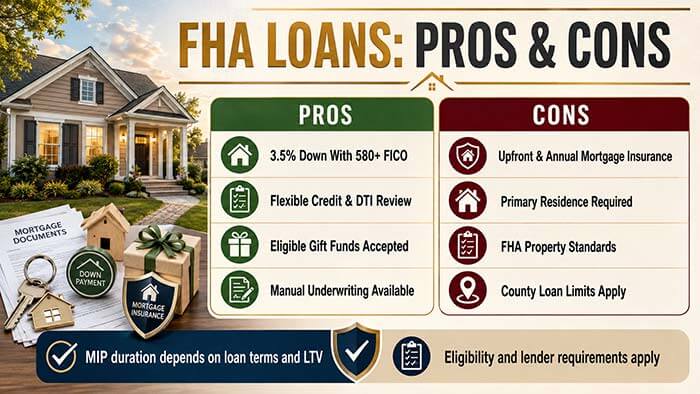
- A down payment of 3.5% is required for those with a credit score of 580 or higher
- 10% down if credit scores range between 500–579
- A family member is allowed to gift 100% of the down payment
- Higher debt-to-income (DTI) ratios allowed
- Works only for primary residences
Many borrowers researching the pros and cons of conventional and FHA loans find FHA attractive because of its lenient guidelines and flexible credit requirements.
What Is a Conventional Loan?
A conventional loan follows the rules set by Fannie Mae and Freddie Mac. It’s not government-insured, which means lenders rely more on the borrower’s financial strength and credit profile.
Highlights for Conventional Loans:
- Minimum 3% down payment for first-time buyers
- 620+ credit score required
- Private Mortgage Insurance (PMI) is required if less than 20% down
- PMI can be canceled once equity hits 20%
- 2025 conforming loan limit: about $766,550 nationwide (higher in high-cost counties)
When comparing the pros and cons of conventional and FHA loans, conventional loans tend to attract folks with better credit and bigger down payments. They’re a good way to save on long-term insurance costs.
FHA vs. Conventional Loan Comparison Table
| Feature | FHA Loan | Conventional Loan |
| Minimum Credit Score | 580 (3.5% down) / 500 (10% down) | 620+ |
| Down Payment | 3.5% | 3%–20% |
| Loan Limit (2025) | $498,257 standard | $766,550 standard |
| Mortgage Insurance | 1.75% upfront + 0.55% annual MIP | PMI if <20% down; cancellable |
| Waiting Period After Bankruptcy | 2 years from discharge | 4 years from discharge |
| Waiting Period After Foreclosure | 3 years from title transfer | 7 years from completion |
| Gift Funds | Allowed 100% | Allowed (depending on occupancy) |
| Property Type | Primary only | Primary, second, or investment |
| Student Loans | 0.5% of balance if not amortized | Uses IBR or credit report payment |
| Best For | Lower credit or limited savings | Strong credit and long-term ownership |
This chart provides a summary of the pros and cons of conventional and FHA loans side-by-side so you can see which better suits your financial profile.
Pros of FHA Loans
1. Easier Credit Qualification
FHA loans are an excellent option for borrowers with credit issues. With credit scores as low as 580, qualifying for a mortgage becomes more accessible, allowing individuals to pursue homeownership despite previous challenges.
2. Flexible Debt Ratios
One of the advantages of FHA loans is their acceptance of higher debt-to-income (DTI) ratios. This flexibility helps buyers with debts secure financing for new homes, opening up options for many potential homeowners.
3. Smaller Down Payment
FHA loans help people buy a home with a 3.5% down payment. This smaller upfront cost is helpful for first-time buyers because it reduces the cash they need at the start, making it easier to own a home.
4. Gift Funds Accepted
100% of the down payment can come from family, making FHA one of the most flexible options when comparing the pros and cons of conventional and FHA loans.
5. Manual Underwriting Allowed
Lenders like Gustan Cho Associates can manually underwrite FHA files when automated systems issue a “Refer,” helping credit-challenged borrowers get approved.
Cons of FHA Loans
1. Mortgage Insurance Premium (MIP)
FHA loans come with a Mortgage Insurance Premium, which consists of an upfront fee of 1.75% and an annual charge of 0.55% on the loan balance. This additional cost is crucial to protecting lenders in case of default and adds to the borrower’s overall expenses.
2. Insurance Lasts the Life of the Loan
FHA borrowers have to pay a mortgage insurance premium (MIP) the whole time they have the loan. The only way to stop paying it is by refinancing into a different type of loan. This means that borrowers need to budget for these ongoing costs throughout the life of their mortgage.
3. Primary Residence Only
FHA loans are specifically designed for borrowers looking to purchase a primary residence and cannot be utilized for investment properties or vacation homes. This limitation ensures that the loans support homeownership for primary dwellings only.
4. Strict Appraisal Standards
FHA appraisals are more rigorous than traditional appraisals. They require properties to meet stringent safety and habitability standards set by HUD, ensuring that the homes purchased with FHA loans are safe and suitable for living.
5. Lower Loan Limits
FHA loans typically have lower borrowing caps than conventional loans, which can limit buying power in high-cost housing markets. This may require some borrowers to adjust their home searches to stay within FHA loan limits.
These details are important when comparing the pros and cons of conventional and FHA loans, especially in high-cost areas.
Pros of Conventional Loans
1. No Upfront Insurance Fees
One major advantage of the debate on the pros and cons of conventional and FHA loans is that conventional loans do not need an upfront premium.
2. Removable PMI
Once you reach 20% equity, PMI can be canceled, saving thousands over time.
3. Higher Loan Limits
Conventional loans allow larger mortgage amounts—ideal for buyers in expensive housing markets.
4. Multiple Property Uses
You can buy a primary, second home, or investment property.
5. Lower Long-Term Cost
Even if the rate is slightly higher, eliminating mortgage insurance early makes conventional loans cheaper over the life of the loan.
Cons of Conventional Loans
1. Tougher Credit Standards
A 620 score is the minimum, and better rates usually require 700+.
2. Larger Down Payment for Lower Scores
Buyers with weaker credit often need 10%–20% down.
3. Longer Waiting Period After Bankruptcy or Foreclosure
Conventional loans require four years after bankruptcy and seven after foreclosure.
4. Lower Debt Ratio Limits
Compared to FHA’s flexibility, DTIs are capped at around 45%–50%.
5. Variable PMI Rates
PMI depends on your credit—lower scores mean higher insurance costs.
When borrowers compare the pros and cons of conventional and FHA loans, these differences often determine which program offers the best approval odds and monthly affordability.
FHA vs. Conventional Example
| FHA Loan | Conventional Loan | |
| Home Price | $300,000 | $300,000 |
| Down Payment | 3.5% ($10,500) | 5% ($15,000) |
| Interest Rate | 6.25% | 6.50% |
| Upfront Insurance | $5,250 (1.75%) | None |
| Monthly Insurance | ~$135 (0.55%/12) | ~$75 (varies) |
This real-world FHA and conventional loan comparison shows that even though FHA loans have lower rates, their mortgage insurance can raise monthly payments. Borrowers with limited funds often start with FHA and refinance into conventional once equity builds and credit improves.
Waiting Periods After Bankruptcy or Foreclosure
Borrowers weighing the pros and cons of conventional and FHA loans should understand post-event timelines:
- FHA Loans
- Chapter 7 Bankruptcy: 2 years from discharge
- Chapter 13: Eligible after 12 months of on-time payments
- Foreclosure: 3 years after title transfer
- Conventional Loans
- Chapter 7: 4 years from discharge
- Short Sale/Deed-in-Lieu: 4 years
- Foreclosure: 7 years after completion
FHA offers shorter recovery windows, making it a better fit for borrowers rebuilding after financial hardship.
Which Is Better: FHA or Conventional?
The best option depends on your financial story. When evaluating the pros and cons of conventional and FHA loans, consider:
Choose FHA if:
- Credit score below 620
- Limited savings for a down payment
- Need to buy after bankruptcy or foreclosure
- Require manual underwriting flexibility
Choose Conventional if:
- Credit score 680+
- Stable income and 5%–20% down
- Plan to stay in the home long term
- Want the ability to remove PMI later
The pros and cons of conventional and FHA loans ultimately balance between short-term affordability (FHA) and long-term cost savings (Conventional).
How Gustan Cho Associates Can Help
Gustan Cho Associates offers FHA and Conventional loans with no lender overlays. Our team specializes in manual underwriting, TBD approvals, and credit-rebuilding solutions—even for borrowers other lenders turn away.
If you’re comparing the pros and cons of conventional and FHA loans, we’ll guide you through both programs and find the option that saves you the most money.
Borrowers who need a five-star national mortgage company licensed in 48 states with no overlays and who are experts on the pros and cons of Conventional and FHA loans, please contact us at 800-900-8569, text us for a faster response, or email us at alex@gustancho.com.
We’re available seven days a week to help you achieve homeownership.
Frequently Asked Questions About the Pros and Cons of Conventional and FHA Loans:
Q: What are the Main Pros and Cons of Conventional and FHA Loans?
A: When it comes to conventional versus FHA loans, the best choice really depends on your credit score, income, and savings. FHA loans are easy to snag if your credit score isn’t the best. In contrast, conventional loans can actually save you money over time because you can get rid of the PMI once you reach 20% equity.
Q: Which is Better for First-Time Homebuyers — FHA or Conventional?
A: Many first-time buyers choose FHA loans because they need smaller down payments and are easier to qualify for. However, a conventional loan can be better if your credit score is higher since it has lower long-term costs. Knowing the pros and cons of conventional and FHA loans will help you choose the right fit.
Q: Can I Get Approved for a Home Loan with Bad Credit?
A: You can totally still get approved! FHA loans let you have credit scores as low as 580 with just 3.5% down. Conventional loans usually want you to have at least a 620. When looking at the pros and cons of conventional and FHA loans, FHA is usually the better option for borrowers rebuilding their credit.
Q: What’s the Difference Between FHA Mortgage Insurance and PMI on a Conventional Loan?
A: FHA loans charge both an upfront and annual mortgage insurance premium (MIP) that lasts for the life of the loan. Conventional loans charge PMI only if you put down less than 20%, which can be canceled later. That’s a big part of comparing the pros and cons of conventional and FHA loans.
Q: Can I Use Gift Money for My Down Payment on Either Loan?
A: Yes. FHA loans allow 100% of your down payment from gift funds, while conventional loans allow gift money depending on occupancy and down payment size.
Q: What are the Waiting Periods After Bankruptcy or Foreclosure?
A: FHA loans require two years after bankruptcy and three years after foreclosure, while conventional loans require four years after bankruptcy and seven years after foreclosure.
Q: Can I Buy an Investment Property with an FHA Loan?
A: No. FHA loans are for primary homes only. Conventional loans can be used for investment or vacation properties. That’s one of the major pros and cons of conventional and FHA loans depending on your goals.
Q: Which Loan has Lower Monthly Payments — FHA or Conventional?
A: It all comes down to your credit score and how much you can put down. FHA loans usually have lower interest rates, but their insurance costs can be higher. Conventional loans may have slightly higher rates but lower PMI for good credit borrowers. Comparing the pros and cons of conventional and FHA loans can show which gives you the best monthly payment.
Q: Do FHA Loans have Stricter Property Requirements?
A: Yes. FHA loans require homes to meet safety and livability standards under HUD guidelines, while conventional loans are more flexible regarding property condition.
Q: How Do I Know Which Loan is Right for Me?
A: To decide which loan is right for you, talk to a lender who understands FHA and conventional loans. Gustan Cho Associates can look at your credit, income, and goals to help you. They will explain the pros and cons of each loan clearly, so you can choose the best one for you.
This article about “The Pros and Cons of Conventional and FHA Loans” was updated on October 13th, 2025.
Use Seller Credits & Gifts the Smart Way (FHA)
FHA allows 6% seller concessions and gift funds to help cover costs—let’s structure your offer right.